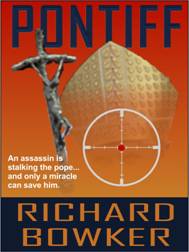
Pontiff: Help me choose a cover

There are three versions of a cover in play for Pontiff, which is described here and here.  All are variations on a theme. There are certain constraints on how you do covers in the e-book world, which I’ll talk about sometime.  The main one, though, is you don’t want to spend a bazillion dollars, ’cause it’s your own money.

By the way, I don’t have to choose one or the other of these choices; I can mix and match elements, adjust the color or the font size, etc.

Anyway, here is Version A:

Cover A


And here’s B:

Cover B


And here’s C:

Cover C


So, help me out here.


Pontiff upcoming

The next novel to turn into an e-book is Pontiff.  Those of you with the collected works of moi displayed proudly on your bookshelf will search them in vain for Pontiff. (Maybe I’ll talk about that some time.), so buying the e-book is the only way to get your  hands on the thing.  Like most of my stuff, it’s, like, a pulse-pounding thriller with twists and turns galore, plus some philosophical nattering on the margins.  Also, it has the best ending I ever wrote.

Maybe the second best.

Those of you who have been paying attention may have noticed a little, er, skepticism about religion popping up here and there.  So what’s up with writing a novel called Pontiff?  It’s another instance of writing about what you don’t know, I think.  I don’t have a religious bone in my body, but I find the psychology of religious belief fascinating, and writing fiction gives me a chance to imagine what it would be like to devote yourself to that belief.

There are all kinds of religious characters in Pontiff.  The title character, for example, is the first African pope, tortured for his faith in some unnamed African dictatorship and suddenly finding himself a compromise choice for the papacy.  That’s an imaginative stretch.  But the real imaginative stretch was the protagonist, Father Joe Hurley, who grew up in the Boston suburbs and left behind a job on Wall Street because he couldn’t shake the idea that he had a vocation.  Who does that anymore?  Well, some people clearly do.  Why?  Well, let’s write a novel and find out.  And, of course, as novels are supposed to do, we set up some interesting challenges to Hurley’s beliefs and his vocation (most prominently, a beautiful Boston policewoman) and see how he reacts.

Design

One more little thing from The Believing Brain — about the Argument from Design, which came up in our discussion of A Universe from Nothing (still waiting to be read).

Shermer discusses the results of a survey he did in which he asked people why they believe in God.  The top two reasons that people gave for why they believed in God were “the good design of the universe” and “the experience of God in everyday life.”

If we believe Shermer, of course, the belief in God came first, and the explanation for the belief came along later.  But it is interesting that the Argument from Design (as applied to the universe) is the first thing people tend to come up with.  I bet that, two hundred years ago, people would also have applied the Argument from Design to us, but evolution has made that much less plausible to people who aren’t prepared to dismiss science altogether; now religion has to accommodate itself to evolution.  But until recently, science had nothing to say about the origin of the universe, and that left religion free to claim it for a Designer.

David Hume in his Dialogues Concerning Natural Religion has the character Philo make some powerful arguments against the Argument from Design.  But even Philo wobbles towards the end — I imagine because, when Hume was writing in 1776, even a thoroughgoing skeptic couldn’t quite get past the miracle that is man. And it was impossible to completely dismiss the wonder of the creation.

Look round the world: contemplate the whole and every part of it: You will find it to be nothing but one great-machine, subdivided into an infinite number of lesser machines, which again admit of subdivisions to a degree beyond what human senses and faculties can trace and explain. All these various machines, and even their most minute parts, are adjusted to each other with an accuracy, which ravishes into admiration all men who have ever contemplated them. The curious adapting of means to ends, throughout all nature, resembles exactly, though it much exceeds, the productions of human contrivance; of human design, thought, wisdom, and intelligence. Since therefore the effects resemble each other, we are led to infer, by all the rules of analogy, that the causes also resemble; and that the Author of Nature is somewhat similar to the mind of man; though possessed of much larger faculties, proportioned to the grandeur of the work which he has executed. By this argument a posteriori, and by this argument alone, do we prove at once the existence of a Deity, and his similarity to human mind and intelligence.

Over time, if the new theories work out, I imagine more and more believers will leave behind “the good design of the universe” and center their belief on “the experience of God.”  But then, of course, you have the neuroscientists hard at work on that one….

Chapel of Love

It’s Valentine’s Day!

I saw an interview with Ellie Greenwich once where she said that, as soon as she wrote this song (with Jeff Barry and Phil Spector), she knew it would hit Number 1.  And it did.

These Brill Building songs from the early 60s seemed to find the absolute essence of the popular song.  The words and melodies couldn’t have been simpler, or more memorable.  Five years later we had yellow matter custard dripping from a dead dog’s eye.

Write About What You Don’t Know

Conjuring up life in a foreign land is one part of writing that is exciting and fulfilling.  But the most fun is conjuring up a character who is nothing like you — who is nothing like anyone, really.

Daniel Fulton in Summit is a brilliant, eccentric pianist who has turned his back on public performance, instead sitting around his messy home and playing the piano whenever it pleases him.

Glenn Gould was a brilliant, eccentric pianist who turned his back on public performance . . .

Coincidence?  I think not.

The back stories are completely different, of course.  Fulton stopped playing in public for reasons that make sense in the context of the novel’s plot.  Gould stopped playing for his own combination of personal and philosophical reasons.  Once he stopped, he never returned to the stage.  Unlike Horowitz, unlike Weissenberg.  Unlike Daniel Fulton.

In general, concert pianists are a breed apart, even among musicians.  Music is almost always a group endeavor.  Almost no other musician goes before the public all by himself — without even sheet music to aid him.  It’s just him and his instrument — and the long history of other great performers, other great interpretations of the same standard repertoire, against which his audience will judge him.

When you write about a concert pianist, you are really writing about what you don’t know, and what you cannot know.

This is all just an excuse to embed this video of Gould performing — to an audience consisting apparently of his dog and, maybe, a couple of birds outside his window.  What has always been astonishing to me about Gould is the absolute clarity of the voices when he plays counterpoint, as if each hand was controlled by a separate brain. (And, even in his recordings, there was the annoying humming, which he was never able to control.)

The Republican Brain

Today is Darwin’s birthday, so I thought I’d make one more evolutionary point related to The Believing Brain before I move on.

In that post I worried about facile evolutionary explanations of psychological traits.  At the site Why Evolution is True, Jerry Coyne takes on just such an explanation, based on an article about a forthcoming book, The Republican Brain by Chris Mooney.  The book’s thesis is that Republicans and Democrats have observable differences in brain structure, and these differences have a genetic component.  The author then pushes the theory into the world of evolution, and Coyne (who is a professor of evolutionary biology at the University of Chicago) will have none of it:

Mooney concludes, then, that liberals are a bunch of soft-nosed tree-huggers and bunny lovers, while conservatives are alert and wary, easy to perceive threat.  Where does the evolution come in? Because Mooney suggests that those differences, to the extent that they’re genetic, arose by natural selection.  Not only that, but “liberal” genes are less adaptive than “conservative ones”!:

The big question lying behind all this, of course, is why some people would have stronger and quicker responses than others to that which is perceived as negative and threatening (and disgusting). Or alternatively, why some people — liberals — would be less threat aversive than others. For as the University of Nebraska-Lincoln researchers note: “given the compelling evolutionary logic for organisms to be overly sensitive to aversive stimuli, it may be that those on the political left are more out of step with adaptive behaviors.”

“Compelling evolutionary logic,” of course, is not data: it’s just the perceived ability to make a convincing story. I could easily make a story about why it’s more adaptive for people to smile at bunnies than to frown at Bill Clinton: perhaps that is a byproduct of devotion to one’s children and family, which is also adaptive.  The point, though, is that we have no idea a priori which sort of behavior is or was adaptive in the evolutionary sense of conferring reproductive advantage, and absolutely no data on the reproductive output of liberals versus conservatives.

Science is more powerful than superstition, but you need to think clearly about it, and that often requires experts.  Of course, those alert and wary conservatives don’t have anything good to say nowadays about experts.

The Believing Brain (again)

To pick up where we left off: The Believing Brain makes the case that beliefs come first, and explanations follow.  We’re hardwired to believe, and this wiring leads to all kinds of false conclusions about the world, because the way our belief system works leaves us open to all kinds of cognitive biases.

Shermer coins a couple of ugly words to embody the basic biological issues underpinning belief: patternicity and agenticity.  Patternicity is our tendency to see patterns — even when they aren’t there.  Agenticity is our tendency to infuse these patterns with meaning, intention, and agency.  (Shermer acknowledges that agenticity is comparable to what Daniel Dennett calls “the intentional stance.”)

Presumably evolution selected for these traits.  You’re better off if you occasionally see a pattern that isn’t there than if you miss patterns and as a result are eaten by a predator hiding in the trees.  You’re more likely to survive if you assume that some inexplicable event was caused by someone with a mind like your own.  And, of course, God is the ultimate pattern, the ultimate agent.  So, primitive man sees lightning in the sky and wonders What’s up with that?  He tries to see a pattern in the even, he assumes that there is intention behind the event.  He decides that some being in the sky is angry about something.  What’s he angry about?  Well, maybe he’s angry at us.  What can we do to calm him down?  Maybe we should sacrifice a goat or something.  Sacrifice a goat, and maybe the lightning stops.  Hey, it works!  Better keep sacrificing goats.  If the lightning comes back — maybe we didn’t sacrifice enough goats.  Or maybe we sacrificed them the wrong way. Or maybe he’s sick of goats — he wants rams or our virgin daughters or something.  Let’s give them a try!

This all seems plausible to me, and Shermer points to lots of neurological research to show what may be going on in the brain to account for this at the physical level (dopamine and whatnot).  But I’m always a little worried when people come up with evolutionary explanations for the way we are — not because I don’t believe in evolution, but because these explanations don’t tend to be testable, so  you can make up an evolutionary case for just about anything and no one can prove you wrong.

This is popular science writing, so Shermer also brings in lots of anecdotes from appearances on TV shows and encounters with conspiracy fanatics and the like.  These are pretty entertaining, although they don’t always advance the plot.  For example, he goes into a lot of detail about why the 9/11 truthers are nuts — good to know, but a little off topic.

The counterbalance to the believing brain is, of course, the scientific method.  Shermer’s discussion of the scientific method is fine, although I started skimming at that point — I already knew most of what he was talking about. Science is our only hope but, as Shermer acknowledges, the problem with the scientific method is that if it leads to conclusions that counter our beliefs, we tend to stick with our beliefs.  It’s easier to believe in miracles than to understand the null hypothesis.


What kind of cigarette would a Soviet spy smoke?

I don’t know, but I used to.

One of the joys of writing a book like Summit is that you get to research stuff like that.  One of the resulting temptations is to try to fit every last bit of research you did into the novel.  You want to show off all the shiny pieces of geography and cuisine and cultural ephemera that you so laboriously picked up.  It’s not hard to spot this in some novels.  In some cases, you wonder if the author set a scene in a particular locale so that he could deduct a vacation as a business expense — I really went to Jamaica to get local color for my novel, not to lie on the beach.

The goal, of course, is to make the novel’s world come alive for the reader.  Throwing in the names of Russian cigarettes and cars and subway stops helps, but of course there’s way more to it than that.  The key is to get inside your characters and figure out how they interact with this world — not just what they smoke, but why they smoke.

Of course, you’re going to get some things wrong.  I was told that Summit was extremely accurate in its depiction of the Soviet Union, but I had a character wearing the wrong kind of coat in one scene.  How did that happen?  I wrote down enough notes about Soviet clothing!

Does a lapse in verisimilitude matter?  Not to the vast majority of readers, who have no way of telling, and are just going to take the author’s word for it.  But it mattered to me.  You want to do your job right.