Unknown's avatar

About Richard Bowker

Author of the Portal series, the Last P.I. series, and other novels

The Believing Brain (again)

To pick up where we left off: The Believing Brain makes the case that beliefs come first, and explanations follow.  We’re hardwired to believe, and this wiring leads to all kinds of false conclusions about the world, because the way our belief system works leaves us open to all kinds of cognitive biases.

Shermer coins a couple of ugly words to embody the basic biological issues underpinning belief: patternicity and agenticity.  Patternicity is our tendency to see patterns — even when they aren’t there.  Agenticity is our tendency to infuse these patterns with meaning, intention, and agency.  (Shermer acknowledges that agenticity is comparable to what Daniel Dennett calls “the intentional stance.”)

Presumably evolution selected for these traits.  You’re better off if you occasionally see a pattern that isn’t there than if you miss patterns and as a result are eaten by a predator hiding in the trees.  You’re more likely to survive if you assume that some inexplicable event was caused by someone with a mind like your own.  And, of course, God is the ultimate pattern, the ultimate agent.  So, primitive man sees lightning in the sky and wonders What’s up with that?  He tries to see a pattern in the even, he assumes that there is intention behind the event.  He decides that some being in the sky is angry about something.  What’s he angry about?  Well, maybe he’s angry at us.  What can we do to calm him down?  Maybe we should sacrifice a goat or something.  Sacrifice a goat, and maybe the lightning stops.  Hey, it works!  Better keep sacrificing goats.  If the lightning comes back — maybe we didn’t sacrifice enough goats.  Or maybe we sacrificed them the wrong way. Or maybe he’s sick of goats — he wants rams or our virgin daughters or something.  Let’s give them a try!

This all seems plausible to me, and Shermer points to lots of neurological research to show what may be going on in the brain to account for this at the physical level (dopamine and whatnot).  But I’m always a little worried when people come up with evolutionary explanations for the way we are — not because I don’t believe in evolution, but because these explanations don’t tend to be testable, so  you can make up an evolutionary case for just about anything and no one can prove you wrong.

This is popular science writing, so Shermer also brings in lots of anecdotes from appearances on TV shows and encounters with conspiracy fanatics and the like.  These are pretty entertaining, although they don’t always advance the plot.  For example, he goes into a lot of detail about why the 9/11 truthers are nuts — good to know, but a little off topic.

The counterbalance to the believing brain is, of course, the scientific method.  Shermer’s discussion of the scientific method is fine, although I started skimming at that point — I already knew most of what he was talking about. Science is our only hope but, as Shermer acknowledges, the problem with the scientific method is that if it leads to conclusions that counter our beliefs, we tend to stick with our beliefs.  It’s easier to believe in miracles than to understand the null hypothesis.
 

What kind of cigarette would a Soviet spy smoke?

I don’t know, but I used to.

One of the joys of writing a book like Summit is that you get to research stuff like that.  One of the resulting temptations is to try to fit every last bit of research you did into the novel.  You want to show off all the shiny pieces of geography and cuisine and cultural ephemera that you so laboriously picked up.  It’s not hard to spot this in some novels.  In some cases, you wonder if the author set a scene in a particular locale so that he could deduct a vacation as a business expense — I really went to Jamaica to get local color for my novel, not to lie on the beach.

The goal, of course, is to make the novel’s world come alive for the reader.  Throwing in the names of Russian cigarettes and cars and subway stops helps, but of course there’s way more to it than that.  The key is to get inside your characters and figure out how they interact with this world — not just what they smoke, but why they smoke.

Of course, you’re going to get some things wrong.  I was told that Summit was extremely accurate in its depiction of the Soviet Union, but I had a character wearing the wrong kind of coat in one scene.  How did that happen?  I wrote down enough notes about Soviet clothing!

Does a lapse in verisimilitude matter?  Not to the vast majority of readers, who have no way of telling, and are just going to take the author’s word for it.  But it mattered to me.  You want to do your job right.

A Very Old Obituary

Maybe someday everything will be available online.  Here’s something I hadn’t expected: the college newspaper I did some writing for has made its archives available on the Internet.  I can’t bring myself to read most of what I wrote way back then.  But there was one piece I was curious about — an obituary for Richard Cushing, the Archbishop of Boston when I was growing up (I was named for him, incidentally).  It holds up pretty well, I think, although the balance doesn’t quite work in one spot, and there’s a which in there that I’d definitely turn into a that.

FOR SOMEONE who grew up a Catholic in Boston, Cushing was not a name, not even an institution, he was a part of life itself: he was always there, at Confirmations and graduations and dedications of the countless schools and churches he helped build. His picture was in everyone’s hallway, a fullcolor portrait cut out of the Globe when he was made a Cardinal. You took pride in his voice and his Red Sox cap and his friendship with your President because in him you had someone only Boston could produce: that blend of worldliness and sanctity, that despiser of stuffiness and lover of ritual.

Times change-the schools start closing, the churches aren’t quite as filled anymore; a younger man with a strange unIrish name takes over. And finally, Cushing himself is gone, less than a month after the ceremony which concluded his life’s work. It’s fitting; you know it could hardly have been otherwise. But still the memories linger, of the rasping twang, of the swishing of his red silk robes, of a life that was part of Boston’s life.

Cushing is part of the past now, but he can’t rest there-by the nature of things he must become the stuff of legend and anecdote. You are supposed to remember that there was a pool for how long he would speak at Confirmation, with the winning number being around an hour. And you will recall the stories and tell the jokes even if they seem to miss what he meant to you, because Cushing was from Boston, and that is how Boston remembers a man, that is how Boston honors a saint.

Here’s the link.

Summit Available on Amazon and B&N!

The Kindle edition is available here.

The Nook edition is available here.

I’ll get it onto other sites sooner or later.

I’m charging $2.99, which I figure is somewhere between “It’s so cheap there must be something wrong with it” and “It’s so expensive it can’t be worth it”.

Don’t be tempted to buy the used paperbacks also on offer.  They won’t give you the same quiet sense of satisfaction you’ll get knowing that some of your money is going to the author in return for his hard work in perpetrating the novel.

Next up, Pontiff!

The Worst Movie Ever Made

I Don’t Know How She Does It.

I’m not talking about the stuff on Mystery Science Theater.  This is a movie with A-list actors (well B+-list actors) directed by a guy who made a movie I liked (Emma).

“4.3!” — IMDB

“Insipid, unfunny, and cliché-ridden!” — Washington Post

“Witless!” — San Francisco Chronicle

We watched about twenty minutes of it, and we felt as though our brains were turning to oatmeal.

Here’s the official trailer.  I dare you to watch the whole thing:

Publishing an e-book

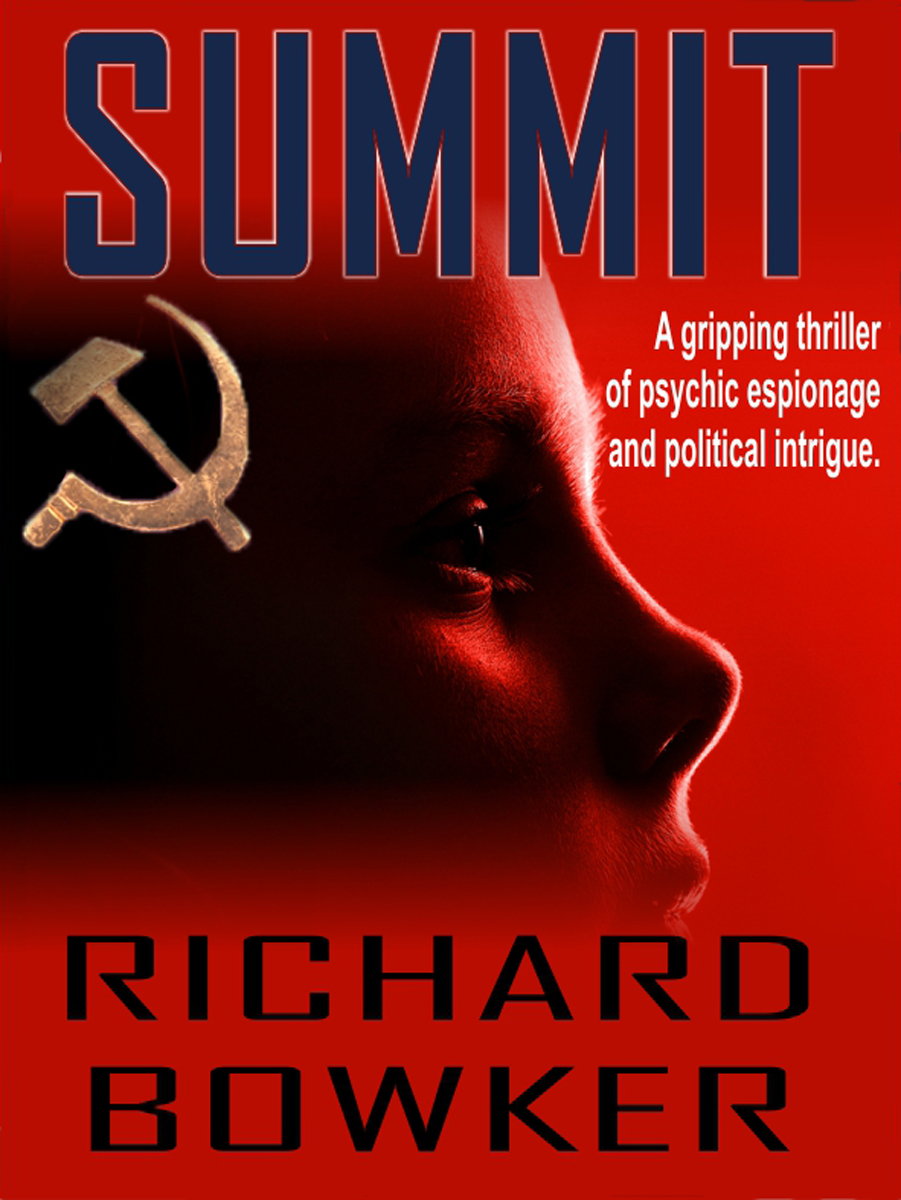
Well, it just doesn’t seem to be that hard.  Surprisingly, the hard part seems to have been writing the book in the first place. Here is the cover:

Summit

Actually, the cover was kinda hard, too.  And okay, I had help.

Amazon and Barnes & Noble are currently pondering whether I’ve made any mistakes.  If I haven’t, the thing should show up in their catalogs in a day or two.

How much would you pay for an e-book?

I’ve got to figure out my pricing before very long.

Seems to me that publishers’ prices for e-books are stupidly high.  Presumably they don’t want to set them so low that they cannibalize their hardcopy sales (and annoy their retailers).  But that’s not a problem I have.

One theory I’ve heard is that buying an e-book is an impulse purchase, and you want to set your price low enough to encourage that sort of irresponsible behavior.  What price would make you act irresponsibly?

(Of course, a price of $0.00 is not unheard of.  That may increase my readership, but it won’t make me wealthy beyond the dreams of avarice.)

Are e-books damaging society?

Jonathan Franzen seems to think so.

Andrew Sullivan’s readers ponder the issue.  Some of their points are relevant to my post Is the Internet Forever? One of them says:

I don’t know that I buy Jonanthan Franzen’s argument that the future of democracy depends on the survival of the physical book and I understand the great utility of ebooks. However, there is a great deal to be said for keeping the printed page alive.  If its language is English, I can pick up a 400-year-old book and read it. A floppy disc from ten years ago is useless to me.  Your assumption that the cloud will somehow always be there to provide continuity of knowledge strikes me as naïve.  Technological failures on a grand scale do not seem all that improbable, given the history of the world and of mankind. Too, if we are left to rely on others to keep the knowledge intact for us, then they have control over what is kept and what is erased and to what we have access.  I say, long live the book.

An issue not raised in the discussion is disintermediation (one of my favorite words).  With printed books, there is the publisher (at least) between the author and his or her potential readers (unless you want to self-publish, at great cost and with no obvious form of distribution).  Amazon and friends will publish just about any damn thing, as long as it’s not pornography and it’s formatted properly.  That’s got to be a good thing.

Is the Internet Forever?

There are two reasons to turn your old print books into e-books:

  1. The e-book world is thriving, and adding your books to it will make you wealthy beyond the dreams of avarice.
  2. The Internet will make your books live forever.

I’ll be able to test reason 1, and I’ll be sure to let you know the result.  But what about reason 2?

Most of the plays of Sophocles, Aeschylus, and Euripides are gone forever.  After just a few years some of my paperbacks had faded covers and yellowed and crumbling pages.  The Internet would have saved Aeschylus!  The Internet will save me!

In the short run, I’m sure this is true.  Pages don’t turn yellow on the Internet. But still . . . The Internet has been around for 20 years or so.  Print books have been around for half a millennium.  Most print books are gone forever, but some aren’t.  Shakespeare’s First Folio had a print run of about 750 in 1623, and there are still a couple hundred left.  Where is the Internet going to be in 500 years?  Where will .mobi and .epub files be?

If you want to last, you’re probably better off writing like Shakespeare or Aeschylus.

Cover Page of the First Folio