Joe Hurley explains why he became a priest

In this scene from Pontiff, Father Joe Hurley explains to Lieutenant Kathleen Morelli, a lapsed and very suspicious Catholic, why he became a priest. They have teamed up to try to track down a possible threat to the Pope when he visits Boston, and are driving back from interviewing someone who might have information about the threat.

This is something of an antidote to the theology I talked about in this post.

**********************

Morelli glanced over at him. She was beginning to think she had misjudged him, somehow. Priests weren’t all alike, she supposed, but still… “So what’s your story, Father?” she asked. “How did you end up—you know—”

“Trapped in Holy Orders?” Hurley suggested. “Doing a thirteenth-century job in the twenty-first century? It’s strange how often I’m called upon to defend my career choice.” He paused, as if considering how much to give back in return for her life story. “Well, to begin with,” he said, “I was raised in what I’d call a relaxed Catholic family. Nothing like yours—which probably says a lot about how to bring up your kids if you want them to be religious. Anyway, we went to Mass on Sundays, but if we skipped it was no big deal, and we didn’t bother with much else. I was mostly a jock growing up—football meant a lot more to me than God. I was a star in high school, got an athletic scholarship to Boston College, and then things sort of went downhill. I had some injuries, and maybe I wasn’t quite as good as I thought I was, so I spent most of my varsity career as third-string quarterback, getting ready for an opportunity that never actually came.

“But looking back, that was all to the good. Gave me a chance to think, to focus on the big picture. And the big picture, much to my surprise, didn’t include football. I had pretty much decided in my senior year that I wanted to enter the seminary, and then I just had to put up with people—including my family—trying to talk me out of it.”

“But why?” Morelli persisted. “Why become a priest? I just don’t get why anyone would want to do that nowadays.”

“Exactly what my family and friends said—and even quite a few of the priests I talked to. I felt like a freak. Perfect strangers would hear about my decision and feel compelled to come up to me and tell me I was making a big mistake. And this was at a Catholic college, right? So I’m a weak person and eventually I caved in. I graduated and I went to work on Wall Street for a few years—and, you know, I wasn’t bad at it. I made a pot of money and my bosses told me I had a great future and I thought about applying to business school. I left religion for Sundays. All my friends breathed easier, as if they’d saved me from becoming a Moonie.

“And it didn’t take. I just couldn’t get the priesthood out of my mind. Now you can keep asking me why, just like my family and friends, and I could give you answers that have to do with helping people and making a difference, but they wouldn’t be the real story, because my reasons are beyond logic, beyond rational explanation. They call it a vocation—a calling. God called me. I have no idea why He called me instead of my roommate or the middle linebacker on the football team or that kid in Economics class who actually looked like a priest; but He did. I’m as sure of it as I’m sure I’m sitting in this car. So eventually I gave up trying to please everyone else and trying to kid myself, and I did what I knew I had to do. And here I am.”

Morelli took the Brighton exit off the Turnpike, and she made her way toward Hurley’s apartment. What about sex? she wanted to ask him—wasn’t that all anyone really wanted to know about a priest?—but she didn’t. He still made her uncomfortable—even more so now, after she had heard his story, and she knew he wasn’t some mama’s boy who had been saying the rosary since he was three and never had a thought of living in the real world. He wasn’t in the priesthood, apparently, to hide from life, or because he had some big problem to work out. He was just like everyone else—except he had chosen to be different.

She decided to ask about something else. “So, with this calling of yours—does that mean you agree with all the Church’s teachings? I’m really not trying to be obnoxious about this, Father. I just don’t know how it works. I’m only used to one way of looking at things—my father’s way.”

“First,” Hurley said, “if you don’t call me Joe, I’m going to jump out of the car.”

“Okay. Joe.”

“Thank you. Second, you don’t check your brain or your conscience when you enter the seminary. At least, I didn’t. This may sound stupid—all right, I know it’ll sound stupid—but I think of it like being on a football team. You may not agree with the play the coach is calling, but he’s the coach, and you know that the only way you can win is through discipline and sticking together. If you worry about why he’s doing what he’s doing, you’re going to mess up. His job is to call the plays, and your job is to execute them.”

“But football is about winning,” she pointed out. “Religion isn’t about winning, it’s about the truth.”

Hurley shook his head. “Religion isn’t about anything,” he responded. “It is. Religion is the sport, the gridiron, the reason you’re out there wearing pads and helmets and cleats and having three-hundred-pound men hurling you to the ground. It isn’t about whether the coach calls a draw play when you think you should be running a play action. It isn’t about punting instead of going for it on fourth down. Those are just… details. It’s a mistake to get lost in the details.”

“That is totally sick, Joe. Those ‘details’ ruin people’s lives, if they can’t get access to birth control or a legal abortion.”

“What I mean is, yeah, they’re important, but we shouldn’t confuse them with the game—with religion itself, I mean. Um, I think my metaphor has gotten out of control.”

Morelli looked over at him, and he was grinning sheepishly, and she found herself grinning back, something she never expected to be doing when arguing religion with a priest.

She parked in a handicapped space near Hurley’s apartment building. Time to call it a night.

“So, what’s next?” he asked.

“Well, I’d say we still need to track down Bandini, if we can.”

“How—the phone number?”

“That’s a start. We can trace it. I’ll let you know what we come up with.”

“Thanks. I appreciate it,” Hurley said. He reached over and touched her arm. “And I appreciate your telling me about yourself, Kathleen. Seriously. I hope you don’t consider me the enemy. I don’t want to be your enemy.”

Morelli could feel herself blushing. Her Jeep seemed far too small all of a sudden. Hurley seemed to realize his mistake, because he retreated immediately, smiling nervously, in perhaps his own version of a blush.

“Of course you’re not my enemy,” she said. “But that doesn’t mean the Church doesn’t have a lot to answer for. Anyway, I hate football.”

“Maybe that’s because you haven’t played enough of it.” He opened his door. “Goodnight, Kathleen.”

“Good night, Joe.”
In which a miracle is performed

Pontiff is (among other things) about miracles of various sorts, and their paradoxical effect on the people who perform them, and the people on whom they are performed. In the novel, the new pope has a reputation as a healer.  Before being elected to the papacy, he was the courageous leader of the Church in a nameless African country.  In this flashback, he has been imprisoned by the country’s maniacal dictator, Leonard Tokomi.  One night he is pulled from his prison cell, and he assumes he is going to finally be executed.  Instead, he is brought to the presidential palace.

What, then? Did Tokomi want to kill him himself? That seemed more than plausible; there were rumors of far worse outrages that had taken place inside the palace walls.

He was led through softly lit hallways and up a flight of stairs, until finally he faced a couple of enormous men standing guard in front of a set of equally enormous double doors.

“He is to go in alone,” the army officer instructed the guards. The guards said nothing, but searched Gurdani thoroughly. When they were satisfied, one of them grunted, and the officer removed his handcuffs. “Even though you are alone, you will be watched every moment,” the officer said to him. “Do not think of trying anything, or you will be dead before the thought is finished.”

Gurdani rubbed his wrists and said nothing. One of the guards opened the doors, and the other guard pushed him inside.

He was in a huge room dominated by a large canopied four-poster bed. He was so used to the grim monochrome life of a prison cell that his senses were momentarily overloaded by the luxury that surrounded him—from the vivid wall-hangings to the thick carpet beneath his feet. His brain started to clear, finally, when he say the shrunken figure lying in the bed. At first glance the figure looked like a corpse, but then it raised a bony arm and beckoned to him to come closer.

Gurdani did as he was instructed, and it was only when he was standing next to the bed that he recognized the figure lying before him. It was Tokomi, though so wasted by illness that Gurdani could scarcely believe that this was the monster who had bludgeoned an entire nation into submission through the force of his will.

But his eyes still sparkled with fierce intelligence, and his mouth still twisted into a malevolent sneer. There could be no doubt that Gurdani was now in the presence of the foe he had battled for so many years.

“Welcome, your Eminence,” Tokomi rasped.

He didn’t reply. Tokomi’s face was blotched; he was sweating, and he breathed with difficulty. Death has him in his grip, Gurdani thought. And that made it difficult to think about anything else.

“Are you pleased to see me in this condition, Joseph?” Tokomi went on. In their previous meetings he had always liked to use Gurdani’s first name, as if he were dealing with a child. “Are you savoring the punishment of the wicked?”

“What is it?” Gurdani asked finally. “Cancer?”

Tokomi waved the guess away. “Some new disease. The idiot doctors know nothing about it, except that it is contracted from sexual encounters. Even more reason for God’s punishment, eh? It does nothing itself, they say, but leaves your body open to every other disease that comes along. Not good. Not good.”

Tokomi’s gaze drifted away, and Gurdani tried to figure out why he had been brought here. He didn’t think it likely that Tokomi was seeking a deathbed reconciliation with the Church. If not that, then what? He stood by the bed, waiting to find out.

The dictator finally focused his attention back on Gurdani. “They’re idiots,” he repeated. “They know nothing. They tell me to rest. I haven’t the strength to do anything but rest. Do you see? I’m dying, and they shrug their shoulders and tell me there’s nothing they can do. I’ll let them know how it feels to die!”

Gurdani continued to wait. He had nothing to say to this man.

“So I want you to cure me,” Tokomi said finally.

Gurdani was too taken aback to understand at first. “Me?”

Tokomi managed a grin. “You, Joseph. You who are so close to God. You’ve cured others—I know the stories, I know everything about you. So cure me.” Tokomi reached out a hand toward him, and Gurdani involuntarily shrank back.

“Don’t be afraid, Joseph,” Tokomi said. “God will protect you. He’s protected you very well so far, or you would have been dead years ago. You should thank me for that, as well as God. I didn’t want to risk killing such a favorite of His, for fear of His wrath. Now you must return the favor. Lay your hands on me, and bring me back from the dead.”

Gurdani stared down at him. He couldn’t imagine it—couldn’t imagine trying to save this monster’s life. How desperate must Tokomi have been to ask such a favor of his archenemy! Desperate, but still he obviously enjoyed the position he had put Gurdani in. “Do you play God, your Eminence?” Tokomi demanded. “Do you decide who is worthy of saving and who isn’t? What if you cure me and I repent my sins—wouldn’t that make it worth doing? Wouldn’t God want you to cure me, rather than let me die and go straight to hell?”

“I cure no one,” Gurdani pointed out. “Only God can do such a thing.”

Tokomi waved away the distinction. “He cures through you,” he said. “You are His favorite, and you know it.”

“Will you repent if you are cured?” Gurdani asked.

“But that makes it too easy, doesn’t it?” Tokomi pointed out. “I would say anything to be cured, but how can you be sure I’m not lying, or won’t change my mind? No, you should cure me because you’re a Christian and I am in need.”

“I must also think of the innocent victims of your cruelty—past and to come,” Gurdani responded. “They are in need, too.”

“Is your morality a matter of statistics, then? Do you need to count up the numbers of people helped and hurt before deciding right from wrong? Your God disappoints me, Joseph. I didn’t know He was nothing more than an accountant.”

Tokomi closed his eyes, worn out once again. Gurdani gazed at him. He could almost see the skull beneath the taut skin. His breathing was shallow, irregular. Gurdani could imagine taking a pillow and smothering him right now; it wouldn’t take much to kill him. Could he finish the deed before the guards shot him?

His back was starting to hurt from standing for so long—Tokomi’s doing, of course. A minor beating long ago: one tiny sin among so many. It was strange that tonight he had at last come to understand why nothing worse had happened to him: Tokomi was afraid of him, afraid of the power God had given him. He was as superstitious as most of his subjects, and probably thought of Gurdani as some sort of witch doctor, capable of brewing up spells for evil as well as for good. But Tokomi wasn’t so afraid that he wouldn’t drag his enemy to his deathbed, in desperate hopes of a miracle he of all men least deserved. Did he think he could chop logic to convince Gurdani to do it? Or was he counting on fear, his oldest ally, which worked on many but had never worked on his greatest enemy?

Gurdani had no interest in what Tokomi had to say. Instead he looked into his own heart and tried to understand what Jesus wanted him to do.

The answer was clear. Jesus had not scrupled to cure sinners, and neither would he, who cured only through Jesus’ power. Jesus had never had to deal with someone like Tokomi, but was it possible to imagine him refusing to help? Gurdani couldn’t. He wouldn’t think about the consequences of success—he couldn’t bear to. And what of the consequences of failure? No worse, he supposed, than those of refusing to try. He could only do what was right, and hope for the best.

He leaned over Tokomi and placed a hand on his clammy forehead. Perhaps the guards would misinterpret the action and kill him now. Perhaps he should hope for it to happen before he had a chance to do what he was about to do. But the room remained quiet, except for Tokomi’s ragged breathing. He opened his eyes finally, and they showed surprise and, yes, fear. “Save me,” the fiend whispered, and his bony hand gripped Gurdani’s arm.

Gurdani closed his own eyes. This wasn’t a monster but a human being, he told himself. A child of God. Did anyone besides God love him? Could anyone possibly love him?

And suddenly Gurdani felt himself flooded with love, not just for this man but for all of humanity. So much pain, caused and suffered. So much striving, so much loss. What had all Tokomi’s striving achieved for him but a lonely deathbed, an ending filled with terror and (one could only hope) regret? You can only love, or die.

And then he felt the familiar wind of grace pass through him, and into Tokomi. And for a moment he thought he felt all the weight of Tokomi’s sickness and sinfulness bearing down in turn on him, and he staggered backwards, then crumpled to the floor.

When he looked up Tokomi was staring at him from the bed. The feverish glitter had disappeared from his eyes, replaced by dullness and confusion. Something had happened, but he didn’t know—or was not yet willing to admit—what it was. “Is the feel of my skin so unpleasant it makes you fall to the ground?” he asked, but it was clear his heart wasn’t in the sarcasm.

Gurdani struggled to his feet. “God has touched you,” he said. “You might consider your good fortune. I would say that you may be the luckiest man alive.”

A sneer appeared on Tokomi’s face, then faded again into confusion. “Nice to see you, Joseph,” he replied. “Thank you for your assistance. Let’s be sure to meet again.”

Gurdani gazed at him, then left the room, saying nothing more.

He never did meet Tokomi again. He returned to the prison, where conditions improved markedly for him, presumably on Tokomi’s orders. A couple of weeks later, though, word swept through the cells: It had finally happened; Tokomi had died.

Shot to death by his closest aides, it was said. It was only later that Gurdani pieced together the story. They had gotten used to the idea of their leader dying and begun readying themselves for the new era. When his condition inexplicably improved, they became impatient and took matters into their own hands, murdering him while he slept. Gurdani’s miracle had miraculously accomplished nothing. Except, perhaps, inside Tokomi’s heart. Gurdani would never know what changes God had wrought there.

Pontiff is available on Kindle and Nook!

Pontiff has arrived!

Kindle edition is here.

Nook edition is here.

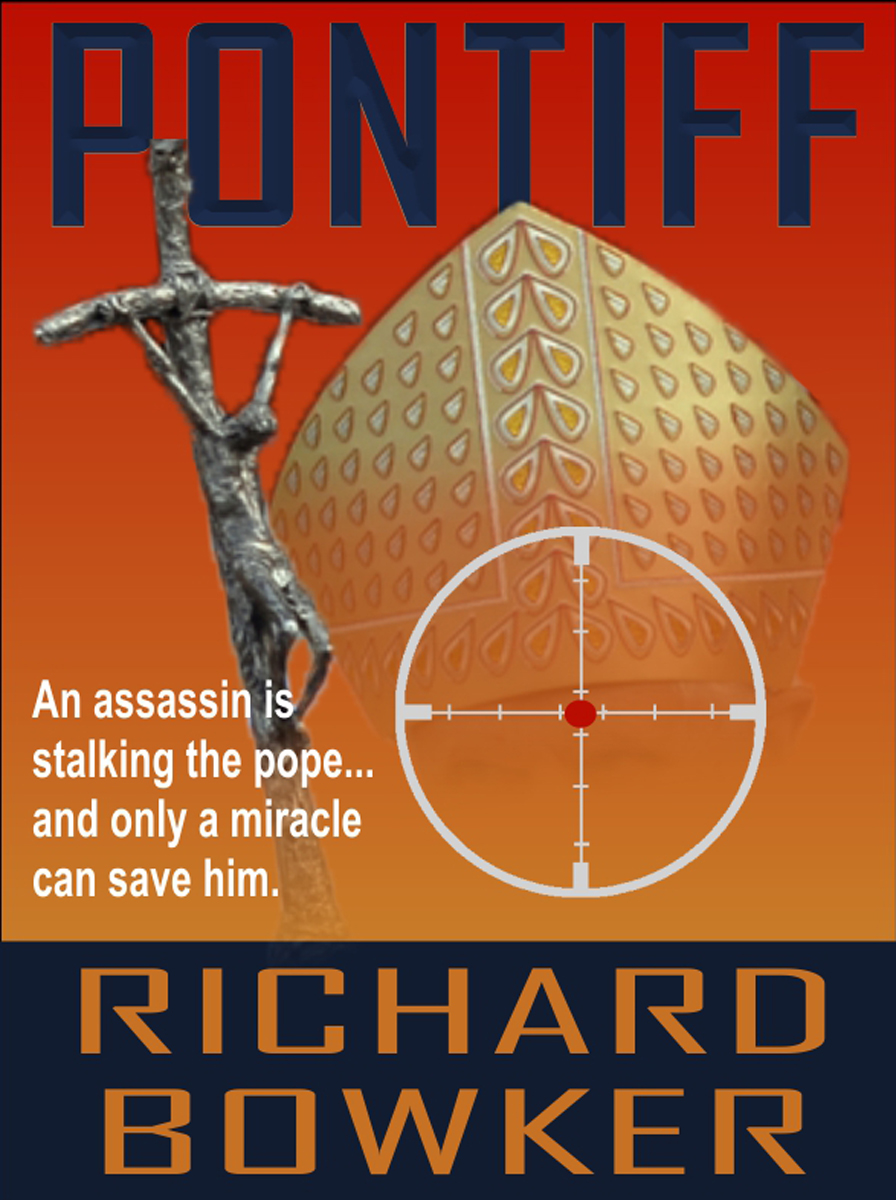
Here’s what the cover looks like (choice A with some tweaks):

Pontiff


The price: a mere $5.99.  OK, that’s twice what Summit costs, but we’re still experimenting here.  Think of it this way: it’s less than you probably spent for lunch yesterday.  And sure, that stewed haddock (let’s say) was good, but you’ve already digested it, and now you just have to eat all over again.  And it’ll take you a lot longer to read Pontiff than it took you to watch John Carter.  More value for your entertainment dollar!

One final note: if you think you’ve already read this novel, you are very probably wrong.