Why “Revenge of the Fluffy Bunnies” is a better title than “Dover Beach”

I’m not the best guy to offer advice on titles, so I won’t.  Most of my titles are single-word descriptive titles: Senator is about a senator; Pontiff is about a pontiff.  Shorter is, I think, better than longer, but then again, I really like the title The Assassination of Jesse James by the Coward Robert Ford.  The problem with shorter titles is that they can tend to mislead.  Pontiff is about more than a pontiff; Summit is about more than a summit.  But, when combined with the cover, they do the trick.

Titles get easier if the book is part of a series, like A is for Alibi.  Funny books should have funny titles.  The best title I’ve ever been involved with is Revenge of the Fluffy Bunnies by the great Craig Shaw Gardner.  I recall a good bit of discussion about just what adjective should be applied to those bunnies.  Having arrived at fluffy, I can’t imagine what other words could possibly have been considered.

Titles serve two purposes. The obvious purpose is to make a reader want to buy the book (or read the story, or click on the blog post).  Like the cover, they’re part of the way you market the thing. Who wouldn’t want to read a book called Revenge of the Fluffy Bunnies? (Well, if that’s not the kind of book you want to read, the title will do a great job of steering you away from it.)

But titles are also part of the aesthetic experience of the text, if I can get high-falutin’ for a minute.  The title Gravity’s Rainbow means nothing by itself; its significance grows out of the novel to which it’s attached.  Same with Ulysses.  Same with A Canticle for Leibowitz. You don’t come up with titles like that to sell books.  You come up with them because they grow organically out of the story you’re telling.

This brings us to Dover Beach, which is going to show up as an ebook before very long.  The title was suggested by my editor at Bantam, and I loved it.  The novel is about love and loyalty in a grim world after a limited nuclear war, and I liked the way the title brought out the connections with the themes of Matthew Arnold’s famous poem.

Which is to say, the title works really well in the “part of the aesthetic experience” department.  But Dover Beach was a mass-market science fiction paperback.  The title also needed to move product, as they say.  And that product didn’t move–at least, not compared to its predecessor Replica.  I think the title must have had something to do with it.  If the average science fiction reader read Arnold’s poem at all, it was probably because he was forced to in sophomore English class, and who wants to be reminded of sophomore English class?

For good or ill, the title is Dover Beach, and I’m sticking with it.

Here is the last stanza of “Dover Beach”, which is still moving a hundred and fifty years after first publication:

Ah, love, let us be true
To one another! for the world, which seems
To lie before us like a land of dreams,
So various, so beautiful, so new,
Hath really neither joy, nor love, nor light,
Nor certitude, nor peace, nor help for pain;
And we are here as on a darkling plain
Swept with confused alarms of struggle and flight,
Where ignorant armies clash by night.
Where should you write?

I was reminded of this question when I viewed this troubling video from John Klobucher, who has started an interesting writing project at his very fine blog Lore of the Underlings:

If I correctly understand this video, he writes his novel while he’s driving his car.  How does he pull that off?  Does he encounter a lot of red lights?  Or empty stretches of highway? Should we find out what his route is so we can avoid it?

So that’s deeply concerning from the perspective of automotive safety.  But on the other hand, good for him!  This is one man’s approach to following Rule 0.  If the only time you have to write is while you’re driving, just make it work. I wrote a good chunk of Senator while commuting on a subway train.  If I couldn’t find a seat, I would stand at the end of the car so that I could lean against the emergency door and have both hands free to hold my notebook and scribble.  I remember reading about Joseph Conrad finishing Lord Jim or some other novel while watching over his daughter as she recovered from a disease.  I’ve heard of people writing while waiting for their kids to finish soccer practice. You do what you have to do.

So now on to Aristotle.  (I don’t know where he wrote, but he sure managed to write a lot.)

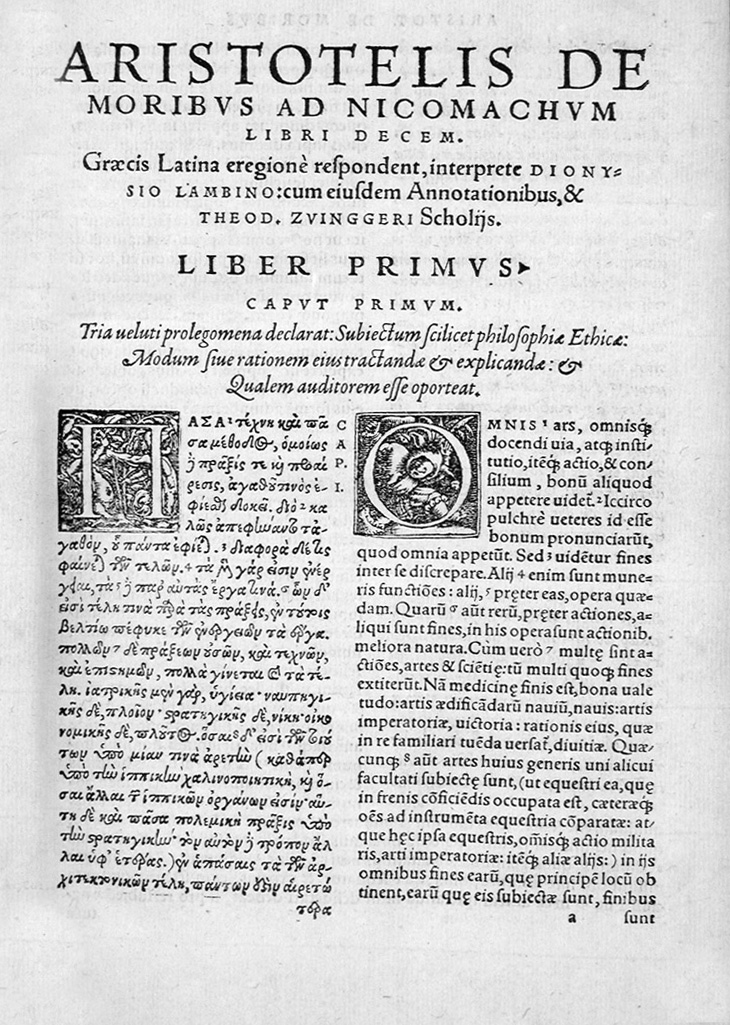
Readers of this dispiriting blog may recall that while I drive I listen to online courses downloaded from iTunes University.  Lately I’ve been listening to an Open Yale course called The Philosophy and Science of Human Nature. I recommend it!  The professor is currently doing a deep dive into Aristotle’s Nichomachean Ethics.  (I don’t know much about the Nichomachean Ethics, but I love saying the words out loud.)  Anyway, one of Aristotle’s points is that virtue is a matter of habit.  If you want to be just, get in the habit of doing just things.  If you want to be a harpist, practice playing the harp — over and over again. As Wikipedia puts it:

People become habituated well by first performing actions which are virtuous, possibly because of the guidance of teachers or experience, and in turn these habitual actions then become real virtue where we choose good actions deliberately.

Seems to me that this applies to writing, too.  (Whether writing itself is virtuous is a whole nuther question.)  You become a writer by writing; everything else (reading, research, note-taking, making up great stories in your head, talking to your friends about those great stories) is beside the point.  In my long-running writing group, we once had a come-to-Jesus meeting to try to help the folks in the group who weren’t producing anything to get started.  This had the predictable effect of making some people feel really bad about themselves.  One of them said, “You know, my whole life I’ve thought of myself as a writer, but I’ve never really written anything.”  This has always struck me as a desperately sad statement.  What, after all, was stopping him?  It wasn’t like he wanted to become an astronaut.  All he had to do was pick up a pen and start writing. This wouldn’t have made him a published writer, but none of us have much control over that.

So don’t be like him.  Be like John Klobucher instead.  Get in your car and start writing!

Did Shakespeare revise his plays?

We should all revise our work.  And we shouldn’t spend too much time feeling sorry for ourselves because Shakespeare didn’t have to revise his work.  His plays, we are told, are all inspired first drafts.  At least, that’s what Heminge and Condell said in their “Epistle to the Great Variety of Readers” of the First Folio:

His mind and hand went together: And what he thought, he uttered with that easinesse, that wee have scarse received from him a blot in his papers.

This has become part of the enduring image of Shakespeare — so supreme a genius that he he didn’t even have to labor over his masterpieces, like Mozart interrupting a game of billiards to jot down a movement in a string quartet. And, of course, this image is always paired with Ben Jonson’s envious comment:

“The Players have often mentioned it as an honor to Shakespeare that in his writing, whatsoever he penned, he never blotted out line. My answer hath been, ‘would he had blotted a thousand.'”

There was only one Shakespeare, and we’re not him.  And neither was Ben Jonson.

This image is under attack from modern critics.  Here is Stephen Greenblatt, interrupting his writing of The Swerve to write in the Wall Street Journal:

A number of Shakespeare’s plays survive in both the small quarto editions, inexpensively published during his lifetime, and in the first folio. Comparing versions of the same play, I and other scholars have concluded that many of the differences are probably due to Shakespeare’s own obsessive fiddling.

The Quarto

A particularly significant amount of fiddling occurred in King Lear, where there are extensive changes between the quarto edition and the First Folio.  As a result, some modern editions include both versions, instead of presenting a single edition that conflates both versions.  The Arden edition I own is of the conflated school.  It uses F and Q superscripts to indicate words that are only found in one version or the other.  Lear’s final line in the play, spoken over the dead body of Cordelia, appears only in the folio version:

Do you see this?  Look on her; look, her lips,
Look there, look there!   He dies.

Does he die joyfully, thinking Cordelia is really alive?  What was Shakespeare up to when he added the line?  Who knows?

Of course, there is no real evidence of revision, just of differences.  Maybe both the quarto and the folio are simply different versions of a lost original manuscript.  Maybe some of the differences are due to lines that were added by actors during rehearsals.  Greenblatt and others are convinced that Shakespeare fiddled, but that’s based on interpretation, not evidence.  The next generation of scholars may come up with some other interpretation — or decide that Heminge and Condell knew what they were talking about.

Still, it’s nice to think that Shakespeare was like the rest of us, adding words and taking them out and moving them around, trying to achieve some kind of perfection that is always just out of our reach.

Happy Bloomsday

…celebrating the travels of Leopold Bloom through Dublin on June 16, 1904.

Here is what Wikipedia has to say about Bloomsday.  I didn’t know that the manuscript of Ulysses resided in Philadelphia. Here is a page from the Circe episode:

Speaking of revisions, Joyce did his share.  I remember seeing a page from the manuscript of Finnegan’s Wake at the British Library, and every single word on it was crossed out.

Here is a great reading of the final lines of Molly Bloom’s soliloquy.  In it, Joyce probably breaks every rule of good writing.  And it doesn’t matter; fiction doesn’t get any better than this:

Rules for Writing — Rule 2: Revise

Here’s another in an intermittent series of my randomly (and repetitively) numbered rules for fiction writers who aren’t quite good enough to get away with breaking all the rules.  If you’re reading this post, I’m talking about you.

First, let’s distinguish revising from rewriting.  The distinction is a little arbitrary, but for my purposes, revising is taking what you’ve written and making it better; rewriting is taking what you’ve written and writing it all over again.  On a computer, when you revise, you’re working on the same file; when you rewrite, you’re opening a new file and labeling it “Chapter 1 Draft 2” or something.

I’m inclined to believe that everyone revises; I’m not so sure that professional authors cranking out multiple books per year are doing much rewriting.  But anyway, in my opinion, revising is the most fun you can have as a writer.  Staring at a blank screen can be intimidating and discouraging; the blinking cursor seems to tick away the seconds of your life.  But once that screen is filled with words, it’s much easier, and more satisfying, to mess with those words and make them better.

As I mentioned in my post on Rule 0, it’s helpful to begin a writing session by revising your previous day’s output.  But there’s really no bad time to revise; it’s just a question of deciding when to stop.  Somebody once said that he knew he was done with a story when he’d go through it and take out some commas, and then he’d go through it again and start putting the commas back in.

Revising is mostly about style; rewriting is mostly about plot and characterization.  So revising involves applying all them grammer and spelling rules that you learned in Rule 7, but it also involves going beyond them; you want to make your prose sing (or, at least, to keep it from wandering off key).  How do you do that?  A good place to start is with George Orwell’s rules for writing (from his essay “Politics and the English Language“):

  1. Never use a metaphor, simile, or other figure of speech which you are used to seeing in print.
  2. Never use a long word where a short one will do.
  3. If it is possible to cut a word out, always cut it out.
  4. Never use the passive where you can use the active.
  5. Never use a foreign phrase, a scientific word, or a jargon word if you can think of an everyday English equivalent.
  6. Break any of these rules sooner than say anything outright barbarous.

I don’t know to what extent Orwell intended these rules to apply to fiction, but I’d say that Rule 6 is even more applicable to a novelist than it is to a non-fiction writer.  There are times when you’re striving for an effect that may require the passive voice, or a foreign phrase, or a cliché, particularly in dialog or a first-person narrative.  But it’s a good idea to be aware of Orwell’s rules, even if you decide to break them.

Orwell’s rules don’t cover something that is central to revision but that’s hard to put into into a rule: the rhythm of your words.  Sometimes, for example, you want to repeat a word for an effect; sometimes the repetition just sounds stupid or awkward.  Sometimes you want to start a bunch of consecutive sentences in the same way; sometimes that’s just an oversight that needs fixing.  I’ve heard of writers who read their words aloud to check how they sound — that’s certainly a good idea for dialog.  I don’t do it, but I sound out everything in my mind.

And there’s a related rule that I’ll talk about more someday: Show your work to someone else. Sometimes the words that sound just right to you will provoke a violent allergic reaction in your friends. Better to know that before you’re finished than after.

Rule 7: Learn all them grammer and spelling rules

Here is some prose Ernest Hemingway scribbled on the envelope of a letter he wrote to F. Scott Fitzgerald:

What about The Sun also and the movies? Any chance? I dint put in about the good parts. You know how good they are. You’re write about the book of stories. I wanted to hold it for more. That last one I had in Cosmopolitan would have made it.

(The letter itself is wonderful, and you can read it here.)

I dint put in?  You’re write?  Of course, Fitzgerald was a notoriously bad speller himself.

If you are as good a writer as Fitzgerald and Hemingway, you can spell however you please.  Why are you paying any attention to me?  Go back to your novel!  But if you’re not, do yourself a favor and learn how to spell.  And learn the rules of grammar, even if you choose to break them.  Clearly I’m still learning.  But this stuff matters.  The site I linked to above says of Hemingway:

Whenever his newspaper editors complained about [his poor spelling], he’d retort, “Well, that’s what you’re hired to correct!”

But editors aren’t doing that anymore!  The editors didn’t pick up the Pulitzer-Prize-winning Harvard English professor’s misspelling of “Ptolemy.”  No one noticed the grammatical errors and the misspelling of “rarefied” in Lisa Randall’s Knocking on Heaven’s Door.  I was looking at the résumé for a technical editor a few months ago, and I noticed he had misspelled the name of the college from which he had graduated.  “Rutgers” just isn’t that hard to get right!  Even when their spelling is OK, some of these editors don’t seem to notice when they use the serial comma in one sentence and don’t use it in the next.  Make up your minds already!  Microsoft Word helps, but notice that its spellchecker wouldn’t have picked up “dint” or “write” in the Hemingway quote.  (It did pick up “Rutgars” though — the “editor” didn’t even bother to spellcheck his own résumé!)

Writers are pretty much on their own nowadays, particularly if they are going the self-publishing route with ebooks.  And that means it’s up to them to get the basics right.  If they don’t bother, they better hope they are as talented as Hemingway and Fitzgerald.