Chicago Water Tower

I was wandering around Chicago the other night instead of finishing my novel.  Here is the Chicago Water Tower:

2016-02-26 21.51.18

According to Wikipedia, Oscar Wilde was not amused by this building:

The structure has not been universally admired. Oscar Wilde said it looked like “a castellated monstrosity with pepper boxes stuck all over it,” although he did admire the arrangement and movement of the pumping machinery inside.

Why didn’t Republican elites try to stop Trump?

I’ve been too busy finishing my novel to blog about my many insightful political observations.  But anyway, I was reading many discussions in the media over the past few days about how the Republican elites failed to stop Trump.  The canonical text is this article in the New York Times.

In public, there were calls for the party to unite behind a single candidate. In dozens of interviews, elected officials, political strategists and donors described a frantic, last-ditch campaign to block Mr. Trump — and the agonizing reasons that many of them have become convinced it will fail. Behind the scenes, a desperate mission to save the party sputtered and stalled at every turn.

This became obvious to me as I worked out in my local gym in the mornings leading up to the New Hampshire primary.  The Boston TV stations reach into New Hampshire, so we see all the campaign ads aimed at NH voters.  I would be on the treadmill looking at the news on three separate TVs, and each of them would be running the same set of ads.  And none of them were negative ads aimed at Trump.  I can see why the individual candidates wouldn’t run them–they were too busy trying to bolster their own campaigns.  But why not an outside SuperPAC?  Why wouldn’t Mitt Romney dump a few million dollars into this?

The Massachusetts primary is coming up this Tuesday, and the latest poll shows Trump getting 43% of the vote.  And where is our popular, moderate Republican governor Charlie Baker?  Sitting silently on the sidelines, now that the candidate he endorsed, Chris Christie, has dropped out.  Why won’t he use any of his political capital to try to stop Trump?

If I were a rational Republican (and I don’t know how many of them there are), I would be gnashing my teeth.  But of course, if they were really rational, they would long ago have abandoned the modern Republican party.  Here is Josh Marshall in Talking Points Memo:

Trump is very little different from the average candidate Republicans elected in 2010 and 2014, in terms of radical views and extreme rhetoric. All he’s done is take the actual GOP issue package, turn it up to eleven and put it on a high speed collision course with RNC headquarters smack in the middle of presidential election year.

“The Year of Lear”

Every time I read a Shakespeare play or read a good book about him, I wonder why I waste my time doing anything else.  Here’s one: The Year of Lear: Shakespeare in 1606 is James Shapiro’s followup to his A Year in the Life of William Shakespeare: 1599.  The idea is to connect the plays Shakespeare wrote in a given year with the events taking place that year.  England in 1606 saw the aftermath of the Gunpowder Plot, concerns about King James’s push to unite England and Scotland, witchcraft trials, repression of Catholics, and the return of the plague.  Among other things.  During this welter of events, and presumably reacting to them, Shakespeare found the time to write King Lear, Macbeth, and Anthony and Cleopatra. Not a bad year.

Of course, Shapiro’s book is full of suppositions, because we know absolutely nothing about Shakespeare’s inner life.  But it’s fun to guess!  Shapiro has a lot to say about what I think is one of the most fascinating issues in Shakespeare.  Why did he rework the plot of an older play called King Leir and change its happy ending to the unbearably tragic ending of his version?  Was it the times?  Was it something in his personal life?  Was he trying different meds?

And what caused him (or someone else) to change his original ending (published in the Quarto of 1608) to what we find in the First Folio of 1623?  It’s still tragic, but there is now a thin shaft of light amid the all-encompassing darkness.  (This still wasn’t enough for playgoers, who preferred a version adapted by Nehum Tate that restored the happy ending of King Leir; this version held the stage until 1838.)

Anyway, Shakespeare is forever.  And I’m pleased to see that Glenda Jackson is returning to the stage in a gender-blind production of King Lear at the Old Vic. That’s big news, since Jackson has been away from acting since 1992.

I saw her in a production of Macbeth with Christopher Plummer in 1988.  It was not a success, as the Times review makes clear; maybe that contributed to her decision to go into politics.  The production was still in ferment when I saw it in Boston.  In the performance I attended, I remember her practically masturbating during the “unsex me here” speech.  Not sure that made it to Broadway.

Oddly, a brief clip from the production survived into the YouTube age.  Here it is, although be warned: you’ll have to look at the insufferable Gene Shalit interviewing Jackson:

The site of Jesus’ baptism

It’s supposedly here, not far from the Dead Sea resort where we were staying.  Well, who knows?  Here’s an interesting article about UNESCO designating the Jordan baptismal area (where we were) as a World Heritage site:

For years, Christian pilgrims have waded into the Jordan River from both its eastern and western banks to connect with a core event of their faith — the baptism of Jesus. The parallel traditions allowed Jordan and Israel to compete for tourism dollars in marketing one of Christianity’s most important sites.

But now UNESCO has weighed in on the rivalry, designating Jordan’s baptismal area on the eastern bank a World Heritage site. The U.N. cultural agency declared this month that the site “is believed to be” the location of Jesus’ baptism, based on what it said is a view shared by most Christian churches.

The decision drew cheers in Jordan, where the number of tourists has dropped sharply since the 2011 Arab Spring and the rise of the Islamic State group. Israel has kept silent while a Palestinian official said the western baptismal site, located in an Israeli-occupied area sought for a Palestinian state, should have been included.

It “has nothing to do with archaeological reality,” said Jodi Magness, an archaeologist at the University of North Carolina at Chapel Hill. “We don’t have any sites with evidence or archaeological remains that were continuously venerated from the first century on.”

Jordan certainly makes a big deal of how tolerant it is to be operating this site.  Here is a large photo at the entrance of King Abdullah chillin’ with Pope Francis:

DSCN0246

The place where you buy your tickets isn’t all that inspirational:

DSCN0245

You take a bus part of the way down to the river and then you proceed the rest of the way on foot, along covered boardwalks to, finally, stone paths.  Here’s what things look like in the neighborhood.  My son tells me that the area was mined until Jordan and Israel signed their peace treaty.

DSCN0250

A small Greek Orthodox church was recently built near the site:
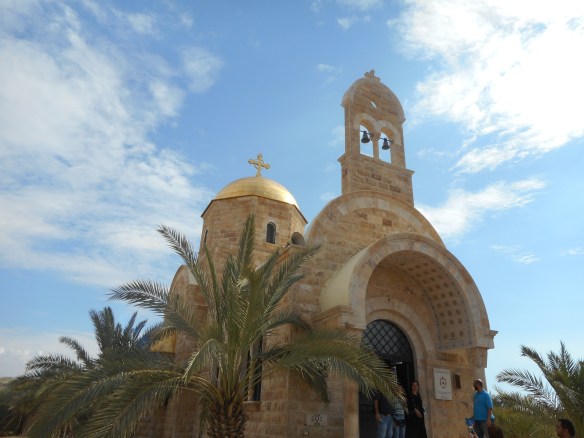
DSCN0257

And here, finally, is the Jordan River, looking across to the Israeli side.

DSCN0258

A couple of points:

The spiritual “Michaell Row the Boat Ashore” has this line: “Jordan’s river is deep and wide, hallelujah.”  Well, not anymore, at least not at the time of year we were there.  You could throw a rock to the Israeli side of the river (not that I’d recommend doing this, of course).

Also, note that the river isn’t exactly beckoning you to come in and dunk your head in it. My wife had a vague idea beforehand about doing this, but she took one look at that muddy brown color and decided not to bother.  On the other hand, I saw a couple of people on the other side wearing white robes with red crosses on them who looked like they were getting up their nerve to take the plunge.  We had to return to the bus before we could see how that worked out for them, though.

In which Marco Rubio dispels with this fiction that Barack Obama doesn’t know what he’s doing

People have made fun of Marco Rubio’s robotic repetition of the talking point “Barack Obama doesn’t know what he’s doing; he knows exactly what he’s doing”  in the debate the other night.

But I don’t believe people have made enough fun of the fact that his robotic repetition was ungrammatical.  He’s gone to all this trouble of memorizing some sound byte that his advisers think is clever and persuasive, but the sound byte is non-standard English.  Here is what a writer in Slate has to say:

As [Dave] Weigel notes, dispel with isn’t really a thing. You can dispel something, sure. (Rubio did little to dispel concerns that he’s not fit for the White House, for example.) But if you want to use with after a verb, then dispense is more appropriate.

A quick Google search illustrates the uniqueness of Rubio’s word choice. A search for “dispel with” that’s restricted to results prior to Saturday night’s debate shows mostly mentions about video games. It seems Dispel is a spell in Final Fantasy. And you can apparently use Dispel with all kinds of things, including the Holy Torch. That’s probably not what Rubio had in mind.

Language Log points out just how weird this construction is:

My first reaction was that this was a malapropism, “dispel with” substituted for “dispense with”.

But this tends to counter the “scripted” meme, since presumably the Rubio campaign can afford to hire writers with a good grasp of English subcategorization conventions. So I wondered whether it might just be a usage that I’ve missed, rather than a case of bad scriptwriting or imperfect script-remembering.

However, “[dispel]with” in the relevant sense doesn’t occur in the 520 million words of the BYU Corpus of Contemporary American English,  although forms ofdispel occur 1,585 times. There are five examples of passive-voice dispelledwhere a following with-clause has an instrumental interpretation, e.g. “If they had had any doubt that the concept would work, it was dispelled with the very first test photo.”

I suppose the Republican candidates for president provide us with much more serious things to worry about.  But this is just irritating.

The Dead Sea

Still trying to cover our trip to Jordan last November . . .

Pro traveling tip: Don’t try to drive from Wadi Rum to Petra, visit Petra, and then drive up to the Dead Sea.  Not unless you know the route a lot better than we did.  We arrived at our hotel late and cranky.

Luckily it was a really fancy hotel, one of a number of upscale hotels in a resort area on the Dead Sea.  And they take security very seriously — with good reason.  This was the first time I’ve ever had a camera wheeled under our car looking for explosives.  The hotel had a variety of restaurants for every taste.  We were too worn out to make a good decision, so we ended up at an American Sports Bar, featuring bad American food (I cannot recommend their Philly cheese steak) while soccer matches were displayed on the big-screen TVs. The next day we went to the site of Jesus’s baptism, which I’ll get to in another post.  In the afternoon we relaxed back at the hotel, which had no shortage of swimming pools.

2015-10-31 09.12.36-1

But what you really want to do is walk down endless steps to the Dead Sea, the lowest point on Earth:

2015-10-30 15.14.06-1

Really, it ain’t much of a beach.  But you’re there to sit in the water.  (Try not to get a mouthful of the water; it is really salty.)

2015-10-30 15.03.45-1

Also you’re supposed to slather yourself with some Dead Sea mud, which is apparently good for what ails you.  I declined.

Here is the Dead Sea as the sun sets:

2015-10-30 16.07.41-1

That night we had a magical dinner outdoors with friends of my son and their parents.  Below us a wedding was taking place; cats roamed the terrace looking for treats.  We drank wine and ate great food and talked about football and our children; we looked across the sea at the lights twinkling on the West Bank.  How could anything go wrong in such a world?

2015-10-30 21.51.46-1

In which Cam Newton demures from the truth

The Boston Globe sports page this morning contained this sentence:

He can’t demure from the truth: that race is a factor in how he is perceived because the expectations for comportment at the position he plays have been shaped largely by quarterbacks who didn’t look, play, or act like him.

By this evening the sentence had been corrected to say “demur from the truth”.  Well, “demur from” is certainly better than “demure from”, although “demur from the truth” sure sounds awkward to me. “Demur” basically means “object” — how do you object from something?

The confusion between “demur” and “demure” is deep enough to require explication from grammar sites. Sports writers probably don’t need to know the difference between the two words, but newspaper copy editors really ought to.