Unknown's avatar

About Richard Bowker

Author of the Portal series, the Last P.I. series, and other novels

Who stole Shakespeare’s skull?

According to this New York Times article, it was a guy named Frank Chambers.  First, researchers used radar imaging of Shakespeare’s grave site at a church in Stratford-upon-Avon.  The imaging indicated that the skull was probably missing.  This led them to an account of a doctor named Chambers robbing the grave in 1794:

“We’ve done lots of research literally trying to pick holes in this story,” Mr. Colls said, adding that the group had looked into the names of Chambers’s gravedigger accomplices, the inns they visited before and after the heist, and the depth to which they were said to have excavated; all the details checked out. “If the grave-robbing account is a made-up story,” he said, “then it’s unbelievably accurate in all its details.”

What I like about this piece is its consideration of whether the researchers’ imaging technique “moved” Shakespeare’s bones, which would mean that the inscription above the grave — “Curst be he that moves my bones” — would apply to them:

Whether the archaeologists beaming radar into Shakespeare’s grave were able to escape the curse printed above the grave depends on how much you believe in quantum physics. Radar waves, like every other form of electromagnetic radiation including visible light, carry energy and momentum, a lesson every schoolkid learns when asking where a comet’s tail comes from: particles of cosmic fluff pushed into a stream by the pressure of sunlight. Indeed, scientists have suggested that spacecraft with giant foil sails propelled by sunlight or powerful lasers might be the cheapest form of interplanetary or even interstellar travel.

One of the ineluctable rules of quantum mechanics (and perhaps journalism) is that you can’t observe something without disturbing it and influencing it in some way. For Shakespeare’s remains to be detected, electrons in the atoms of his bones would have to absorb energy and momentum from the radar waves and then kick it back out. So to see Shakespeare is to give him a quantum tickle. Safely embedded in the ground, the bones might not have moved much or at all, but they knew someone was watching.

Good stuff.

Here is Shakespeare, back when his skull was attached to his body:

A nice review of “The Portal”

Here’s a nice review someone just posted on Amazon for my novel The Portal:

The story is riveting from beginning to end. Two preteens far from home but in fact not far but in a parallel universe is a fascinating concept all by itself. Throw in the time travel, dangerous situations, an array of interesting characters to interact with, and the emotions evoked as they experience privations and loss, and this becomes a captivating story you don’t want to put down until the very end. Recommended for teens and adults.

I couldn’t have said it better myself!  I’ll probably post more of these when I get closer to publishing its somewhat long-awaited sequel.

Did I really write that sentence?

I have finished the third draft of my novel.  It’s now five thousand words longer and considerably better.  I think I’m pretty close to being done.  Here is how this works, in my experience:

  • First draft — I figure out what I want to say.
  • Second draft — I say it.
  • Third draft — I clean up the mess.

Here’s an example of the mess.  I came across this sentence the other morning: “After a few hours we stopped to eat and feed the horses.”  Wait, what?  How can you feed the horses after you have eaten them?  I guess maybe that wasn’t what I had in mind.

Was I asleep when I wrote that sentence?  Drunk?  No, I was just working through the action and not paying enough attention to the style.  So that sentence is fixed.

Now I need to read through the whole thing again.  You know, just in case.

Hardly a man is now alive…

I went to a funeral on Nantucket yesterday.  The island was cold and deserted, but still beautiful:

2016-03-12 15.58.40

The woman who died was a relative of my wife’s.  I had known her for a long time, but I didn’t know this about her until yesterday: she was present during the Japanese attack on Pearl Harbor.  Her father had been stationed there, and after the attack the Navy brought her family to California, from which they took a cross-country train back to Massachusetts, and home to Nantucket.

It occurred to me that the Second World War is slowly turning from memory to history as men and women like this die.  I work with a woman whose father was present at the first atomic bomb blast at Los Alamos, but he is over 90. How many of those folks are left?

All of which reminds me of the great final scene of From Here to Eternity, when Donna Reed’s character starts turning memory into myth as she stands on the deck of a ship leaving Hawaii after Pearl Harbor — inventing a story about her relationship with Montgomery Clift’s character as the leis float out to sea.  She, like my wife’s relative, will never go back.

George Martin

George Martin has died at the age of 90..

I can’t begin to tell you how much pleasure George Martin has added to my life. Here is “In My Life,” which includes the famous piano bridge written and performed by Martin:

And this is how Wikipedia describes the bridge:

The song was recorded on 18 October 1965, and was complete except for the instrumental bridge. At that time, Lennon had not decided what instrument to use, but he subsequently asked George Martin to play a piano solo, suggesting “something Baroque-sounding”. Martin wrote a Bach-influenced piece that he found he could not play at the song’s tempo. On 22 October, the solo was recorded with the tape running at half speed, so when played back at normal pace the piano was twice as fast and an octave higher, solving the performance challenge and also giving the solo a unique timbre, reminiscent of a harpsichord.

It’s hard to believe that this song has been around for over 50 years.

Chicago Water Tower

I was wandering around Chicago the other night instead of finishing my novel.  Here is the Chicago Water Tower:

2016-02-26 21.51.18

According to Wikipedia, Oscar Wilde was not amused by this building:

The structure has not been universally admired. Oscar Wilde said it looked like “a castellated monstrosity with pepper boxes stuck all over it,” although he did admire the arrangement and movement of the pumping machinery inside.

Why didn’t Republican elites try to stop Trump?

I’ve been too busy finishing my novel to blog about my many insightful political observations.  But anyway, I was reading many discussions in the media over the past few days about how the Republican elites failed to stop Trump.  The canonical text is this article in the New York Times.

In public, there were calls for the party to unite behind a single candidate. In dozens of interviews, elected officials, political strategists and donors described a frantic, last-ditch campaign to block Mr. Trump — and the agonizing reasons that many of them have become convinced it will fail. Behind the scenes, a desperate mission to save the party sputtered and stalled at every turn.

This became obvious to me as I worked out in my local gym in the mornings leading up to the New Hampshire primary.  The Boston TV stations reach into New Hampshire, so we see all the campaign ads aimed at NH voters.  I would be on the treadmill looking at the news on three separate TVs, and each of them would be running the same set of ads.  And none of them were negative ads aimed at Trump.  I can see why the individual candidates wouldn’t run them–they were too busy trying to bolster their own campaigns.  But why not an outside SuperPAC?  Why wouldn’t Mitt Romney dump a few million dollars into this?

The Massachusetts primary is coming up this Tuesday, and the latest poll shows Trump getting 43% of the vote.  And where is our popular, moderate Republican governor Charlie Baker?  Sitting silently on the sidelines, now that the candidate he endorsed, Chris Christie, has dropped out.  Why won’t he use any of his political capital to try to stop Trump?

If I were a rational Republican (and I don’t know how many of them there are), I would be gnashing my teeth.  But of course, if they were really rational, they would long ago have abandoned the modern Republican party.  Here is Josh Marshall in Talking Points Memo:

Trump is very little different from the average candidate Republicans elected in 2010 and 2014, in terms of radical views and extreme rhetoric. All he’s done is take the actual GOP issue package, turn it up to eleven and put it on a high speed collision course with RNC headquarters smack in the middle of presidential election year.

“The Year of Lear”

Every time I read a Shakespeare play or read a good book about him, I wonder why I waste my time doing anything else.  Here’s one: The Year of Lear: Shakespeare in 1606 is James Shapiro’s followup to his A Year in the Life of William Shakespeare: 1599.  The idea is to connect the plays Shakespeare wrote in a given year with the events taking place that year.  England in 1606 saw the aftermath of the Gunpowder Plot, concerns about King James’s push to unite England and Scotland, witchcraft trials, repression of Catholics, and the return of the plague.  Among other things.  During this welter of events, and presumably reacting to them, Shakespeare found the time to write King Lear, Macbeth, and Anthony and Cleopatra. Not a bad year.

Of course, Shapiro’s book is full of suppositions, because we know absolutely nothing about Shakespeare’s inner life.  But it’s fun to guess!  Shapiro has a lot to say about what I think is one of the most fascinating issues in Shakespeare.  Why did he rework the plot of an older play called King Leir and change its happy ending to the unbearably tragic ending of his version?  Was it the times?  Was it something in his personal life?  Was he trying different meds?

And what caused him (or someone else) to change his original ending (published in the Quarto of 1608) to what we find in the First Folio of 1623?  It’s still tragic, but there is now a thin shaft of light amid the all-encompassing darkness.  (This still wasn’t enough for playgoers, who preferred a version adapted by Nehum Tate that restored the happy ending of King Leir; this version held the stage until 1838.)

Anyway, Shakespeare is forever.  And I’m pleased to see that Glenda Jackson is returning to the stage in a gender-blind production of King Lear at the Old Vic. That’s big news, since Jackson has been away from acting since 1992.

I saw her in a production of Macbeth with Christopher Plummer in 1988.  It was not a success, as the Times review makes clear; maybe that contributed to her decision to go into politics.  The production was still in ferment when I saw it in Boston.  In the performance I attended, I remember her practically masturbating during the “unsex me here” speech.  Not sure that made it to Broadway.

Oddly, a brief clip from the production survived into the YouTube age.  Here it is, although be warned: you’ll have to look at the insufferable Gene Shalit interviewing Jackson:

The site of Jesus’ baptism

It’s supposedly here, not far from the Dead Sea resort where we were staying.  Well, who knows?  Here’s an interesting article about UNESCO designating the Jordan baptismal area (where we were) as a World Heritage site:

For years, Christian pilgrims have waded into the Jordan River from both its eastern and western banks to connect with a core event of their faith — the baptism of Jesus. The parallel traditions allowed Jordan and Israel to compete for tourism dollars in marketing one of Christianity’s most important sites.

But now UNESCO has weighed in on the rivalry, designating Jordan’s baptismal area on the eastern bank a World Heritage site. The U.N. cultural agency declared this month that the site “is believed to be” the location of Jesus’ baptism, based on what it said is a view shared by most Christian churches.

The decision drew cheers in Jordan, where the number of tourists has dropped sharply since the 2011 Arab Spring and the rise of the Islamic State group. Israel has kept silent while a Palestinian official said the western baptismal site, located in an Israeli-occupied area sought for a Palestinian state, should have been included.

It “has nothing to do with archaeological reality,” said Jodi Magness, an archaeologist at the University of North Carolina at Chapel Hill. “We don’t have any sites with evidence or archaeological remains that were continuously venerated from the first century on.”

Jordan certainly makes a big deal of how tolerant it is to be operating this site.  Here is a large photo at the entrance of King Abdullah chillin’ with Pope Francis:

DSCN0246

The place where you buy your tickets isn’t all that inspirational:

DSCN0245

You take a bus part of the way down to the river and then you proceed the rest of the way on foot, along covered boardwalks to, finally, stone paths.  Here’s what things look like in the neighborhood.  My son tells me that the area was mined until Jordan and Israel signed their peace treaty.

DSCN0250

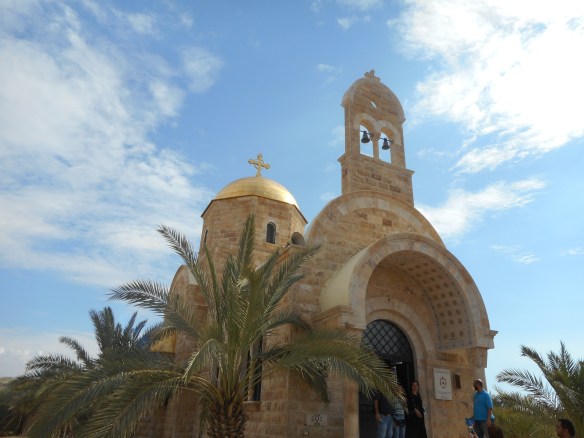
A small Greek Orthodox church was recently built near the site:

DSCN0257

And here, finally, is the Jordan River, looking across to the Israeli side.

DSCN0258

A couple of points:

The spiritual “Michaell Row the Boat Ashore” has this line: “Jordan’s river is deep and wide, hallelujah.”  Well, not anymore, at least not at the time of year we were there.  You could throw a rock to the Israeli side of the river (not that I’d recommend doing this, of course).

Also, note that the river isn’t exactly beckoning you to come in and dunk your head in it. My wife had a vague idea beforehand about doing this, but she took one look at that muddy brown color and decided not to bother.  On the other hand, I saw a couple of people on the other side wearing white robes with red crosses on them who looked like they were getting up their nerve to take the plunge.  We had to return to the bus before we could see how that worked out for them, though.