Unknown's avatar

About Richard Bowker

Author of the Portal series, the Last P.I. series, and other novels

What do the Upanishads, the Torah, the New Testament, the Koran, and Carl Sagan have in common?

They were all sources of readings at the Tufts Baccalaureate Service, which took place the day before its commencement.

A baccalaureate service is explicitly religious, so the inclusion of Sagan is interesting — especially since Tufts doesn’t appear to have a Humanist Chaplaincy (as Harvard does).  I have no insight into the process for deciding what quotes to include, the order of the quotes, who gets to read them, etc. The sequence was chronological, so Sagan came last.  So we begin with the Upanishads asking for us to be led from fear of death to the knowledge of immortality, later we have the New Testament telling us to lay up treasures in Heaven, and finally we have this bracing piece of wisdom for the graduates:

The world is so exquisite, with so much love and moral depth, that there is no reason to deceive ourselves with pretty stories for which there’s little good evidence.  Far better, it seems to me, in our vulnerability is to look Death in the eye and be grateful every day for the brief but magnificent opportunity that life provides.

Good for Tufts!

Scenes from a commencement

Sunday was the157th commencement of Tufts University.  And kid number one was part of it!

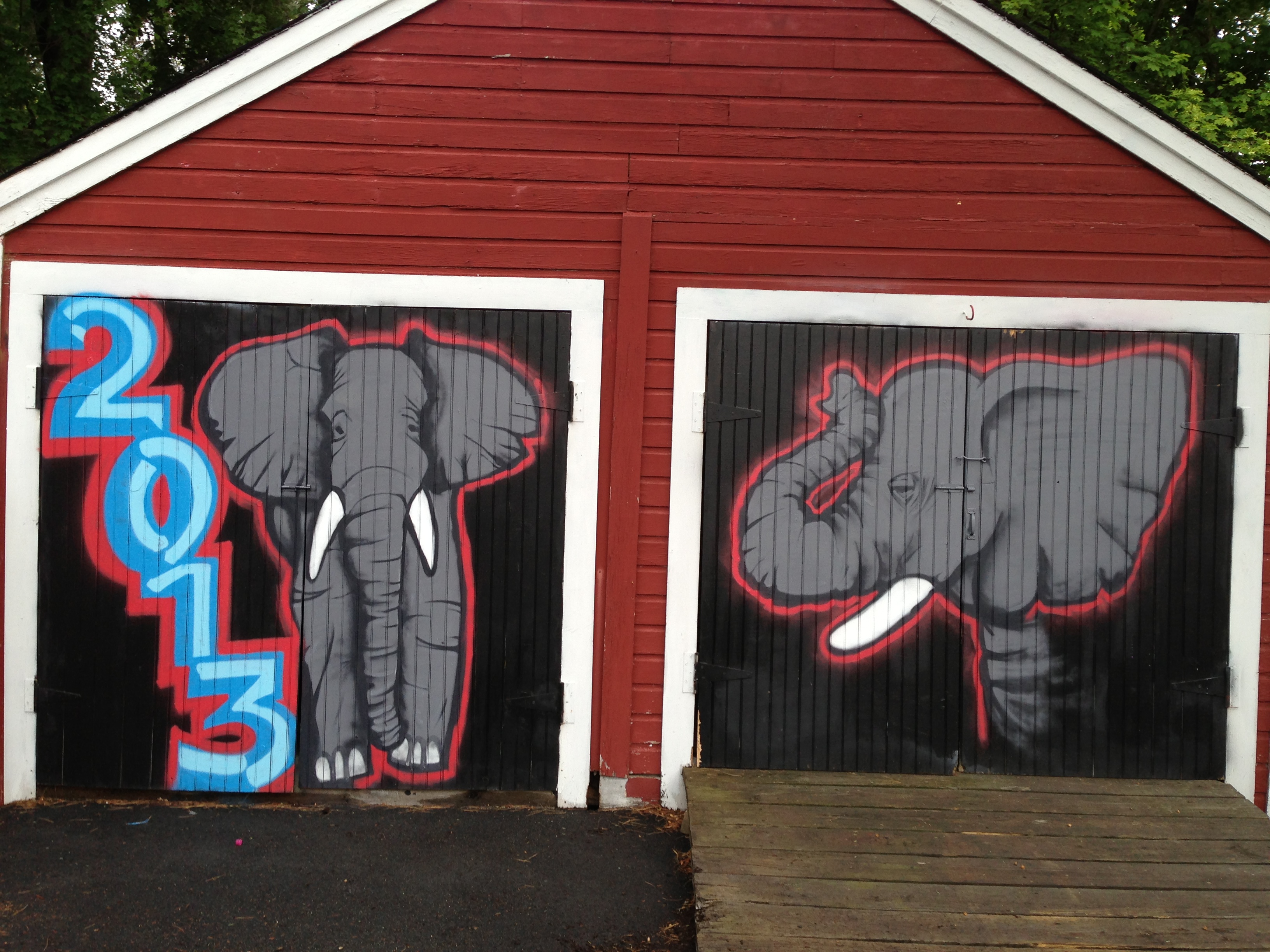
The Tufts mascot is Jumbo the elephant, because P. T. Barnum was an early benefactor.  Here’s a statue of Jumbo:

2013-05-19 08.31.46

And here’s how we painted our garage doors to celebrate the commencement:

2013-05-20 07.49.55

Tom Brady attended the B.U. commencement, but hey, we got B. J. Novak from “The Office”!  His brother was graduating.

2013-05-19 10.54.13

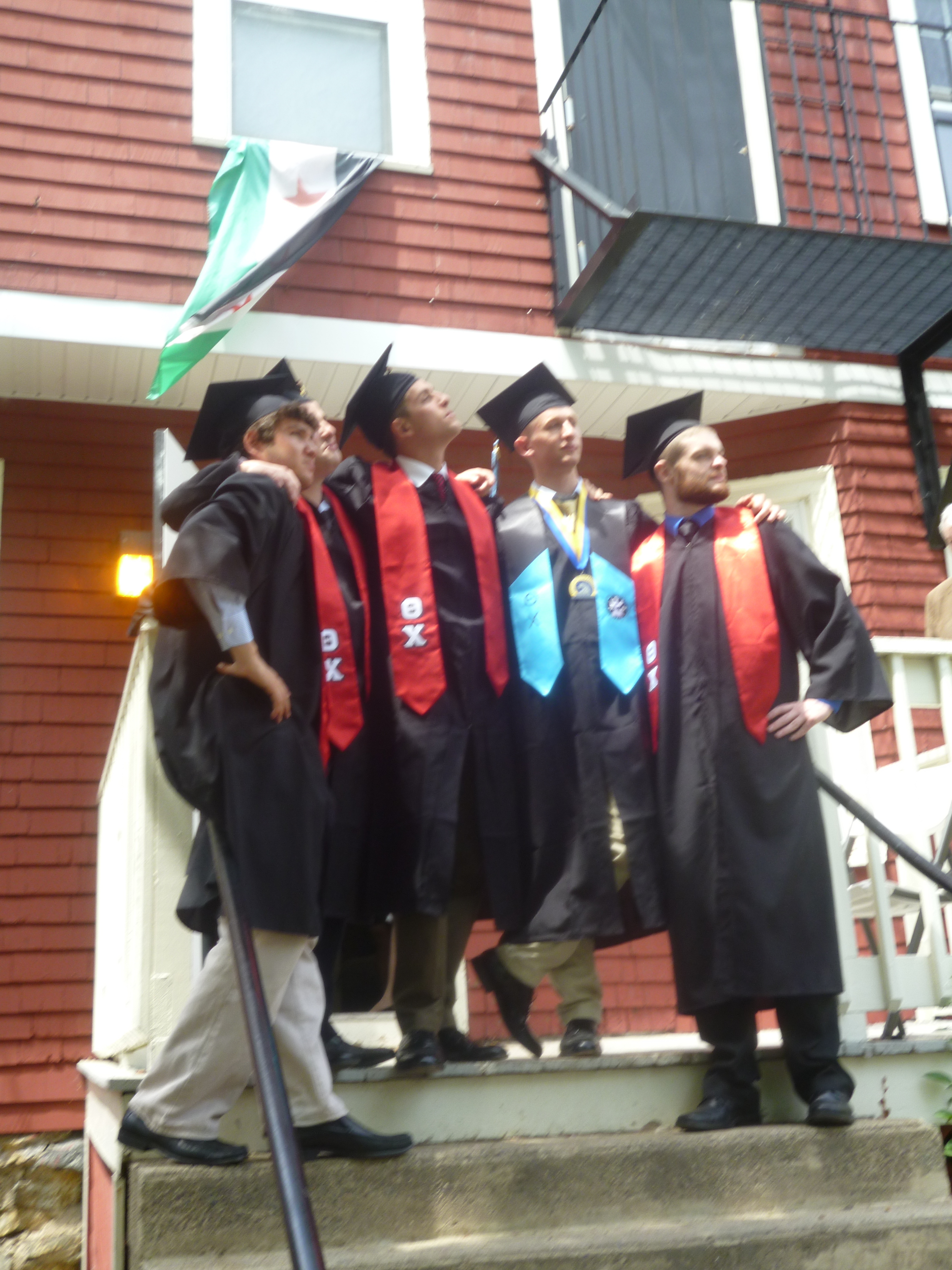
Here is our graduate with some of his fraternity brothers, gazing off into the unimaginable future:

2013-05-19 12.30.58

Here is the basement of the fraternity house, a scene of unimaginable decadence and squalor:

2013-05-19 12.08.58

I’d include a photo of their bathroom, but I might face sanctions from WordPress.

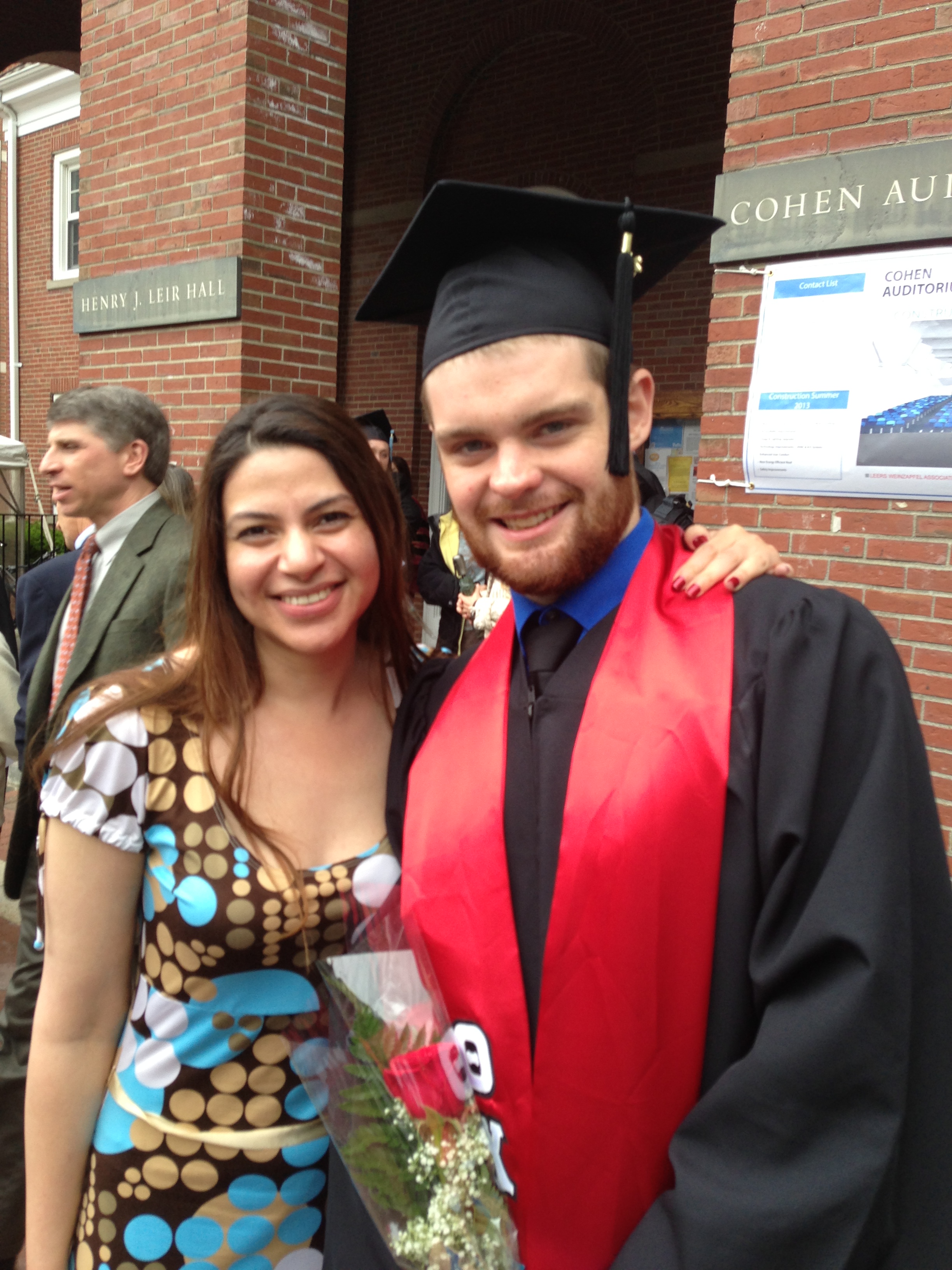
Here is James with his Arabic professor.  I don’t recall professors like this in my day.

2013-05-19 15.12.45

Congratulations to James, and Jumbo, and B. J. Novak’s brother, and everyone!

Portal, an online novel: Chapter 33

Chapter 32: Larry finally meets the preacher from the Burger Queen world once again. The preacher explains a bit about the portal, although he thinks that’s a dumb name for the thing.  He too is just a traveler, part of a kind of priesthood that uses the portal to visit different worlds and impart wisdom.  He gives Larry some enigmatic advice about how to get home, and then he disappears — just as Kevin arrives to tell Larry that Stinky has snitched on them to Lieutenant Carmody, who is on his way to Glanbury to prevent them from returning to their world.  What else can go wrong?

******************

Chapter 33

“We have to go,” Kevin said as we hurried along the dark corridor to the church hall.  “We have to get to the portal before Carmody finds us.”

“Well, we might have a problem there.”

“I don’t care if it’s snowing, Larry.  I don’t care if it’s a hurricane.  We finally know where the portal is.  We’re going.”

We entered the hall, which was almost overpoweringly warm and bright after being in the church and outside in the snow.  The musicians were taking a break.  Stinky was standing by the fireplace, looking guilty.  We went over to him.  “What’s going on, Julian?” I demanded.

“I’m sorry, Lawrence,” he said.  “Really I am.  If I’d known, I never would have done it.”

“I don’t understand.  Start at the beginning.”

He took a deep breath.  “Well, see, it started with Sergeant Hornbeam,” he said.

“Hornbeam?  What about him?”

“You remember how I did favors for the soldiers at the camp?  I was just trying to survive, you know–get some extra food once in a while.  There wasn’t anything bad about it.”

“I remember.  What about Sergeant Hornbeam?”

“Well, one day he asked me to look after you.  He said you were important to the army–he wouldn’t say why–and you’d started showing up at the camp.  He wanted to make sure nothing bad happened to you.”

“Wait–so when you rescued me from those kids who stole my coat–”

“Hornbeam had told me to follow you,” Stinky admitted.  “But I was glad to do it!  Then I didn’t see you again until the morning after the battle.”

“That was on orders, too?”

He nodded.  “After the battle I talked my way past the guards to get into the army camp.  I was just looking for a meal and a cot.  I had no idea you were there.  But I ran into Sergeant Hornbeam again, and he told me to stay with the two of you and keep you safe.  He said if I did a good job he’d see to it that I got out of my ‘prenticeship so I could join the army.

“And I did do a good job–didn’t I?  I kept you alive.  I got you to Glanbury.  And it wasn’t just a job–I liked you.  You became my mates.”

“Gimme a break,” Kevin muttered.

Stinky gave Kevin a look that suggested they were no longer quite so matey.  “So why did you leave?” I asked.

“Well, you know how it was.  The war was over.  I couldn’t stay with you forever–my master was in town and searching for me.  I surely didn’t want to run into him.  So I made my way back to Boston and started looking for Sergeant Hornbeam.  I found him finally, and he brought me to a lieutenant at headquarters–”

“Carmody,” I said.

Stinky nodded.  “And he was awfully excited to find out you were alive.  But he seemed worried that you’d escape again.  I heard him talking to the sergeant, and he said, ‘Why haven’t they found it?’ or something like that.  ‘We’ve got to catch them before they get away for good.'”

Stinky looked at me pleadingly.  “Lawrence, I don’t know what you fellows did and I don’t want to know.  There’s a lot I don’t understand.  I never really believed the stories you told me–about being orphans and such.  But I never meant to hurt you.  So after I spoke to the lieutenant, I decided I couldn’t stay in Boston, even though Sergeant Hornbeam said he was going to take care of me.  I came right back to Glanbury to warn you–got a ride from a peddler part of the way, and I walked the rest.  I figured I’d find you here.”

“So when is he coming?”

“I don’t know,” Stinky admitted.  “But I don’t imagine he’ll delay.”

“It doesn’t matter what he imagines,” Kevin said to me.  “We have to go.”

“I’ve never had many friends,” Stinky said.  By now he looked like he was about to cry.  “When I met you, I thought perhaps–”

“It’s all right, Julian,” I said.  “Really.  I’m grateful you came all the way back here to warn us.”

“If there’s anything more I can do . . . ”

“You’ve done enough.  Thank you.”

We left him and went to find my parents.  “Don’t see why you were so nice to him,” Kevin muttered.

“Don’t see why you treated him like a jerk.  But listen.  The preacher showed up–that’s who I was chasing after.  The thing is, he said he moved the portal.”

What?”

“Just to the other side of the road–but that might explain why we never found it.  But I don’t know–talking to him is like talking to Yoda or something.  Everything’s a riddle, except when he’s calling us stupid kids.”

Kevin looked like he wanted to shoot somebody.  “Your parents over there,” he said.  “Did you explain to them–?”

“They know about us and the portal,” I said.  “They don’t know this last bit, though.”

My parents were talking to each other across the room.  We made our way over to them.  “Things are getting complicated,” I said.  I began by summarizing what Stinky had told us.

Dad was outraged.  “No one can force you to stay here,” he said.  “That lieutenant can’t just kidnap you.  This isn’t New Portugal.  There are laws.  If you don’t want to stay, you don’t have to.”

I was pretty sure he underestimated Lieutenant Carmody’s power, but still it felt good to have him on our side.  “The thing is,” I said, “we need to find the portal before he stops us.”

“Well, the snow isn’t going to help, but the Fitton place isn’t far.”

“I know, except the portal might not be where we think.”  And I explained what I’d learned from the preacher.

“This is baffling,” Dad replied.  “What do we do?”

“I think we need to go home right now and figure this out,” my mother said.

That seemed like a pretty good idea.  “Very well,” Dad said.  “I’ll go fetch Matthew.”

He went searching for Matthew, and while he did Sarah Lally came up to us, looking flushed and happy.  “It’s such a wonderful party, don’t you think?” she said.

I hadn’t had a second to enjoy it.  But I said sure, it was great.

“I was rather hoping you’d ask me to dance, Larry,” she murmured, looking down at the floor.

Nothing would have made me happier, but Kevin would have killed me if we delayed leaving so I could dance with her.  “I’m so sorry, Sarah,” I replied, “but something’s come up, and we all have to go home.”

Her eyes crinkled with disappointment.  “So soon?  No one’s ill, I hope?”

“No, it’s just that–”  I didn’t know what to say, so Mom jumped in.

“Actually, Mr. Barnes is quite tired,” she said.  “He’s just back from the war, you know.”

“Oh, of course,” Sarah said quickly.  “Forgive me.  Perhaps you’ll come visit me later this week, Larry?”

“I’ll try, Sarah.  I’ll try.”

She reached out and squeezed my hand.  I squeezed back, and then she walked away.  “It’s wonderful having you here, Larry,” she called out over her shoulder.

I smiled at her.  “Get a grip,” Kevin said to me.

Meanwhile Dad had grabbed Matthew, who was really upset about having to leave so soon.  “Can’t we stay for a half hour more?” he pleaded.

Dad shook his head.  “We have to go now.  I’m sorry.  Let’s get our coats.”

A couple of minutes later we had said our goodbyes and were outside, climbing into the wagon.  The snow was coming down even harder now, with a strong wind swirling it all around us.  Mom put her arm around Matthew, who buried his face in her coat.  We had a lantern, but its flickering light didn’t penetrate far through the storm.  “Travel won’t be easy,” my father muttered.  He flicked the reins, and Gretel set out.

This is all going way too fast, I thought.  I needed more time to think things through, but I wasn’t getting any.  I looked at Kevin, who was sitting next to me, nervously glancing around as if he was expecting Carmody to appear out of the darkness.

I thought about telling him the one good thing the preacher had said: that the portal would take us home.

Except even that wasn’t very clear.  If you want to go home, the portal will take you home.  That would work for Kevin, certainly.  But what about me?  What if the portal read my mind or something and decided I didn’t really want to go home?  Would I end up somewhere else?  Back here?  Why wouldn’t the guy give me a straight answer?  For someone who traveled to different universes handing out wisdom, he sure didn’t seem to have a whole lot of social skills.

“I don’t know, lads,” my father called out.  “It’ll be all we can do to get back to the farmhouse in this weather.”

He was right.  We could barely see the road now, and Gretel was straining to make her way.  How much worse was it going to be after a few more miles of travel?  And how were we going to find an invisible portal in the woods in this mess?  I looked at Kevin again.  He just looked glum and stayed silent.

“Mr. Barnes can take you at first light,” Mom said.

“Where are they going?” Matthew asked.

“We’ll explain later,” Mom said.

At least Lieutenant Carmody was going to have as much difficulty in the storm as we were having, I thought.  It was hard for my father to find the turn into the lane leading to the farmhouse.  But Gretel seemed to know the way, and finally we pulled silently up toward the house.

“Did you leave a lantern burning, Henry?” Mom asked.

“Of course not,” Dad replied.

We all stared at the light shining in the window.  As we got closer, we saw a horse and carriage tied up by the front door.  “Let’s get out of here,” Kevin said to me, and he got ready to jump out of the wagon.

“Don’t, lad,” Dad said.  “You won’t survive in the storm.”

“He’s not going to capture us,” Kevin replied.  “Come on, Larry.”

“Who’s not going to capture you?” Matthew demanded.  “What’s going on?”

“That’s not the lieutenant’s carriage,” I pointed out.

Just then the door opened, and a single figure stepped out into the night.  I breathed a sigh of relief and joy.

It was Professor Palmer.

“Summit” is #1 free spy thriller on Amazon

It would be better if people were, you know, actually paying for it.  But I’ll take what I can get!

Here’s the most recent customer review:

Richard Bowker manages to give lots of credibility to the subject of psychics. What is there not to agree in the end? Psychics do exist, even if their lives are depicted more in the dark forces type of books than in a thriller.
Deep thoughtful take on American and Russian ideals, the perceptions and beliefs ingrained in their nationals to infuse a patriotic love, which makes us explore our own psyche and rattles perhaps our own confidence in our righteousness. The same political corruption and power greed exists at all levels, in all countries- and is perfectly delineated in the pages of this book. It is difficult not to love the heroes, and the insertion of a love story makes the read even more enjoyable for female readership. I did enjoy this book till the (perfect) end.

Don’t read this if you’re a Dan Brown fan

I have never read a Dan Brown novel.  But that didn’t stop me from laughing at this column in the Telegraph.  Here’s a sample:

Renowned author Dan Brown hated the critics. Ever since he had become one of the world’s top renowned authors they had made fun of him. They had mocked bestselling book The Da Vinci Code, successful novel Digital Fortress, popular tome Deception Point, money-spinning volume Angels & Demons and chart-topping work of narrative fiction The Lost Symbol.

The critics said his writing was clumsy, ungrammatical, repetitive and repetitive. They said it was full of unnecessary tautology. They said his prose was swamped in a sea of mixed metaphors. For some reason they found something funny in sentences such as “His eyes went white, like a shark about to attack.” They even say my books are packed with banal and superfluous description, thought the 5ft 9in man. He particularly hated it when they said his imagery was nonsensical. It made his insect eyes flash like a rocket.

So I looked at the beginning of The Lost Symbol on Amazon and saw this:

Robert Langdon jolted upright in his soft leather seat, startling out of the semiconscious daydream.  He was sitting all alone in the cabin of a Falcon 2000EX corporate jet as it bounced its way through turbulence. In the background, the dual Pratt & Whitney engines hummed evenly.

Elsewhere in the chapter we find out that the Eiffel tower’s elevator was made by Otis and had articulated pistons, and the Washington monument is 555 feet high. I call this “index card” writing.  You can see the writer getting out the index card containing his research on corporate jets or the Eiffel tower’s elevator and making sure he jams every detail into his prose.

It works for Dan Brown, I guess.

Would you write a novel in someone else’s universe?

Today’s Boston Globe has an article (behind their paywall) about the estate of the late Robert B. Parker hiring writers to continue his various novel series.  Apparently the guy writing the new Spenser novels is doing a pretty good job.

This is, of course, standard practice nowadays.  Why stop a successful series just because its author is dead?  The author had a style and a formula; just hire someone to copy them.  If the new author does a good job, why should the reader care if he isn’t Robert B. Parker or Ian Fleming or Robert Ludlum?

Similarly, lots of authors write novels in the Star Wars world or the Battlestar Galactica world or the World of Warcraft world.  There’s nothing wrong with any of this–it pays the bills, which is not something that writing your own novels tends to do.

The closest I came to this sort of work for hire was when my agent set up a deal with a famous New Age guru.  (I’d love to name the guy, but I can’t recall if I signed a confidentiality agreement.)  He had an idea for a novel and wanted someone to ghostwrite it for him.  For some reason my novels with psychic protagonists seemed to qualify me for the task.  I signed the contract and read a couple of the guru’s nonfiction books.  They were terrible — filled with absurd profundities supposedly based on the deep truths of quantum physics.  The universe is conscious!  We are all one!

On the other hand, I worked out what I thought was a pretty good plot for the novel.  I can’t remember a thing about it, alas.  Before I could send in an outline, the guru changed his mind and decided he would write the novel himself.  I never checked to see if he actually did.  My agent worked out a settlement where I got to keep half of the advance, which meant I earned a couple thousand dollars, and all I had to do for it was read a couple of the guy’s books.  It was reasonable compensation for my pain and suffering.

Portal, an online novel: Chapter 32

Chapter 31: Larry and Kevin go to the Christmas Eve celebration with the Barnes family.  And there they run into the Harper family, who rescued them from the New Portuguese soldiers when they first arrived in this world.  The Harpers remember exactly where they had seen the two boys running out of the woods, and suddenly the mystery of where the portal is has been solved.  But now, in the church sanctuary, Larry has to have the conversation he has been dreading with his parents — explaining who he really is and where he comes from.  They believe him — it’s like his mother had known all along — and she tells him he has to go back to his own world.  To his real mother.  They leave him to think about it.  And as he does, a man steps forward from the back of the church and asks for his coat back.

********************

Chapter 32

Soft voice, black beard, glittering eyes.

The preacher from the Burger Queen world, from the park in Boston.  The guy who had left behind his coat for me.  The guy who had told me it was all his fault.

“Who are you?” I demanded.  I moved a little closer to him.  He was wearing a ragged brown coat now.  His hair was wet from the snow.

“A traveler, like you,” he replied, still standing in the doorway.

“What do you want?”

He shook his head.  “A better question might be: What do you want?”

“I want to know why you’re following me.  I want to know what you know that I don’t.”

“I wouldn’t say that I’m following you,” he said.  “It’s more that . . . our paths have crossed.”

“Whatever.  The portal–is that your machine?”

“‘Portal’–is that what you call it?  Kind of clichéd, don’t you think?  Couldn’t you come up with something more original?  ‘Cosmic gateway’–what about that?”

I was starting to get angry.  “You didn’t answer my question–you’re not answering any of my questions.”

He smiled sheepishly.  “I know,” he said.  “It’s kind of a habit.  We’re not really supposed to answer questions.”

“Who is ‘we’?” I almost shouted.

“Okay, okay,” he said.  “Just calm down.  I guess I can make an exception for you.  You’ve had a tough time of it.  And it wasn’t like you meant any harm.  You were just, you know, stupid.”

I was so upset by now that I thought I might go over and start pounding him.  But I managed to stay quiet, and he kept talking.

“So no, the portal, or the cosmic gateway, or whatever, isn’t mine, and it isn’t exactly a machine–at least, not in the way you think of machines.  I just borrow it for my travels.  Like you, except not so stupid.  Didn’t your mother ever tell you not to set foot inside invisible gizmos from other universes?  That would be, like, rule number one if I were a parent.”

I ignored the insult.  “So what is it?”  I demanded.  “Where does it come from?”

“Okay, that one I really don’t know the answer to.  There are lots of universes, right?  You know that now, of course.  Imagine one where people have advanced way beyond anything you can imagine, if that makes any sense.  So they develop these portals.  And then they disappear.  At least–none of us know has a clue where to find them.”

Portals–there’s more than one of them?”

“Uh-huh.  Or maybe they’re all manifestations of a single underlying entity.  Who knows?”

I had no idea what that last part meant, but I had another question.  “You keep saying ‘we’, ‘us’–are you from my universe?  Is there more than one of you?”

“No, I’m from a different universe–although it’s not all that different, and I’ve visited yours from time to time–yours needs a lot of help, if you ask me.  Anyway, there’s a group of us who use the portal.  You might call us a priesthood.”

“Priesthood?  You’re part of a religion?”

He tilted his head and thought for a moment.  “Not in the way you’d think of it,” he replied.  “We don’t have a set of beliefs.  We’re not trying to convert anyone.  We just want to impart some wisdom.”

“So you just, like, travel around to different universes and give sermons and stuff?”

He looked insulted.  “Well, yes,” he said, “but–”

“Don’t you help people?  I mean, like, this world.  What if you could cure drikana?  Would you do it?”

He shook his head.  “It’s forbidden.  Simply coming to a world, simply crushing a blade of grass underfoot, is interference enough.  We don’t tell anyone who we are or where we come from.  We just say what we have to say, and then leave.”

I thought of giving President Gardner the Heimlich maneuver.  If someone’s dying, you try to save him.  “But that’s crazy,” I said.  “That’s–immoral.”

“If we save one life, why not save all of them?” he argued.  “We’re just visitors.  Who are we to decide who lives and who dies?  It’s a small step from that to teaching people how to build better bombs–or electric fences.  Look, what’s most important is to guard against the corruption of power.  That’s something we face every day.  Any of us could become ruler of a run-of-the-mill world like this–we could be worshipped as gods–by using a tenth of what we know.  Does that make any sense to you?”

I supposed that it did, but I had more important things I needed to learn from him.  “How did you know who I was?” I asked.  “Even on that other world it seemed like you could tell I was–I was an outsider.  You knew I had come in the portal.  Didn’t you?”

He smiled.  “Sure.  It’s not really that hard, after you have some experience.  What’s obvious to us may not be at all obvious to anyone else, of course.”

“So more people use the portals than just you guys?”

“Yes, unfortunately.  People like you.  Random travelers.  And observing the bad results of their interference has made us develop our own rules.”

“So am I in trouble or something?  I’ve broken your rules.”

He shook his head.  “Not at all.  We live by our rules.  Others do as they please.”

That was a relief.  But I still hadn’t gotten to the really important question.  “Can you tell me–can we get home in the portal?” I asked.  “We’ve been looking for it, and now we think we know where it is.  But we don’t know where it will take us.”

“Do you want to go home?” he asked.

“I don’t know,” I admitted.  “This is home too, sort of.  But maybe it’d be easier to make a decision if I wasn’t worried that we’d end up on a world where we’d be eaten by dinosaurs or something.”

“I understand,” he replied.  Then he was silent for a long time.  “Listen,” he said finally.  “I’m not trying to make things difficult for you–really I’m not.  I shouldn’t have left the portal in the woods like that in your world.  It was too close to an inhabited area, I admit it.  If kids find invisible cosmic gateways, they’re going to use them.  We know that.  So I’m trying to help you out.  But I’m just not supposed to answer stuff like that.  So here’s the best I can do: If you want to go home, the portal will take you home.”

I couldn’t tell if that was an answer or not.  So I said, “You once said: It is only by setting out that we can finally return home.  Were you talking to me when you said that?”

He shrugged.  “I was talking to whoever would listen.”

“Well then, what should I do: Should I stay here, or should I go back to where I came from?”

“Ah,” he said softly.  “Now there’s a question I can answer.  Sort of.  The answer is: Listen only to your own heart.  It’ll tell you what to do.

I should have known that was the sort of thing he’d say.

“One final thing,” he added.  “The portal?  I don’t really think you know where it is.  I moved it across the road.  Too many people in the woods near the Fitton farmhouse.  I’m trying to learn my lesson.”

Then I heard a door open behind me.  I turned and saw Kevin standing there, looking upset.  “Where have you been?” he demanded.  “Who are you talking to?”

“I’ve been right here,” I said.  “Talking to–”  I turned back to the preacher, but of course he was gone.  The front door to the church was open.  I went outside and looked around, but I couldn’t spot him.  There were tracks in the snow.  I followed them, down the walkway to the street.  “Come back here!” I shouted into the night.  “You can’t just leave like that!”

I tripped and fell on the street, and when I got up I couldn’t find the tracks, and I couldn’t find him.  “Come on!” I shouted again.  “Please help us!”

Kevin came up behind me.  “What the heck is going on?” he asked.

“The–the preacher–the stupid preacher–”  I was too mad to explain.

“Doesn’t matter,” Kevin interrupted.  “You’ve gotta come with me.  Right now.”

“Why?  What happened?”

“Stinky’s a snitch–he’s been a snitch all along.  He went back to Boston and told the lieutenant where we were, and Carmody’s coming to get us.  Let’s go.”

Swell, I thought.  What else could go wrong?  I followed Kevin back into the church hall.

Portal, an online novel: Chapter 31

Chapter 30: Larry’s father has finally returned from the army.  Kevin and Larry are, awkwardly, a part of the homecoming.  Mr. Barnes tells the story of the final defeat of Canada.  Tomorrow is Christmas Eve — when the town will be celebrating New England’s victory.  With his father’s return, Larry’s trip to Boston is off.  But what does their future hold?  Life might be good in this world, but things will never be the same.

I feel as though we’re heading towards the climax, don’t you?

********************

Chapter 31

Christmas Eve.  It was a strange morning.  The family was so happy; it was so sad.  After breakfast Mom and Dad went to visit Cassie’s grave, and they spent a long time there.  Matthew, meanwhile, wanted to know if Kevin and I were staying.

“We’ll certainly stay for the celebration tonight,” I said.

“But you can live here forever,” he pointed out.  “Don’t you want to?”

“I don’t know, Matthew.  It’s complicated.  We’ll see.”

Matthew didn’t look satisfied.

When they got back from the grave, Mom said Dad would take her to town so she could help out with the preparations at the church hall.  “I understand you were going to Boston today,” Dad said to us.  “I think it’s wise to handle that business as soon as possible.  Perhaps we can take you tomorrow.”

“Thank you, sir,” I said.

He gave me kind of a puzzled look, and I knew he remembered what I’d said to him last night.  But he didn’t say anything.  Instead he went to hitch up Gretel while Mom got ready to go to town.  Matthew decided to go with them, so after they left Kevin and I were by ourselves for a while.  I went outside to chop some firewood, and Kevin joined me.  The day was cold and gray, and it felt like snow was coming.  A white Christmas, maybe.  I was nervous, although I couldn’t exactly say why.  “Something’s going to happen,” I said to Kevin.  “You feel it?”

“Yeah,” he replied.  “Maybe we should look for the portal.  If there’s a blizzard, who knows when we’ll have another chance?”

“You go ahead.  I want to finish chopping this wood.”

Kevin just shook his head and continued to sit on a stump while I worked.

When Dad and Matthew got back, Matthew was worried, too.  “We don’t know where Julian is,” he told us.

“He said he was going back to his master,” I said.  “You know, Mr.–uh–”

“Kincaid,” Dad said.  “We met Kincaid at the church hall.  He hasn’t seen Julian since they were in the camp.”

“Well,” I said, “I don’t think he liked Mr. Kincaid very much. Maybe he just decided he wanted to do something else.”

“Kincaid’s a hard man,” Dad pointed out.  “He’ll have the law on Julian if he tries to leave his apprenticeship.”

“I miss Julian,” Matthew said.

I did, too.  I didn’t know why, but finding out that he’d disappeared made me even more nervous.

In the afternoon Dad went around the farm in that deliberate way of his, taking stock of what needed to be done.  “You boys have helped a great deal,” he remarked afterwards.  “I was very concerned about how Mrs. Barnes would make out by herself.  It seems that I needn’t have been so worried.”  Dad wasn’t much on handing out compliments, so that was a big one, coming from him.

“We were happy to pitch in,” I said.

He nodded.  “Still, it’s strange that you decided to come here when your father died.  Now how did you say you were related to Mrs. Barnes?”

Dad was a lot harder to lie to than Mom.  “I didn’t, sir,” I said.  “I’m really not sure.”

He nodded again, and I felt like he saw right through me.  But if he didn’t believe me, he certainly couldn’t imagine what the truth was.  Anyway, he didn’t interrogate me any further, and pretty soon it was time to get ready for the celebration.

Matthew slicked back his hair and put on his best blue shirt.  Dad trimmed his beard and wore a white ruffled shirt and la ong dark coat.  Kevin and I just had our usual clothes–but at least they were clean.

I wondered what Sarah Lally would be wearing.

There were a few snowflakes falling when we started out.  Dad shook his head.  “Hope this doesn’t get any worse,” he murmured.

Matthew was so excited he started to sing.

The church hall was stuck onto the back of the church, up on the little hill overlooking the town center.  When we got there wagons and carriages were already lined up in front of it, with the horses shifting and stamping their feet in the cold.  We left our wagon with the others and hurried inside.  The place was blazing with light–I hadn’t seen a room so bright since the first time I’d been to Coolidge Palace.  In one corner, musicians were playing a violin, an accordion, and a piano, and in the middle of the floor couples were doing one of those complicated dances where everyone’s moving around and switching partners and ducking in and out of lines.  Red-white-and-blue striped ribbons and flags hung from the ceiling.  There was a roaring fire in the big fireplace, and the mantel over the fireplace was decorated with pine boughs and holly; the boughs made the room smell like Christmas, even if that’s not what we were celebrating.  Along the far wall were tables piled with turkey and venison and ham and vegetables and loaves of bread and cakes . . .  It was amazing.

Mom was behind one of the tables, helping to serve the food.  She waved to us when we came in.  Other people started coming over to greet Dad, and Matthew ran off to join his friends.  Sarah Lally was dancing, but she spotted me and waved too.  She was wearing a bright green dress and had a green bow in her hair, and she looked gorgeous.  I grinned and waved back.

“Great music, huh?” I said to Kevin.

“I thought Matthew said Stinky was missing,” he replied.  “Look, he’s right over there, stuffing his face.”

Sure enough, Stinky was standing next to one of the food tables, eating from a very full plate.  When he noticed us, his eyes widened and he put the plate down.  “That’s odd,” I remarked.  “Let’s go find out what’s up.”

The music stopped just then, and I was thinking I’d rather go talk to Sarah than to Stinky.  And that’s when I heard a little voice behind me say, “Look, Mama, the boys from the woods.”

The voice sounded familiar, so I turned, and I found myself staring into the faces of the Harper family.

The Harper family–Samuel and Martha, with their little boy and girl.  The family that had saved Kevin and me from the Portuguese when we stumbled out of the portal so long ago.  The ones who had driven us into Boston when we were friendless and clueless in this world, and I was still worried about the piano lesson I was missing.

It was the little girl who had spoken–was her name Rachel?–the one who thought Kevin had been in the navy because he was wearing an Old Navy t-shirt.  They were all looking at us, though.  And so was my father, who must have been talking to them.

“Bless the Lord,” Martha said, “I’m so glad you boys are safe.  I’ve often thought of you since that day we took you to Boston.”

“I never did understand where you came from,” Samuel said, still grumpy at us.  “First your family was murdered, then they weren’t murdered . . . Where did you say you were from?  America, was it?  Never heard of the place.”

“I don’t understand any of this,” my father put in.  “What woods?  What murder?”

“Where’s your watch?” the boy asked Kevin.  “Do you still have that watch?”

Kevin shook his head sadly.  And then his face lit up–you could almost see the lightbulb going off over his head, like in the comics. “Do any of you happen to remember,” he asked, “when we came out of the woods and you picked us up on the Post Road–where was that, exactly?”

Samuel and Martha looked at each other.  “It was just past Joshua Fitton’s place, wasn’t it, Martha?” Samuel said.

Martha nodded.  “Yes, certainly it was.  I remember seeing the smoke from the house, and we heard the Portuguese soldiers shouting to each other in the woods, and we were sure we’d left too late and be captured.  And then you two boys came running out of the woods on the other side of the road.  We didn’t know what to make of you.”

“Thought you were pirates, or spies,” Samuel said.  “Those strange clothes.  Those accents.  You don’t have so much of an accent now.”

“The Fitton place,” Kevin repeated.

“Yes, about three miles past the Barnes’ farm along the Post Road,” Samuel said.  “You know where it is, don’t you, Henry?”

“Of course I know the Fitton place,” Dad said.  “But what the deuce is this all about?”

“I can explain,” I said softly.

Everyone looked at me.

“Well, um, I need to talk to Mr. Barnes–and Mrs. Barnes–in private.”

Dad nodded slowly.  “I believe that would be a good idea.”

I turned to Kevin.  He looked so happy.  He didn’t care about anything except the Fitton place.  He knew exactly where to look for the portal now.  “Want to come?” I asked.

“Sure.  Whatever.”

We started to walk off with my father, but all of a sudden Stinky was standing in front of us, still looking upset.  “Larry, we need to talk,” he said.

I had more important things to do now than talking to him.  “Later, Julian.  I’m kind of busy.”

“But it’s important,” he insisted.

I shrugged.  Nothing I could do about it.

“I’ll talk to him,” Kevin said.  “You go on with Mr. Barnes.”

That worked for me.  Stinky still looked upset, but he went off with Kevin.  Dad and I made our way to the food tables.  Mom smiled at us.  “Look at this food,” she said happily.  “Two months ago, could you ever have imagined it?”

“Emma,” Dad replied, “Larry would like to speak to us in private.”

Mom’s brow furrowed.  “Is anything the matter?” she asked me.

I shook my head.  “Nothing’s the matter.  It’s just–we need to talk.”

“Oh.”  Mom set down the platter she’d been holding and looked around.  “Yes,” she said.  “Well, then.  Why don’t we go into the church?”

She acted as if she had been expecting this conversation.

I followed them through a door and along a short corridor that connected the hall to the church.  The church was cold and dark. Through the tall windows along the sides I could see snow falling.  Mom lit a lamp while Dad threw a couple of logs into an iron stove.  The walls were plain white, and there was a simple pulpit at the front.  I sat in the first pew.  Mom and Dad sat opposite me, on the steps to the pulpit.  Waiting.

I wished I had Kevin’s watch.  That would at least give me a way of starting, something they could examine and touch and use.  It had worked with Professor Palmer and Lieutenant Carmody, and it was the kind of thing that would work with my Dad.  But I had nothing, if you didn’t count my sneakers and my pants with their amazing zipper.  Nothing but my words.

What words could I use?

“There are other worlds,” I began.  “Not just this one.  And these worlds have other Bostons in them, other Glanburies.  I don’t understand why or how, only I guess–if God could make one universe, why couldn’t He make lots of them?  The thing is: Kevin and I come from one of those other worlds.  It’s a lot like this one, but, you know, different–sometimes in little ways, sometimes in big ones.  Like these sneakers and our clothes–they’re not from China, like I told you.  They’re what we wear at home.  In this other world.”

Here’s one thing I like about my Dad: he takes you seriously.  Matthew will start explaining one of his stupid ideas about why we have hair or who invented checkers or something–just to hear himself talk, I think–and Dad will sit there and listen and nod and occasionally ask a question, like Matthew is some sort of expert on  hair or checkers.  He might smile a little bit, but he never tells Matthew to put a sock in it.  Same thing with Cassie when she starts complaining about how awful her life is.  Afterwards she complains that Dad never does anything to solve her problems, but just listening is a whole lot more than I’d do when she starts up.

So I guess I shouldn’t have worried that he’d laugh at me or something when I started the explanation.  Instead he nodded like I was making perfect sense and said, “You’re not talking about heaven and hell, I take it.  You’re talking about, er, real worlds.”

“Right.”

“And why don’t we know about these worlds?”

“Well, because you don’t know how to travel between them.”

“But you do.”

“That’s right,” I said.  “Or, well, somebody does.  Kevin and I just happened to–see, we found a–a device, a machine.  We call it a portal.  We don’t know who made it or why–it’s probably not even from our world.  It was just sitting there in the woods behind my house–except, well, it’s invisible.  Anyway, we got in it and just kind of like stepped through it, and we were here.  By mistake.  That’s when the Harpers saw us–we’d just gotten out of the portal, and the Portuguese soldiers were chasing us, and we couldn’t get back to it.  So we sort of ended up, you know, stuck here.”

“An invisible machine,” Dad said.  Again, not sarcastically, but like he was just trying to understand.

“And that’s what Kevin is looking for when he goes off walking along the Post Road by himself?” Mom asked.

“Yes, ma’am,” I replied.  “He’s trying to get home.”

“And this other business,” Dad said, “about your father being a professor and dying in the war–you made all that up?”

“Well, yeah.  Except there really is a professor.”  And then I explained some of what happened to Kevin and me after the Harpers brought us to Boston.  I left out about Kevin’s drikana.  And I left out the–well, the complicated part, about why I was talking to them about all this instead of anyone else in this world.  Not that I was going to be able to avoid that part for long.

Dad kept nodding, as if this was the sort of thing kids told him every day.  “So you’re responsible for those airships and that fence–is that what you’re saying?”

“Well, more or less.  On our world there are inventions that are much more amazing than those things, but there wasn’t time to figure out how to build them here.”  I didn’t really want to talk about computers and telephones and stuff like that–it would just make things more difficult to believe.

“But this still doesn’t make sense, does it?” Dad said.  “Why did you come to the Fens camp?  Why were you looking for us?”

That was the complicated part.  But strangely, I didn’t have to explain.  Mom understood.  “Larry hasn’t really finished describing his world,” she said.  “Have you, Larry?”

“No, ma’am.”

She was staring at me hard, the way she had in the camp when I first gave that confusing lie about who I was.  And then Dad got it.  “‘Dad’, you called me last night,” he said.  “Not a word we use much in these parts.  But I’ve heard it.  I know what it means.”

I nodded.  “Some people exist in both worlds.  They’re different in lots of ways–different jobs, different homes.  But they’re basically the same.”

“And you’re saying that–that we’re there in this other world?” Dad said.

“Yes.  And Cassie, and Matthew.  And me–I was part of the family too.  And that’s why I went looking for you in the camp.  And that’s why I was so happy to find you.  I had found my family.”

I fell silent and waited for a response.  Dad couldn’t just act like he was taking me seriously; he had to make a decision.  He had to believe, or not believe.  He’s logical; he’s a computer programmer.  Professor Palmer had talked about Occam’s Razor–I could almost see Dad struggling to use it on my story.  “Larry,” he said finally, “this is very interesting and, well, moving, but you’ll have to admit it’s a bizarre tale.  You’re saying that–that you’re the son we buried as an infant.  Still alive, grown up to be a young man.”

“Yes, sir, that’s what I’m saying.  I’m your son on another world, where medicine is better, and they can cure fevers and consumption and smallpox.  I didn’t die of whatever killed me here.  I’m just a regular boy who goes to school and has an older sister who complains too much and a younger brother who talks too much.  And a wonderful mother who worries about all of us all the time.”

“Well frankly, I don’t see how you can expect us to–”

As he spoke I realized that he wasn’t the one I needed to be talking to.  “Do you believe me?” I asked Mom.

She was gripping Dad’s arm now.  A single tear worked its way down her cheek.  “Of course I do, Larry,” she whispered.  “Of course I do.”

Dad turned to her.  “Emma,” he said, “I know how grateful you are to Larry, but–”

She shook her head.  “No, that’s not it.  I know him, Henry.  I know him.  I couldn’t understand it–couldn’t understand this feeling I had when I looked at him, when I talked to him–but now I do.  He’s our son.  He’s my baby.  I don’t understand anything more, and I don’t need to.”

We were silent again.  I could hear the ticking of the clock on the rear wall of the church, and the distant sound of the joyful music from the church hall.

“I suppose we’ll find out the truth of it soon enough,” Dad said to me.  “If this–this portal is still there by Joshua Fitton’s farm, we should be able to find it, invisible or not.  And then you can use it go home.”

Home.  All those conversations with Kevin, and now the moment had arrived.

“Well . . . I don’t know,” I said.

“What do you mean?” he asked.  “What don’t you know?”

“See, I was thinking of staying.  You know, to help you out.  There’s a lot I don’t know about farming and stuff, but I can learn.  I can be part of this family too.  I feel like–like I already am.”

I hadn’t known I was going to say that.  I had thought about it a lot, but I hadn’t ever really decided.  Now, there it was.

But instead of acting all happy, Mom was shaking her head.  “You have to go home, Larry.  I love you, but you can’t stay here.”

“Trying to go home could be dangerous,” I pointed out.  “We don’t even know if the portal will take us home.  We might end up in some universe where the Earth doesn’t even exist.  Kevin is willing to take the risk–he doesn’t have a family here.  But I have you, and I don’t want to give you up.”

I could tell the idea of the danger bothered Mom, but it wasn’t enough to change her mind.  “If–if I’m there, too, imagine how much I miss you.  Every moment of every day, Larry.  Wondering where my baby went.”

So I guess I hadn’t really thought it through.  I thought maybe they wouldn’t believe me and I’d have to convince them, but once they were convinced they’d be happy to have me stay.  I could see now how stupid that was.  In reality, Mom loved me so much that she had to let me go.

But she couldn’t force me to go.  If I stayed here, she might feel guilty, but she’d get over it.  And for all I knew, maybe we could figure out how to come back here in the portal, and I could be part of both worlds.  It was possible, wasn’t it?

“I don’t know,” I said.  “I don’t want to leave you, now that I’ve found you.”

“I understand, Larry,” she replied.  “I don’t want you to leave either.  But you have to.  And I’m sure you know it.  Take some time to think it over.”  She stood up.  “For now, why don’t we go back to the hall?” she said.  “Really, we have much to celebrate.”

“Do you mind if I stay here for a while?” I said.  “Maybe I do need to think about things.”

Mom shook her head and put her hand on my arm.  “That is very wise, Larry.”

Dad stood up too.  “I certainly want to talk more with you, Larry,” he said.  “But perhaps this is enough for now.”

I nodded and watched the two of them as they walked out of the church.  Then I leaned back in the pew and closed my eyes.  Now what?  Kevin would want to head off to look for the portal as soon as possible–he’d do it right now if he could.  So should I obey my mother and go with him?  Go back to a world where I didn’t matter, where our family argued morning and night and the schoolbus was a nightmare and I never learned or did a single thing that was really important, that really made a difference?

Where my mother missed me every moment of every day?

I tried to pray.  I’ve never been good at praying, but now seemed like a pretty good time to ask for help.  So I did.

I don’t know how long I sat there.  When I finally opened my eyes, the lamp was burning low and I knew I should get back to the church hall.  I stood up.  And that’s when I heard the noise behind me.

It was–well–it was a quiet noise.  A rustle, a breath.  I wasn’t really sure I had heard anything.  But I turned, and in the dimness I saw the outline of a figure standing at the back of the church.

My heart started thumping.  “Who are you?” I whispered.

“I really could use that coat back,” the figure replied.  And he took a step forward.

Big ideas and little ideas in “Forbidden Sanctuary”

My first novel, Forbidden Sanctuary, isn’t getting many sales as an ebook.  Fine.  Whatever.  Have it your way.  But I was actually pleased at how well it held up when I re-read it during the ebookification process.  It’s good solid idea-based science fiction.  So go buy it!

This post about big ideas and small ideas got me to thinking about the big ideas behind Forbidden Sanctuary.  When you’re starting out, you’re dying to find a big idea that you can turn into a publishable novel.  I had two big ideas behind this novel.

The first one was: What if the Christian pattern of redemption and resurrection occurs on other planets as well?  What if each intelligent life form has its own Christ figure?  If we accept that there is alien intelligence, why should God care only about us?

This is a not a bad idea, as science fiction ideas go.  At least I thought so.  But by itself it didn’t give me a novel; there’s no conflict or tension, and therefore there’s no story.  So it was the second big idea that got me to the starting line.  What if we have a first contact story, where one of the aliens who land on Earth is a member of a Christian-like persecuted sect who would be killed if his beliefs were known?  And so the alien escapes and is hidden by Christians, and the alien leaders demand his return, and there’s your conflict and tension.

But as usual it’s a little idea that I remember most fondly from the novel.  A first contact novel requires some explanation of why the aliens are here — are they trying to straighten us out or conquer us or steal our women or what?  The idea I came up with was that, for the aliens in my novel, space travel was a ritual of the state religion.  They belonged to an ancient Roman-like culture and no longer understood how they did what they did; in fact, their technology was otherwise far behind ours, so they were as afraid of us as we were of them.  And that helped motivate much of the action in the novel.

This idea is a bit of a stretch, but FTL travel in and of itself is a stretch.  Every thriller plot is a stretch.  And I couldn’t have written the novel if I hadn’t come up with it.