Unknown's avatar

About Richard Bowker

Author of the Portal series, the Last P.I. series, and other novels

Is religion, like, true?

And does that, like, matter?

Here‘s an essay by a guy named Alain de Botton who has gotten a lot of press lately.  (Don’t you wish you were named “Alain de Botton”?)  The first paragraph goes:

Probably the most boring question you can ask about religion is whether or not the whole thing is “true.” Unfortunately, recent public discussions on religion have focused obsessively on precisely this issue, with a hardcore group of fanatical believers pitting themselves against an equally small band of fanatical atheists.

Folks like Jerry Coyne and Jason Rosenhouse are annoyed at this, and not just because they wish they were named “Alain de Botton.”  It’s a common criticism of new atheists that they’re just like religious fundamentalists — all hung up about the literal truth of the Bible and whatnot — while more sophisticated folks (with sophisticated names like “Alain de Botton”) think more deeply and wisely about such matters.

This brings to mind an experience I had teaching a bunch of kids at my Unitarian church.  Unitarianism is a kinda sorta religion, with no fixed creed, just a set of principles and an all-embracing support for each person’s “search for truth.”  I was helping to teach a program called “Coming of Age,” which is the Unitarian equivalent of Confirmation or Bar Mitzvah.  Our job in this program is to guide mostly eighth- and ninth-grade kids to an understanding of what they believe at this point in their lives.  The goal is the production of a “Faith Statement” that they could present to the congregation.

This being Unitarianism, there are no right answers.  The kid could decide he or she was a Christian, or an atheist, or a Buddhist, or a Wiccan . . . it’s all good!  Maybe in ten years the kid will believe something entirely different — and that’s good too.  Keep searching!

This is all fine, except . . . one Sunday we were discussing codes you can live by.  One such code is the ten commandments (but there are others!  and you can make up your own!).  We were talking about God giving the tablets to Moses on Mount Sinai.  And one kid asked, “Is this, like, true?”

What an interesting question — at least, I thought so.  Alain de Botton would probably disagree.  And the question started to bother me.  In the entire curriculum, there was no opportunity to discuss the truth claims of any religion.  It was almost as if such a discussion would be impolite.  Further, we didn’t spend any time teaching kids how to think about or judge religious truth claims.  Lots of kids were attracted to the idea of reincarnation; it has a moral feeling to it without being tied down to the kind of Christian dogma that probably drove most of their parents into Unitarianism.  But we never said a word about whether there was any scientific evidence for reincarnation, or why such evidence would or would not matter.  This left me with a feeling of unease about the program, a sense that we had let the kids down.  We had liberated the kids from the constraints of dogma, but we hadn’t made any attempt to give them the tools to judge dogma in any kind of rational way.  Should they care if there is no independent evidence of Moses’ existence beyond the story in the Bible?  Should they care that evolution has shown that there couldn’t have been an Adam and Eve?  Is it all about community and morality?

Does any of this matter?  Alain de Botton would say it doesn’t matter because all religions are obviously untrue.  Karen Armstrong would probably say it doesn’t matter because all religions are manifestations of underlying truths that are inaccessible to scientific or historical investigation.  Lots of people would probably say: don’t worry about it, you’ve confused those kids enough as it is.

But I still can’t help feeling that I let them down….
Janacek

For reasons best known to Haruki Murakami, Janácek’s Sinfonietta is a major thematic element in 1Q84. (For reasons best known to WordPress, they don’t provide any way that I can see to add that accent-thingy over the “c” in “Janacek”.)

Here is the last movement, played at the Proms.  Most of the comments about the video have to do with 1Q84.  One guys says: “Well, I enjoyed that, so that’s one single positive thing I can say about 1Q84: it went on about this so much I felt obliged to look it up.”

It’s worth cranking the volume up to 11 for the final couple of minutes, where every horn player in London gets to join in:

Pontiff is available on Kindle and Nook!

Pontiff has arrived!

Kindle edition is here.

Nook edition is here.

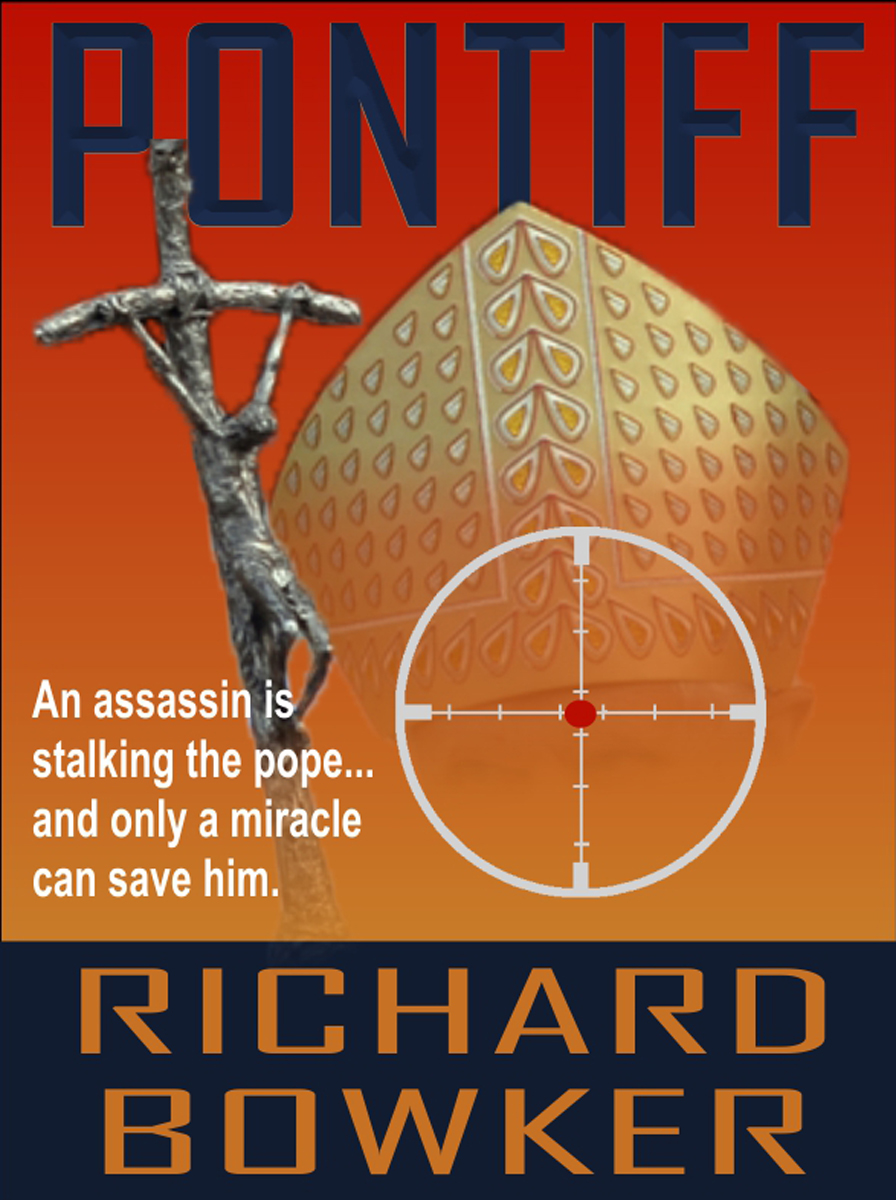
Here’s what the cover looks like (choice A with some tweaks):

Pontiff


The price: a mere $5.99.  OK, that’s twice what Summit costs, but we’re still experimenting here.  Think of it this way: it’s less than you probably spent for lunch yesterday.  And sure, that stewed haddock (let’s say) was good, but you’ve already digested it, and now you just have to eat all over again.  And it’ll take you a lot longer to read Pontiff than it took you to watch John Carter.  More value for your entertainment dollar!

One final note: if you think you’ve already read this novel, you are very probably wrong.

Why do books have typos?

The Swerve was written by a distinguished professor from what some folks apparently call “The World’s Greatest University.”  It was published by a top-shelf publisher (W. W. Norton).  It won the National Book Award for Nonfiction.  It’s a big deal.

But in the book we have Greenblatt referring repeatedly to Ptolomey and the Ptolomaic dynasty.  And in a footnote he talks about a “palimsest”.   How can this happen?  Microsoft Word’s spellchecker catches these mistakes.  Heck, even the WordPress text editor I’m using to write this post catches them.  Heads should roll!

My guess is that Greenblatt still uses an electric typewriter or a quill pen or something, and to save money Norton sends manuscripts out to harried freelance copy editors who don’t have time to do anything but skim.  So some of the writer’s mistakes are going to get through.

In the ebook world, everything ends up in a Word file at some point in the process, and that means you can use its spelling and grammar checkers to full advantage.  And you’re an idiot if you don’t.  Of course, they’re not going to catch the amusing faces/feces typo that the scanning process introduced into Summit.  The author is on his own to catch that sort of thing.

Ultimately, these sorts of typos reduce the authority of the text.  It’s not as if Greenblatt is a classics scholar or an expert on the Italian Renaissance — he’s a Shakespeare guy who is extending his range.  So you end up thinking: if he doesn’t know how to spell Ptolemy, what else is he missing?

Can books be forever?

I’ve started reading The Swerve by Stephen Greenblatt, author of Will in the World, a book I enjoyed very much. (How did they come up with a price of $9.43 for the Kindle edition of this thing?  Did someone just pick a number out of a hat?)

The Swerve is about the discovery, at the dawn of the Renaissance, of a long-forgotten copy of the great poem De Rerum Natura (“On the Nature of Things”) by the ancient Roman writer Lucretius, who otherwise would have been totally lost to history.  The book has a lot to say about science and religion, which you may have noticed are topics of some interest to me.  But for now I just want to talk about how it relates to my post “Is the Internet Forever?”

Greenblatt talks about how few books have come down to us from the ancient Greek and Roman world.  And, until some manuscript fragments were found at Herculaneum (next door to Pompeii), all we had were copies:

Apart from the charred papyrus fragments recovered in Herculaneum, there are no surviving contemporary manuscripts from the ancient Greek and Roman world.  Everything that has reached us is a copy, most often very far removed in time, place, and culture from the original. And these copies represent only a small portion of the works even of the most celebrated writers of antiquity.

Depressing.  Greenblatt recounts the sacking of the great Library at Alexandria by Christian mobs in the early fifth century.  This is also the subject of the really fine movie Agora, which pretty much disappeared in the US.  (What genius thought a movie that presented Christians as a bunch of crazed book-burners would be a box-office winner in this country?)

Anyway, this brings us to a guy I used to work with named Brewster Kahle.  He subsequently made a lot of money at a startup and is using it to digitally preserve old web sites and lots of other stuff at www.archive.org.  Now, the New York Times reports, he wants to save physical books as well.  So he has a huge warehouse in California where he hopes to collect 10 million physical items, mostly discarded from libraries or personal collections–just in case.

“We must keep the past even as we’re inventing a new future,” [Kahle] said. “If the Library of Alexandria had made a copy of every book and sent it to India or China, we’d have the other works of Aristotle, the other plays of Euripides. One copy in one institution is not good enough.”

Is Brewster nuts?  Some people quoted in the article don’t sound especially enthusiastic about his project.  But it seems to me there are worse ways to spend your Internet millions.  Lucretius would probably think so, too.

“Calls will be answered in the order they are received”

Can you spot the grammatical problem with this familiar sentence?  Yeah, me neither.

A sentence like that one came up at work, and our very fine editors were deeply disappointed with me when I didn’t understand what was wrong with it.

It seems that the “in” in the sentence is doing double duty.  The sentence should really go: “Calls will be answered in the order in which they are received.”  Or, if you don’t mind a preposition at the end of a sentence: “Calls will be answered in the order they are received in.”

This is the sort of nuance that separates the grammatical sheep from the grammatical goats.  And of course the Internet possesses all kinds of wisdom about it: here is one example.  Fowler’s Modern English Usage calls the phenomenon”cannibalism”–the first “in” has swallowed the second one.

I opined to the editors that this kind of “cannibalism” wasn’t that big a deal, and one of the editors opined back that it was “deplorable, repugnant, and vile.”  Tough crowd.

Help me design a cover for Senator!

Senator is next for ebookifying!  So I need to think about the cover.

Unlike Pontiff, Senator has existing covers to ponder.

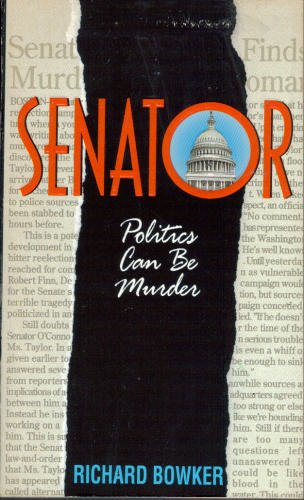
Here is the hardcover cover, which I don’t much like — but maybe you do!  I think the protagonist’s Irishness is not particularly central to the plot.  (In case this isn’t clear, run-of-the-mill authors have no say in the covers for their books, at least in the standard publishing model.)


Here is the paperback cover.


And here is the cover for the Japanese paperback. I have no idea what the text on the cover says.  The shamrock doesn’t mean anything in Japan, I suppose, nor does the Capitol building, presumably.  A bloody knife — that, they get.  Senator actually sold pretty well in Japan.


So, any suggestions?

A Universe from Nothing

I finally finished the book.  It’s fairly short — please note that Summit is twice as long and a quarter of the price, and it contains absolutely no equations (although I’ll admit it has lots of Russian names to keep track of).

The first part of the book is an overview of the current state of cosmology — suffice it to say that things are looking weirder and weirder, and the more scientists find out space and time and matter and energy, the more difficult it becomes to present a tidy narrative like the Big Bang of why things are the way they are.  Much of this material was also covered in the Yale astronomy course I listened to, but that doesn’t mean I can understand it at even the most general level.  I certainly can’t judge whether Krauss is right.  He seems to have the credentials, although anyone who would write a book calledThe Physics of Star Trek has some ‘splainin’ to do (although it could be a great book, for all I know).

Krauss discusses the ramifications of modern cosmological research in the second part of the book. So:

Something from nothing. This is the key discussion.  There is now a scientific approach to understanding “creation” — how something comes from nothing.  It will undoubtedly not satisfy theologians, but putting creation ex nihilo within the reach of scientific explanation means that theologians and philosophers become irrelevant to the discussion.

The anthropic principle.  This is the puzzling concept that physical laws seem fine-tuned for our existence. If some of the baseline constants of the universe were even slightly different, life couldn’t have formed and we wouldn’t be here to measure those constants and ponder this puzzling concept.  Another way of thinking about this is Einstein’s famous question: “What I want to know is whether God had any choice in the creation of the universe.”  (What Einstein meant by God is not what theologians mean byGod.)  That is, do the laws of nature have to be what they are?  If not, why are they what they are?

The trendy cosmological response to this is the theory of multiverses, which Krauss supports.  There are lots of universes, goes the theory, maybe an infinite number, of which ours is just one.  Krauss says:

[I]n discussions with those who feel the need for a creator, the existence of a multiverse is viewed as a cop-out conceived by physicists who have run out of answers–or perhaps questions.  This may eventually be the case, but it is not so now.  Almost every logical possibility we can imagine regarding extending laws of physics as we know them, on small scales, into a more complete theory, suggests that, on large scales, our universe is not unique.

(That final sentence is not one of Krauss’s better ones.) If ours is not unique, then there is nothing special about the laws that govern it — they just happen to be ones that allow for the development of intelligent life.

Of course, to make this science, the multiverse theory has to be testable — and how can you test it if you can’t see or experience or measure anything outside our own little universe?  So is it science?  This guy, at any rate, doesn’t think so.

Here is Krauss’s summary of his book:

We have discovered that all signs suggest a universe that could and plausibly did arise from a deeper nothing–involving the absence of space itself–and which may one day return to nothing via processes that may not only be comprehensible but also processes that do not require any external control or direction.  In this sense, science, as physicist Steven Weinberg has emphasized, does not make it impossible to believe in God, but rather makes it possible to not believe in God.  Without science, everything is a miracle. With science, there remains the possibility that nothing is.  Religious belief in this case becomes less and less necessary, and also less and less relevant.

The afterword by Dawkins is inconsequential.


Petra and Wadi Rum

At least one of us is having an adventure.

Sent to us while Skyping from a chilly Internet café in Amman.

What am I doing for an adventure?  Well, I’m thinking of changing my default breakfast cereal.  But I don’t want to rush into anything.