Hardly a man is now alive…

This is the 240th anniversary of Paul Revere’s Ride.  Longfellow’s poem starts like this:

Listen, my children, and you shall hear
Of the midnight ride of Paul Revere,
On the eighteenth of April, in Seventy-five;
Hardly a man is now alive
Who remembers that famous day and year.

It was written in 1861, on the eve of the Civil War, so personal memory of the Revolution had just about died out.  The poem itself is pretty bad, but Longfellow did succeed in his aim of creating a national myth.  No one was building statues of Revere before Longfellow’s poem.

(“2010 NorthEnd Boston 4621037522” by Richard Wood from Tacoma, Washington, USA – Boston 2010-05-02-15. Licensed under CC BY 2.0 via Wikimedia Commons)

While I have your attention, let me recommend David Hackett Fisher’s book Paul Revere’s Ridewhich is just fabulous.

First person, third person

I continue to intermittently make my way through Lee Child’s oeuvre, and I recently listened to The Enemy, from 2004.. It has much of what I’ve come to expect from a Jack Reacher novel: a crackerjack (if occasionally absurd) plot, much gratuitous violence, well-developed (if occasionally absurdly villainous) characters, and a ton of background information, some interesting, some not so much (for example, there is a multi-page essay on crowbars that I could have done without).

What’s different about The Enemy is that it’s told in the first person (and, less importantly, it’s a prequel, taking place back in 1990, when he was still in the military). I didn’t know you could mix third-person and first-person narrative in a series!  Does anyone else do it? It works just fine, although I always have the same reaction to first-person stories like The Enemy: when is the narrator writing this story down?  Why?

This sort of baffles me in the books in my first-person Last P.I. series (the most recent of which, Where All the Ladders Start, is available at fine online retailers everywhere!). Walter’s friend Art, proprietor of Art’s Filthy Bookstore, is always badgering him to write up his cases, and Walter is always making excuses about why he can’t do it.  But in fact, here we are reading the first-person narratives.of those very cases.   How did that happen?  Is Walter lying to Art?  Does the writing take place some time in the future?  No explanation is given, perhaps because no explanation is possible.

I’m pretty sure I’m the only one who worries about stuff like this.

The more it snows (Tiddely pom)

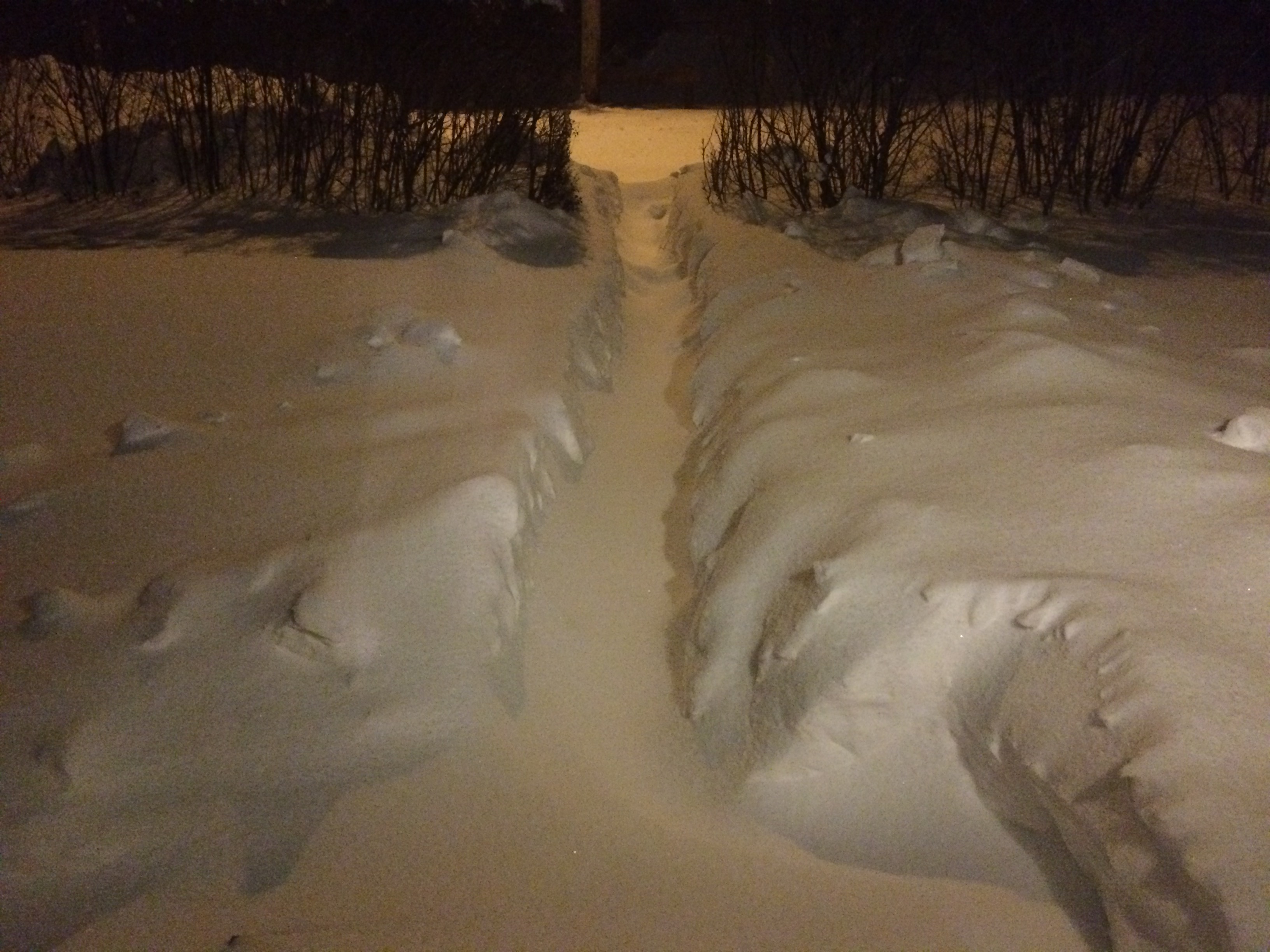
Eight p.m. and it’s still snowing.  We shoveled a while ago, but it doesn’t seem worth the effort.  The plows are undoubtedly coming back, and we’ll have to do it again.

2015-01-27 20.14.01

This is probably our favorite snow poem, by A.A. Milne.  We would recite it to our kids whenever it snowed, and I think eventually they started looking at us funny.

The more it snows (Tiddely pom),
The more it goes (Tiddely pom),
On snowing.

And nobody knows (Tiddely pom),
How cold my toes (Tiddely pom),
Are growing.

The Snow-Storm

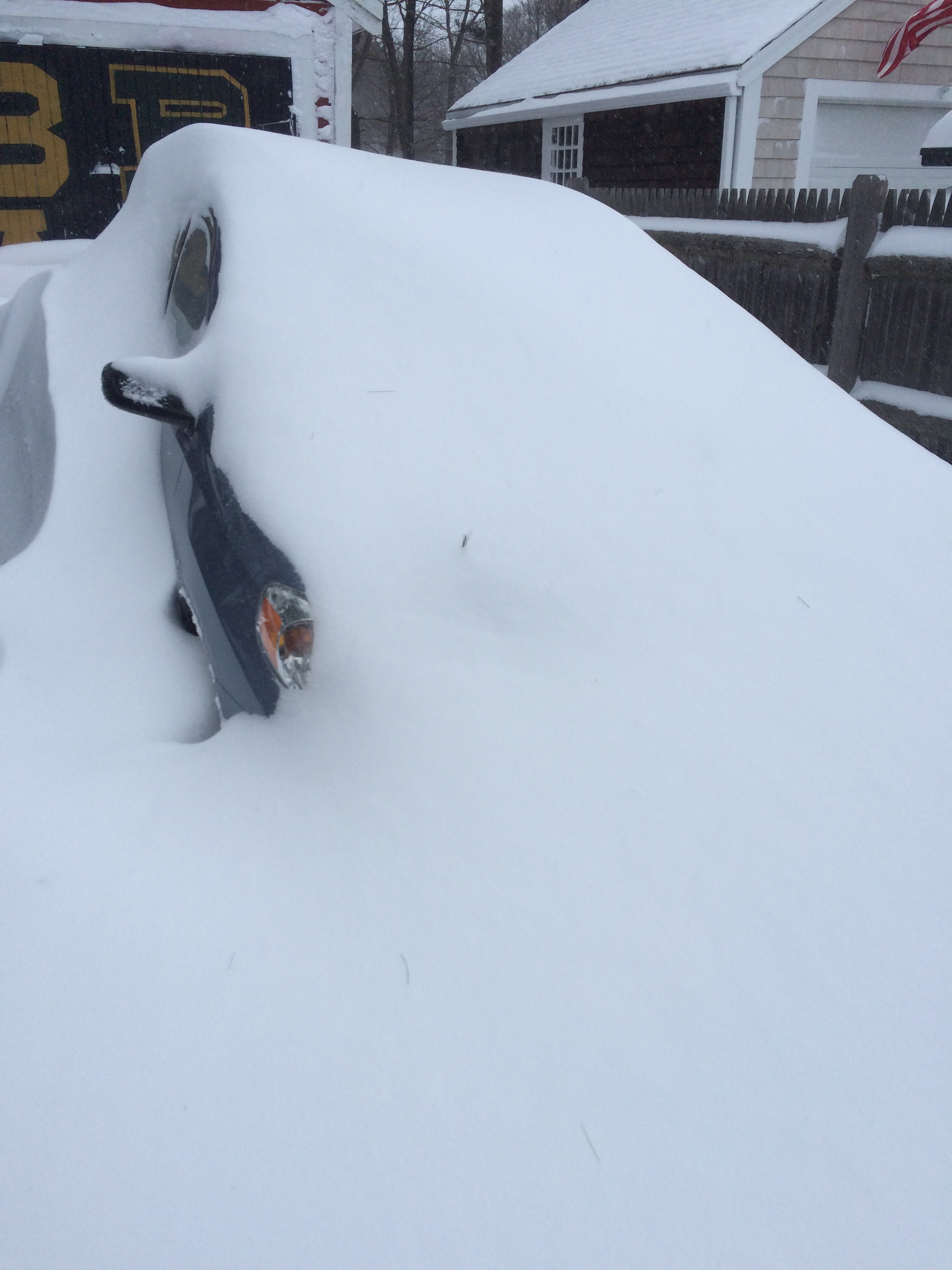
Still snowing in my neck of the woods.

2015-01-27 15.55.36

Emerson wrote this poem in 1841, about 30 miles from where I’m sitting by my radiant fireplace, in a tumultuous privacy of storm.

Announced by all the trumpets of the sky,
Arrives the snow, and, driving o’er the fields,
Seems nowhere to alight: the whited air
Hides hills and woods, the river and the heaven,
And veils the farmhouse at the garden’s end.
The steed and traveler stopped, the courier’s feet
Delayed, all friends shut out, the housemates sit
Around the radiant fireplace, enclosed
In a tumultuous privacy of storm.

Come see the north wind’s masonry
Out of an unseen quarry evermore
Furnished with tile, the fierce artificer
Curves his white bastions with projected roof
Round every windward stake, or tree, or door.
Speeding, the myriad-handed, his wild work
So fanciful, so savage, nought cares he
For number or proportion. Mockingly,
On coop or kennel he hangs Parian wreaths;
A swan-like form invests the hidden thorn;
Fills up the farmer’s lane from wall to wall,
Maugre the farmer’s sighs; and, at the gate,
A tapering turret overtops the work.
And when his hours are numbered, and the world
Is all his own, retiring, as he were not,
Leaves, when the sun appears, astonished Art
To mimic in slow structure, stone by stone,
Built in an age, the mad wind’s night-work,
The frolic architecture of the snow.

Books I read in 2014

Some of them, anyway, and in no particular order.  A couple others I’ve talked about previously.

King Leopold’s Ghost — This harrowing book, about the Belgian colonization of the Congo, is depressing enough to make to make you swear off humanity once and for all.

The Origins of Consciousness in the Breakdown of the Bicameral Mind — Written decades ago, the author’s thesis still holds up pretty well, it seems to me.  I read it as an ebook, and the OCR is pretty bad, though.  It has a cameo role in my new novel, Where All the Ladders Start.  See if you can spot it!

The Glory of the KingsThis is a novel by my cousin’s husband, Dan Close, and it’s really good.  It’s about Ethiopia repelling an Italian invasion in 1896, and Dan’s affection for his characters and his deep understanding of the country (he served in the Peace Corps there) shine through on every page.

Someone — Alice McDermott’s novel is the kind I wish I could write but can’t — a series of vignettes from an ordinary life, scattered in time, that add up to way more than the sum of their parts.

All the Shah’s Men — This is the story of the US and British-led coup of the Iranian leader in 1953.  If you want to know why so many people hate us in Iran, this is a good place to start.  We have a lot to be sorry for, but the Iranians don’t come off looking very good either.

Our Mathematical Universe — Max Tegmark is an MIT professor with interesting ideas about multiverses.  I’m incapable of judging the science behind his speculations, but he’s an engaging writer.  Very useful background if you’re interested in writing alternative history novels set in a multiverse.

Inferno — This is a history of Word War 2 by Max Hastings.  I’m not sure why I decided to listen to it, except I had this suspicion that I didn’t know much about the subject, and it turned out I was correct.  Ask me anything about the Battle of the Bulge.  OK, don’t do that.  But at least I now have a clue about what the battle was all about.

The Life and Opinions of Tristram Shandy, Gentleman — I remember being entranced by this novel when I was in high school  Either I have a faulty memory, or I was one weird kid (probably both are true).  The book is occasionally hilarious and charming, but eventually I found the endless digressions annoying, and I started skimming.

Echo Burning — I keep dipping into Lee Child’s oeuvre.  This one is better than some of his later books, but as usual he goes to great lengths to justify why Jack Reacher has to go around killing everyone in sight.

The Demon under the Microscope — I had this suspicion that I didn’t know anything about the development of sulfa drugs in the 1930s, and it turned out I was correct.  A very entertaining story about the discovery of the first antibiotics, and how they changed the world.

Salt — I also had this suspicion that I didn’t have a proper understanding of the role of salt in world history.  Now I do, but I’m not sure I care.  Listening to this book was a mistake; if I had read it, I would have skimmed long sections of it.  Recipes don’t work well in audiobooks.

The Circle — This is David Eggers’ brave-new-worldy novel about modern social media and Facebooky corporations.  I found it predictable and uninteresting, and finally I gave up on it.

Why Nations Fail — The authors have an explanation, which they hammer home relentlessly.  It seemed pretty persuasive to me, but what do I know?

The Origins of Political Order — By Francis Fukuyama.  More than I wanted to know about almost everything.

Eternity’s End

My friend Jeff Carver has been running a highly successful BookBub promotion of his epic Nebula-nominated science-fiction novel Eternity’s End. Only 99 cents!  But hurry–this is the sale’s final weekend!

Here’s the star-spanning description:

The Flying Dutchman of the stars! Rigger and star pilot Renwald Legroeder undertakes a search for the legendary ghost ship Impris—and her passengers and crew—whose fate is entwined with interstellar piracy, quantum defects in space-time, galactic coverup conspiracies, and deep-cyber romance. A stand-alone Star Rigger novel, and an excellent starting point for readers new to the Star Rigger Universe. A Nebula Award finalist, from the author of The Chaos Chronicles.

I have always wanted to write novels about interstellar piracy, quantum defects in space-time, galactic coverup conspiracies, and deep-cyber romance.  But somehow Jeff always beats me to it.

A Nocturnal Upon Saint Lucy’s Day, Being the Shortest Day

Saint Lucy’s Day is December 13, which used to coincide with the Winter Solstice.  “Lucy” is derived from the Latin word for light, and Saint Lucy’s Day is celebrated as a festival of light in Scandinavian countries.. Here is John Donne’s great poem about dark and light, loss and love, death and rebirth.

‘Tis the year’s midnight, and it is the day’s,
Lucy’s, who scarce seven hours herself unmasks;
The sun is spent, and now his flasks
Send forth light squibs, no constant rays;
The world’s whole sap is sunk;
The general balm th’ hydroptic earth hath drunk,
Whither, as to the bed’s-feet, life is shrunk,
Dead and interr’d; yet all these seem to laugh,
Compared with me, who am their epitaph.

Study me then, you who shall lovers be
At the next world, that is, at the next spring;
For I am every dead thing,
In whom Love wrought new alchemy.
For his art did express
A quintessence even from nothingness,
From dull privations, and lean emptiness;
He ruin’d me, and I am re-begot
Of absence, darkness, death—things which are not.

All others, from all things, draw all that’s good,
Life, soul, form, spirit, whence they being have;
I, by Love’s limbec, am the grave
Of all, that’s nothing. Oft a flood
Have we two wept, and so
Drown’d the whole world, us two; oft did we grow,
To be two chaoses, when we did show
Care to aught else; and often absences
Withdrew our souls, and made us carcasses.

But I am by her death—which word wrongs her—
Of the first nothing the elixir grown;
Were I a man, that I were one
I needs must know; I should prefer,
If I were any beast,
Some ends, some means ; yea plants, yea stones detest,
And love; all, all some properties invest.
If I an ordinary nothing were,
As shadow, a light, and body must be here.

But I am none; nor will my sun renew.
You lovers, for whose sake the lesser sun
At this time to the Goat is run
To fetch new lust, and give it you,
Enjoy your summer all,
Since she enjoys her long night’s festival.
Let me prepare towards her, and let me call
This hour her vigil, and her eve, since this
Both the year’s and the day’s deep midnight is.

Happy belated birthday to William Blake

I seemed to have missed it by a day.  Here is his great poem “London”.  Did anyone ever write a better phrase than “mind-forg’d manacles”?  And did any two words ever pack more of a punch than “marriage-hearse”?

I wandered through each chartered street,
Near where the chartered Thames does flow,
A mark in every face I meet,
Marks of weakness, marks of woe.

In every cry of every man,
In every infant’s cry of fear,
In every voice, in every ban,
The mind-forg’d manacles I hear:

How the chimney-sweeper’s cry
Every blackening church appals,
And the hapless soldier’s sigh
Runs in blood down palace-walls.

But most, through midnight streets I hear
How the youthful harlot’s curse
Blasts the new-born infant’s tear,
And blights with plagues the marriage-hearse.

Is this the greatest novel in the English language?

Middlemarch, I mean.  Wikipedia tells me that this is the opinion of Martin Amis and Julian Barnes.  It also quotes Virginia Woolf, who calls it “one of the few English novels written for grown-up people.”

I first read it back in high school or college, when I read pretty much everything.  I doubt that it was assigned reading — it’s about a billion pages long.  So I probably spent a chunk of my spare time devouring it one summer.  This time around, almost out  of the blue, I decided to have my hero Walter Sands read it in the course of Where All the Ladders Start (coming soon to an ebook store near you!), and I decided I’d better take another look at it myself, to make sure the things I said about it were true.

It surely is a novel for grown-ups.  I can’t imagine subjecting a middle schooler to it, the way we make them read Oliver Twist.  I can’t imagine what I would have made of the book in high school.  A few more thoughts:

  • Middlemarch has its moments of rustic humor, but Eliot is never as funny with her rude mechanicals as Dickens is with his working-class folks.  And she even doesn’t try to be as funny as Jane Austen when it comes to relations between men and women.  That is serious business.
  • There’s a bit of social commentary in the novel.  I didn’t recall this from my first reading, but it’s actually a historical novel — written in the 1870s but taking place in the 1830s.  So we see the railroad about to make an appearance in the area, for example, and the Reform Bill is in the air.  But that material seemed fairly bland to me.
  • Where Eliot is great — and maybe unequaled — is when she deals with love and marriage, and the complexities of serious relationships in a serious world.  Dorothea and Casaubon, Dorothea and Will Ladislaw, Rosamond and Lydgate — by the end of the book, we are so deeply inside these characters’ heads that we seem to know them as well as we know ourselves.  That’s a pretty impressive achievement.

That is to say, I re-read the whole damn thing, which used up a large chunk of my reading time for the year.  It was worth it.

Print on Demand reaches “Lore of the Underlings”

My friend John Klobucher has created an interesting fantasy universe in his episodic series Lore of the Underlings.  He has now collected the first set of episodes in old-fashioned book form:

Print books are great!  You can read them in the bathtub, and I’m pretty sure they don’t require batteries.  So pick up a few.

Note that John did the cover art.  He also creates podcasts of the episodes, where he does the narration and all the voices.  Plus he composes original music for them.

He’s a bit of a show-off.