I really don’t care what Harry Bosch had for dinner

I like to listen to Harry Bosch novels on my endless commute.  They don’t require deep thinking, and the narrators are really good. One problem with audio books, though, is you can’t skim.  And there are lots of times in a Harry Bosch novel where I really want to skim.

I won’t bother discussing the endless descriptions of Bosch listening to CDs of jazz performances.  These are by definition boring.  Instead I want to talk about the endless descriptions of the restaurants he goes to and what he orders and what toppings he has on his pizza and how much macaroni and cheese is left over after dinner with his daughter and ARGGH!  Make it stop!

There is, I’m sure, a rationale for this obsession with Harry Bosch and food.  Presumably Connelly wants to show us how cops live in present-day LA.  Here are their hangouts.  Here’s where they eat when they go to court or the shooting range or the forensics lab.  And here’s the kind of food a typical cop likes to eat.  But I don’t care.  Just tell the story.

I have a personal rule for writing that says I don’t put in anything that I’m unlikely to read in someone else’s novel.   Five hundred words about a sunset?  No thank you.  How well a certain Merlot goes with steak tips?  Spare me.  Nothing about women’s shoes.  And, of course, nothing about jazz.  Never, ever, anything about jazz.

“I could kill you now, Detective Bosch. But that would be too easy.”

I’ve been listening to The Black Box, a Harry Bosch novel by Michael Connelly.  It turns out he uses an “I could kill you now, Mr. Bond” setup for his climax.  I expected more of Mr. Connelly, whose strong suit is his plotting.  Harry Bosch has been taken prisoner by the killer he has been tracking down.  He is at the killer’s mercy.  The killer points a gun at him.  It’s all over for Bosch!  But what does the killer do?  Instead of killing Harry, he handcuffs him to a wooden post in a barn and leaves him to go kill some other folks.  Why?  Connelly has Bosch come up with a reason eventually, but boy, is it lame.

So Bosch is left by himself, and guess what?  Spoiler alert!!  It turns out the Bosch is an expert at unlocking handcuffs with random stuff!  He gets hold of a watch from a corpse the killer left at his feet and uses the winding pin to escape from the cuffs.  (The watch itself has been brought to our attention with a standard Chekhov’s gun maneuver — why, look at that interesting watch that this guy who is obviously going to get killed is wearing!)

This sort of thing is fine in The Heat and James Bond movies, where plausibility just doesn’t matter.  But it was just too over-the-top for this sort of novel.  Connelly can do better.

Should we boycott Orson Scott Card because he’s viciously homophobic?

My lovely wife just read a book called Dickens in Love about Dickens’s love affair with Ellen Ternan.  “I didn’t know he was such a creep,” she said.  Well, yeah.  Lots of writers are solipsistic jerks, and lots of them have obnoxious political positions.

One quite reasonable interpretation of the scant documentation of Shakespeare’s life is that he was a money-grubbing, social-climbing adulterer.

Lord Byron probably slept with his half-sister, among many other offenses.

Knut Hamsun (winner of the Nobel Prize for Literature) called Hitler “a preacher of the gospel of justice for all nations.”

I read a bit of Orson Scott Card back in the 80s.  I enjoyed Ender’s Game, although I don’t recall thinking it was anything like a classic.  At some point I gave up on Card because I thought there was something weird about his treatment of violence.  I haven’t been paying attention to him since then, so I didn’t realize he was beyond-bonkers homophobic, to the point of advocating violent revolution to prevent gay marriage:

How long before married people answer the dictators thus: Regardless of law, marriage has only one definition, and any government that attempts to change it is my mortal enemy. I will act to destroy that government and bring it down, so it can be replaced with a government that will respect and support marriage, and help me raise my children in a society where they will expect to marry in their turn.

The movie version of Ender’s Game is coming out in a few months, and people are making noises about boycotting it.  In response, the terrified filmmakers say the movie and the book have nothing to do with gay issues, and, as the 16-year-old star cleverly puts it, “You can’t blame a book for its author.”

Absolutely true.  On the other hand, Card is still among us, and Dickens, Shakespeare, Byron, and Hamsun are not.  He makes money any time we purchase one of his works.  And he hasn’t been shy about expressing his opinions and trying to affect public policy.  There are plenty of good books to read and good movies to watch (well, I could be wrong about the supply of good movies).  I can’t think of any reason to support Card’s career.

By the way, here’s Dickens’s mistress, Ellen Ternan:

And here’s Byron’s half-sister, Augusta Leigh:

And here’s a very unpleasant-looking Knut Hamsun:

But that would be too easy: Dan Brown’s “I could kill you now, Mr. Bond” problem

The Heat is a hilarious movie that doesn’t bother much with plausibility. Towards the end Sandra Bullock and Melissa McCarthy track down the bad guys to a warehouse, kill a few of them, but then get captured by the #2 bad guy.  He could simply shoot them, of course, but he decides to tie them up and torture them first.  Oh, no!  The torture is about to begin when he is called upstairs to a meeting with the #1 bad guy.  So Sandra and Melissa get to exchange some snappy dialog, figure out how to untie themselves, and carry on with the plot.

This is a standard action movie sequence.  The hero doesn’t get killed as the climax approaches; he gets tied up.  My friend Craig Gardner calls this the “I could kill you now, Mr. Bond” moment.  The evil mastermind has Bond in his clutches, but his hubris makes him say something like: “I could kill you now, Mr. Bond.  But that would be too easy.  Instead, I will let you watch as I carry out my plan for world domination. And then you will die a slow, horrible death.”

The evil mastermind’s hubris always leads to his downfall in these movies, of course.  And in the meantime we get to see the hero extricate himself from a difficult situation just in the nick of time to save the world.

Dan Brown’s Inferno is an action novel that features a standard evil mastermind with plenty of hubris.  Stripped of its endless lessons about art and literature and history and geography, it’s a James Bond novel.  Except that Brown makes a lot of odd plotting decisions that, for me at least, screw up this basic plot structure completely and fundamentally ruin the novel.  Spoiler alert: don’t read on if you are going to care about this plot:

  • First and foremost, the entire plot is predicated on the evil mastermind’s hubris, not just the climactic scene where he decides to keep the hero alive.  Nothing that happens in the book has to happen, except that this guy decides to leave some clever clues behind, mainly because he can.  He could simply have carried out his evil plan without telling anyone.
  • Second, and almost as bad, all the hero’s running around trying to stop the evil plan doesn’t amount to anything whatsoever because the evil plan has already successfully taken place by the time the novel starts.  We just don’t find out until page 400 or so.  So the action is doubly pointless.  Robert Langdon has raced around Florence and Venice and Istanbul for absolutely no reason.
  • Next, the evil mastermind is dead by the time the plot starts.  So there is no opportunity for a climactic confrontation, and his explanations for what he is doing all take place in flashback.
  • Finally–and I find this deeply weird–Brown seems to agree with the evil mastermind.  Well, Brown seems to be saying, his methods may not have been the best, but his analysis of the overpopulation problem was accurate, and obviously something more needs to be done . . .   He never allows any of the good guys to offer a convincing rebuttal to that analysis, although surely one exists (I could do a better job than the good guys, frankly).

So we spend the novel rooting for Langdon to succeed, but ultimately we find out that he couldn’t have succeeded, and we probably wouldn’t have wanted him to succeed.  What a letdown.

Know what Dan Brown needs?! The interrobang!!!!

The interrobang is almost a real thing, and Dan Brown is successful enough to demand that his publisher give him a font that includes one, like so:

His breathless, italics-laden style is what the interrobang was designed for.  Here are some random examples from Inferno:

What the hell do they think I did? Why is my own government hunting me?!

Here he needs interrobangs in consecutive sentences:

Has the speech been canceled?! The city is in near shutdown due to the weather . . . has it kept Zobrist from coming tonight?!

This example is in Italian, although the translation apparently doesn’t require one:

“Lei è Robert Langdon, vero?!” You’re Robert Langdon, aren’t you?”

Here Brown reverses the order of the punctuation marks, for some reason that is too subtle for me to make out.  Perhaps we need a banginterro for this usage:

He turned to the woman. “How do we get up there!?”

Somewhere I learned the rule that a writer should avoid exclamation points: your prose should convey the excitement, not your punctuation. But Dan Brown doesn’t need such lessons; he needs the interrobang.

By the way, let’s not confuse the punctuation mark with this local band that I’ve actually heard play (and some of whose members have hung out at my house).  Or this other band with almost the same name.  With so many great names for bands floating around the universe, why is this happening?

What’s the best book you couldn’t finish?

Goodreads has a list of the top five books that people couldn’t finish:

Hmm.  I’ve already posted about my inability to finish Atlas Shrugged. Its popularity makes me realize there is a limit to my ability to understand human nature.  I re-read Moby Dick a couple of years ago; I finished it, but I have to admit it was a struggle — too much stuff about whaling!  Ulysses is not a book you’re going to get through without a large commitment of time and effort; plus, you’re going to need some help.  But it surely repays the effort.  I have no idea why anyone would have any difficulty finishing Lord of the Rings or Catch-22.

I suppose the most important book I haven’t been able to finish is Proust’s Remembrance of Things Past (if you consider that a single novel).  I forced myself to read Swann’s Way a few years ago, but I hated every minute of it.  I also couldn’t make it through anything by Thomas Mann except Death in Venice; I only finished that one because it was so short.

There are plenty of lesser novels that I haven’t finished, and I get more impatient as I grow older.  I did manage to finish Dan Brown’s Inferno, though, and I’ll blog about that when I gather up my courage.

Dan Brown’s Inferno: Round 1

I have finally gotten up my nerve and started reading a Dan Brown novel.  I’m 40 pages into Inferno, and I haven’t thrown the book across the room yet.  So that’s good.

On the plus side, Brown clearly knows how to write a plot-driven thriller.  The action is standard superhero stuff, involving amnesia and a nameless villain and a shadowy organization known only as The Consortium, but it’s not so ridiculous that I don’t want to find out what’s going on.  And his style is OK: he still has to tell us the exact size of Brunelleschi’s Dome in Florence, but the “index-card” writing isn’t as blatant as in the sample chapter I read of one of his earlier books.

On the minus side, the one thing I know something about so far, Brown didn’t get right.  And that makes me wary about Brown’s mastery of detail.  He has his Harvard professor hero, Robert Langton, wake up in a hospital with amnesia. The doctor asks him where he thinks he is.  The last thing he can remember is walking across the Harvard campus, so he guesses: “Massachusetts General Hospital?”  There are two things wrong with that answer.  First, if you’re from around here, you’d simply say “Mass General.”  No one says “Massachusetts General Hospital.”  Second, he’d know if he had a medical problem at Harvard he’d end up at Mount Auburn Hospital, just down the road in Cambridge.  But of course that’s a much less interesting answer than the world-famous hospital a few miles further away.

And then there is the doctor.  OK, she’s beautiful, and also lissome (which is a dopey word), and she drops everything to save Langton’s life when the spiky-haired female assassin (who was probably also lissome) starts shooting the place up.  That’s pretty standard.  But does she also have to have an IQ of 208?  Did she also have to play Puck in Midsummer Night’s Dream at the age of five?  Realism clearly isn’t what Brown is after here (although he index-cards a couple of real child prodigies that Langton happens to know about).  At that point you have to decide you’re just going to go with the flow.  Or you throw the book across the room.

Is “The Double Helix” really the seventh greatest English-language nonfiction book of the 20th century?

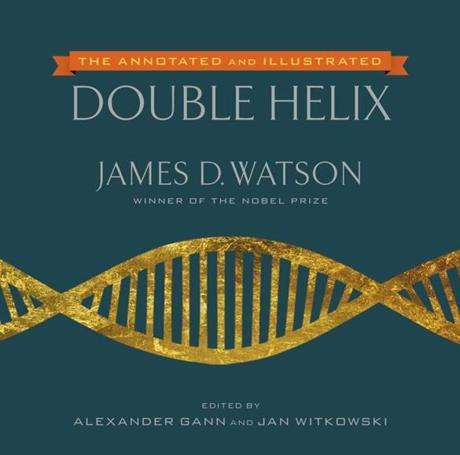
That’s where it ranks in the Modern Library poll, just behind T.S. Eliot’s Selected Essays and just before Nabokov’s Speak, Memory.  The 60th anniversary of the publication of the Watson-Crick hypothesis has just passed, and Simon & Schuster have published an annotated/illustrated version of Watson’s account of the discover of the genetic code.

How do you judge a work of nonfiction?  I thoroughly enjoyed the book when I read it a couple of weeks ago (the annotations and illustrations really helped).  The events Watson describes were, of course, hugely important for our understanding of how life works.  And the approach Watson takes–showing how science really works, with people worrying about their grants and competing scientists, chasing girls and complaining about the lack of heat in their flats–is refreshing and eye-opening.

On the other hand, the writing, while perfectly competent, isn’t out of the ordinary.  And Watson doesn’t make much of an effort to give the reader any context about the nature of the problem he and Crick were trying to solve, why it was so important, and why it was so amenable to solution at just that point in history.  Turns out that The Double Helix wasn’t the best science book I read that week–The Immortal Life of Henrietta Lacks worked better for me both as a personal narrative and as an explanation of science.

The Modern Library list seems reasonable, although arbitrary.  It seems clear that they considered the significance of a book to its time (The Silent Spring), its contribution to human thought (A Theory of Justice), as well as its literary quality (A Room of One’s Own).  As usual, there were lots of books on the list that I haven’t read, and a few that I’ve never heard of.  I was pleased to see Samuel Johnson by Walter Jackson Bate come in at number 50.  Bate’s course on Johnson and his contemporaries was one of the best I took in college, and I recall a standing-room-only audience for his lecture on the death of Johnson, which was apparently legendary at Harvard.  I also can’t quarrel with The Education of Henry Adams as number 1.  It made a huge impression on me in college, and I recall that the last paper I wrote there was a comparison of Adams’s third-person narrative style with that of Norman Mailer.  (It’s interesting that Mailer doesn’t appear on either the fiction or the nonfiction list.  History has not treated him kindly, so far.)

Dan Brown. Dan Brown. Dan Brown. And other pitiable aspects of the writer’s life.

This blog post, “10 Reasons Not to Be A Writer,” is pretty funny.  I like this reason:

One of the very worst things about being a writer is the existence of other writers. There are literally thousands of writers out there, and many of them will have better Amazon rankings than you and be placed in more prominent places in bookshops. Other writers win prizes and climb bestseller lists and are photographed at all the right events. Other writers are probably having a whale of a time, naked, rolling around on the floor, glugging absinthe with other naked people while they scream Beat Poetry up at the ceiling.

While they were doing this, I was wasting a perfectly lovely Memorial Day bleeding words onto a screen.

And then, of course, there’s Dan Brown.  Reason number 7 not to be a writer boils down to Dan Brown.  Dan Brown.  Dan Brown.

My well-read brother visited recently for my son’s graduation, and he left behind a pristine copy of Dan Brown’s latest, Inferno.  Should I read it?  If I hate it, that will be bad, because his success would be so unfair.  But what if I love it?  That would be even worse, because it would mean life is fair, and if you’re not successful, you deserve to not be successful. By the way, he looks like a really nice guy:

You can’t win when it comes to Dan Brown.

Don’t read this if you’re a Dan Brown fan

I have never read a Dan Brown novel.  But that didn’t stop me from laughing at this column in the Telegraph.  Here’s a sample:

Renowned author Dan Brown hated the critics. Ever since he had become one of the world’s top renowned authors they had made fun of him. They had mocked bestselling book The Da Vinci Code, successful novel Digital Fortress, popular tome Deception Point, money-spinning volume Angels & Demons and chart-topping work of narrative fiction The Lost Symbol.

The critics said his writing was clumsy, ungrammatical, repetitive and repetitive. They said it was full of unnecessary tautology. They said his prose was swamped in a sea of mixed metaphors. For some reason they found something funny in sentences such as “His eyes went white, like a shark about to attack.” They even say my books are packed with banal and superfluous description, thought the 5ft 9in man. He particularly hated it when they said his imagery was nonsensical. It made his insect eyes flash like a rocket.

So I looked at the beginning of The Lost Symbol on Amazon and saw this:

Robert Langdon jolted upright in his soft leather seat, startling out of the semiconscious daydream.  He was sitting all alone in the cabin of a Falcon 2000EX corporate jet as it bounced its way through turbulence. In the background, the dual Pratt & Whitney engines hummed evenly.

Elsewhere in the chapter we find out that the Eiffel tower’s elevator was made by Otis and had articulated pistons, and the Washington monument is 555 feet high. I call this “index card” writing.  You can see the writer getting out the index card containing his research on corporate jets or the Eiffel tower’s elevator and making sure he jams every detail into his prose.

It works for Dan Brown, I guess.