This is what the book looks like. For some background, see this post.
Here’s the cover: And the back cover (somehow the angle makes it looks like there are no pages–but there are!):
 And the inside:
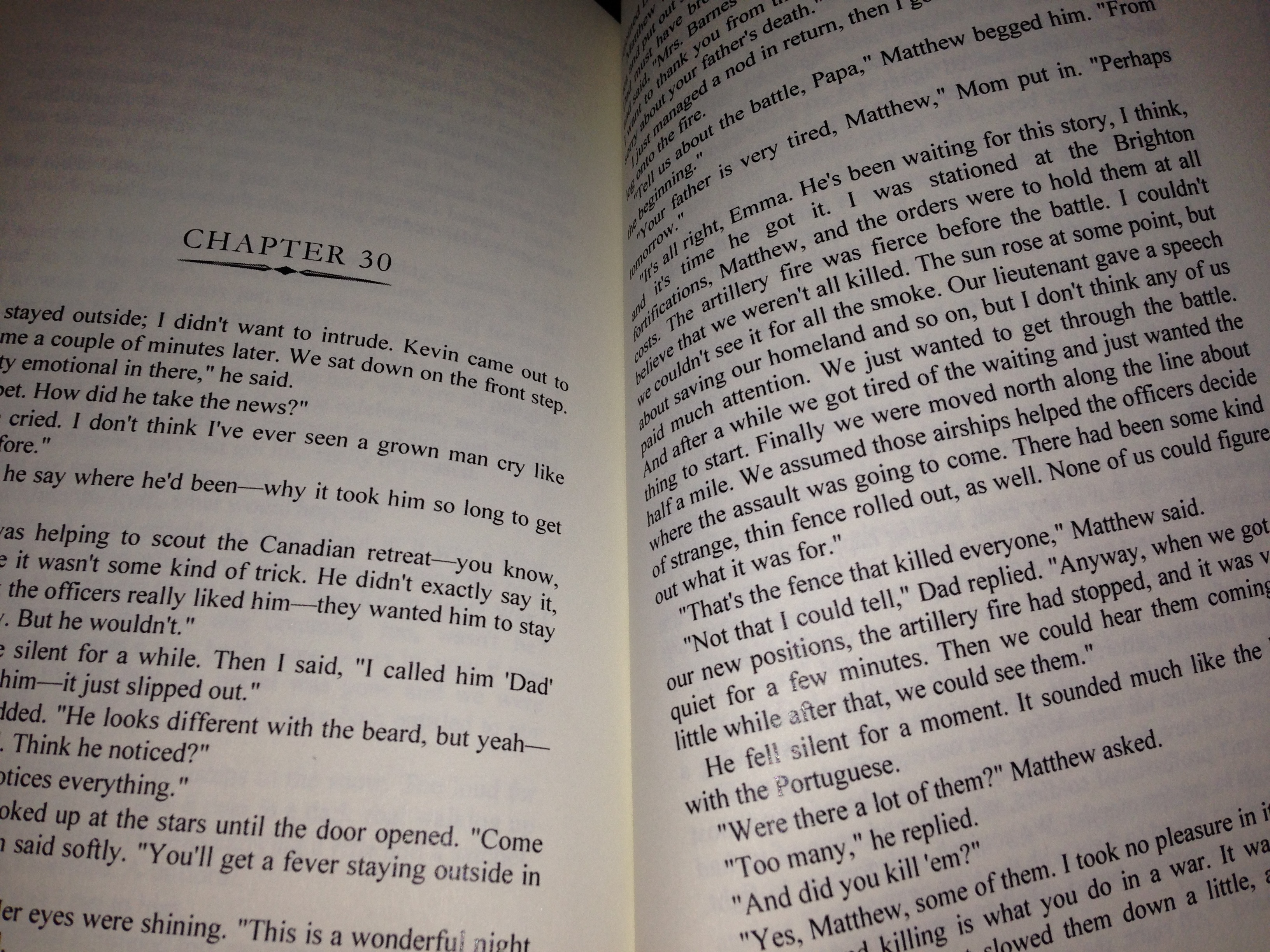 I dunno. Looks just like a real book to me.

This is what the book looks like. For some background, see this post.
Here’s the cover:And the back cover (somehow the angle makes it looks like there are no pages–but there are!):And the inside:I dunno. Looks just like a real book to me.
Jonathan Franzen isn’t sure.
In an article for Guardian Review before the publication of his new book, The Kraus Project, he writes: “In my own little corner of the world, which is to say American fiction, Jeff Bezos of Amazon may not be the antichrist, but he surely looks like one of the four horsemen. Amazon wants a world in which books are either self-published or published by Amazon itself, with readers dependent on Amazon reviews in choosing books, and with authors responsible for their own promotion.”
He goes on to say:
“As fewer and fewer readers are able to find their way, amid all the noise and disappointing books and phony reviews, to the work produced by the new generation of this kind of writer, Amazon is well on its way to making writers into the kind of prospectless workers whom its contractors employ in its warehouses, labouring harder for less and less, with no job security, because the warehouses are situated in places where they’re the only business hiring.”
This is the dystopian vision of Scott Turow and the Author’s Guild, where every move that Amazon makes is greeted as the next step towards the end of literature as we know it. And I just don’t get it. Amazon, and the e-book revolution, have certainly made publication more democratic. It’s now open to anyone, which of course means there will be more junk available. But do these folks really believe that there will be no way for readers to distinguish the good writers from the bad? My novel Senator has a bunch of reviews on Amazon, and the review deemed most helpful by readers also happens to be (in my opinion) the best of the bunch. Read that review, and you’ll get as good a sense of the novel as any newspaper review.
Further, do they really think that, even if Amazon controlled the entire publishing industry, it wouldn’t have an incentive to find and publish great books? And do they really think that Amazon can control the entire publishing industry? Jonathan Franzen is a world-class writer with a large following. If he wanted to bypass Amazon and self-publish on jonathanfranzen.com, he could do it. Or, he could start his own publishing house, giving his imprimatur to the kind of fiction he thinks the world wants; no one is going to stop him, and the barriers to entry are minimal.
I’m also a little baffled by this view that Amazon is destroying the financial prospects of good writers. Writers have no financial prospects! They have never had any financial prospects! If anything, Amazon has opened the doors to a whole class of writers who were shunned by the traditional publishing industry but now at least have a chance at reaching an audience, thanks to the Internet.
Finally, I just want to say that the Red Sox are back in the playoffs thanks to a complete-game victory by John Lackey. And that’s one of those sentences I never thought I’d write.
My publisher changed its mind about “Alternate History“. The primary reason: Amazon uses “Alternative History” as its category for ebooks and “Alternate History” for books. So here is today’s cover:

My friend Kathy (who can’t possibly be old enough to be the parent of a tween) complains that using the word “History” on the cover will turn off kids the age of her son. This is interesting. Publishers feel the need to categorize novels, because readers tend to stick to their favorite genres, and it’s much harder to market a novel if it can’t be fit neatly into a genre. (My first agent gave up on me when I sent him Marlborough Street and he had no idea how to pitch it to publishers. My current publisher decided it was a “psychic thriller,” which I guess is a thing.)
Kathy also queries why the novel isn’t marketed directly to tweens — don’t they have their own category? Yes, they do. But I’m pretty sure adults will enjoy The Portal, and if you market a novel specifically to young adults, you’re not going to get any adults reading it (unless you’re J.K. Rowling). So, I dunno. I’d much rather write the stuff than figure out how to market it.
My e-book publisher has started a Print on Demand (POD) service to go along with its e-book publishing services. I’m going to try it out for Portal.
POD fills a gap in the e-book self-publishing model: some people just prefer a printed book. A guy at work said he’d like to read one of my books, but what he really wanted was an autographed copy. Can’t autograph an e-book. (It seemed kind of weird that a co-worker would want my autograph, but not totally weird. There’s something about a signed copy of a book that makes it special.)
There are two major players in the POD world: CreateSpace and Lightning Source. This article explains the differences in mind-numbing detail and ultimately recommends CreateSpace. My publisher uses Lightning Source. Oh, well. The publisher’s model, as with e-books, is that I pay them a (relatively small) amount of money to do all the prep work. They also handle the ongoing dealings with Lightning Source, in return for a small cut of the royalties. You can eliminate the middleman and do all the work yourself if you use CreateSpace, assuming you have the time and energy; I have neither. Per-unit royalties through my publisher are much lower than they are for e-books, because there’s so much more overhead in creating a printed book. The idea is that most of your revenue would be from e-book sales, but the printed option is there for people who prefer it. I can, of course, buy any number of books at a steep discount, and then sign ’em for my co-workers, give them away to passing strangers, etc.
POD is another blow against the business model of traditional publishing. Time to give it a shot.
The judge has ruled against Apple in the suit that the Justice Department brought against it. Now there’ll be another trial for damages. And Apple has vowed to appeal. So nothing is really decided. But hey, we all know Apple is guilty!
Here is the graphical evidence of what happened to e-book prices when the major publishers, in collusion with Apple, forced Amazon to go to the agency model, thereby ending price competition among e-book vendors:

Prices went up two dollars or more per book overnight. The exceptions were Random House and all the little publishers; none of them were party to the collusion. Thanks, Apple!
I have never paid much attention to Goodreads, but it seems like a fine idea for a web site — a place where readers can go to rate books, swap recommendations, discover what their friends are reading, and so on. So now Amazon has scooped it up, and the Authors Guild isn’t happy. Here‘s Scott Turow, the Guild president:
“Amazon’s acquisition of Goodreads is a textbook example of how modern Internet monopolies can be built,” said Scott Turow, Authors Guild president. “The key is to eliminate or absorb competitors before they pose a serious threat. With its 16 million subscribers, Goodreads could easily have become a competing on-line bookseller, or played a role in directing buyers to a site other than Amazon. Instead, Amazon has scuttled that potential and also squelched what was fast becoming the go-to venue for on-line reviews, attracting far more attention than Amazon for those seeking independent assessment and discussion of books. As those in advertising have long known, the key to driving sales is controlling information.
This seems pretty odd. In what sense did Amazon scuttle the potential for Goodreads to become an online vendor? This was Goodreads’ decision, not Amazon’s. If that wasn’t the direction they wanted to take their business, well, frankly I think they’re pretty smart.
Should we be worried that Amazon will “squelch” Goodreads’ reviews and online community? That would be insane — that’s what Amazon is buying. The more people who go there and talk about books, the more books Amazon will sell.
What Amazon will presumably squelch are links from Goodreads to other booksellers. Goodreads has a “Get a copy” feature that links out to different online vendors, allowing you to go directly from the Goodreads page for a book to the bookseller of your choice. I assume this feature will go away, and you will only be directed to Amazon (as is the case with IMDb, another Amazon subsidiary). How important is that to the Goodreads community? I guess we’ll find out. But if it’s really important, someone will start a new online community; it’s not like the barriers to entry are particularly high. And it’s not like the lack of a link to Barnes & Noble, say, will make it a lot more difficult for a Goodreads user to buy a book from them instead of Amazon. We’re talking about about a couple additional mouseclicks here.
The Authors Guild seems to have a deep fear of Amazon’s potential monopolistic power; they also came out against the Justice Department’s suit against Apple and the major book publishers for (essentially) price fixing. The Guild was arguing that readers should pay higher prices for ebooks to guard against the potential of an Amazon ebook monopoly. I’m not convinced Amazon is the threat the Guild thinks it is. I have no doubt that Amazon would like to corner as much of the online bookselling market as they can; I just don’t see how they can keep other smart, nimble vendors out of that same market.
 Richard Bowker