In which I report on the 24th best English-language novel of the 20th century

That would be Winesburg, Ohio, as determined by the board of the Modern Library. It was recommended by my very fine commenter Col, so how could I go wrong?  (Also, it’s short!)

Let’s make one obvious point right off the bat: If I were the writer whose novel came in at position 101 on the Modern Library’s 100 Best Novels list, I would be lodging a formal complaint with the international governing body of top 100 lists, because Winesburg, Ohio isn’t a novel; it’s a short story cycle.  I have nothing against short story cycles — The Martian Chronicles is a good one — but they bypass problems that novels have to solve — like sustaining a narrative arc, like introducing characters at the appropriate time and developing them in sufficient detail to justify their roles.  No one is going to admire Winesburg, Ohio for its plot, because it ain’t got any.

Sherwood Anderson: Does this guy look happy to you?

What it has are lots of small-town turn-of-the-century characters afflicted with “vague hungers and secret unnamable desires.”  People who go for long walks in the dark and the rain pondering the waste of their lives.  People who dream of leaving and never leave.  People who leave, then return as failures.  People who leave and are never heard of again.  People who long to make a connection with other people, but never quite manage to do connect.  Lots and lots of sexual repression.

What it doesn’t have: Humor.  Warmth.  Happiness, except in fleeting moments. Did I mention that it doesn’t have a plot?  It has recurring characters, especially the young reporter who shows up in most of the stories and (spoiler alert) finally leaves town at the end of the book. But nothing much in the way of character development.

Still, I couldn’t put the book down.  Anderson’s descriptions of small-town life and small-town characters are powerful and often moving.  The stories are mostly pretty short–they make their point, and then move on–so I never felt bogged down.  I have a feeling that some of the stories are going to stay with me.

Ultimately, I think the book gets the high ranking that it does for historical reasons–its themes and style are daring for 1919, and it apparently paved the way for American writers we remember better. Winesburg, Ohio came out early in Anderson’s career, and nothing else he wrote made much of an impression.

So, who should I try next?  Theodore Dreiser?  Sinclair Lewis?  Ford Madox Ford? James T. Farrell?  They’re on the Modern Library’s list, but I haven’t read any of them.

So many good books, so little time.

What it’s like to be a young writer

Yesterday I mentioned the young Harvard writer, Kaavya Viswanathan, who apparently stole material for a YA novel she wrote in the summer after high school.  Here’s what she said in an interview on NBC:

All I can say is that I’ve read both of Megan McCafferty’s books, “Sloppy Firsts” and “Second Helpings” when I was in high school.  I think the first one came out when I was about 14, and I read both those books three or four times each.  I completely see the similarities, I’m not denying that those are there, but I can honestly say that any of those similarities were completely unconscious and unintentional, that while I was reading Megan McCafferty’s books, I must have just internalized her words.  I never, ever intended to deliberately take any of her words.

The Wikipedia article about her novel points out other similarities to other books from other writers.  They’re pretty obvious.  I don’t want to litigate this.  It could be that this was all a calculated attempt to craft a novel that would get her into Harvard and make a name for herself.  Her parents had hired some consulting agency to help with the college admissions process, and it sounds like she had a good bit of assistance, from them and others, in writing, packaging, and marketing the novel.  But I’d like to assume it was something entirely different — that this was a girl who was desperate to become a writer, and was just too young to pull it off by herself.
I’d like to think that because it feels awfully familiar to me.  Like a lot of would-be writers, I suspect, I wanted to become a writer from a very early age.  And, again, like a lot of those would-be writers, I had two major problems:

  • I didn’t know how to write.
  • I didn’t have anything to write about.

As a result, I had to live in other people’s imaginations.  And what a wonderful place that was!  I remember when I was about eleven years old reading a science fiction novel that I couldn’t get out of my head.  So I decided to write my own science fiction novel — in pencil, with my own hand-drawn illustrations.  The plot, as I recall it, was pretty much the same as that of the novel I had read, except that I was the hero.  I don’t think I got more than a few pages into the thing before I abandoned it.  It’s much easier to read than to write.

I got better at writing as I got older, but it was always hard to escape other people’s imaginations — they lived more interesting lives, thought more interesting thoughts, and could express themselves in more interesting ways.  I couldn’t compete.  So when I wrote a short story, it would come out sounding like an adolescent imitation of a Graham Greene short story, or an Isaac Asimov short story, or a Ray Bradbury short story.  What I wrote didn’t sound like me, because I didn’t yet have a sound.

So I can imagine an 18-year-old girl from India desperately wanting to write a novel about her life in America, but I can’t imagine her pulling it off.  Not without channeling all the authors she had read who had helped her make sense of her experiences, who had helped form her imagination.  And maybe what she wrote with the help (conscious or unconscious) of those authors was pretty good: it got her parents excited, it got her college admissions consultants excited, it got her an agent and some assistance in fleshing out her ideas, and before long everything spiraled out of control.  She was no longer just a kid dreaming of becoming a writer; she was a professional.  And that’s when her problems started.

That’s what I’d like to think.

iBooks? My books! ebooks? Free books!

Update: In comments, Jeff provides the magical link to Senator in the iTunes library.  He also reminds me to tell folks to go to the Senator page on Amazon and inform them that you’ve found Senator for a lower price elsewhere.  That’s how a book gets to be free for the Kindle–you can’t just tell Amazon to give it away.

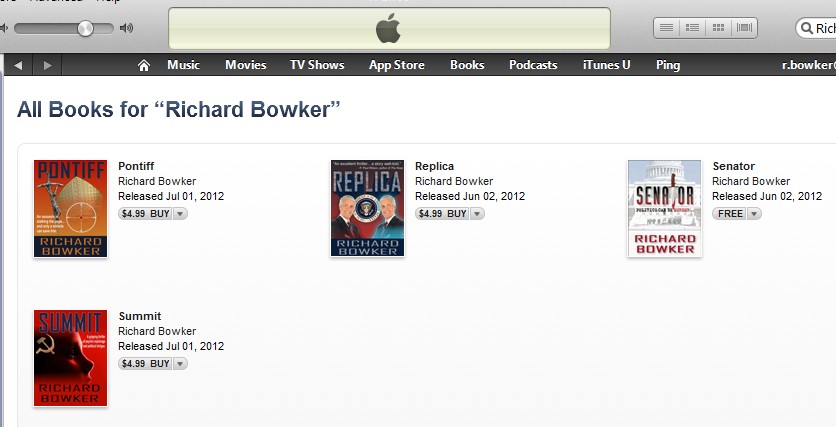
The four novels I have so far released in ebook format are now available on Apple’s iBook store.  Yay!  I don’t know how to link to these guys, but here’s what they look like in iTunes:

Eagle-eyed readers will notice that Senator is free.  That’s right–for a limited time only, it’s available for insanely low price of zero dollars and zero cents.  That’s pretty darn cheap!  At this price, quantities can’t last, so you’d better pick up yours quickly, before Apple runs out.

For those of you who picked up Senator at a higher price, my apologies.  As I noted here, we’ve made some changes to our business model.  I’m using an outside publisher to get my stuff onto sites like iBooks, as well as to goose sales generally.  A standard way to do that is to give a book away and get people hooked so that they’ll buy the others.

Anyway, here is the great (and tragic) Phil Ochs singing his great song “Changes,” just a couple of years before his death.  In a kinder, fairer world, Phil Ochs would have been as long-lived and honored as Dylan.

Happy Bloomsday

…celebrating the travels of Leopold Bloom through Dublin on June 16, 1904.

Here is what Wikipedia has to say about Bloomsday.  I didn’t know that the manuscript of Ulysses resided in Philadelphia. Here is a page from the Circe episode:

Speaking of revisions, Joyce did his share.  I remember seeing a page from the manuscript of Finnegan’s Wake at the British Library, and every single word on it was crossed out.

Here is a great reading of the final lines of Molly Bloom’s soliloquy.  In it, Joyce probably breaks every rule of good writing.  And it doesn’t matter; fiction doesn’t get any better than this: