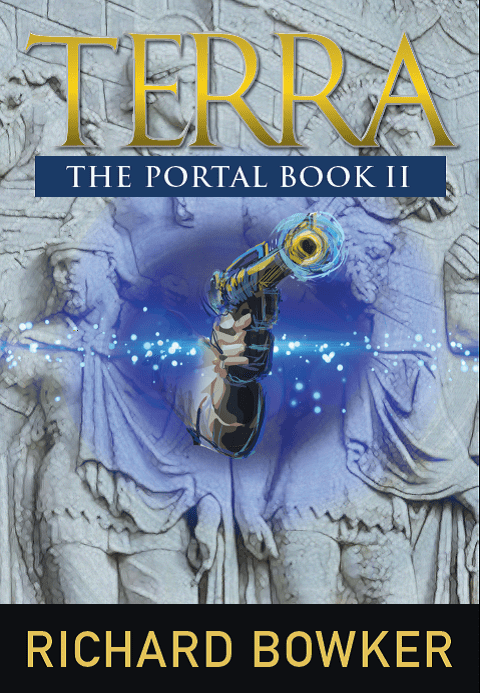
Cover for my new novel

. . . which is called Terra, you will recall.  Subject to further fiddling.  Comments are welcome.  You will notice that we’re looking for a parallel universe vibe here.  What is that ray gun doing against the backdrop of a bas-relief from ancient Rome?  Guess you’ll have to read the novel to find out.

Terra cover

Renowned be thy grave

As today’s Google Doodle will let you know, this is the 400th anniversary of Shakespeare’s death.  The Times today has a clever faux-obituary.

Here is a funeral song he wrote a few years before his death.

Fear no more the heat o’ th’ sun
Nor the furious winter’s rages;
Thou thy worldly task hast done,
Home art gone and ta’en thy wages.
Golden lads and girls all must,
As chimney-sweepers, come to dust.

Fear no more the frown o’ th’ great;
Thou art past the tyrant’s stroke.
Care no more to clothe and eat;
To thee the reed is as the oak.
The sceptre, learning, physic, must
All follow this and come to dust.

Fear no more the lightning flash,
Nor th’ all-dreaded thunder-stone;
Fear no slander, censure rash;
Thou hast finished joy and moan.
All lovers young, all lovers must
Consign to thee and come to dust.

No exorciser harm thee,
Nor no witchcraft charm thee.
Ghost unlaid forbear thee;
Nothing ill come near thee.
Quiet consummation have,
And renowned be thy grave.

As is often the case in Shakespeare’s late romances, the beautiful young woman to whom this song is sung is not in fact dead.  (In real life she wasn’t even a woman, but that’s neither here nor there.)  Shakespeare, of course, isn’t really dead either.  Let’s raise a tankard to him today!

So what’s that new novel of yours about, anyway?

I’m glad you asked.  It’s called Terra — have I mentioned that?  And it’s the follow-up to The Portal.  Here’s the marketing blurb I wrote for it yesterday:

Larry Barnes thinks he’ll never use the portal again.  The strange device that took him to a parallel universe has disappeared, and he is back living his normal life — until one day a beautiful woman appears and begs for his help.  She tells him that the mysterious preacher he met in his travels is in trouble on another world, and only Larry can save him.  Against his better judgment Larry enters the portal with her, and soon he finds himself in a desperate battle against a secret priesthood that wants to kill the preacher – and Larry.  As he struggles to defeat the priests and return home, Larry begins to sense he may have powers that he never dreamed of, and he begins to understand that his fate is inextricably linked to that of the preacher . . . and the portal.

I don’t like these sorts of blurbs; they seem to suck everything that’s interesting or different out of a book in order to fit it comfortably into its genre.  Maybe I can do better.  Should I bring in the many-worlds interpretation of quantum mechanics?  That would probably help sell some copies, don’t you think?

Amy

I saw the Oscar-winning documentary Amy the other day.  It’s the harrowing story of the decline and fall of Amy Winehouse, who managed to put out one great album on her way to an early grave.  I liked the film, but there was about a half hour too much harrow for my taste. And, as a friend of mine said, “We’ve seen this story already, haven’t we?”

Of course we have.  And the story has been even more poignant.  Here is Amy Winehouse singing “Back to Black” live.

The song is pretty good, and her voice is great, but she isn’t much of a performer.  It’s kind of hard to tell that this is supposed to be a sad song.

Now let’s take a look at Janis Joplin singing “Summertime” in Sweden in July 1969.

This performance is not just great; it takes you to a whole other plane of existence.  Could anyone pour more of herself into a song than Janis Joplin?  She was dead 15 months later.

Lie Lady Lie, lie across my big brass bed

Here’s an article about a moderately interesting study showing that people who get upset about grammar errors are, you know, kind of jerks:

Scientists have found that people who constantly get bothered by grammatical errors online have “less agreeable” personalities than those who just let them slide.

And those friends who are super-sensitive to typos on your Facebook page? Psychological testing reveals they’re generally less open, and are also more likely to be judging you for your mistakes than everyone else. In other words, they’re exactly who you thought they were.

So, my wonderful kid is home for Easter, and he says: “I think I’ll go lay down.”  What is a father to do?  Constantly correct your kid’s grammar, and maybe he’ll think “Maybe I’ll lay down somewhere else next Easter.”  Ignore his errors, and you are obviously failing as a parent.  My response was to sort of mutter the correct usage and hope my kid learned something.

Of course, the lay/lie distinction is clearly on its way out.  I just bought a Fitbit.  Good for me!  Here’s a paragraph from the manual:

While it may track stats such as steps and floors when placed in a pocket or backpack, it is most accurate on the wrist. For all-day wear, your Charge HR should usually rest a finger’s width below your wrist bone and lay flat (as you’d normally wear a watch).

Should I worry about Fitbit’s quality control if they let that use of “lay” into their documentation?  Probably not.

Anyway, I’ll give Bob Dylan the final word.  I have a feeling that Dylan knew the difference between “lay” and “lie” perfectly well, but just liked the sound of “lay” better.  Geniuses can do that.

Who doesn’t like MORE busts of Roman emperors?

For some reason, one of my most popular post here was this one showing some busts of Roman emperors from Boston’s Museum of Fine Arts.  I was at the Harvard Art Museums the other day, and guess what?  More busts!

Here’s the Emperor Tiberius:

2016-03-28 13.48.12

He’s not looking all that great, if you ask me.  The accompanying description says the bust was probably sculpted when he was in his early sixties.  Read Tom Holland’s book Dynasty for an interesting discussion of this tortured soul.

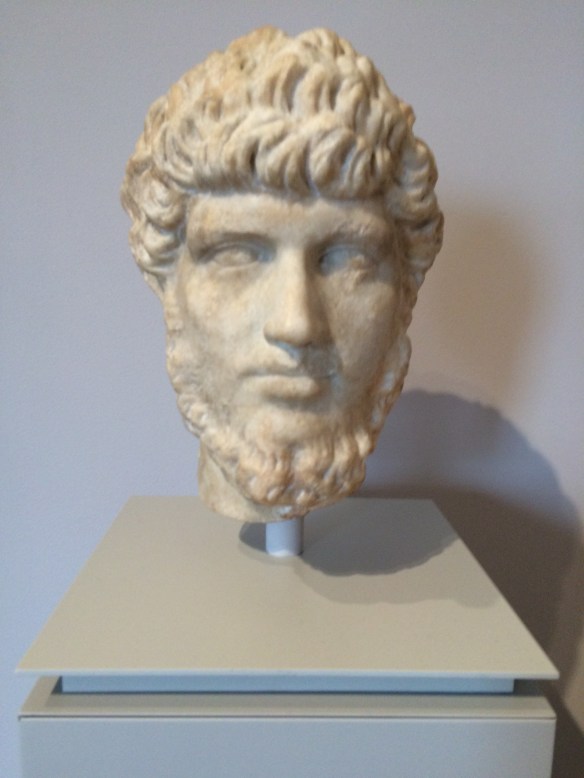
Here is Lucius Verus, who ruled for a while in the second century AD with his adoptive brother Marcus Aurelius.
2016-03-28 13.47.40

Note the beard, which became fashionable for emperors starting with Hadrian earlier in the century.

Finally, here’s a full statue (well, almost full) of the Emperor Trajan:

2016-03-28 13.46.18

The description in the Harvard catalog suggests that he was probably holding a spear in his left hand.

Trajan was one of the best of the Roman emperors.  Wikipedia says:

As an emperor, Trajan’s reputation has endured – he is one of the few rulers whose reputation has survived nineteen centuries. Every new emperor after him was honored by the Senate with the wish felicior Augusto, melior Traiano (that he be “luckier than Augustus and better than Trajan”). Among medieval Christian theologians, Trajan was considered a virtuous pagan. In the Renaissance, Machiavelli, speaking on the advantages of adoptive succession over heredity, mentioned the five successive good emperors “from Nerva to Marcus”[2] – a trope out of which the 18th-century historian Edward Gibbon popularized the notion of the Five Good Emperors, of whom Trajan was the second.[3]

Once you’ve finished reading Dynasty, you should read the wonderful SPQR  by Mary Beard, for a fuller view of a thousand years of ancient Rome.