Unknown's avatar

About Richard Bowker

Author of the Portal series, the Last P.I. series, and other novels

The gig is up

I was intrigued by the Clinton camp’s response to the Times bombshell about Trump’s taxes. One phrase stuck out:

Clinton’s campaign said the report “reveals the colossal nature of Donald Trump’s past business failures” and declared “the gig is up.”

What does that mean: “the gig is up”?  Shouldn’t it be “the jig is up”?  Was the Clinton press team so excited that they misspelled “jig”? (Okay, shouldn’t I be more interested in the future of our nation?)  Google Ngram Viewer shows that “the jig is up” is way more popular, and always has been, although “the gig is up” also shows up occasionally.  But maybe the 2016 campaign will change usage, as with the word denouncement.

Here is a hilariously detailed discussion about jig vs. gig from the CBC.  Just a taste:

Replacing the “j” with a hard “g” (as in “guffaw”) suddenly makes the expression far less familiar, if not actually strange, to the ear and eye.

Musicians have called short-term jobs “gigs” since the early 20th century – especially one-night engagements. But do jobs ever become up? Certainly contracts can be up, which means they’ve expired on a specific date. But gigs?

Although there is no reason we couldn’t start saying “the gig is up” to mean “the gig is over,” the phrase isn’t well established.

“The jig is up,” on the other hand, is cited by lexicographers all over the western hemisphere. Indeed, in his Dictionary of Historical Slang, Eric Partridge points out that “the jig is up” was actually “standard English” until 1850, when it slid down a few notches to colloquial status.

Now that I have that off my chest, I can go back to worrying about our future.
Points of view

Here’s an article from the Times Book Review about the return of the omniscient point of view in fiction:

Most 19th-­century novelists didn’t try to hide their authorial presence. With modernism’s emphasis on the self and the rendering of individual consciousness, omniscience became unfashionable. ­Twentieth-century realists moved closer to their characters and wrote in the first person or limited third.

I have been thinking a lot about point of view lately.  All my novels to date have been told either in the first person or limited third-person (where you can have multiple points of view, but you’re only in one person’s point of view for any one scene).  All of them, that is, until Terra, where ninety percent of the novel is told in the first person, and then in the final chapter I switch to limited third for two different characters.  I worried about doing this, but I did it to set up the next novel in the sequence, Barbarica, which I’m working on now.

Barbarica is structured as a kind of kaleidoscopic limited-third novel — that is, we shift constantly from one point of view to another as the story progresses.  Will this work?  Dunno.  My writing group, which is experiencing this in real time, is getting antsy to see something from the point of view of my original narrator, Larry Barnes.  So, I have finally reached him in the sequence I’ve vaguely laid out, and suddenly I don’t know how to proceed.  Should I go back into his familiar first-person narrative style?  Or should we encounter Larry for the first time in limited third?  I think the decision will be fairly important to the reader’s experience of the story.

So now I’ll end this blog post and make the call.

Writing is hard, by the way.

Terra now available on Kobo, Google Play, iTunes…

For those of you who like to take less-traveled roads, my new novel Terra is now available on Kobo, Google Play, and iTunes.  I’m not sure what’s taking Barnes & Noble so long.

Here’s an article about the market shares of ebook vendors.  iTunes has 11% of the market; Barnes & Noble has 8%; Kobo has 3%; Google Play has 2%; Amazon has almost all the rest.  Oddly, most of my sales come from Barnes & Noble.  I do see a smattering of sales from the other vendors not named Amazon.

I will now start reminding people that customer reviews are the life’s blood of book sales.  So far Terra has none.  I expect that they may be hard to come by, since the novel will be of most interest to folks who have read The Portal.  So it’s all the more urgent for me to browbeat you into both reading and reviewing the thing.

Here’s the plot summary and first chapter.

“Terra” is now available from Amazon!

It took longer than I expected — but Terra is finally here.

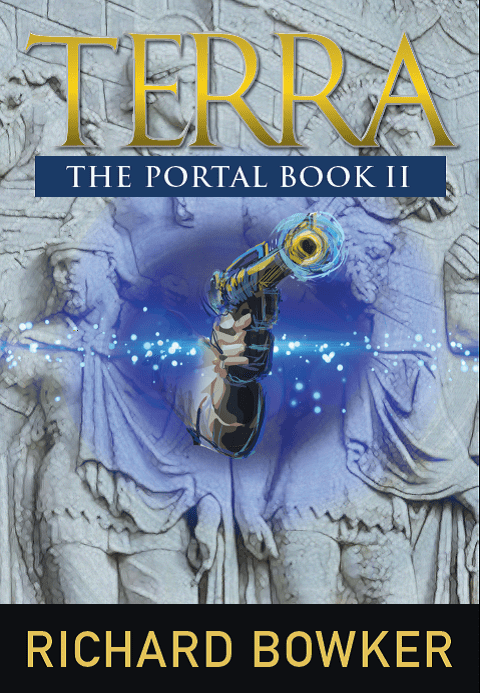
Terra is the sequel to my novel The Portal; it extends and deepens the story of Larry Barnes and the cosmic gateway he has discovered to parallel universes.  Here’s a summary, along with the first chapter.

Terra cover

The ebook will be available on Barnes & Noble and other online vendors before long.  A print version will show up shortly thereafter.

By the way, if you read the marketing description of Terra on Amazon, you’ll notice a reference to the next book in the series, which is called Barbarica.  Don’t hold your breath waiting for it to appear, though; I’m about a quarter of the way through the first draft.

The Girl on the Train; also, chapter titles

Everyone seems to love The Girl on the Train.  It was a number one best seller; it’s being made into a movie; it’s on Obama’s summer vacation reading list.  So fine.  I just read it on my summer vacation.

The first thing I noticed is that the author used the technique I have settled on for my new novel: the point-of-view character is identified at the beginning of each chapter (along with the date and time of day).  I have become a little dubious about this technique since my
writing group reviewed my latest chapters, and Jeff pointed out that I hadn’t correctly established my point-of-view character in one of them.  “But I don’t need to,” I said.  “The point-of-view character is identified in the chapter title.”

“Oh,” Jeff replied.  “I hadn’t noticed that.”

So maybe I need to remove the “Chapter” designation; maybe I need to make the name of the character bigger.  That’s what Paula Hawkins does.  It’s probably all that stands between me and a deal for a major motion picture.

Anyway, her novel is well written and cleverly constructed, but I ended up being pretty disappointed.  Here are the problems I had with it (moderate spoiler alert):

  • I figured out who the murderer was pretty early on.  I kept expecting there would be a further twist, but the twist never came.
  • The critical event in the plot is witnessed by one of the narrators, but she doesn’t remember what happened because she was having an alcoholic blackout.  Or perhaps it didn’t happen.  Or perhaps she remembered it incorrectly.  But finally she remembers it, and that solves the mystery.  Meh.
  • One of the other narrators solves the mystery because the murderer unaccountably holds onto a key piece of evidence against him.  Phooey.
  • The climax is straight out of a Lifetime movie.  Woman finally realizes that the man she loved is really a lying cheating murdering psychopath.  The man comes after her.  Can she summon up the moxie to defeat him?  Ugh.

But really, her chapter titles are pretty good.

Life is stupider than fiction: Trump edition

Here is me complaining about how stupid it was for Mitt Romney’s campaign manager to go public with their plan to “Etch-a-Sketch” his campaign after he won the nomination.

Those were such innocent times!

I find it difficult to imagine Trump as a literary character, because the humorous parts of his character (his absurd vanity, for example) are so hard to reconcile with the incredible damage he could if he somehow managed to get himself elected.  This is real life, unfortunately.

Fiction (the kind of fiction I write, anyway) needs to assume a level of competence in the protagonist — that’s where the tension comes from.  You want a real Russian spy, not the dim-witted dupe that Trump apparently is.  You want a real billionaire who is nefariously turning his attention to politics after mastering the business world, not an unsuccessful huckster.

Trump’s incompetence would be disqualifying in a novel; it should be disqualifying in real life as well.  Too bad reality doesn’t play by the same rules.

We’re hearing a lot of denouncements of Donald Trump lately

But why aren’t they denunciations?

Here’s the sort of thing I’ve noticed, from the Times:

Representative Ben Ray Luján of New Mexico, the chairman of the House Democratic campaign arm, said his party was aiming to ensure that Republicans would be tarnished by Mr. Trump, even if they distanced themselves from him.

“A denouncement of Trump at this point is too little, too late,” Mr. Luján warned.

In another article, I spotted a Times writer using denouncements outside a quotation, but later the word was switched to denunciations in the online version.

Here’s a HuffPo article with denouncement in the headline and denunciation in the subhead.  “Trump’s Denouncements of KKK Leader Don’t Matter Anymore”:

“Anyone with two brain cells to rub together can see the denunciations are not sincere,” said a Southern Poverty Law Center fellow.

Maybe there’s just been a lot of denouncing going on lately.  Or maybe the language is changing, and denounce/denunciation is going the way of repel/repulsion, and the noun/verb pair is becoming similar.  In the case of repel/repulse, Google Ngram Viewer shows us a big uptick in the use of the verb repulse over the past twenty years, although repel is still more frequent.  Denouncement is used about ten times less than denunciation, Google says.  But maybe this campaign will change all that.

The Bad Sex award

The Bad Sex award for 2015 was given out last December.  Guess I missed it.  Here’s an interesting article in The Guardian about it.  The British award is given out for badly written erotic passages in otherwise good novels.  The winner was the singer Morrissey for a ridiculous passage in his novel List of the Lost.  The article makes the point that fear of being nominated for the award may actually be having a beneficial effect on literature, at least in the UK:

Grandees of the English novel are now hardly ever shortlisted because even the likes of Ian McEwan and Howard Jacobson now eschew sexual description, quite possibly in part due to awareness that such scenes could be performed to a baying, champagne-guzzling audience at the In And Out club the following December; and newcomers emerge from their creative writing degrees equally convinced that they’re best avoided.

I find writing a sex scene to be difficult.  Here’s the problem: a sex scene in most novels tends to be important; something major is happening to central characters.  (If they’re not central, why are you showing them having sex?)  Important scenes require vivid writing; you can’t just say: “They went into the bedroom, took their clothes off, and made love.”  So you want to ramp up the prose.  But what can you say about sex that hasn’t already been said?  You start reaching for metaphors, and before you know it you’re heading towards a Bad Sex nomination.

The thing to do, I think, is to focus on the characters’ reactions to what is happening, their emotions, rather than physical description.  Because the characters are what matter, after all; not the sex.  So sex scenes become exercises in characterization, not description.

By the way, Lee Child wants no part of writing sex scenes in his Jack Reacher novels.  He usually summarizes them briefly after the fact.  It had been good, Reacher thought.  It had been very good.  This is actually a good approach for Child.  A very good approach.  I wish he’d use the same approach for exploding brains and the like.

Malcolm Gladwell and the mystery of free-throw shooting

Here’s an interesting podcast in which Malcolm Gladwell confronts one of the fundamental mysteries of Western civilization: Why don’t basketball players shoot free-throws underhanded?  The evidence is incontrovertible that this method produces better outcomes than the overhand method.  And yet almost no one uses it.

This is of particular interest to me because, growing up, shot free-throws underhanded — I guess because my father did.  And I was good!  In the 7th grade, I was elected captain of my gym team, basically because I could shoot free-throws better than anyone else.  But this came to an end when the gym teacher noticed what I was doing and ordered me to cut it out.  So I did.  I was also pretty good shooting overhand, but nowhere near as good as I was underhand; it’s just harder.

Gladwell tells the story in his typical entertaining fashion, focusing on Wilt Chamberlain’s legendary 100-point game, which would never have happened if he hadn’t been going through a phase where he was shooting free throws underhand.  But then later, he changed back to the overhand method he was so bad at, because it made him “feel like a sissy.”  Wilt Chamberlain felt like a sissy!  Gladwell also brings in other standard examples from sports of people who can’t do the right thing even though they know better, like coaches who insist on punting when all the data says they should go for it on fourth down.

But, as usual, Gladwell’s explanation for this is, well, not that interesting, at least to me.  He uses the same theory of “thresholds” that he has also advanced to explain riots and school shootings.  Some people are go-it-aloners who don’t need to feel like they’re part of a crowd; for free-throw shooting, this would be Rick Barry, who didn’t care that no one else shot underhanded.  He knew he was right, and so that’s what he did.  He had a low “threshold”.  Most people have much higher thresholds; they can’t bring themselves to shoot free throws underhand or go for it on fourth down unless everyone else is doing it.  If everyone is doing the wrong thing, they will do the wrong thing–this might be the lesson of the Milgram experiments and others that emphasize the importance of situation in predicting human behavior.

Gladwell may be right; I don’t know.  But I’d have liked him to dig a little deeper.  Why would someone like Wilt Chamberlain feel compelled to be a conformist when it came to free-throw shooting, despite being as out of the ordinary as one could imagine in so many other ways?  What causes someone to have a different threshold?  No explanation is given.