Unknown's avatar

About Richard Bowker

Author of the Portal series, the Last P.I. series, and other novels

Spotlight

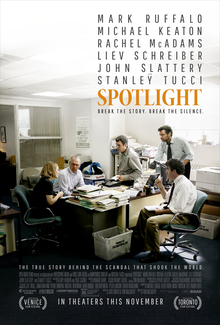
Spotlight is the new movie about the Boston Globe’s expose of the the Boston Archdiocese’s coverup of extensive child abuse by its priests.  It expanded to wide distribution this weekend, and it seems to be doing reasonably well, if the near-sellout showing I attended on a Sunday afternoon in my little town is any indication.  That’s good, because every Catholic in America should see this movie (and everyone else should see it as well, if they want to see a great movie).

Of course, my little town has reason to be interested in the movie — an ex-pastor of one of its two Catholic churches (the church where my kids had their First Communion) is now serving life in prison for molesting little boys.  It happened here, but it also happened pretty much everywhere, in the Archdiocese of Boston and around the world.  (The movie ends by showing a seemingly endless list of the places where abuse by Catholic priests has been uncovered since the Globe broke the story.)

It also happened at the high school I attended. B.C. High. (My brothers and one of my sons also went there.) B.C. High figures prominently in the movie even though, as a Jesuit institution, it was at most a sidebar to the main story of the institutional failings of the Boston Archdiocese.  The main character, Michael Keaton, attended the school, and it’s right across the street from the Globe–that’s probably why they wanted to feature it, even though, by all accounts, the Jesuits handled their scandal far better than Cardinal Law.  The scene that takes place at B.C. High is almost ridiculously person to me.  The B.C. High principal portrayed was still the principal when my son attended the school.  Paul Guilfoyle, the actor who plays an archdiocesan big-wig in the scene, went to B.C. High with me, and I acted in a couple of plays with him; he’s had a nice Hollywood career as a character actor.  (It’s interesting and sad that another character in that scene, a B.C. High trustee named Jack Dunn, is devastated by his portrayal in the movie–apparently it didn’t get everything right.)

One thing the movie brought back to me was how soon after 9/11 the Globe broke this story–its reporters were pulled off the investigation to join in the 9/11 coverage; they then refocused on the story and published it in January 2002.  In retrospect, this was a watershed moment for religion in America; it certainly was a watershed moment for me.  You could no longer believe (or pretend to believe) that religion was primarily a force for good in the world; you could no longer be a cultural Catholic who went to Mass occasionally without worrying too much about the consequences of the Church’s beliefs and institutional practices.  The Church has done little since the story broke to change my mind.

One of many things the movie gets right, I think, is to not oversell the heroism of the intrepid Globe reporters and editors.  This story had been sitting under the Globe’s nose for literally decades, and somehow it never paid attention.  But at least the Globe finally did; and at least we now have a movie that does the story justice.

About Amman

I keep meaning to post about my recent trip to Jordan.  Let’s start with Amman.

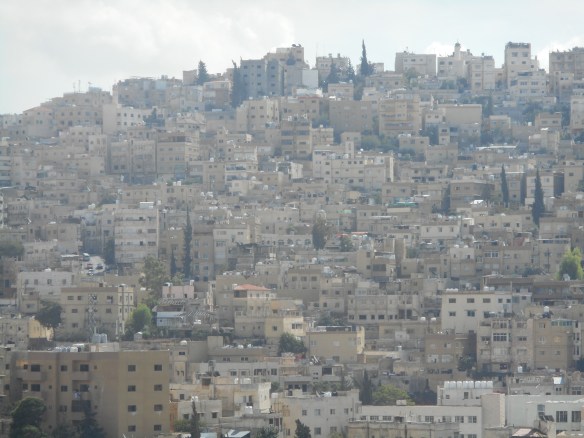
Here is Amman, viewed from the Amman Citadel:
DSCN0021

It’s build on a series of hills, and it’s overwhelmingly monochromatic–just shades of gray and brown.

Here’s the Temple of Hercules on the Citadel, which is the primary tourist attraction in the city:

DSCN0027

Here’s my favorite photo from the Citadel: fingers from a massive Roman statue (presumably of Hercules):

DSCN0032

While we were on the Citadel we heard the noontime call to prayer being broadcast from some mosque.  Then we heard it from some other mosque.  My son didn’t know how that works–shouldn’t they be synchronized somehow?

Here’s the Roman amphitheater, viewed from the Citadel:

DSCN0022

It’s still in use.

The traffic in Amman is awful.  My son drove us everywhere, and he was great, but this place makes Boston drivers look like they’re from the Midwest.  Those hills are filled with narrow side streets, and the major streets are connected by a series of “rings” (that is, roundabouts or rotaries), and if the drivers were observing any rules on those rings, I didn’t notice them.  One cultural item: if you stop to let a pedestrian cross the street, he puts his hand over his heart as a sign of thanks.  That was sweet.

Here’s the street where my son lives:

2015-10-31 13.07.58

There are lots of Western chain stores in Amman — Popeye’s, Hardees, Starbucks.  And there are lots of chain-store wannabes.  There is a local chain of donut stores that uses the orange and pink color scheme of Dunkin’ Donuts.  I didn’t see a Dollar Rent-a-Car, but I saw a Dinar Rent-a-Car. Here is a faux Stop ‘n Shop in my son’s neighborhood:

DSCN0265

It can feel pretty Western, until suddenly it doesn’t.  For example:

  • People smoke hookahs in restaurants after dinner.  This looked pretty civilized to me, actually.
  • Toilet paper in some places seems to be, er optional.  That does not seem civilized to me.
  • No one neuters their pets, so there are lots of stray cats roaming the streets.
  • I’d say about a third to a half of women wear non-Western styles of dress, from headscarves to (some) burkas.
  • I saw several old men sitting by the side of the road selling lottery tickets.  This is not a wealthy country.

The thing I missed most while I was there was grass–I’d even have appreciated weeds in a vacant lot (and there were plenty of vacant lots).  There just wasn’t any.

The people were unfailingly delightful.

Randall Munroe goes all Up Goer 5 on us

I’m a big fan of Randall Munroe and his xkcd strip.  I’m also a big fan of Up Goer 5.  So it was really nice of him to write a whole book called Thing Explainer in Up Goer 5, which is coming out next Tuesday.

If you can’t wait, he has an excerpt in the New Yorker. Here’s how it starts:

There once was a doctor with cool white hair. He was well known because he came up with some important ideas. He didn’t grow the cool hair until after he was done figuring that stuff out, but by the time everyone realized how good his ideas were, he had grown the hair, so that’s how everyone pictures him. He was so good at coming up with ideas that we use his name to mean “someone who’s good at thinking.”


I’m going to figure my plot out next Saturday at noon

I was listening to an interview with the prolific British historical novelist Bernard Cornwell (who, oddly, lives on Cape Cod, not that far from my little South Shore town).  In it, he said that he doesn’t plot out his books ahead of time, although he wished he could.  He recalled that he recently had to finish his latest novel before catching a plane the next day (presumably because of a deadline), but he had no idea how it was supposed to end.  So he got up at three in the morning, the ending came to him, and he finished the book by noon, in time for him to catch his flight.

This is odd, but somehow that’s the way it often works.  I have been noodling about a plot problem in my latest novel for a while now.  Something hadn’t worked in the first draft, but I didn’t know how to fix it.  Earlier this week I reached the point in the second draft where I had to figure this out.  I had non-writing stuff to do for a few days, and my next writing session was going to be Saturday at noon.  So I sat down on Saturday, mulled things over for a while, and the new plot-line came to me.  Right on schedule.

Writing fiction doesn’t always work that way, but life is much more pleasant when it does.

New header image

I have moved on from Hokusai as the header image at the top of this site and now have a photo of Wadi Rum, the remote Jordanian spot where they filmed The Martian.  (I happened to be in Jordan last week, which accounts for the light posting recently.)

Here’s the uncropped photo:

DSCN0130

Where did Homer get his MFA?

Homer and I go way back — all the way to the summer before my senior year in high school, when one evening a week I would drive to Dorchester and translate the Odyssey while dripping sweat onto the ancient text.

I’ve lost all my knowledge of ancient Greek in the intervening years, but I feel the need to reacquaint myself with Homer every once in a while.  Most recently, I listened to an audio version of the Iliad narrated by Dan Stevens.  Listening to this ancient epic while fighting traffic on Interstate 93 isn’t perhaps the ideal way of encountering Homer, but it’s the best I can do nowadays.  A few brief comments:

  • Dan Stevens is pretty good!  He obviously made the right career decision by quitting Downton Abbey for the lucrative business of narrating epic poems.
  • It’s amazing how modern some of the narrative structure is — for example, Homer needs a scene that shows Hector’s wife Andromache mourning his death.  But the sceone won’t work unless he has a previous scene establishing their love.  And that’s exactly what he has–a set up, and then a while later, the payoff.
  • On the other hand, he must have been absent the day his MFA program went over the rules for naming characters.  The Iliad, of course, features two major characters with the same name: Ajax. So Homer has to put his Homeric epithets into overdrive to ensure that we know which one he’s talking about. (Someone mentioned to me that some people point to this as evidence that these were real people–even back then, no one would be stupid enough to give two made-up characters the same name.)  Also, of course, multiple characters have more than one name.  Thanks a lot!  Generally, although not always, the alternative name is just a patronymic; even so, this doesn’t help us follow the action.  Similarly, Homer doesn’t bother to call the Greeks “Greeks”; instead they are Argives or Achaeans or Danaans.  (And Troy is randomly referred to as Ilion.) That is also really helpful.
  • The gods are hugely present in the Iliad, and are generally speaking much more entertaining than our current crop of deities.  The Zeus/Hera squabbling never gets old.  Here is a photo of grey-eyed Athena from the Museum of Fine Arts:

2015-08-09 12.38.24

  • On the other hand, I have never been happy with how much the gods motivate the action.  It’s never the case the one side does well because somebody has a good plan; or, if he does have a plan, it’s because a god put him in mind of it.  This is the sort of thing that Julian Jaynes points to in everyone’s favorite bookThe Origins of Consciousness in the Breakdown of the Bicameral Mind, as evidence that back in those days people weren’t conscious in the way we are today; instead, they heard voices in their minds that they interpreted as being the gods.
  • Finally, after all these years, I still prefer the Odyssey to the Iliad.  I ultimately find the incessant battle scenes repetitive and a bit exhausting.  Along with the rest of the Argives and Achaeans and Danaans, I just want Achilles to get over himself and come back and win the damn war.