Unknown's avatar

About Richard Bowker

Author of the Portal series, the Last P.I. series, and other novels

Eternity’s End

My friend Jeff Carver has been running a highly successful BookBub promotion of his epic Nebula-nominated science-fiction novel Eternity’s End. Only 99 cents!  But hurry–this is the sale’s final weekend!

Here’s the star-spanning description:

The Flying Dutchman of the stars! Rigger and star pilot Renwald Legroeder undertakes a search for the legendary ghost ship Impris—and her passengers and crew—whose fate is entwined with interstellar piracy, quantum defects in space-time, galactic coverup conspiracies, and deep-cyber romance. A stand-alone Star Rigger novel, and an excellent starting point for readers new to the Star Rigger Universe. A Nebula Award finalist, from the author of The Chaos Chronicles.

I have always wanted to write novels about interstellar piracy, quantum defects in space-time, galactic coverup conspiracies, and deep-cyber romance.  But somehow Jeff always beats me to it.

I’m still Charlie

I’ve changed back to my regular header image, but je suis encore Charlie.

I’ve seen some people (like David Brooks and Glenn Greenwald) complain that the Charlie Hebdo cartoons were stupid, racist, and unfunny, and where was the outrage when someone or other published published an anti-Semitic cartoon?  This seems to me to miss the point.

A few years ago an atheist science blogger, P.Z. Myers, got hold of a Eucharist.  He dithered about what to do with it for while, and then finally he threw it in the trash with torn-up copies of the Koran and The God Delusion.  This was a childish stunt designed to make an obvious point.  But if he had been murdered by an enraged Catholic or Muslim (or, I suppose, Richard Dawkins), it changes from being a childish stunt to a fundamental issue of what we should be allowed to do and say in our society.  Most of us don’t go out of our way to offend people, but we need to stand up for people’s right to be offensive.

Je Suis Charlie

That new header image up there is probably pretty pointless, but you have to do something, don’t you?

Here’s the image everyone is sharing:

(It’s apparently not by Banksy.)

And here’s a good piece by Ross Douthat (of all people):

In a different context, a context where the cartoons and other provocations only inspired angry press releases and furious blog comments, I might sympathize with the FT’s Tony Barber when he writes that publications like Hebdo “purport to strike a blow for freedom when they provoke Muslims, but are actually just being stupid.” (If all you have to fear is a religious group’s fax machine, what you’re doing might not be as truth-to-power-ish as you think.) But if publishing something might get you slaughtered and you publish it anyway, by definition you are striking a blow for freedom, and that’s precisely the context when you need your fellow citizens to set aside their squeamishness and rise to your defense.

Goya and more

We visited the massive, crowded Goya exhibit at Boston’s Museum of Fine Arts yesterday.  What’s amazing about Goya is the prodigality and variety of his output–everything from standard portraits of royalty to antiwar prints to pure weirdness.  I couldn’t take photos, but here are some images that stuck with me.  First, an allegory of time:

Here’s the lovely Duchess of Alba (pointing to the ground, where “solo Goya” is written–Goya alone could have painted this: And here’s the luminous “Last Communion of Saint Joseph of Calasanz”:


The reproduction, alas, doesn’t give you any sense of the size and power of the image (in particular, it cuts off the celestial light shining down out of the endless black space about the scene).

Since I had my iPhone with me, I took a photo of an MFA favorite: “Boston Common at Twilight” by Childe Hassam:

2015-01-02 15.03.17
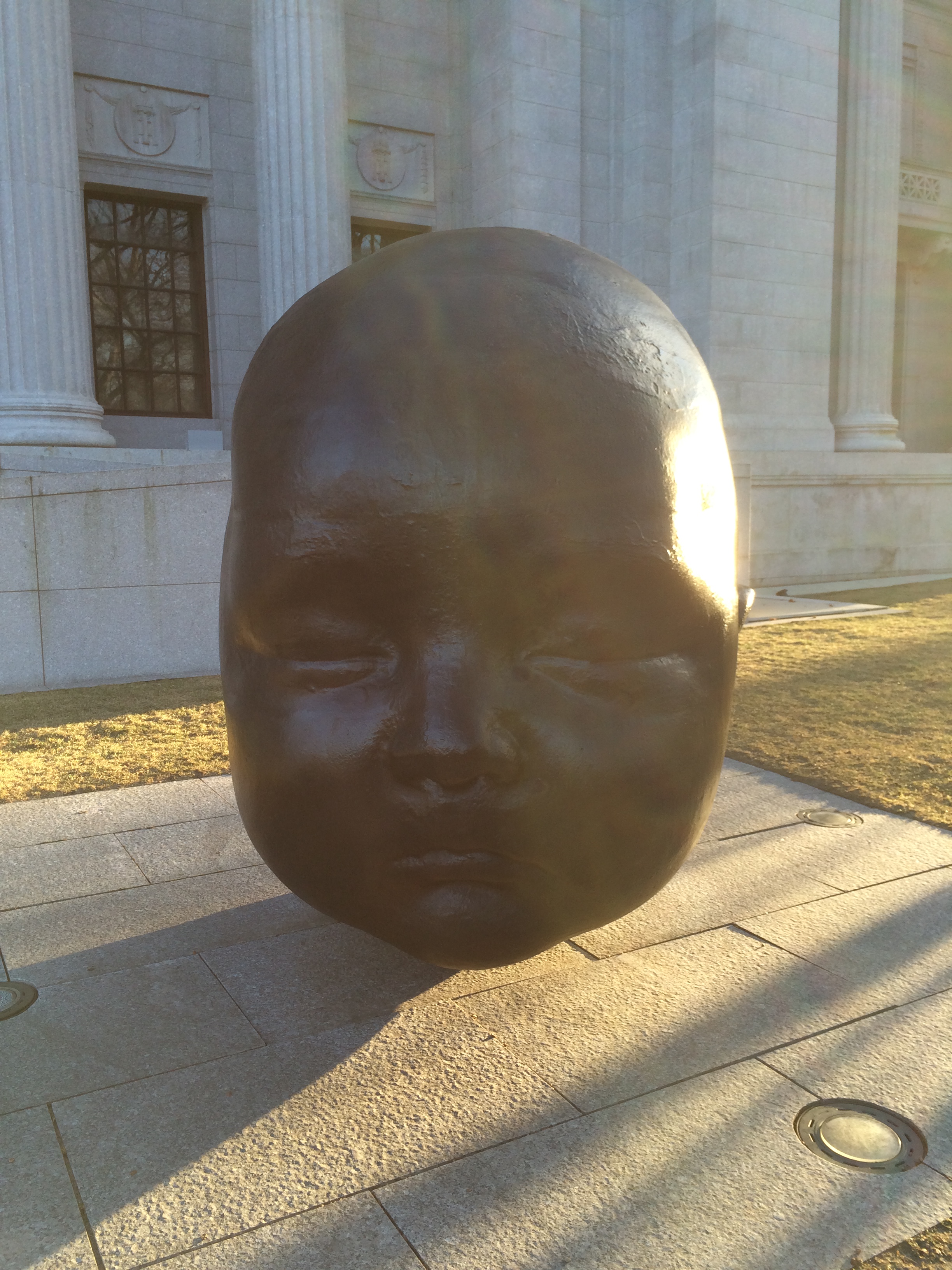
And here’s one of a pair of weird sculptures now displayed at either side of the museum’s Fenway entrance.  They’re called Night and Day and they’re by a contemporary Spanish painter. This one, with her eyes closed, is night:

2015-01-02 15.27.58

The hardest thing about writing fiction…

. . . is transitions.

I have spent most of the day getting my characters from one place to another.  They were doing something interesting in the place they left.  I am confident that they’ll do something even more interesting when they arrive at their destination.  There’s really not a whole lot to say about the journey, though.  You can’t just say, “After a dull journey they arrived where they were going.”  But you don’t want to go on for too long about what they saw and heard and thought about and felt during the journey, because none of that really matters.  You have to right-size the thing.

I’m exhausted.

High standards in publishing

Here’s a passage from Kurt Vonnegut’s first novel, Player Piano (1952), which imagines a world in which managers and engineers run the world.  A woman is explaining why she has become a prostitute.  Turns out her husband is an unsuccessful novelist.  In this world, all novels are reviewed by the National Council of Arts and Letters.

“Anyway,” said the girl, “my husband’s book was rejected by the Council.”

“Badly written,”  said Halyard primly.  “The standards are high.”

“Beautifully written,” she said patiently.  “But it was 27 pages longer than the maximum length, its readability quotient was 26.3, and–”

“No club will touch anything with an R.Q. above 17,” explained Halyard.

“And,” the girl continued, “it had an antimachine theme.”

Halyard’s eyebrows arched high.  “Well!  I should hope they wouldn’t print it!  What on earth does he think he’s doing?  Good lord, he’s lucky if he isn’t behind bars, inciting to advocate the commission of sabotage like that…”

The writer is ordered to go into public relations rather than fiction-writing, and he refuses.

“This husband of yours, he’d rather have his wife a– Rather, have her–” Halyard cleared his throat “–than go into public relations?”

“I’m proud to say,” said the girl, “that he’s one of the few men on earth with a little self-respect left.”

This comes to mind when reading this story, about Amazon removing a novel from sale because it had too many hyphens:

“When they ran an automated spell check against the manuscript they found that over 100 words in the 90,000-word novel contained that dreaded little line,” he says. “This, apparently ‘significantly impacts the readability of your book’ and, as a result, ‘We have suppressed the book because of the combined impact to customers.’”

Reynolds complained, pointing out “that the use of a hyphen to join two words together was perfectly valid in the English language”, and says he was told by Amazon: “As quality issues with your book negatively affect the reading experience, we have removed your title from sale until these issues are corrected … Once you correct hyphenated words, please republish your book and make it available for sale.”

This article treats the issue humorously, but it does play into the doomsday predictions of writers like Ursula K. LeGuin that Amazon is aiming to control who and what we can read. After all, if they can control the number of hyphens in a novel, can’t they control its readability quotient?

Well, sure. But the difference between our world and Vonnegut’s is that Amazon has competition (at least, so far) and will respond to a public outcry (again, so far).  I can imagine a world where this would be different, but that dystopian future is not here yet.

(By the way, I found Player Piano much less compelling than it was when I first read it.  Vonnegut hadn’t quite found his voice yet.)

“I Feel Fine” is 50!

Yesterday we pondered the genius of John Donne.  Today we honor another British genius, John Lennon.  Fifty years ago this week “I Feel Fine” was the number one song in the US.  Seems like only yesterday.

Donne was a great poet, but it clearly never occurred to him to add guitar feedback to a rock-and-roll song.  It fell to Lennon to come up with this idea three centuries later.

A Nocturnal Upon Saint Lucy’s Day, Being the Shortest Day

Saint Lucy’s Day is December 13, which used to coincide with the Winter Solstice.  “Lucy” is derived from the Latin word for light, and Saint Lucy’s Day is celebrated as a festival of light in Scandinavian countries.. Here is John Donne’s great poem about dark and light, loss and love, death and rebirth.

‘Tis the year’s midnight, and it is the day’s,
Lucy’s, who scarce seven hours herself unmasks;
The sun is spent, and now his flasks
Send forth light squibs, no constant rays;
The world’s whole sap is sunk;
The general balm th’ hydroptic earth hath drunk,
Whither, as to the bed’s-feet, life is shrunk,
Dead and interr’d; yet all these seem to laugh,
Compared with me, who am their epitaph.

Study me then, you who shall lovers be
At the next world, that is, at the next spring;
For I am every dead thing,
In whom Love wrought new alchemy.
For his art did express
A quintessence even from nothingness,
From dull privations, and lean emptiness;
He ruin’d me, and I am re-begot
Of absence, darkness, death—things which are not.

All others, from all things, draw all that’s good,
Life, soul, form, spirit, whence they being have;
I, by Love’s limbec, am the grave
Of all, that’s nothing. Oft a flood
Have we two wept, and so
Drown’d the whole world, us two; oft did we grow,
To be two chaoses, when we did show
Care to aught else; and often absences
Withdrew our souls, and made us carcasses.

But I am by her death—which word wrongs her—
Of the first nothing the elixir grown;
Were I a man, that I were one
I needs must know; I should prefer,
If I were any beast,
Some ends, some means ; yea plants, yea stones detest,
And love; all, all some properties invest.
If I an ordinary nothing were,
As shadow, a light, and body must be here.

But I am none; nor will my sun renew.
You lovers, for whose sake the lesser sun
At this time to the Goat is run
To fetch new lust, and give it you,
Enjoy your summer all,
Since she enjoys her long night’s festival.
Let me prepare towards her, and let me call
This hour her vigil, and her eve, since this
Both the year’s and the day’s deep midnight is.