Unknown's avatar

About Richard Bowker

Author of the Portal series, the Last P.I. series, and other novels

Keep it short, except when it needs to be long

Here’s a New York Times op-ed that spends 800 words or so extolling the virtues of brevity when it comes to writing.  Except, of course, the author doesn’t really mean that.  It’s only towards the end that he quotes from Strunk and White, who say what he really means:

Vigorous writing is concise. A sentence should contain no unnecessary words, a paragraph no unnecessary sentences, for the same reason that a drawing should have no unnecessary lines and a machine no unnecessary parts. This requires not that the writer make all his sentences short, or that he avoid all detail and treat his subjects only in outline, but that every word tell.

Got it.  Now, why did we need the other 700 words?

This comes to mind when reading this listicle from The American Scholar listing the “ten best sentences,” which presumably boils down to “ten sentences that the editors really like.”  Many of them are decidedly not short, like this one from Nicholas Nickleby:

There are many pleasant fictions of the law in constant operation, but there is not one so pleasant or practically humorous as that which supposes every man to be of equal value in its impartial eye, and the benefits of all laws to be equally attainable by all men, without the smallest reference to the furniture of their pockets.

But here is a brief beauty from Lolita:

There is nothing more atrociously cruel than an adored child.

And in the comments someone mentions one of my favorites — this classic from Ring Lardner:

“Shut up,” he explained.

Every word tells.

What does Barnes & Noble know about me?

I occasionally look at a liberal-leaning website called Talking Points Memo. It displays ads in the right column of their web page.  One of them is for Barnes & Noble, and it features four books I might be interested in buying from http://www.bn.com.  Today, three of them were thrillers or mysteries by authors II’d never heard of.  The fourth was The Portal, an alternative history novel by Richard Bowker.  Hey, that’s me!

So, how is B&N figuring out what books to display in the ad?  They could be looking at my sales history, but that would tell them I have already bought The Portal from them. (I know that sounds pitiful, but I wanted to goose the novel’s sales rank when it first came out; I promise I won’t do it again.)  Surely that should factor into their algorithm.  Are they tracking which pages I visit on their web site?  But I have never gone anywhere near the other authors whose books they want me to buy.  Is my publisher paying B&N to improve the book’s ad placement generally?  If so, they didn’t bother to tell me.

I find it very mysterious.

Writing as an act of faith

My friend Jeff Carver has a nice post up about writing as an act of faith, and how that faith was unexpectedly rewarded for him the other night.

As he says, writing is an act of faith almost by definition.  Maybe hubris is a better word — you have to think: I have the talent and the resolve to bleed out 70,00 words that will entertain and maybe also uplift and inspire a host of unknown readers.  (Actually, for Jeff it’s more like 200,000 words.)  And, of course, you have to be prepared for your faith to be shaken when you read your first draft.

I have one quibble with his post.  He is working on his second draft in front of a roaring fire at a secluded B&B on Cape Cod.  Frankly, anyone can write a frickin’ novel sitting in front of a roaring fire at a secluded B&B on Cape Cod.  Real authors write their novels while police are shooting at bank robbers outside their windows.  Let’s see him try that!

Writers in movies: Young Cassidy

In honor of Saint Patrick’s Day, here’s an Irish writer in this occasional series. This time it’s Young Cassidy, the 1965 biopic of Irish playwright Sean O’Casey starring Rod Taylor, Maggie Smith, and Julie Christie.

As you can see from the poster, the movie doesn’t emphasize his writing. OK, it doesn’t mention it at all.  But boy, do we get an idea of what his soaring male senses are up to.The writing does show up in the actual movie, of course.  But they aren’t able to do much with it.  We just get a peek at him now and then staring with grim determination at a blank sheet of paper or a typewriter, in between his brawls and his romances.  (The young, gorgeous Julie Christie only has a few couple of scenes, but she makes, um, quite an impression.)

The movie really isn’t very good — and it was a flop at the box office.  Mostly it’s just a bunch of more or less disconnected episodes from O’Casey’s autobiography, never building to much of anything.  But we do see Rod Taylor betraying his best friend by making him a character in The Plough and the Stars — that’s a nice writerly touch.  And (spoiler alert) the ever-faithful Maggie Smith finally dumps him, realizing she isn’t cut out to be the wife of a famous writer.  Another nice touch.

Anyway, if you want to experience more of Rod Taylor’s soaring male senses, here is the the trailer (assuming I can get the embedding to work):

Weekend in Vermont: giant jellyfish in the trees, Irish music, and breakfast with the beautiful people

Here are the jellyfish, in Burlington City Hall Park.  Why they are there, I haven’t a clue.2014-03-15 15.05.54The Irish music was provided by Danu at the Flynn Theater.  Here they are, singing a gorgeous ballad they also performed at the Flynn:

http://www.youtube.com/watch?v=JTsBb-pXJ_0

(This video isn’t embedding–sorry. WordPress is letting me down.)

They were great.

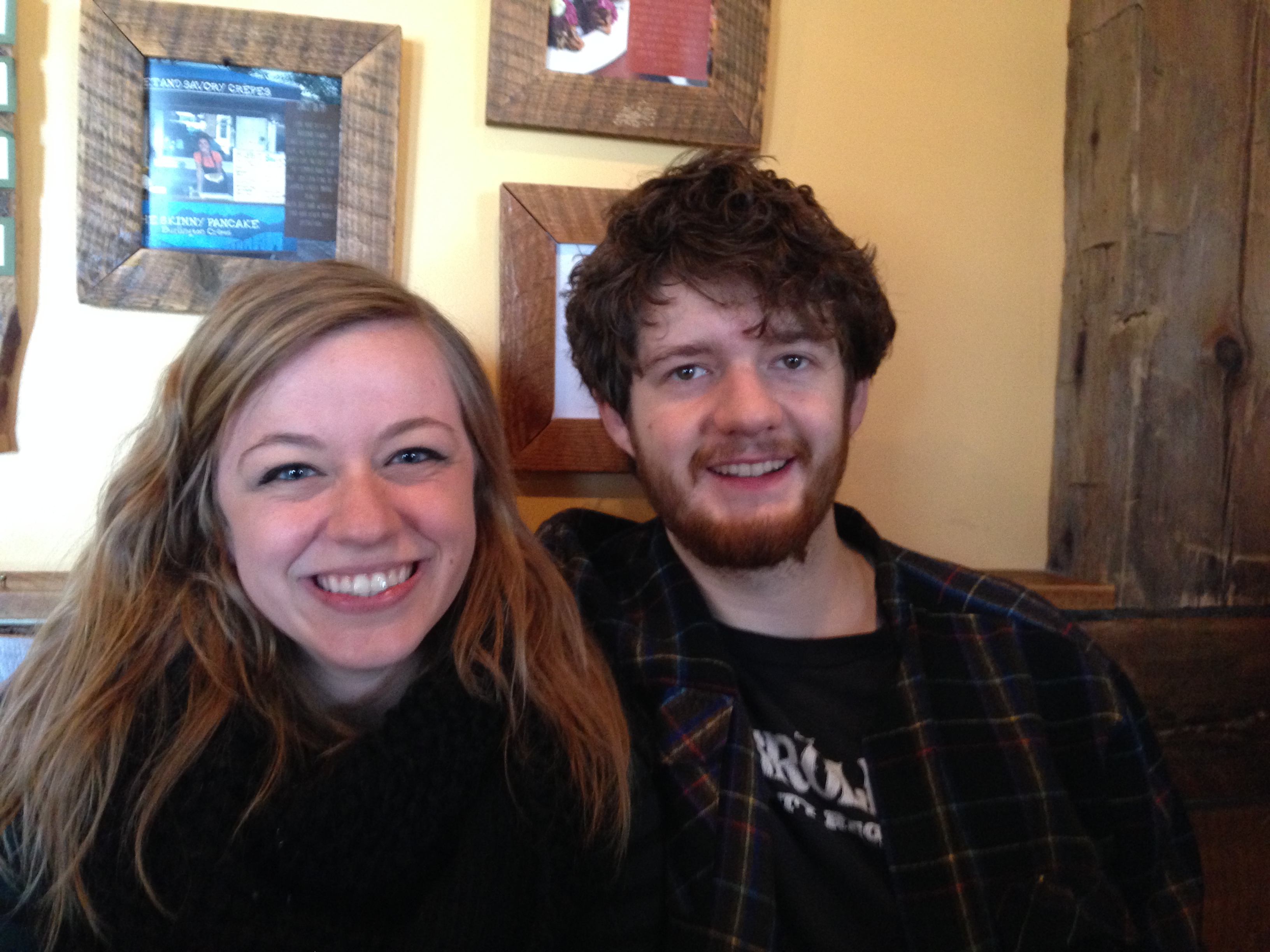
And here are the beautiful people, at the Skinny Pancake on Lake Champlain:2014-03-16 11.11.37Well, maybe the guy on the right could use a haircut.

What a difference 97 years makes!

Back in 1917 Arab forces, including British Colonel T. E. Lawrence, defeated the Ottomans in a surprise land-based attack on the sleepy port town of Aqaba.  The battle probably looked nothing like this:

https://www.youtube.com/watch?feature=player_detailpage&v=lChJz2DSpsE

Today my son called me from his hotel room in the bustling resort city of Aqaba to give an exhilarated, sleep-deprived account of his participation in the “Dead2Red” relay race from the Dead Sea to the Red Sea in Jordan.  The distance is about 240 kilometers, and his segments of the race amounted to the equivalent of about a half-marathon.  He was particularly pleased that he and his team of college study-abroad students overtook a U.N. team in the final few kilometers inside the city.

Should this give us all hope for the future of humanity?  Let’s check back in another 97 years.

Did I write that paragraph? Really?

I read my first drafts so you don’t have to.  Those paragraphs I wrote last year seemed like a good idea at the time.  But now that I’m starting in on my second draft and have a much clearer sense of the characters and the story, much of what I had to say then seems at best unfocused and sometimes, well, just plain bad.

But not to worry!  It’s getting better day by day.  And before you know it, it’ll be perfect!

Writers in movies: Stuck in Love

Another in a random series.

Stuck in Love is a pleasant indie movie from 2012 starring Greg Kinnear and Jennifer Connelly.  Here’s the IMDB summary:

An acclaimed writer, his ex-wife, and their teenaged children come to terms with the complexities of love in all its forms over the course of one tumultuous year.

What the summary leaves out is that both the kids are writers (or would-be writers) as well — the father (Kinnear) is determined to make them novelists like him.  So we’re given a whole family full of writers, which is a recipe for dysfunction and angst if I ever heard one.

The writer/director, Josh Boone, drops quotes from Raymond Carver and Flannery O’Connor into the script and clearly has a sympathetic sense of the writing life.  Here’s something he gets right: The movie begins with Kinnear preparing Thanksgiving dinner for his son, who is in high school, and daughter, who home from college.  At dinner the daughter drops the news that her novel has been accepted by a major publisher.  The predictable result is that dinner is ruined.  The father is upset that she abandoned the novel he has helped edit and written an entirely different book over the summer; the brother is so jealous of her success that he can’t be at the same table with her.  Writers are just awful!

Here’s what Boone gets wrong: The daughter writes a novel over the summer, sends it to her agent, who submits it anonymously and gets it accepted by a major publisher, and page proofs are ready by Thanksgiving?  Really?  In what universe?  (I’m into the fifteenth month of working on my current novel, so I may be feeling especially grumpy about this part.)

The father has written two successful literary novels, but has had writer’s block since his wife left him.  The writer’s block is reasonable; I’d be pretty upset if Jennifer Connelly dumped me.  But, with no other apparent income, he still manages to live in a gorgeous ocean-front house and pay his daughter’s tuition to college.  How does that work?

Later in the movie, the son writes an SF short story, which his sister gets hold of.  Then what?  Without telling the brother, the sister sends it to Stephen King, who loves it so much he gets it published in a major SF magazine and calls the kid to let him know.  Of course.  Happens all the time.  (I remember the stories I wrote when I was in high school; just thinking about them makes me cringe.)

In other words, this is a typical movie world, where success comes too easily and is rewarded too much; love is what’s hard.  It makes me appreciate the world of The Wordsin which the writer is talented and hard-working, pours his soul into his novel, and gets exactly nowhere.  That’s a lot more like the real writing life.

“The Portal” is now only $1.99 on Amazon!

I know, you’ve been longing to own The Portal, but you just couldn’t come up with the outrageous $4.99 Amazon was charging you for the Kindle edition.  Why, for that price you could almost buy a Starbucks Grande Cappuccino in France!  I sympathize!

But now your prayers have been answered: Amazon has followed Barnes & Noble’s lead and reduced the price of my astonishing alternative history novel to a laughably low $1.99.  That’s half the average price of a Big Mac in the United States!  You heard me right, you can buy two copies of The Portal and avoid the 704 calories you would consume if you bought a Big Mac with the same money!

I like the way Amazon expresses the discount in terms of the retail list price (which nobody pays) of the print version (which almost nobody buys).  You save 88%!  So why are you still just sitting there?  Buy the book!

Second draft

I’ve started work on the second draft of my novel.

For me, the second draft is always more fun than the first draft — mainly because it goes much faster, since  I have a better idea of where I’m heading, and I know where the bumpy parts are.

The goal is to finish it in three months.  I’m pretty sure I’m already behind schedule.