Unknown's avatar

About Richard Bowker

Author of the Portal series, the Last P.I. series, and other novels

When it comes to customer reviews, it’s quantity, not quality, that counts

My publisher asked an analytics firm to study their sales data and determine the key factor that determines sales.  Here’s what they came up with:

When all the basics are covered, the number one factor determining sales is, without question, the number of reviews (not stars, but reviews). The more reviews, the more sales. In other words, “people are interested in buying what other people are interested in reviewing”. This is the basic definition of Social Engagement.

(The basics include a commercially viable book, a good cover, wide distribution, and good sales copy.)

I find this a bit hard to believe in its starkest form — if a book has 800 reviews that all say it stinks, I’m not going to buy it, and I don’t think you would, either.  But it makes sense as a rule of thumb.  So please review my books!  It doesn’t take long!  On Barnes & Noble, you don’t even have to say anything!  If you hate one of my books, I promise to do better next time!

My publisher also suggests that authors leave polite comments in response to reviews.

By establishing your presence among reviewers you accomplish several things.

1.    Your presence will temper reviewer responses because readers see that you’re watching.

2.    Reviewers will be anxious to leave a favorable review because they want you to talk to them (and they’ll expect it too, so consistency is key).

3.    If you create a reputation for talking to readers, they will talk back to you and (mostly) say nice things.

Overall, this back-and-forth effort creates social engagement, which increases reviews, which creates curiosity, which leads to sales and more reviews, which leads to more social engagement, all of which can lead to even more sales.

I didn’t know you could do this!  I actually can’t figure out how to it works on Barnes & Noble, but it’s easy enough on Amazon.  So if you leave me a review on Amazon, I will actually talk to you!  And if that isn’t exciting, I don’t know what is.

What should we do when an artist is a creep?

It doesn’t get much creepier than this:

What’s your favorite Woody Allen movie? Before you answer, you should know: when I was seven years old, Woody Allen took me by the hand and led me into a dim, closet-like attic on the second floor of our house. He told me to lay on my stomach and play with my brother’s electric train set. Then he sexually assaulted me. He talked to me while he did it, whispering that I was a good girl, that this was our secret, promising that we’d go to Paris and I’d be a star in his movies. I remember staring at that toy train, focusing on it as it traveled in its circle around the attic. To this day, I find it difficult to look at toy trains.

It makes me happy when a writer (or anyone else)  I admire turns out to be a nice person — Stephen King, say, or Bobby Orr.  But ultimately it doesn’t matter.  As far as I can tell, John Updike was a much nicer human being than Philip Roth.  But I’d much rather read a Philip Roth novel.  The more you learn about Charles Dickens and the way he treated his wife and children, the less you’re going to like him.  Woody Allen apparently should be in prison, as should Roman Polanski.  And probably any number of other folks whose works I admire.  I don’t think Blue Jasmine or any other Woody Allen movie was worth Dylan Farrow’s happiness, and I won’t be rooting for Woody Allen at the Oscars. But ultimately we engage with the work of art, not the artist.

Not all my Nook reviews are drivel

After this post, I thought I should mention that Nook readers generally have very nice things to say about Dover Beach.  Here’s the current “most helpful” review:

The most satisfying read in a long time. This was my first book by Mr. Bowker, but it won’t be my last. Unpretentious, well written fun. Effortlessly realized characters who inhabit an engaging, imaginative story. You don’t have to be a fan of the noir detective genre to enjoy this book, but for those who are, it will be a real treat.

So there.  That was a five-star review.  Here’s a nice four-star review:

A post-apocalyptic Boston and its first private eye? Sure, why not? Quite good character development and plot, great atmosphere. I dare to say it could move to the big screen very well. There was nice exposition of the “whats” of this future, but never explained much about the whys and hows of the apocalypse – just enough – I was satisfied. I would hardly call Dover Beach a science fiction novel, though. I could hardly put it down, and plan to buy more after this Free Friday treat. Enjoy!

Of course, ya gotta love reviewers who say they plan to buy more of your stuff.  That, of course, is the point of making a book free.  This seems to be working, at least on Barnes & Noble.  Dover Beach‘s sequel, The Distance Beacons, currently has a very nice sales rank of 819, which, oddly, is higher than Dover Beach‘s rank.  This is working out way better than on Amazon, where Dover Beach is still free, but The Distance Beacons has a rather dreary sales rank of 176,736.  Too bad.  But here’s a nice review of Dover Beach from an Amazon reader to compensate:

Richard Bowker presents an awesome look at the role of a P.I. in a post-apocalyptic world. My first reaction was what on Earth would the remains of society need a Private Investigator for—it’s unlikely a P.I. would be hired to checkout phony insurance claims when there ain’t no more insurance companies. Richard builds a compelling plot with polished nuances sparkling for the reader. The plight of the survivors in Boston is rather frightful. The contrast between the shattered United States and merry old England is striking. He provides a nicely developed depth to his cast of players, and with all things considered, their surroundings are believable. I liked how he addresses real world money issues and there isn’t a P.I. with a pocket full of cash—but a meal at a London McDonalds is affordable. Richard did a marvelous job of resolving all the dangling loose ends—including a few dangling parts the reader doesn’t suspect are dangling—so to speak.

I like the way he calls me “Richard.”  Like we’re friends.  And we are!

Is it just me, or are Nook customer reviews somewhat lacking?

. . . at least, compared to Amazon review.

That “Free Fridays” publicity got a lot of people downloading Dover Beach.  And some of them apparently have more free time on their hands than I do, because they’ve already left reviews.  Some are reasonably well written, but then there’s this sort of one-star review:

DO NOT EVER LEND LendMe BOOKS TO NON- EXISTIENT PEOPLE!!!!!! NEVER EVER EVER EVER EVER EVER EVER EVER EVER EVER EVER EVER EVER EVER EVER EVER EVER EVER EVER EVER EVER EVER EVER EVER EVER EVER EVER EVER EVER EVER DO THAT!!!!!!!!!!!!

(I left out about 50 exclamation points.)

The good news is that only three of out of 73 people (currently) found this review helpful.  The bad news is that there are three people out there who found this review helpful.

Here is a one-star review that I’m actually OK with:

This was a weird book. It started out almost as if missing half of it or it was part 2 in a series. You just felt lost like they were talking about things that happened and you werent a part of it. There was no explanation for anything, while the premise might have been good, a little more explanation would have made this book much better. As is, it sucked. Woild not recommend at all. Terrible.

Somewhere on this blog I’ve probably mentioned that I made a conscious decision not to give the backstory of the war in whose aftermath this story takes place.  The war happened in someone else’s world; these characters inhabit another world altogether.  If that doesn’t work for a reader, my apologies. If you’re a Free Fridays reader, all you’ve lost is your time.

At least I can get some consolation from this.

Pull on a thread, unravel a subplot

My writing group sits by the fire, drinking Whale’s Tail and eating cashews.  They have read my latest chapters, and it’s time to comment on them.  They like them!  That’s great, because the first draft is almost done and lots of stuff is starting to come together.

There’s just this one teensy tiny plot thread that doesn’t seem quite right.  Do I need to add a sentence?  Do I need to explain a motivation a little more?  Well, no, that doesn’t quite do it.  What if my hero does this?  What if the female character does that?  What if something happened in a previous chapter to set things up better?  Her husband — what if he does something?  But wait, we haven’t even met the husband!  And suddenly he’s the key to everything!  How did that happen?

By the time I finish my Whale’s Tail I have another whole subplot to write, and I am further away from finishing my novel than when I started drinking.  Time for another Whale’s Tail.

Thanks a lot, writing group!

I’d rather write than talk about writing

This is the weekend when the Arisia science fiction convention takes place in Boston.  Back in the day, I was the guest of honor at the first Arisia.  It was just about the last science fiction convention I’ve attended.  This can’t have had a good effect on my writing career (such as it is).  But I just don’t like talking about writing, or publishing, or science fiction, or anything related thereunto.  But I’m happy to write about that stuff here!

Many (perhaps most) of my acquaintances don’t know that I write novels.  And that’s fine with me.  Because when they find out, the conversations are mostly painful.  Where do you get your ideas?  Why haven’t your books been made into movies?  Why do you still have a day job?  Also: I have this great idea for a novel, but I’ve never had the time to write it up.  Maybe you can do that for me, and we can split the profits!

At conventions, you’re basically trying to sell your books to people who are mainly there to dress up in costumes, which is a different sort of pain.  Or you’re talking to other writers, which can be fun, but it’s mostly depressing.  Either they’re like you, and therefore they’re going to complain about everything having to do with the publishing industry.  Or else they’re more successful than you, in which case you have to contain your envy.

I have always envied Thomas Pynchon, who was successful early enough to never have to deal with any of that.  Just write your books and cash your checks.  What could be better?

What do you do if you discover that you’ve made one huge mistake?

I’m closing in on the completion of the first draft of my novel, and I have finally, definitively realized that I made one huge mistake in my plotting.  I revealed a secret too soon, and as a result everyone’s motivations for the rest of the story are messed up.  So, should I go back and start rewriting?  Or should I soldier on to the finish, knowing that I’m going to have to revise a lot of what I’m currently writing?

I believe the answer, alas, is to soldier on and complete the first draft.  The problem with stopping to rewrite is that I can’t know what else I’ve messed up until I get to the end and survey the damage.

The mistake stems from not having a clear enough idea of the various subplots when I began the thing.  So I’ve ended up with a bunch of characters who weren’t there in the original outline.  They just, er, showed up as I made my way through the story, and I never managed to integrate them well enough into the plot.

I always think: next time I’ll get everything right in the outline.  But I never do.  I figure out the journey I want to take, but there are always lots of unexpected detours before I get where I want to go.

Writers in moves: Leave Her to Heaven

This is my second offering in this series.

Leave Her to Heaven was a popular film noir (beautifully filmed in Technicolor, actually) from 1945.  Here is IMDB’s summary:

A writer meets a young socialite on board a train. The two fall in love and are married soon after, but her obsessive love for him threatens to be the undoing of both them and everyone else around them.

Gene Tierney is the psychopathic socialite; Cornel Wilde is the writer.  The premise is fine, and Gene Tierney is great (and gorgeous).  The problem I had with the movie was that the Cornell Wilde character is a complete drip, and Cornell Wilde isn’t enough of an actor to make us care about him.

The fact that the main character is a writer is of little significance to the plot.  It mainly allows Wilde and Tierney to meet cute — he sees her reading his novel on a train.  This lets him quote a line from the novel to her:

When I looked at you, exotic words drifted across the mirror of my mind like clouds across the summer sky.

Oh, dear.  I’m pretty sure it’s always a mistake to quote from a fictional writer’s work in a movie.

(As an aside, on a plane once I sat across from a woman  who was reading something I had written — not one of my novels, alas, but a work-for-hire I had perpetrated for a high-tech company.  When I mentioned the coincidence to her as we deplaned, she was signally uninterested.  At least she wasn’t a psychopath.  I think.)

After the train scene, we just see Wilde occasionally pecking away at an old-fashioned manual typewriter, always wearing a writerly jacket and tie. There is no discussion of the creative process; there is no angst over deadlines; he finishes the book, and one day a copy arrives in the mail.  Writing novels is just what he does, because he comes from Boston, don’t you know, and went to Harvard.

I’ll just add that the trial sequence, featuring Vincent Price as the DA who was also Gene Tierney’s scorned lover, is about as over-the-top ridiculous as anything I’ve seen recently.

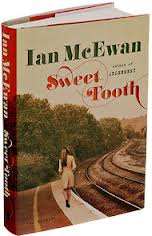
Any Ian McEwan fans out there?

Ian McEwan is a superb writer, and his subject matter is the sort of thing I’m attracted to: murder, science, espionage, literature.  I’ve read most of his novels, and each one of them leaves me feeling dissatisfied for one reason or another.  The latest is called Sweet Tooth (bad title), which is kinda sorta an espionage novel set in the England of the 1970s.  I raced through it, but I was thoroughly annoyed by the end.  Here’s why:

  • Despite being set in England’s MI5 and filled with espionage types, the book is really light on plot.  Not much actually happens.
  • In reality, the focus turns out to be on a fairly uninteresting love triangle among three not very sympathetic people.
  • The novel ends with a post-modern twist.  (McEwan did something similar in Atonement.)  Time was I was very much in favor of post-modern twists.  My tastes have apparently changed, or maybe McEwan just didn’t pull this one off.  In this case, it just made me want to toss the completed book against the nearest wall.

The novel got lots of rave reviews from critics, but on Amazon it has a relatively modest 3.5 rating (by contrast, my novel Senator has, ahem, a 4.3 rating and Dover Beach a 4.1). Lots of people seem to share my reservations.

What I liked about the novel was its wonderfully detailed depiction of England in the 1970s. On the other hand, the couple of times McEwan wrote about something I’m familiar with, he got it wrong.  (No one “takes a legal degree from Harvard” — at least, not back then.)  Kinda shakes your confidence.