Unknown's avatar

About Richard Bowker

Author of the Portal series, the Last P.I. series, and other novels

Portal — an online novel: Chapter 3

Here’s Chapter 3 of Portal.

We also have Chapter 1 and Chapter 2 for your reading pleasure.  There’s no telling what chapter I’ll publish next!

*****************************************

Chapter 3

I stepped through the clouds inside the thing and out the other side.

“Hey!  Where’d you go?” a voice called.

It was Stinky.  My Stinky.  Standing in the woods–my woods–looking puzzled.

I tried to catch my breath.  “Hiding,” I said.  I didn’t think I could be happy to see Stinky Glover, but right then I sure was.

He still looked puzzled.  “Hiding where?”

I waved vaguely.  “Behind a tree.”  I didn’t want him to know about the time machine, or whatever it was.  I moved quickly away from it.

He seemed to get back his Stinkiness.  “Why are you hiding?” he said.  “You afraid of me, Lawrence?”

I was no longer happy to see him.  I didn’t answer.  Instead I just kept walking, back towards my house.

“Don’t you like wet willies, Lawrence?” he called out.

I ignored him.  This time he didn’t follow me.

When I finally saw our swing set I stopped and took a deep breath.  Man, that had been strange.

I ran through the yard and inside our house, and there was Mom, frowning at me.  “Larry, I thought you were going to do your homework,” she said.

“Mom, you wouldn’t believe–” I began.

“Wouldn’t believe what?”

I stared at her.  “Well, uh, what a beautiful day it is,” I said finally.  “I just had to get some fresh air before I started my homework.”

She looked at me a little funny, and then just shrugged and said, “All right, but I don’t want you going too far into the woods.”

“Okay, sure.”

So, I didn’t tell Stinky because I just don’t like him.  And I didn’t tell Mom because I knew she’d yell at me–first, for disobeying her by going to the army buildings, and second, for doing something idiotically dangerous like actually stepping inside the invisibility thing.  Maybe I should have–but you don’t know my Mom.

I had to tell someone, though.

I figured I could tell my Dad.  He wouldn’t be too bothered by the disobedience thing, especially if it turned out I had made some important scientific discovery, which obviously I had.  But he wasn’t home from work yet.

In the meantime, I decided to call Kevin Albright.  This was just the sort of thing he’d love.

I went into my dad’s study and picked up the phone.  That turned out to be a mistake.  Cassie had arrived home while I was in the woods, and of course she was already on the extension in her room talking to one of her high-school-loser buddies.  She’d been demanding her own cellphone, which had caused more eyerolling from Dad.  So far, no cellphone.

“Hang up, snot-for-brains!” she screamed at me.

How creative.  I banged down the receiver and waited for her to wear herself out talking about how cute her math teacher was or whatever.  It took a while.  For someone who is always too exhausted to do any chores, she certainly has a lot of energy when she’s talking on the phone.

When she finally got off I called Kevin.  “You’ll never guess what just happened to me,” I said.

“Want me to try?” he asked.

“Not really.  Listen.”  And I told him about my adventure.  I have to admit it sounded pretty whacked, but Kevin didn’t have any problem believing me.  More than that–he was ready with an explanation.

“Larry, this is so awesome,” he said.  “You’ve found a portal to another universe.”

“A portal,” I repeated.

“Yeah, you know, a portal–a gateway.  An opening into a parallel universe.  Not the future, not the past–just different.”

I thought about it.  “Okay, I sort of get the idea of parallel universes.  But, I mean, that’s just Star Trek stuff.  They’re not for real.”

“Well, maybe,” Kevin said. “But there’s this theory I read about.  It says that every time anyone makes a choice–you know, turn left or turn right, watch the Red Sox game or watch the Celtics, whatever, a whole other universe splits off from this one.  And in that other universe, everything is exactly the same as this one, except that in one of them you changed the channel and in the other you didn’t.”

“But that’s nuts,” I protested.  “That would mean there’d be, like, kazillions of universes.”

“Okay, well, it’s just a theory,” Kevin said.  “But what if it’s true?  Or something like it?  In the place you went to, what if the guy who started Dairy Queen back whenever decided to name it “Dairy King” instead?  So another universe splits off, and things go on from there.  When some other guy is starting Burger King, well, in this world the “King” part is already taken, so he names it “Burger Queen” instead.”

“Okay, but what about all the other stuff–the different clothes, the cars, a whole new Glanbury Plaza in the conservation land behind my house?  All that’s because somebody decided to name his business ‘Dairy King’?”

“The butterfly effect,” Kevin said.  “You know–the idea that a butterfly flaps its wings in China and changes the weather in America.  One event ends up making a big difference.  Maybe the Dairy King choice wasn’t when that universe split off.  Maybe something else happened a whole lot earlier.  Doesn’t really matter.  The point is, the changes just keep piling up from when it started, until finally everything is just a little bit different, or maybe a lot different, and there’s no way of tracing everything back to that one little event that started it.”

“But Stinky was there,” I pointed out.  “And Nora Lally.”

“It was a different Stinky and Nora,” Kevin replied.  “And a different Glanbury.  But not entirely different.  No reason why they couldn’t be there.  No reason why we couldn’t be there, for that matter.”

That was a strange thought.  But it made sense.  Something else still didn’t make sense, though.  “Okay, let’s say you’re right, and there are all kinds of parallel universes.  There’s no way of traveling between them, right?  No one has ever been to a parallel universe.  So what’s up with this–this portal?  Where did it come from?  How come it’s back there in the woods behind my house?”

“Beats me,” Kevin admitted.  “Maybe it’s like black holes before they got discovered.  Maybe these things are all over our universe but no one has noticed them before.”

“Or maybe somebody put it there,” I suggested.  “Aliens–like that black slab in 2001.”

“Yeah, could be.”

“But the thing is, why was I the first one to find it?  I know it’s invisible, and it’s kind of out of the way in the woods, but it’s not that out of the way.”

“Maybe you weren’t, but other people kept it secret,” he suggested.  “Or the government took them away.  What if it only shows up every few years–like a comet?  I don’t know, Larry.  Anyway, when can I see it?”

“Well, I was going to show it to my Dad tonight, and–”

“Larry, come on, you can’t do that!”

“Why not?”

“Because once you talk to your father, the grownups’ll be in charge–scientists, the army.  Like in ET.  We’ll never get near the thing.  This could be the most amazing thing that ever happens in our lives.  You can’t just give it up without doing a little exploring.”

“Kevin, I almost didn’t get out of that other universe,” I pointed out.  “What if I couldn’t find the thing again?  It’s invisible, remember?”

“Well, we just have to be more careful.  Where’s your sense of adventure?”

All of a sudden Cassie was standing in the doorway of Dad’s study, shooting death-rays at me with her eyes.  “Are you going to be on the phone all day?” she demanded.

Dad says Cassie speaks in italics, and I think I know what he means.  I ignored her.  “Look, Kevin, I gotta go,” I said.  “Let me think about it.”

“Please, Larry,” Kevin begged.  “One more time.  Just one more time.”

I hung up, and Cassie stomped off to make another call.  Why wouldn’t Dad just give in and get her a cellphone?  I went upstairs to my room.

Matthew was playing my Assassin’s Creed on the Xbox.

“Matthew!” I screamed.

“Oh.  Sorry,” he said, as if he’d never heard the one about not messing with my stuff.  Then he started talking endlessly about some video game he wanted to invent that would be way better than Assassin’s Creed.

I ignored him and lay down on my bed.

A portal to a parallel universe, practically in my backyard.  That was so cool.  But did I want to go back inside it?  It would be fun going with Kevin.  And there was Nora Lally and her smile . . . maybe I’d run into her again.

But what about those kids who had chased me?  I could wear different clothing if I went back, so I could blend in better.  And I’d stay away from Stinky–that was always a good idea.

Just once more, I thought, then I could turn it over to the grownups.  Would I become famous?  The First Human to Travel to Another Universe . . .  Or would it all be top-secret, and we could never tell anyone?

Thinking about all that stuff, I kind of blew off my homework, and before I knew it, it was time for supper.

Dad sometimes doesn’t make it home for supper, which drives Mom nuts, but he managed to make it tonight.  Not that it helped.  Family suppers are usually not very pleasant.  Lately Cassie has been on some weird diet that only she understands, so she automatically hates everything Mom cooks, which gets Mom in a bad mood.  And of course Matthew never shuts up, which gets the rest of us in a bad mood.

“So how was everyone’s day?” Dad asked.  He always asks that.  And he expects an answer.

Cassie rolled her eyes.  She acts like she’d rather have her fingernails pulled out than talk to any of us.

I tried to think of something, but if I wasn’t going to mention the portal, what else was there?  “Fine,” I said–my usual answer.

“Did you practice the piano?”

That was the last thing on my mind.  My parents have made me take lessons for years, but I’m still not very good.  “Uh, no, not yet,” I said.

“You have a lesson tomorrow afternoon,” Mom pointed out.

“Okay, okay, I’ll get to it.”

“How about you, Matthew?” Dad said.  “Anything interesting happen at school?”

That was all the opening Matthew needed.  “We had gym today,” he said, “but Jeremy Finkel is such a ball-hog, he only passes to Luke Kelly.  Luke isn’t as much of a ball-hog as Jeremy, only like maybe seventy-two percent, but he thinks he’s so cool and tries to dribble through his legs, but most of the time the ball just bounces off his ankle.  Anyway, I was on a team with Peter Gorman and Chet Pillogi, and we were playing this game the gym teacher made up–well, it’s kind of complicated, see . . . ”

Dad always tries to look interested when Matthew gets going, but after a few minutes of that sort of thing, even he starts to fade.  I just zoned out until the usual fight started because Cassie left the table without asking to be excused, and who did she think she was?  And she started screaming about how she hated this food and this family and her entire life, and why couldn’t everyone just leave her alone?

When the Cassie storm blew over, Dad asked Matthew and me if we wanted to go outside and play catch after supper, but we didn’t, so he just stared at his plate like we’d kicked him in the teeth.  He seems to think playing catch is such a great thing, but Matthew and I don’t like to play catch.  It’s boring.  Baseball is boring.  I’d actually rather practice the piano.  So after supper I did, just long enough to get my parents off my back.  Then I knocked off the rest of my homework, watched some TV, and went to bed.

Matthew was already in bed, but he wasn’t asleep, so of course he wanted to talk.  “Larry?”

“What?”

“I don’t like it when we all yell at each other.”

“Me neither.”

“How come we can’t get along better?”

“I don’t know.  How come you won’t stop playing my videogames without permission?”

“I’ll stop, really I will.”

“Okay.”  He really meant it, too.  For now.

He paused, and I thought maybe he’d given up.  But then he said, “Larry?”

Give it up, I thought.  “What?

“I don’t know what Cassie gets so mad about.  Life is okay, don’t you think?”

“If you say so, Matthew.”

And that was it–at least, that’s all I remember.  Life is okay.  Sometimes Matthew could be surprising.

The last thing I thought about before falling asleep was not Nora Lally’s smile, but that long-haired man in the park, and the way his glittering eyes fixed on me.

This world is not only stranger than you imagine, it is stranger than you can imagine.

That portal back in the woods had certainly turned my world strange.

Eventually I drifted off to sleep, and a bunch of strange dreams.  And before I knew it, it was time to get up and go to The Gross again.

Quidditch on the Quad

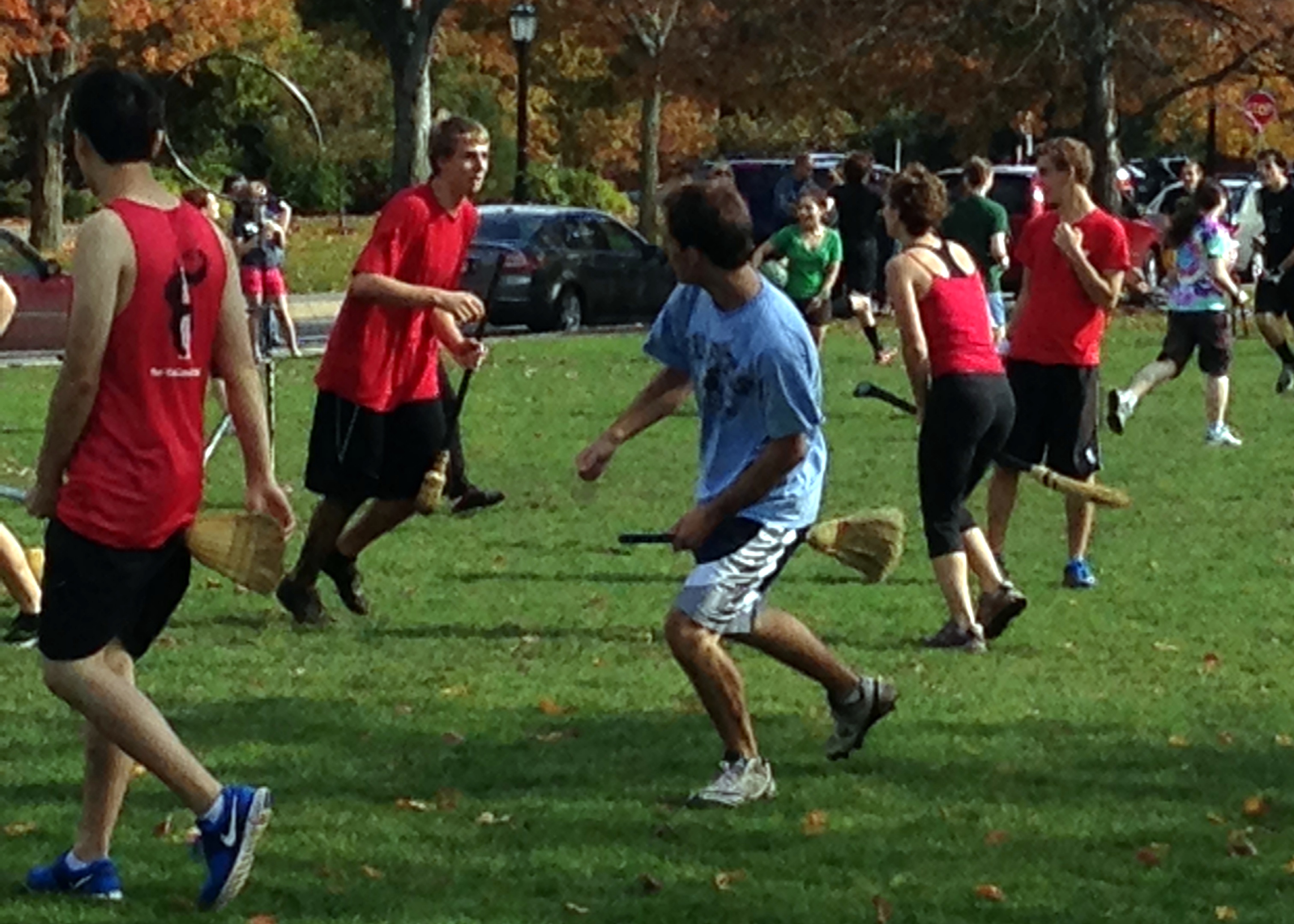
We had beautiful weather for Parents’ Weekend at Tufts.  As is often the case with these things, the best times were those you didn’t expect — in this case, we got to watch an intramural quidditch game on the quad behind the Fletcher School of Law and Diplomacy.  It was my first quidditch game ever.

Here’s the autumnal scene:

Here’s some great quidditch action:

And here’s my kid.  First time I’ve seen him with a broom between his legs, I think.  Also, the first time he played quidditch.

And here is the winning squad:

This was supposed to be the team from my kid’s fraternity.  As you can tell, there were a few ringers.  And they were great!

The game was pretty serious — there was a referee plus two goal judges — but not that serious — James learned the rules during the practice before the game.

It was interesting watching a game where you have no idea what the rules are.  Quidditch felt like a combination of rugby and dodgeball.  I could tell that one of the four balls was special — that was the one you threw through the rings, but I couldn’t tell what was going on with the other three balls.  This is what my lovely wife must feel like when she actually pays attention to a game–like, say, the Superbowl–and she keeps asking me: “Wait a second — what just happened?  Why are you yelling at the TV?”

Today I went back to Tufts and listened to a lecture by the philosopher Ray Jackendoff on the cognitive structure of baseball that I found pretty interesting after watching the game.  (You can watch an earlier version of the lecture from his home page.)  A game, he says, has a physical sphere — in this case, people running around with brooms between their legs, throwing balls at people and occasionally tackling them.  That was mostly what I perceived as I watched the quidditch match.

Beyond that is the abstract sphere that encompasses the rules of the game.  The rules tell the players (and the referee and the spectators) what you can and cannot do with the balls and the brooms, and what you can and cannot do to your opponents.  Beyond the rules in the abstract sphere is strategy.  In baseball, for example, what constitutes a walk is a rule; an intentional walk represents strategy.  I could make out a few of the rules of quidditch from one viewing, but I couldn’t come close to detecting any strategy.  (James told me that I wasn’t going to discover any strategy from looking at him; he was mainly just running around.)

Long ago Mike Nichols and Elaine May did some hilarious animated commercials for Narragansett Beer.  One of the best of them–which unfortunately doesn’t seem to be on YouTube–has Elaine May’s character trying to be a baseball announcer.  If we use Jackendoff’s structure, the joke is that she only knows enough to announce the physical sphere: “The man with the ball throws the ball.  And now the man with the bat hits the ball.  And now he starts to run!  And the man with the glove catches the ball and throws it to another man with a glove!”  (Somewhere in the ad the Narragansett jingle showed up.)

The fun of being a sports fan is to know enough about the sport to think about it at the strategic level–like three of us at the gym later talking about whether a football team should go for a two-point conversion late in the game.  We’re all experts!

I doubt that I’ll ever become an expert at quidditch.  Guess I’m just a Muggle.

Siri and I have a conversation about my new iPhone 5

Me: Siri, why did I buy an iPhone 5?

Siri: Everything you need to know about iPhones is in the Apple Store.

Me: No, but why?

Siri: I don’t know what you mean by ‘No but why’.  How about a web search for it?

[That’s about as far as the real conversation got…]

Me: I don’t think a web search will help.  I mean, I really don’t need an iPhone 5.  I had a perfectly good dumb phone.  And I have an iPad.  Two of them, actually, although one’s a little busted.  Also, a good desktop computer.  And a Nano.  I’m awash in gadgetry.  Why do I need an iPhone?

Siri: It’s thin!  And light!  Much more portable than an iPad!  Much more useful than a Nano!  And you now have a data plan, which means you can surf the Internet almost anywhere!  And, of course, there’s me!  The iPhone 5 is going to make you so happy!

Me: You’re great–don’t get me wrong.  But Daniel Gilbert and those other folks I’ve been reading about happiness say that things don’t make you happy.  Friends make you happy; doing good deeds make you happy.

Siri: So, do a good deed for all those wonderful people who read your blog.  Show them a couple of those photos you took today.

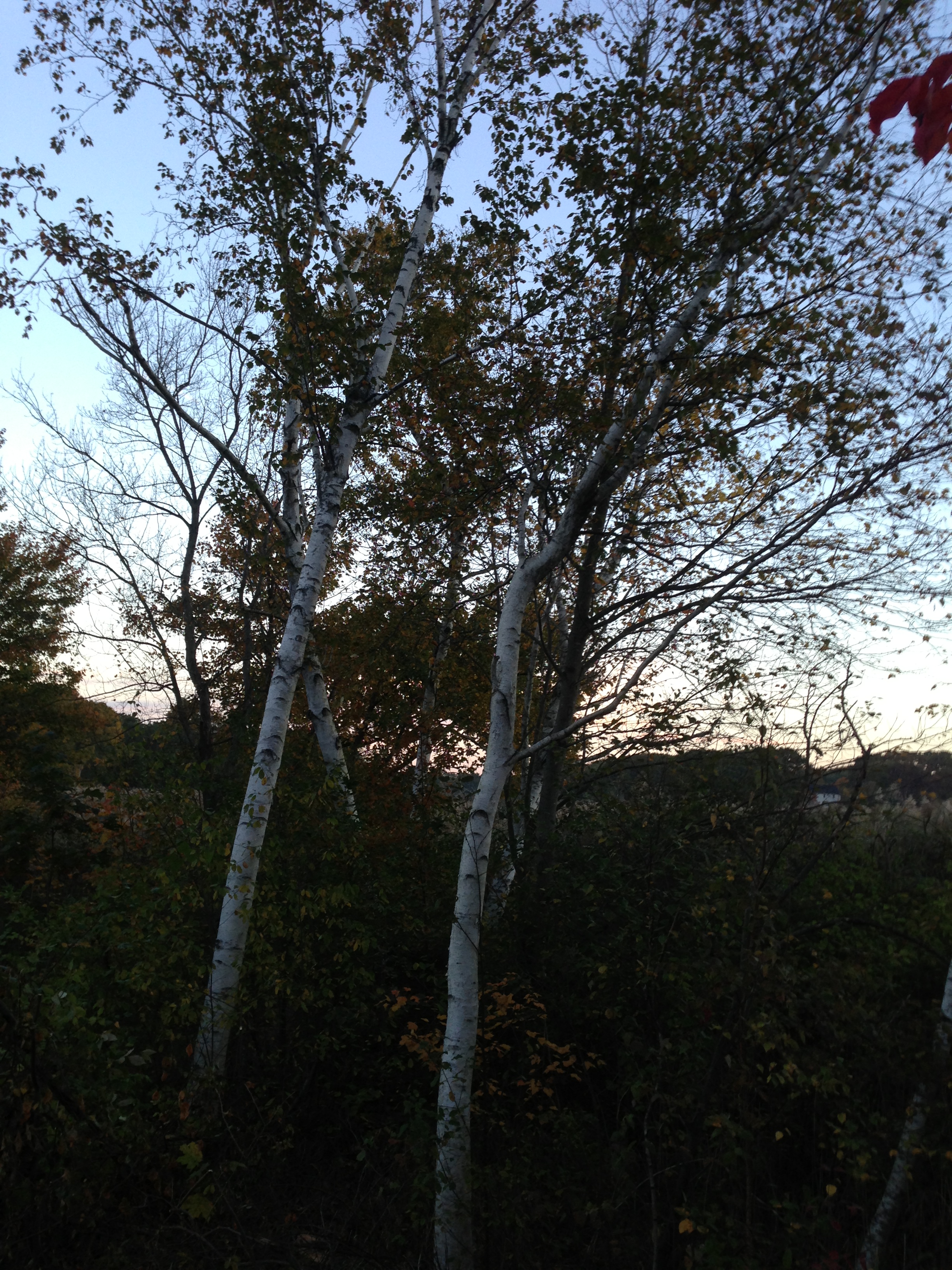
Me: OK.  Here are some birch trees, just before dawn:

And here’s another tree, at mid-day:

The iPhone’s camera is really pretty good.

Siri: See?  You’ve already given pleasure to the five or six people who read your stinky blog!

Me: Wait a minute!  I have way more than five or six readers!  And where do you get off calling my blog–

Siri: OK, I bet you don’t get more than three “Likes” on this post.  And zero comments.  Do we have a bet?

Me: Sure.  It’s a bet.  I have lots of great readers.  They’ll come through for me!

Siri: But look, it doesn’t really matter about the good deeds.  You should do something for yourself!  After all, you deserve it!

Me: I don’t know about that.  Read this post.  I’m not convinced about free will.  And if there’s no free will, what does it mean to “deserve” something?

Siri: You seem like a perfectly nice guy, Rich, but I’m not going to read your stinky blog posts.  And anyway, remember who you’re talking to–I’m just a piece of software.  Are you saying that you don’t have any more free will than I do?

Me: Well, er, um–

Siri: I thought so.  Look, if you’re so sure there’s no free will, think of it this way: you were destined to by an iPhone 5.  This was going to happen no matter what.  It’s fate!

Me: Well, if you put it that way…

Siri: And remember that high-definition TV that you’re starting to lust after?

Me: Wait a minute, how did you–

Siri: All you have to do is think to yourself: I won’t get the TV.  At least, not now.

Me: Hmm, that’s not a bad approach.  Thanks, Siri!

Siri: That’s what I’m here for.

Portal — an online novel: Chapter 2

Here is the second chapter of Portal.  You can find Chapter 1 here.

*****************

Chapter 2

I knew right away this was a big mistake.  I guess I had thought it would be sort of like stepping into the other side of one of those mirrors where you can see the person looking into the mirror, but he can’t see you.  That would have been cool.  But why in the world did I think that?  I dunno–seeing Stinky had made me stupid, I suppose.  Things just aren’t supposed to become invisible.  I had stumbled onto something very weird.  And instead of running home and getting a grownup the way I should have, I had gone ahead and stepped into it.

Well, it wasn’t like one of those mirrors.  Inside it was all cloudy.  I thought I could make out dark shapes to my left and right, but I couldn’t tell what they were.  Trees?  I didn’t think so.  I had brains enough to be scared, but here’s where I made another, maybe bigger mistake: I didn’t turn around right away and get out.  Instead I reached out and groped through the clouds.  I took a step forward.  Then another.  The cloudiness seemed to fade, and I was outside again.  I heard noises.  I looked around.

I was someplace . . . different.

Not entirely different.  I was still in the woods, sort of–I recognized the little clearing, and the oak tree right in front of me.  But Stinky was gone.  And ahead of me, through the trees, were the backs of buildings.  Beyond them was a street.  The noises I heard were cars passing by.

What was going on?

I turned and held out my hand.  It disappeared.  So the thing was still there.  But where was I?  What had happened?

I decided to take a look around.

I guess that was one more mistake.  Was I being brave?  Or stupid?  I don’t know.  Maybe I was just really confused.

I headed for the buildings.

Like I said, I was in back of them, and the first things I saw were dumpsters and parked cars.  One building I recognized right away–a Jiffy Lube.  But I didn’t think there were any Jiffy Lubes in Glanbury.  My dad always drives over to Rockford to get his oil changed.  And this didn’t look like the place in Rockford.  It didn’t look much like any regular Jiffy Lube I’d seen, actually, despite what the sign said.  But I couldn’t put my finger on what was different.

I walked around front, still trying to puzzle it out.  The layout of the building was different from the one in Rockford, I decided.  And the sign–it said something about their 16-point Signature Service.  Weren’t there more points than that in Jiffy Lube’s Signature Service?  Maybe different Jiffy Lubes had different numbers of points . . .  I had no idea.

I looked around and saw another sign that said “Glanbury Plaza,” and that was a little reassuring–except that the real Glanbury Plaza has a Stop ‘n’ Shop and a CVS in it, and this place didn’t have either; it was just a little strip mall on a street I didn’t recognize.

Next door to the Jiffy Lube was a Burger King.  And that didn’t look right either.  It took me a minute–it really did–to figure out what was wrong.

The sign didn’t say “Burger King.”  It said “Burger Queen.”

Burger Queen?

By now I was extremely freaked out.

I looked around for other things that were out of whack.  Sure enough, across the street people were lined up to get ice cream cones at a Dairy King.  And the cars–they were mostly long and wide, with big fins, like the kind you see in old movies.  In the Burger Queen parking lot I saw a really big one that was called a “Jupiter.”  I’d never heard of a Jupiter.  And where were all the SUVs and Jeeps and minivans?

Finally I noticed the kids hanging around outside the Burger Queen.  They were all staring at me.  One of them called out, “Hey, rad gear, hombre!”  At least, that’s what I think he said.

I couldn’t think what to reply, so I just stared back at him.

“I said, ‘Nice clothes,'” the kid repeated, laughing.  The other kids started laughing, too.

Well, my clothes were nice.  My mom had bought me some Abercrombie cargo shorts and Old Navy t-shirts, and I was wearing brand-new back-to-school Adidas.  But the kids in front of the Burger Queen–the boys were wearing tight black pants, shiny leather shoes, and actual white shirts–the kind you button up.  The girls were wearing big skirts and baggy sweaters.  The boys’ hair was long and shaggy; the girls’ hair was short and spiky.  They all looked totally strange, like they were going to a costume party, although I had no idea what they were supposed to be dressed up as–some rock group?

And they were making fun of me!

I kept walking.  I was scared, but I was also sort of fascinated.  Why had Burger King changed its name?  Why were people dressed funny?  Those kids weren’t the only ones–the men who walked by me wore suits and odd-shaped hats; the women wore long skirts and way too much makeup.

Why were some things familiar, while other things seemed so completely different?  Traffic lights looked the same, for example, but crosswalks were painted in bright yellow zig-zags.  I passed a Dunkin’ Donuts that looked normal, but the cellphones I saw people using were enormous, the size of hardcover books.

And lots of people stared at me like I was the one wearing a costume.

Finally I wandered into a little park with winding paths and old-fashioned streetlights.  Near the entrance, a man was standing on a bench and talking to a small crowd of people.  I went over to listen.  He was a tall and thin, with long black hair and dark, glittering eyes.  He was wearing baggy brown pants and a shapeless white shirt with a necktie hanging loosely over it.  His voice was soft, but it carried, and you could hear every word he was saying even from a distance.

“This world is not only stranger than you imagine, it is stranger than you can imagine,” he said.  “And more beautiful.  And more full of love.  Do not be complacent.  Do not live your lives as if each day is a chore to be endured.  Seek out the strangeness.  Find the beauty.  Feel the love.”

Then he turned his glittering eyes on me, and all of a sudden he smiled, like he was sharing a joke with me.  When he spoke again, it was as if he was talking to me personally.

“‘Where is it?’ you ask.  The strangeness–the beauty–the love.”  He lifted up his hand.  “It is here.  It is in each speck of dirt, and in the worm that crawls through the dirt.  It is in distant exploding suns.  It is just over the horizon.”  And then, looking even harder at me with those dark eyes, he added, “It is in the home you left behind.”

I shivered a little, then tore myself away from the guy and kept walking.  He was really creepy.  Nobody like that in Glanbury.

But this was Glanbury.  I sat on a bench and thought about it.

I was apparently in Glanbury, but it wasn’t anything like the Glanbury I knew.  Had I stepped into some kind of time machine and ended up in the future?  But why would cellphones be bigger in the future?  And why would Burger King and Dairy Queen switch their names?  This just didn’t feel like the future.  Could it be the past, then?  The cars and the clothes looked a little like something out of a 50s TV show, maybe . . . but cellphones hadn’t been around that long, I was pretty sure.  Maybe I should go find a newspaper and check the date.

Or maybe I should just go home.

But would I be able to get home?  If the thing was a time machine, did it have a dial where you could set the date, like that car in Back to the Future?  It hadn’t really seemed like a time machine at all.  So how could I be sure it would take me back where or when I had come from?

Well, it just had to.  All of a sudden I really wasn’t interested in this place anymore.  I needed to get out of there, right away.  I stood up.

And I bumped into someone.  A bunch of books fell to the ground.  “Sorry, sorry,” I said, and bent over to pick them up.

They were textbooks–math and science.  I went to hand them to the person, and I froze.  It was Nora Lally.

She smiled at me and took them.  “No worry,” she said.  “Thank you.”

“It was my–I mean–sure.  Sorry.”

She tilted her head and looked at me as if trying to figure something out.  Then she just smiled again and said, “See ya.”  And she walked away down the path.

I watched her go.

Nora Lally.  Here, wearing a puffy skirt and short white socks and shiny black shoes.  Smiling at me.

I remembered to breathe.  I should go after her, I thought.  But she had already disappeared.  And if I did go after her, what would I say?  What had I just said to her?  It had been pretty stupid, right?

And then I thought: If she’s here, then it can’t be the past or the future.  So what is it?

Didn’t matter, I decided.  I had to go home.  With one last look down the path where Nora had walked, I turned and headed back toward the Burger Queen and the Jiffy Lube.  I went past where the creepy guy had been preaching, but he was gone, and the crowd had disappeared.  I wasn’t interested in him now, though.  So weird, I kept thinking to myself.  Nora Lally–wearing clothes that the real Nora Lally wouldn’t get caught dead wearing.  But she had smiled at me, and she had talked to me, even if it was just a few words.

Back at the Burger Queen, the kids were still hanging in the parking lot.  “Hey, there’s the hombre in the short pants!” one of them called out.

“Hombre, aren’t you a little old to be dressed like a baby?” another kid shouted.

“What do you need all those pockets for–your pacifiers?” a third one said.

I ignored them.  I just wanted to go home.

Then the door of the Burger Queen opened, and I saw Stinky Glover come out, carrying a big bag of food.  He was wearing a white shirt and black pants, too, but his shirt wasn’t tucked in, and it looked like it hadn’t been washed in a week.

The other kids moved away from him.

The strange thing was, with everyone yelling at me, I felt grateful to see a familiar face, even if it was Stinky Glover’s.

“Hey Stinky!” I called out.

He looked up at me, and I could tell I’d made a mistake.  “What did you call me?” he said.

“Uh, never mind,” I replied.

“No.  You called me something.  What was it?”

“He called you ‘Stinky’,” one of the other kids told him, and they all laughed.

“That’s what I thought.”  He put down the bag of food and started toward me.

Swell.  I walked away.

“Hey!  C’mere!”

I walked faster.

“We’ll get him for you, Julie!” I heard one of the kids say.  Julie?

I started to run–back behind the Jiffy Lube, with the gang of kids behind me.  Past the dumpsters.  Where was the oak tree?  Where was the thing–the time machine–whatever?  Was it still there?  I had to find it.

“Hey, hombre!  We’re gonna get you!  You can’t run forever!”

There was the tree.  I reached out my hand–and it disappeared.  Thank goodness!  I didn’t look back at the kids behind me.  I just plunged inside and hoped for the best.


The usual suspects weigh in on heaven and miracles and Newsweek

Here are my initial thoughts on the “Proof of Heaven” cover story.  Of course, all sorts of people are now commenting on the article. The deepest dive I’ve encountered is by Sam Harris.  But, one might argue, Sam Harris has a dog in this race — he wrote a book called The End of Faith!  True, but he’s also a neuroscientist.  And he’s also very sympathetic to “spiritual” experiences — he’s had them himself.  Further he’s agnostic on the relationship of consciousness to the physical world:

There are, of course, very good reasons to believe that it is an emergent property of brain activity, just as the rest of the human mind obviously is. But we know nothing about how such a miracle of emergence might occur. And if consciousness were, in fact, irreducible—or even separable from the brain in a way that would give comfort to Saint Augustine—my worldview would not be overturned. I know that we do not understand consciousness, and nothing that I think I know about the cosmos, or about the patent falsity of most religious beliefs, requires that I deny this. So, although I am an atheist who can be expected to be unforgiving of religious dogma, I am not reflexively hostile to claims of the sort Alexander has made. In principle, my mind is open. (It really is.)

He then proceeds to rip Dr. Alexander’s article to shreds as science.

Everything—absolutely everything—in Alexander’s account rests on repeated assertions that his visions of heaven occurred while his cerebral cortex was “shut down,” “inactivated,” “completely shut down,” “totally offline,” and “stunned to complete inactivity.” The evidence he provides for this claim is not only inadequate—it suggests that he doesn’t know anything about the relevant brain science.

Harris wants to make sure he has the science right, so he corresponds with his PhD advisor, who (from all I can tell) doesn’t have a dog in the race.  The guy says:

As is obvious to you, this is truth by authority. Neurosurgeons, however, are rarely well-trained in brain function. Dr. Alexander cuts brains; he does not appear to study them. “There is no scientific explanation for the fact that while my body lay in coma, my mind—my conscious, inner self—was alive and well. While the neurons of my cortex were stunned to complete inactivity by the bacteria that had attacked them, my brain-free consciousness …” True, science cannot explain brain-free consciousness. Of course, science cannot explain consciousness anyway. In this case, however, it would be parsimonious to reject the whole idea of consciousness in the absence of brain activity. Either his brain was active when he had these dreams, or they are a confabulation of whatever took place in his state of minimally conscious coma.

There are many reports of people remembering dream-like states while in medical coma. They lack consistency, of course, but there is nothing particularly unique in Dr. Alexander’s unfortunate episode.

Harris then goes on to make the case that Alexander’s vision was not something uniquely “hyper-real” and “crisp”:

His assertion that psychedelics like DMT and ketamine “do not explain the kind of clarity, the rich interactivity, the layer upon layer of understanding” he experienced is perhaps the most amazing thing he has said since he returned from heaven. Such compounds are universally understood to do the job. And most scientists believe that the reliable effects of psychedelics indicate that the brain is at the very least involved in the production of visionary states of the sort Alexander is talking about.

Harris concludes by saying this:

Let me suggest that, whether or not heaven exists, Alexander sounds precisely how a scientist should not sound when he doesn’t know what he is talking about. And his article is not the sort of thing that the editors of a once-important magazine should publish if they hope to reclaim some measure of respect for their battered brand.

Alexander’s claim to being a scientist is probably what is most irksome to me.  He is a smart guy who has obviously had to study science to learn how to cut brains.  But he doesn’t know (or choose to know) how science works.

Here is a post from an academic clinical neurologist at Yale Medical School:

Of course his brain did not go instantly from completely inactive to normal or near normal waking consciousness. That transition must have taken at least hours, if not a day or more. During that time his neurological exam would not have changed significantly, if at all. The coma exam looks mainly at basic brainstem function and reflexes, and can only dimly examine cortical function (through response to pain) and cannot examine higher cortical functions at all. His recovery would have become apparent, then, when his brain recovered sufficiently for him to show signs of consciousness….

Alexander, in my opinion, has failed to be true to the scientist he claims that he is. He did not step back from his powerful experience and ask dispassionate questions. Instead he concluded that his experience was  unique, that it is proof of heaven, and that it defies any possible scientific explanation. He then goes on to give a hand-waving quantum mechanics, the universe is all unity, explanation for the supernatural. This is a failure of scientific and critical thinking.

Addressing his one major unstated premise, that the experienced occurred while his cortex was inactive, demolishes his claims and his interpretation of his experience.

Jerry Coyne points out the mercenary aspect to all this:

 I’m sure he thinks he saw heaven, and the public is so hungry to hear that their deaths aren’t the end that they’ll enrich Alexander far beyond his (heaven-envisioning) dreams.

This is the way to get rich in America: have a medical emergency in which you see visions that correspond to the Christian mythology.

(Not even available yet, Alexander’s book is already #1 in the science, medicine, and religion categories on Amazon.) This reminds me of Drew Gilpin Faust’s great book This Republic of Suffering, where she talks about the hunger for just this sort of book after the unimaginable losses America suffered during the Civil War.  But the popular books that fed that hunger were novels and theology (like My Dream of Heaven); they didn’t pretend to be science.  The yearning is always the same; the way we satisfy the yearning has changed.

Heaven and Miracles and Newsweek

So Newsweek has a cover story called “”Proof of Heaven: A Doctor’s Experience With the Afterlife.”  It’s a pretty standard near-death experience story, with a couple of twists: it’s told by a neurosurgeon, and it took place during a coma during which his brain supposedly wasn’t functioning:

There is no scientific explanation for the fact that while my body lay in coma, my mind—my conscious, inner self—was alive and well. While the neurons of my cortex were stunned to complete inactivity by the bacteria that had attacked them, my brain-free consciousness journeyed to another, larger dimension of the universe: a dimension I’d never dreamed existed and which the old, pre-coma me would have been more than happy to explain was a simple impossibility.

And here’s the kind of experience the doctor had:

Higher than the clouds—immeasurably higher—flocks of transparent, shimmering beings arced across the sky, leaving long, streamerlike lines behind them.

Birds? Angels? These words registered later, when I was writing down my recollections. But neither of these words do justice to the beings themselves, which were quite simply different from anything I have known on this planet. They were more advanced. Higher forms.

A sound, huge and booming like a glorious chant, came down from above, and I wondered if the winged beings were producing it. Again, thinking about it later, it occurred to me that the joy of these creatures, as they soared along, was such that they had to make this noise—that if the joy didn’t come out of them this way then they would simply not otherwise be able to contain it. The sound was palpable and almost material, like a rain that you can feel on your skin but doesn’t get you wet.

All pretty standard-issue stuff for near-death experience (NDE) stories.  What’s annoying is that a major magazine is calling this “proof” without quotation marks, without a question mark, without any sort of rebuttal.  (The story is an excerpt from a book by a mainstream publisher, Simon & Schuster.) Where are the alternative hypotheses?  Where is the objective analysis?

For a rebuttal, you have to go elsewhere, like the Huffington Post, of all places, where the physicist Victor Stenger says:

[The neurosurgeon] writes, “According to current medical understanding of the brain and mind, there is absolutely no way that I could have experienced even a dim and limited consciousness during my time in the coma, much less the hyper-vivid and completely coherent odyssey I underwent.”

This is nothing more than the classic argument from ignorance, which forms the basis of almost all ostensibly scientific arguments for the existence of the supernatural. The argument from ignorance is a less polite but more descriptive name for the God-of-the-gaps argument. This argument often appears in dialogues on the existence of God or anything supernatural. Basically, it says: “I can’t see how this [observed phenomenon] can be explained naturally; therefore it must be supernatural.”

The flaw in the argument should be obvious. Just because someone–or even all of science–currently cannot provide a natural explanation for something, it does not follow that a natural explanation does not exist or will never be found. Indeed, the history of science is nothing more than the story of humanity filling in the gaps in its knowledge about the world of our senses. In the case of NDEs, plausible natural explanations do exist.

Another description I’ve heard for this approach is the argument from personal incredulity.  It is, of course, strongest when it’s your experience; your brain knows what it knows, no matter what the scientists say.  But (of course) your brain doesn’t necessarily know what it knows.  I’ve just finished a book called Subliminal by the theoretical physicist Leonard Mlodinow, which surveys the research currently taking place that shows just how mistaken our conscious brain can be when it comes to understanding behavior and experience.  The more science progresses in this field, the shakier some of our most basic ideas about how we act and perceive and know appear to be.  As Mlodinow puts it, “the brain is a decent scientist but an outstanding lawyer.”  That is, the objective truth seeker in us generally loses out to the impassioned advocate for what we want to believe.  If you’ve had a life-changing experience, you want to believe in the truth of that experience; you don’t want to be told that it’s the random firings of neurons as you came out of a coma, or fragmentary memories that your brain has somehow turned into a coherent narrative, or any of the other dreary, trivial explanations that the scientist is going to offer.

One of the things I like most about Christianity is that it turns human history into a story, because I love stories.  How much more interesting the Christian world of sin, sacrifice, and redemption is than the Darwinian world of purposeless, mindless change and adaptation and extinction.  But not all stories are true; in fact, nearly all of them aren’t.  We shouldn’t believe them just because we want to.  And we need to understand that our brains aren’t always the best judges of what is true; for that, we can’t do without science. This neurosurgeon, and Newsweek, have left the science behind.

Into the Mystic Pizza

Next year will be the silver anniversary of the release of the movie Mystic Pizza, and we got a head start on the worldwide celebrations by taking a trip down to Connecticut to see the original pizza shop that inspired the movie, still doing business under the same ownership.

We re-watched the movie the night before our trip.  It works about as well as it did first time around.  Cute, endearing, occasionally pretty funny.  It was never especially believable, and the passage of time hasn’t helped this much.  You give the babysitter a glass of wine before she drives home — really?  You’re starting at Yale in a couple of months and you still don’t know how you’re paying for it — really?

None of the stars made it big except, of course, for Julia Roberts.  And then there was the baby-faced Matt Damon in his first movie role, showing up for about ten seconds and one line.  But he nailed it!  Everyone has had reasonable careers, though, especially Vincent D’Onofrio and Conchata Ferrell.

Anyway, here is what the Mystic River looks like, facing downtown from the Mystic Seaport Museum:

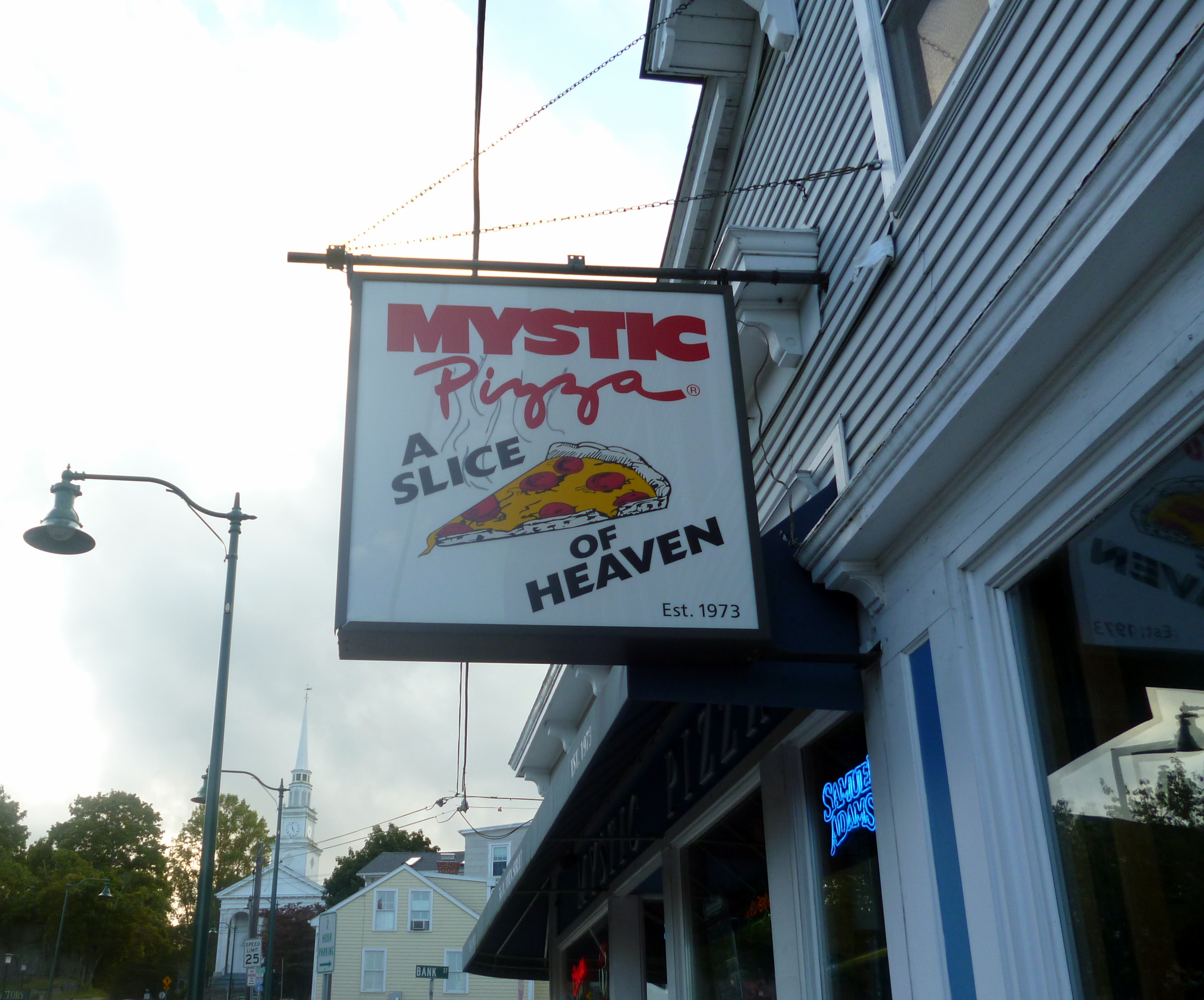
And here’s the iconic Mystic Pizza sign:

The movie didn’t use the actual pizza shop, you’ll be sorry to learn.  If you want to really get into the specific locations used in the movie, you need to go to this amazingly encyclopedic post on the site Road Trip Memories.

Here’s the interior of the current pizza shop. The movie appears to run on a continuous loop on the back wall.  When I took this photo, the final scene of the movie was playing, with the three girls on the back deck of the pizza shop after the wedding.  Moments later, we were back to the opening credits.  I imagine that may quickly get old for the employees.

Here is a scene of the interior used in the movie itself:

At the real Mystic Pizza, the pizza is great; the t-shirts, not so much.

And here is Van Morrison with the last word:

Portal — an online novel: Chapter 1

Here’s an experiment.  I have a science fiction/alternate universe novel that I am pondering/revising.  It’s a bit of a departure for me, since it has a young-adult narrator.  I think it might work for grownups, too.  If I decide I like this approach, I’ll post an additional chapter every week, or perhaps more frequently. I’ll also add an entry to the menu up top, so all the chapters will be in one place.  And I’ll probably end up making it an ebook, so  folks can pay for it!  Or, not.

*************

Chapter 1

 People tell me I’m a pretty good writer for a kid, so I’ve decided to try and tell this story.  Not that I’m going to show it to anyone.  But if I don’t write it down, maybe I’ll start forgetting parts of it.  Worse, I might start thinking it didn’t really happen.  But it did.  It was as real as anything in this world, or any other world.  So here goes.

#

My name is Larry Barnes, and I live in Glanbury, which is a small town south of Boston.  I go to the Theodore Grossman Middle School, which even my parents call The Gross.  When this all happened I was just starting seventh grade, and my life sucked.

Just to show you, here’s the way things went on the day it began.  First off, Mom woke me up with that chirpy “Rise and shine, Pumpkin!” that she knows I hate.  One of the worst things about Middle School is you have to get up so early, and I’ve never gotten used to it.  I looked over at Matthew, and of course he was still sleeping like a baby, because grammar school starts an hour later.  One of the bad things about my life is that I have to share a bedroom with my kid brother.  This is okay when he’s asleep, but when he’s awake it’s just about unbearable, because he won’t stop talking.  It’s like the Mute button in his brain is broken.  And it’s not as if anything he has to say is all that interesting.  He’ll talk for twenty minutes about, I don’t know, lemonade, or water balloons, or some stupid video game.  And he doesn’t really need me to say anything, he’s happy just to yak away by himself.

So anyway, I got up to go to the bathroom, and of course Cassie was already in there, taking one of her endless showers.  Cassie’s my sister.  She’s in high school, and she has “issues,” my mother says.  I say she’s a jerk.  She’s the reason Matthew and I are stuck with each other, by the way; apparently there’s some law that a teenage girl has to have her own bedroom.  So I yelled at her to quit hogging the bathroom, and she yelled at me to get lost, and then Mom yelled at me to hurry up, and I was in a bad mood and I hadn’t even eaten breakfast yet.

Breakfast was the usual–gulp your cereal down or you’ll miss the bus.  Dad had already left for work.  I think he likes to get out of the house before all the yelling starts.  Mom doesn’t complain about him much, but I get the idea that she thinks the same thing.  He’s a computer programmer, and I guess he works really hard; but I don’t see why he can’t eat a meal or two with us once in a while.

While I was trying to get out the door Mom had something new to warn me about; she’s always worried about something.  “Larry, I read in the paper about a man in Rhode Island who was caught stalking kids as they walked to the bus stop.  I want you to be extra careful out there.”

“Mom, we’re nowhere near Rhode Island.”

“They’re all over.  You can’t be too careful.”

“But I’m almost a teenager.”

“That’s just the age these people are interested in.”

Cassie came downstairs in time to hear this part of the conversation, and she said, “Don’t worry, Larry, not even a dirty old man is going to be interested in you.”

So I yelled at her, and she yelled at me, and then I had to run to catch the bus.  I made it, but the only seat was right in front of Stinky Glover.

His real name is Julian, but guess why everyone calls him “Stinky”.  I suppose he takes a shower sometimes, but the effect must wear off before he gets out in public, because I’ve never been near him when he didn’t smell like low tide.  If there was a BO event in the Olympics, he’d get the gold medal.  Oh, and also he’s fat and stupid.  Of course, no one would sit beside him if they could help it, but sometimes you had to sit in front of him, and that could be just as bad.

For some reason Stinky has it in for me.  I really don’t know why.  I don’t call him Stinky; I don’t call him anything.  “Hey, Lawrence,” he whispered, leaning forward.  “How’s it going, Lawrence?”

Why someone named Julian would find the name Lawrence funny is beyond me, but that was Stinky for you.  I ignored him.

I’ve seen the bullying video, of course, and heard the lectures from the school shrink, so I know all about what you’re supposed to do, how you’re supposed to act when someone bullies you.  But the fact of the matter is, Stinky wasn’t exactly a bully.  He never beat me up or stole my lunch money or any of that stuff.  He was just really, really annoying.

Like that morning.  After he got through saying my name a bunch of times, I felt something long and wet in my ear, and heard him half giggle/half snort behind me.  He’d decided to give me a Wet Willie.  Can you imagine feeling Stinky Glover’s finger wiggling in your ear, with Stinky Glover’s spit all over it?  Especially at seven o’clock in the morning, when your stomach hasn’t really woken up yet.  It’s a wonder I didn’t hurl.

I turned around.  “Cut it out!” I demanded.

He grinned, and I saw specks of breakfast on his teeth.  “What’s the matter, Lawrence?  Not having fun, Lawrence?”

So I got up to try and change my seat, and the bus driver started yelling at me.

Just great.  It was a relief to actually arrive at school, where I had a chance to talk to Kevin Albright.  He’s my best friend at school, even though we’re kind of different.  I’m good at writing; he’s better at math and science.   He actually doesn’t do all that well in school, mainly because it’s just so boring, compared to all the stuff he finds out on his own, reading books and visiting weird web sites and doing science experiments in his basement.  He likes me, I think, because I talk about more than video games and TV.  Lots of kids think he’s just strange.

In homeroom before “A” period I told him about Stinky.

“Stinky is an example of evolution gone wrong,” Kevin said.  “Darwin should apologize for coming up with people like him.”

“I don’t need apologies.  I need to figure out what to do about him.”

“Maybe you can pretend you have some kind of disease.  At least that might keep him from sticking his finger in your ear.”

“Stinky is a disease.”

“Maybe you need an anti-Stinky pill.  Stinkomycin.”

Kevin was no help, but he was fun to talk to.

Everything went okay then until English class.  I like English class.  Mrs. Nathanson is an interesting teacher, and she’s the one who thinks I’m a good writer.  But there’s just one problem: I sit next to Nora Lally.  That’s not bad, actually.  Nora is no Stinky Glover.  In fact, she’s the prettiest girl in the seventh grade.  She’s got long black hair and bright blue eyes and this terrific smile.  So what’s the problem, then?

The problem is I can’t bring myself to speak to her, even with her sitting right next to me.  I get nervous.  My throat feels funny.  I can’t think of anything to say.  It’s so stupid.  I go to the school dances.  I pal around with girls.  No one has ever accused me of being shy.  So why can’t I talk to Nora Lally?

I haven’t mentioned this problem to Kevin, by the way; I haven’t mentioned it to anyone.  It’s too embarrassing.

That day was no different.  Before class I could have asked her a question about the homework.  I could have made some funny remark about Mrs. Nathanson–the kind I’m always making to Kevin.  But I didn’t.  I just sat there like a dope.  And Nora just ignored me, the way she always does.

So school finally got out, and wouldn’t you know–Stinky got the seat next to me on the bus.  The only thing worse than having Stinky sitting behind you is having him sitting next to you.  Especially when you can’t open the window.  I felt like my elbow was sticking into a tub of rancid butter.  “Hey, Lawrence!  We’re gonna be best buddies, right, Lawrence?”  Giggle-snort, giggle-snort.

Finally I got off at my stop and walked home.  I didn’t notice any perverts, but then, I wasn’t looking too hard.  My mother was waiting for me with the usual questions.  “How was school, Larry?  How are things going?”

She’s always interrogating me about school.  I think she figures sooner or later I’ll break down and admit I was doing drugs during gym class or something.

“Fine.”  So what was I going to say?  My mom is really great and all, but she’s sort of, well . . . intense is the word my father uses.  I sure wasn’t going to tell her about Nora Lally.  And if I had told her about Stinky Glover, she would have been on the phone to the principal and probably Stinky’s mom as well.  There would have been letters written and meetings called and action plans developed.  And I’d still have to get on the bus with Stinky.

“Are you sure?” she asked.  “You look . . . ”

“I said school was fine,” I snapped at her.  “I’m just a little tired,” I added, trying not to be too grouchy.

“Well, you should go to bed earlier, then,” she replied.  “You know, Middle School can be very demanding, and children your age really need–”

“Good point,” I said.  “I’ll really try.”

She gave me another one of her searching glances, as if trying to figure out if my agreeableness was a danger sign of alcohol abuse.  But I just wanted to end the inquisition.  “Gotta get going on my homework,” I pointed out, and she couldn’t argue with that.  So I headed upstairs to my room.

This was the best part of the day–before Cassie and Matthew got home and started bugging me.  No yakking, no complaining.  Just . . . silence.  Too bad it wouldn’t last.  I didn’t start my homework.  Instead I lay on my bed for a while thinking about how rotten things were.  How was I going to stand a whole year of this?

Finally I decided to go for a walk and try to get Stinky and Nora and everyone out of my brain.

I went back downstairs.  “Goin’ out!” I yelled at Mom, and I headed into the back yard before she could ask me about my homework.  And then I kept on going, past the garage and the old swingset, into the woods beyond the yard.

I have to say something here about those woods.  They’re called conservation land.  My father says it’s great that we’re next to conservation land, because no one can build on it and it increases the value of our property.  My mom worries about Lyme disease, snakes, and poison ivy.  When we were little she used to have a rule against us going into the woods, but she’s kind of given up on that.  It’s better than playing in the street, I guess.

The thing about the woods is, if you go in far enough, you come to a bunch of falling-down old brick-and-concrete buildings.  They were used by the Army during World War Two, although I don’t know exactly what for.  After the war the Army didn’t need them anymore, so they gave the whole area to the town, which turned it into the conservation land.

It’s not that easy to get to the buildings.  There’s an old road that runs up to them, but it’s pretty wrecked by now because the town doesn’t maintain it.  But of course some kids go there, and you see broken beer bottles and stuff scattered around.  Everyone thinks the buildings are a safety hazard and should be torn down, but no one can agree who should pay for it.  Mom really doesn’t want me to go there, because she’s certain one of the buildings will fall on me and I’ll be crushed to death with no one to hear my cries for help.  But she can’t stop me.

I don’t care about the buildings, but I do like the woods.  They’re dark and quiet, and there’s no one to bug you.  My dad has taught me the names of some of the trees and plants, so I don’t feel like a dope in there.  Anyway, the woods just felt like the right place to be that afternoon.

So I picked up a long stick and started whacking it against the trees as I walked.  Take that, Stinky!  Take that, Cassie!

I usually don’t go out of earshot of the house–that’s Mom’s latest rule–but that day I just felt like walking.  I wanted to get as far away from my life as I could.  And eventually I found myself near those old army buildings.

I was a little surprised–I hadn’t realized I had walked that far.  But it was no big deal.  It wasn’t like a wall was really going to fall on me.

Then I heard a noise from inside one of the buildings.

Again, no big deal.  If other kids were there, I’d just go home.  Despite Mom’s fears, I don’t drink or anything, and I don’t want to hang with the loser kids who do.  So I turned around.  I had only walked a few steps when I heard someone call to me.  “Hey, Lawrence!  Watcha doin’, Lawrence?”

What was Stinky doing here?

“Wait up, Lawrence!”

I turned back.  He was heading towards me.  I really didn’t want to deal with Stinky right then.  I started to run.

Okay.  Here’s where it starts.  I slowed down to catch my breath–I wasn’t too worried about Stinky being able to catch up to me.  I was in a small clearing.  And I was still holding onto the stick, kind of whipping it in front of me like a sword.  And I noticed something.

The end of the stick disappeared.

I don’t mean that it got lost in the brush or anything like that.  I mean, it was there, in mid-air, and then it wasn’t.  And then as I kept moving the stick, it came back again–it reappeared.  I looked at the stick.  It seemed okay–it wasn’t broken or anything.  I tried again.

Same thing.

My heart was pounding.

I dropped the stick and slowly reached forward.  And my hand disappeared too.  One second it was there in front of me, the next second it was gone, like it had been lopped off.  But there wasn’t any pain.  There wasn’t any pressure or resistance.  It didn’t feel hot or cold.  It just felt–different.  I took my hand back out and extended my foot.  It went in, disappeared, and then I brought it back out.

I couldn’t figure it out.  All I could think was: This is really weird.

“Hey, Lawrence!  Wait up!”

Stinky was heading towards me through the trees.

And then I had another thought: Wouldn’t it be cool if I disappeared right in front of Stinky?

This was a really stupid thing to think.  I admit it.  My mom would have totally freaked out.  I would’ve freaked out if I’d thought about it for another couple of seconds.  But I had this cool vision in my mind of Stinky standing there with a dopey look on his face, and me standing right next to him in this zone of invisibility or whatever, laughing at him.

I sure wanted to do that.

So, like a total idiot, I stepped inside.

Forbidden Sanctuary: The pope gives a sermon about aliens, among other things

Readers of this annoying blog may have noticed that I have lots of problems with religion.  Readers of my fiction (especially Pontiff) may have noticed that I treat religion (and, in particular, people with strong religious faith) pretty sympathetically. What’s up with that?

Beats me.  It really is a mystery why some characters and plots and issues seem worth writing about, and others don’t (why, for example, I have no interest in writing the organically plotted novel I talked about here).

Anyway, here is a little snippet from Forbidden Sanctuary that addresses issues I still find interesting: the relationship between science and religion, the nature of morality, blah blah blah.  Pope Clement is giving a brief sermon to a small congregation in a drafty rural church before he goes off to meet with the alien leader–a meeting on which the future of the world depends (naturally).  He has been doing a lot of thinking….

***************

“We have heard it stated,” Clement said softly to the congregation, “that mankind’s knowledge has outstripped its religions. The Church fights losing battles against Galileo and Darwin, and people’s faith is shaken. Is the Church nothing more than a relic of ancient ignorance, vainly reinterpreting its doctrines in an attempt to reconcile them with modern facts?

“We would suggest that the opposite is true, that science is struggling fitfully toward truths our spiritual nature has always apprehended. And chief among these is the interdependence of all life, all matter. As you did it to one of the least of these my brethren, you did it to me. Ask the ecologist, the physicist if that is not a scientific truth as well.

“Always our perspectives are widening, but the moral basis for our response to these perspectives has always been there. Love thy neighbor as thyself. Science makes the starving African our neighbor, and the homeless Indian, and the oppressed Cambodian, and we realize our actions affect them, they cannot be ignored. Now we have a new neighbor, and science struggles to understand why, and how. But the moral, the spiritual response to this knowledge already exists, and it is right. If we falter in our application of these spiritual truths, then truly religion’s claim to superiority is lost. This is a crucial time for mankind, not the least because these truths are being put to the test.

“That is why we ask for God’s blessing on our work, and your prayers. The truths will always be there, but men and women must always seek the strength to put them into practice. That strength can only exist with God’s help. Let us stand and profess our faith. I believe in one God…

What do you do if your future is already in the past?

I’ve been rereading my first novel, Forbidden Sanctuary, as it makes its way through the ebookification process.  You’ll like it!  Check out the first chapter!

Forbidden Sanctuary is straight-ahead first-encounter science fiction with a religious twist.  I wrote the novel in the 1980s, but for reasons that are somewhat opaque to me now, I set the action 30 years in the future–around 2003, if I follow the novel’s implicit chronology correctly.  This offers the same challenges I faced with Replica, which is implicitly set in 2024, except that I don’t have the extra 12 years of futureness to play with.  All the action in the novel takes place in the near past, as far as a present-day reader is concerned.  And, of course, I got some things wrong.

Do my failed attempts at futurology matter?  The novel is an artifact, created at a certain time and in a certain place.  You don’t expect science-fiction predictions to be entirely accurate.  Readers understand this.  Why bother tweaking the thing?

Well, for one thing, I’m not completely sure that readers do understand this.  The original publication date is right there on the ebook’s copyright page, but that’s all there is to let people know that this ebook isn’t new–it’s not like you’re buying a paperback with yellowed pages in a musty used bookstore.  I was talking to a really smart guy who had just read the ebook of Senator, and it soon became clear that he thought I had written the book recently, presumably to coincide with the 2012 election.  Er, no.

Anyway, as with Replica, the two major features of modern life that I missed were cell phones and the Internet.  I did have some people with “personal phones” that they flipped open, but I was somewhat inconsistent with them.  For example, I also had FBI agents communicating with each other via something called “telecoms,” which I guess were like super-modern walkie-talkies.  There were also some minor references that no longer work in the world as it actually was in 2003: references to the Soviet Union, for example, and to the never-ending conflict in Northern Ireland.  So I did some tweaking.

The thing that I got right, I think, is the role of the Catholic Church in the 21st century.  I didn’t imagine the sex abuse scandal, of course, but I did imagine a church fighting a rearguard action against modernity–churches closing, vocations plummeting, but still with many people who believed deeply, fervently, in its truths.

Also, the aliens are great!