The android prepares to leave his maker (an excerpt from Replica)

Here’s an excerpt from Replica

Shana is the scientist who has been kidnapped to create an android replica of the president.  Her father had lost his job to a robot, and she is still coming to terms with this.

The android knows that his consciousness of being an android is about to be suppressed so that he “becomes” the president.  The memories of his brief past, it turns out, are happier than Shana’s own childhood memories.

Replica is an in-your-face thriller.  But it ends up also being an odd sort of love story.

*******

They took a walk one afternoon through the thin woods surrounding the back lawn. Shana knew that Gus was following them, making sure they didn’t electrocute themselves trying to escape, but she didn’t care. She was used to being watched now.

They didn’t say much. The android was probably upset that their little idyll here was coming to an end, but was afraid to say so. That was all right. She didn’t need to talk about the end of their idyll.

She watched him stop and stare at a chipmunk, run his hands over a tree trunk, pluck a leaf and rub it between thumb and forefinger. At times, he could seem so childlike. He knew so much but had experienced so little.

If he was a child, she did not want to be his parent.

She remembered taking walks with her father, holding on to his big calloused hand, struggling to keep up with his adult strides. They, too, had said little. Her father was a quiet man, until liquor fueled an explosion of rage and resentment against a world that had stripped him of his job and his dignity. She wanted so badly for him to be happy, and a wink or a smile was enough to flood her heart with joy. She rarely got either during those walks, but at least he was sober; at least he was with her. What did he think about as he trudged wordlessly with her through the park or to the supermarket for a quart of milk? It never occurred to her to wonder; a child doesn’t wonder things like that. It was enough to be together.

“You were the only thing he did right, the only thing he could be proud of,” her mother said when he was gone. “Everything else failed, except you. And then you had to take up with those computers, and it was as if you were spitting at him, making a mockery of his life. How could you do that? How?”

Look at your grandchild, Shana thought suddenly. The idea would not have brightened her parents’ day.

And then she thought: Pity the poor android. No past to comfort him, no happy childhood memories to console him, as he prepares to confront an uncaring world. She smiled grimly.

He was staring at her, probably afraid to ask what the joke was. He was right to be afraid. “I think we’ve gone far enough, Randall,” she said softly. “Time to head back.”

He obeyed without a word.

* * *

He liked the taste of the scotch. It warmed his body and seemed to warm his thoughts, too. Shana had told him to start drinking to get used to it, and that was an order he had no difficulty obeying.

Gus had brought them folding chairs, and they sat in front of the mansion next to the broad columns, sipping their drinks and listening to the birds twittering in the sunset. He could not imagine anything nicer. Except, perhaps, the same scene, with Shana happier, and no deadline facing them.

The deadline was never far from his thoughts now. It was the day on which he would die. He would have served his purpose and would therefore cease to exist except in random snatches, perhaps, yielding his place to the other being inside him who he was and was not, for whom he felt nothing more than a vague sense of ownership, a confused dislike. This was not a prospect that had bothered him before; he supposed it was coded into him not to mind. When he had merely existed in a computer, conscious only in occasional flashes of CPU time as Shana worked on him, it hadn’t mattered that he was constantly dying and being revived. But now something had changed. He had memories—memories that were intrinsically different from the artificial constructs of his Forrester database, even if they were coded identically inside him. They were different because they were his. And when he died, those memories would die with him.

He remembered his first night alive, lying awake in the darkness and wondering if he was asleep, wanting desperately to be with Shana, afraid but so excited that his fear seemed trivial. To have a body! To be real—to touch his creator! And waking up the next morning after sleep had finally taken him unawares—a moment of terror until he finally caught up with his input: a cracked ceiling, a window, sunlight, a firm mattress, soft pillow, full bladder. Alive.

Shana praising him after the first interview with Hunt.

Shana comforting him during his first thunderstorm.

The way she looked at breakfast, her hair still wet from the shower, joking about the food, her eyes sparkling with some idea that had come to her overnight.

Her sadness and her anger, and the many times he had longed to help her and never knew how. And now he would never find out.

He sipped his drink and tried not to be sad himself. There was too little time left to spend it being sad. “It’s beautiful here,” he murmured.

She nodded silently.

“I think scotch makes it even more beautiful.”

That got her to smile, and her smile paradoxically worried him so much that he had to break the fragile happiness of the moment. “When this is over, Shana, will you be all right? What will they do to you?”

She shrugged. “Don’t worry about me, Randall. It’s good of you—it’s hard for you not to—but it’s just a waste of time.”

“All right, Shana.” But it wasn’t hard; it was impossible. He gazed out at the trees and the lawn and the glorious sunset, trying not to be sad and not to worry, and he knew that no amount of beauty, no amount of scotch, would let him succeed.

What should Dover Beach’s cover look like?

Dover Beach is a private eye novel set in Boston and England in the aftermath of a limited nuclear war.  (Yeah, I don’t know why I wrote it either.  But it’s good!  Read the review excerpts at the link!)

Here’s the American cover.  The mushroom cloud suggests that it takes place during a nuclear war, maybe.  The man and the woman look appropriately solemn, I guess.  The guy is the private eye, presumably, and the girl is his girl.  I don’t think the cover makes you want to race out and buy the book.

Here is the Japanese cover.  Surprisingly, the Japanese publisher didn’t opt for a mushroom cloud! I don’t know that the cover gives you any sense that the novel takes place after a nuclear war; maybe that’s for the best.  Dover Beach means nothing to Japanese readers, so it has a different title — but I forget what it is.  The private eye is named Walter Sands, and he calls himself the Sandman sometimes, so that explains the signs on the doors.  I have no idea why there are palm trees.

Anyone got any ideas what the ebook cover should look like?

Let’s all write an extra book a year!

A recent New York Times article highlights the increasing pressure on successful writers to produce even more content to satisfy their readers’ demands for more stuff.

They are trying to satisfy impatient readers who have become used to downloading any e-book they want at the touch of a button, and the publishers who are nudging them toward greater productivity in the belief that the more their authors’ names are out in public, the bigger stars they will become.

“It used to be that once a year was a big deal,” said Lisa Scottoline, a best-selling author of thrillers. “You could saturate the market. But today the culture is a great big hungry maw, and you have to feed it.”

Writers are even being encouraged to come up with digital-only 99-cent short stories to keep their names before the public.

One word that doesn’t occur in the Times article is quality.  This is about writing as business, not writing as art.  One writer complains that “You don’t ever want to get into a situation where your worth is being judged by the amount of your productivity.”  But what else can it be judged by, if you’re pumping out thousands of words a day?

When I get around to writing up more of my rules for writing, Rule 2 will be “Revise” and Rule 3 will be “Rewrite.”  But these two rules assume that quality figures somewhere in your rationale for writing.  At a certain level of professionalism, you can create a reasonable novel in a single draft with minimal revisions — especially if you’re working in a formulaic genre like romance.  But the resulting product can’t possibly be as good as you can make it.  The ability to make a good living off your fiction is in this respect antithetical to the ability to make good fiction. I have never been able to figure out how to make that tradeoff; and that’s why I have a day job.

Lower prices coming on ebooks

The Department of Justice has brought suit in the ebooks pricing case, and three publishers (Hachette, HarperCollins, and Simon & Schuster) have settled.  We mentioned the possibility of the suit here.  The government is saying that five publishers and Apple colluded to force the “agency model” onto the ebook business.  In the agency model, the publisher sets the price, and the seller gets a percentage of that price for each sale.  There’s nothing illegal about the agency model; it’s the collusion that got these guys in trouble.  Apparently the government has pretty good evidence of the collusion.  Here’s the DOJ’s statement, which says in part:

During regular, near-quarterly meetings, we allege that publishing company executives discussed confidential business and competitive matters – including Amazon’s e-book retailing practices – as part of a conspiracy to raise, fix, and stabilize retail prices.   In addition, we allege that these publishers agreed to impose a new model which would enable them to seize pricing authority from bookstores; that they entered into agreements to pay Apple a 30 percent commission on books sold through its iBookstore; and that they promised – through contracts including most-favored-nation provisions – that no other e-book retailer would set a lower price.   Our investigation even revealed that one CEO allegedly went so far as to encourage an e-book retailer to punish another publisher for not engaging in these illegal practices.

The three publishers who settled have agreed to abandon the agency model for two years.  Amazon is already saying it’s ready to lower e-book prices:

“This is a big win for Kindle owners, and we look forward to being allowed to lower prices on more Kindle books,” said an Amazon spokesperson, referring to a settlement the Justice Department reached with Hachette, HarperCollins and Simon & Schuster.

But the Wall Street Journal warns:

The settlement allows publishers to negotiate limits on how much retailers can discount, ensuring retailers can’t lose money overall on e-book sales. Moreover, Amazon may be cautious about across-the-board discounts because its profit margins are already thin.

This is clearly bad news for publishers and bookstores.  Lower prices on ebooks means lower sales of print books.  Amazon may not do across-the-board discounts, but this still opens up the possibility of price-shopping for the best deal on any given ebook.  So it’s good news for ebook readers, at least in the short run.

In the long run, who knows?  What if Apple leaves the ebook business, Barnes & Noble goes bankrupt, and only Amazon is left as a major ebook retailer?  Monopolies aren’t good for consumers.  On the other hand, the barriers to entry in the ebook market are pretty low.  All these vendors have their own reading devices for ebooks, so there is a convenience element to buying and downloading books from their online stores, but I’m not sure how big a deal that will ultimately be.

And, as I mentioned before, this doesn’t affect people like me, who are essentially independent publishers.  Both the wholesale model and the agency model work fine for us, as far as I can tell.  We just have to get people to buy our stinkin’ books.

Replica cover ideas?

The cover for Senator is still in process, but the ebook should be available in a few short weeks.  Next up is Replica.  Which is a really good novel!  Expect some posts about robots and artificial intelligence!

Anyway, we need to start pondering cover art yet again.  Replica, as the link will tell you, is about a plot to create an android replica of the president of the United States.  The novel contains many surprising twists and turns, although I can’t remember any of them off the top of my head.

Here is the American cover:

And here, just for fun, is the cover of the German edition, evidently created by someone who has spent way too much time watching German silent movies:

That could be the worst cover ever created.

Any opinions or suggestions?

Did J. K. Rowling just transform book publishing?

Matthew Yglesias thinks so.  As with his previous article about book publishing, I don’t quite get it.

Rowling has bypassed the standard ebook sellers like Amazon and Barnes & Noble to sell her Harry Potter ebooks on her own web site.  (The books sell for $7.99 or $9.99 apiece, which seems pretty reasonable to me.)  Apparently Amazon points you off to her Pottermore site instead of offering the books directly from its Kindle site; that sounds new.  Presumably if you buy via Amazon she is getting a higher cut of the sale price than the 70% that regular authors get; but that’s not something any random author can pull off.  If you buy directly from her site, presumably she is getting all of the sale price (minus credit card transaction fees and maybe some site design costs).  But that’s not new; I could do it too, if I wanted.

The reason I started this blog is to provide a web presence where I could let people know my ebooks existed.  Previously, if you searched for me on Google, you would encounter lots of hits for a British guy with my name who ran British Rail or something like that (plus some other Richard Bowkers–who knew the name was so popular?).  These other Richard Bowkers haven’t gone away, but you’ll now typically find this site on the first page of Google search results, which is what I had in mind.  Now that I have the web presence,  it wouldn’t be too hard to let you just buy the books here.  More profit for me!

What the Rowling approach doesn’t do is allow readers to buy her ebooks at a discount, which is what the wholesale model is all about.  No matter where you buy the book, you’ll end up paying the same price for it.  So that part of the ebook business hasn’t changed at all with her new site.  Given the agreement I signed with Amazon, I couldn’t charge a different price either.  You might imagine that you could buy a book more cheaply if you were to get it directly from the author.  But if I charge a lower price here, Amazon has the right to lower the price on its site.  So you might just as well buy my books from Amazon, which provides me with another source of publicity for them.  So please do so.

Also, please, write reviews!  And tag my tags!

Have conservatives always been this crazy?

Senator is in the process of ebookification, so expect some political blogging, alas.

Senator is about a conservative Republican senator from Massachusetts in the middle of a difficult reelection campaign.  Things don’t get any simpler for him when he discovers the body of his mistress, who has been brutally murdered in her Back Bay apartment.  Many interesting complications ensue! And I look forward to recalling what they are when I reread the novel to discover what interesting typos the scanning process introduced into the text.

One of my goals in writing the novel was to make the senator (Jim O’Connor) as sympathetic as possible (so it’s written in the first person, for example).  Who wants to read a novel whose protagonist is a creep?  One of the challenges of meeting that goal is that, as a knee-jerk liberal, I needed to find a way to sympathize with a conservative.  I have to say that I found that easier in the early 90s, when I wrote the novel, than I would find it today.  Because to be a Republican in 2012 is to sign on to the crazy.

I’ll just assert the craziness here; listing the many examples would be too depressing.  But a question of some interest is: what happened to the Republican party?  Is the craziness a recent phenomenon?  Or was it always there?  Rick Perlstein, the author of the infinitely depressing Nixonlandargues that it has always been there.  The standard response to this (which you can see in the comments to his article) is: hey, some liberals believe crazy things too!  Well, sure.  But the crazy liberals are not running the Democratic party.  George Romney could stand up to the crazies in the 60s; Mitt Romney saw what happened to his father, and apparently decided that the only way to become president was to embrace the craziness.

I don’t have sufficient imaginative powers to sympathize with someone like that.

Should the government sue over ebook prices?

They’re about to.  Matthew Yglesias recounts the story here.  I’m a big fan of Matthew Yglesias, but I think he’s leaving out a large part of the story here, which is that the collusion between Apple and the major publisher results in higher ebook prices for you and me.

I haven’t been following this very closely, since I’m late to the ebook game, but as I understand it, the original ebook pricing model was based on the traditional hardcopy model.  The publisher sells the book to the retailer (say, Amazon) at a substantial discount off the suggested retail price (say, 40%), and the retailer is then allowed to charge whatever it wants.  If it’s a popular book, the retailer might even want to sell it at a loss to get people to come to its site.  This sets up price competition between sites, which is great for the reading public.

The problem for traditional publishers is that this price war encouraged people to buy ebooks instead of hardcovers.  And when Apple came along and wanted to start its own ebook store for the iPad, it didn’t want to get into a price war with Amazon.  The result of the discussions between Apple and the major publishers was an agreement to implement what is referred to as the agency model.  In this model, the publisher gets to set whatever price it wants for an ebook.  The retailer (Apple or whoever) gets a standard percentage of that price (it turns out to be 30%).  And the publishers can’t use the wholesale model for other sellers.

The result is that there is no price competition among ebook sellers.  And ebook prices are set high enough that they won’t have a significant impact on hardcopy sales.

In the ebook world, I am a publisher with a very limited list of titles.  As you’ve noticed, I get to set the prices for those books.  If I then reduce the price of Summit, say, on Barnes & Noble, according to the standard contract I had to agree to, Amazon is entitled to automatically lower itsprice to match the lower price; and it will.  There are no royalties.  I get 70% of the sales revenue; Amazon (or Barnes & Noble) gets 30%.

This works fine for me as an author/publisher with no hardcopy inventory and pricing to worry about.  The wholesale model would have worked for me just as well.  But in general, I don’t see how the agency model benefits readers.  If the publishers have a problem with ebooks cannibalizing sales of their hardcopy books, the obvious solution for them is to delay the publication of a book in ebook format, in just the way they have always delayed the release of paperbacks, in just the way studios delay the release of movies on DVDs.  Publishers do drop ebook prices as hardcover books are released in cheaper formats, so reader may be able to get a book more cheaply by waiting.  But the reader will never be able to shop around for a better deal.  This is apparently what got the attention of the Justice Department.

I can see one way in which the publishers’ deal with Apple is a good thing: it ensures that Amazon will not be able to use its ebook pricing power to drive all other ebook sellers out of business.  But Amazon already has a huge share of the market without having to cut ebook prices.  Instead of selling ebooks at a loss, they’re selling Kindles at a loss.

From a legal perspective, I have no idea how strong the government’s case is against the publishers and Apple.  Readers can buy a discounted print edition of a book if one is available; no one is forcing them to buy the ebook.  And authors can bypass the major publishers and set their own prices for their ebooks, as I’m doing.  But on the face of it, the publishers’ agreement with Apple just isn’t a good deal for those of us who like to read ebooks.

Fantasy Author Worth Reading

Finally available in ebook, here are some stories by Mary C. Aldridge that I’ve read and enjoyed.  One of them, The Adinkra Cloth, was nominated for a Nebula Award for best short story.  The stories dwell in an interesting corner of the imagination: African fantasy.  Maybe not your first choice of genres for your reading pleasure, but they work really well.  If you’re a cheapskate, you can buy the stories individually for 99 cents each.  Or you can splurge and buy all five for $2.99.  I recommend splurging.

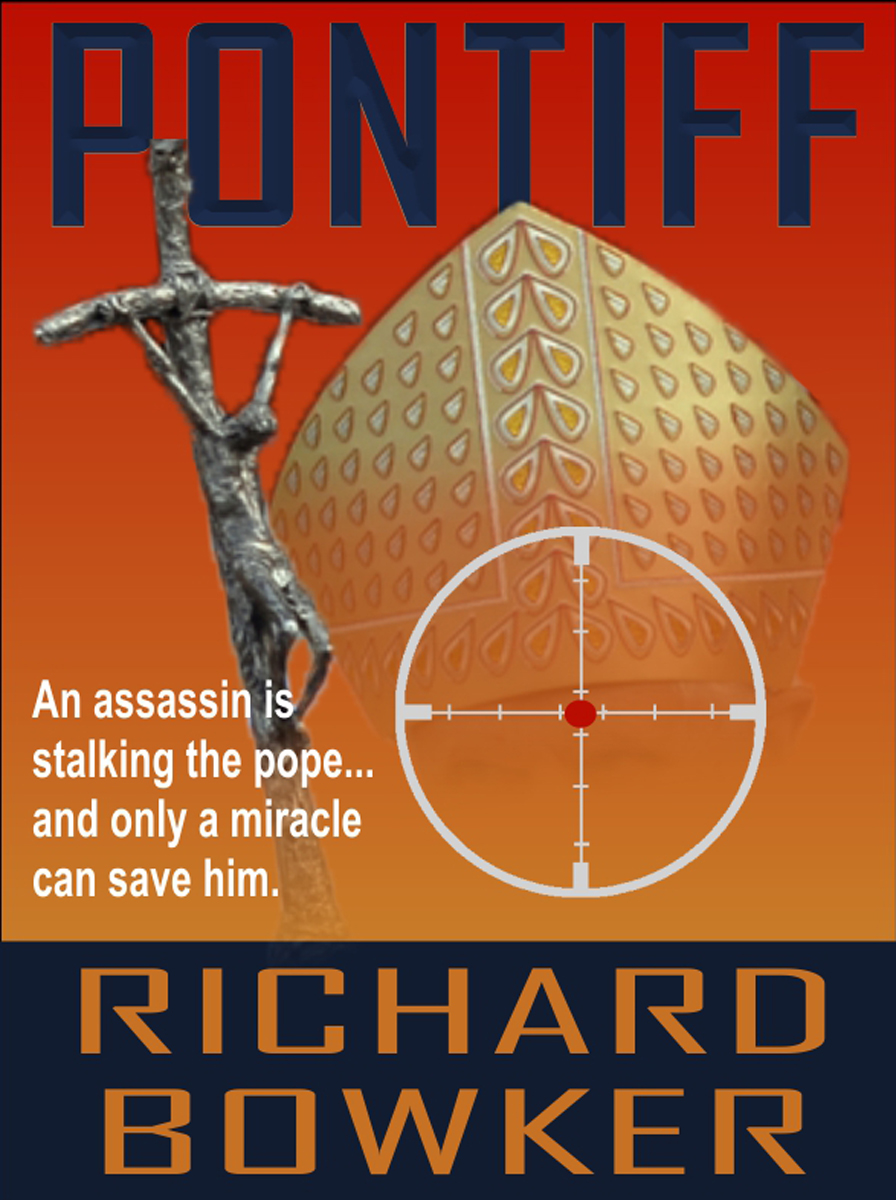
Pontiff is available on Kindle and Nook!

Pontiff has arrived!

Kindle edition is here.

Nook edition is here.

Here’s what the cover looks like (choice A with some tweaks):

Pontiff


The price: a mere $5.99.  OK, that’s twice what Summit costs, but we’re still experimenting here.  Think of it this way: it’s less than you probably spent for lunch yesterday.  And sure, that stewed haddock (let’s say) was good, but you’ve already digested it, and now you just have to eat all over again.  And it’ll take you a lot longer to read Pontiff than it took you to watch John Carter.  More value for your entertainment dollar!

One final note: if you think you’ve already read this novel, you are very probably wrong.