The top 100 British novels, voted by non-British critics

The BBC polled a bunch of non-British book reviewers and literary scholars to come up with their list.  Note that it’s British novels only — so no James Joyce.

I’m a sucker for articles like this.  The first thing I want to know is how many of these books I haven’t read — or, in this case, writers haven’t even heard of.  I count 13 writers who are completely new to me, most of them from the 1980s on.  I haven’t been keeping up!  There are probably another 20 or so that I’ve known about forever but never read — Doris Lessing, John Galsworthy, Arnold Bennett, Paul Scott, Anthony Trollope, George Gissing . . .

Some more thoughts:

  • I’m glad to see P.G. Wodehouse on the list, if only at position 100.  But another 20 of his novels are just as good as Code of the Woosters and could reasonably have ended up on a list like this.
  • I’m also glad to see Philip Pullman’s His Dark Materials on the list.  Someone at work complained about its being rated higher than The Chronicles of Narnia.  That doesn’t bother me a bit.
  • I’m not a big Kazuo Ishiguro fan, so I’m annoyed that he takes up two spots on the list.  Remains of the Day is #18?  Higher than Emma, Persuasion, and Jude the Obscure?  Really?
  • I liked Ian McEwan’s Atonement, but I don’t think it deserved #15.
  • I didn’t like Ford Madox Ford’s The Good Soldier, so I have no idea what it’s doing at #12.
  • I’m OK with Middlemarch at #1, but I’d put it below Great Expectations, which came in at #4.
  • There’s four Virginia Woolf novels on the list.  Maybe it’s time to re-read her.  I liked To the Lighthouse (#2), but I couldn’t finish Orlando (#66).

I need to read more novels.

Happy birthday, William Blake!

Born this day in 1757.

Here is his poem “Infant Joy”:

“I have no name:
I am but two days old.”
What shall I call thee?
“I happy am,
Joy is my name.”
Sweet joy befall thee!

Pretty joy!
Sweet joy, but two days old.
Sweet Joy I call thee:
Thou dost smile,
I sing the while;
Sweet joy befall thee!

Randall Munroe goes all Up Goer 5 on us

I’m a big fan of Randall Munroe and his xkcd strip.  I’m also a big fan of Up Goer 5.  So it was really nice of him to write a whole book called Thing Explainer in Up Goer 5, which is coming out next Tuesday.

If you can’t wait, he has an excerpt in the New Yorker. Here’s how it starts:

There once was a doctor with cool white hair. He was well known because he came up with some important ideas. He didn’t grow the cool hair until after he was done figuring that stuff out, but by the time everyone realized how good his ideas were, he had grown the hair, so that’s how everyone pictures him. He was so good at coming up with ideas that we use his name to mean “someone who’s good at thinking.”


Where did Homer get his MFA?

Homer and I go way back — all the way to the summer before my senior year in high school, when one evening a week I would drive to Dorchester and translate the Odyssey while dripping sweat onto the ancient text.

I’ve lost all my knowledge of ancient Greek in the intervening years, but I feel the need to reacquaint myself with Homer every once in a while.  Most recently, I listened to an audio version of the Iliad narrated by Dan Stevens.  Listening to this ancient epic while fighting traffic on Interstate 93 isn’t perhaps the ideal way of encountering Homer, but it’s the best I can do nowadays.  A few brief comments:

  • Dan Stevens is pretty good!  He obviously made the right career decision by quitting Downton Abbey for the lucrative business of narrating epic poems.
  • It’s amazing how modern some of the narrative structure is — for example, Homer needs a scene that shows Hector’s wife Andromache mourning his death.  But the sceone won’t work unless he has a previous scene establishing their love.  And that’s exactly what he has–a set up, and then a while later, the payoff.
  • On the other hand, he must have been absent the day his MFA program went over the rules for naming characters.  The Iliad, of course, features two major characters with the same name: Ajax. So Homer has to put his Homeric epithets into overdrive to ensure that we know which one he’s talking about. (Someone mentioned to me that some people point to this as evidence that these were real people–even back then, no one would be stupid enough to give two made-up characters the same name.)  Also, of course, multiple characters have more than one name.  Thanks a lot!  Generally, although not always, the alternative name is just a patronymic; even so, this doesn’t help us follow the action.  Similarly, Homer doesn’t bother to call the Greeks “Greeks”; instead they are Argives or Achaeans or Danaans.  (And Troy is randomly referred to as Ilion.) That is also really helpful.
  • The gods are hugely present in the Iliad, and are generally speaking much more entertaining than our current crop of deities.  The Zeus/Hera squabbling never gets old.  Here is a photo of grey-eyed Athena from the Museum of Fine Arts:

2015-08-09 12.38.24

  • On the other hand, I have never been happy with how much the gods motivate the action.  It’s never the case the one side does well because somebody has a good plan; or, if he does have a plan, it’s because a god put him in mind of it.  This is the sort of thing that Julian Jaynes points to in everyone’s favorite bookThe Origins of Consciousness in the Breakdown of the Bicameral Mind, as evidence that back in those days people weren’t conscious in the way we are today; instead, they heard voices in their minds that they interpreted as being the gods.
  • Finally, after all these years, I still prefer the Odyssey to the Iliad.  I ultimately find the incessant battle scenes repetitive and a bit exhausting.  Along with the rest of the Argives and Achaeans and Danaans, I just want Achilles to get over himself and come back and win the damn war.

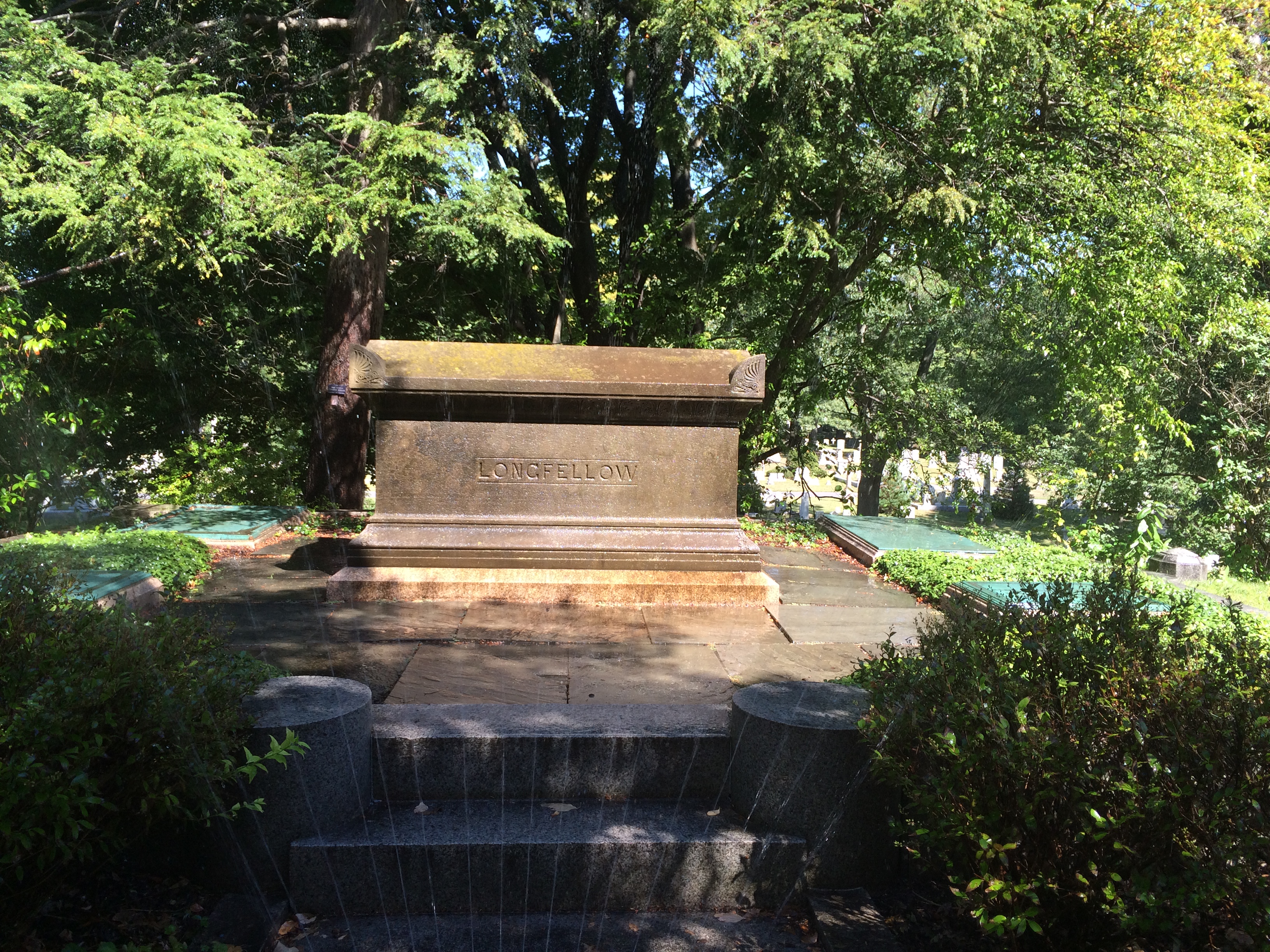
Longfellow’s tomb

Life (and death) brought me back to Mount Auburn Cemetery the other day, so I can now include a personal photo of Henry Wadsworth Longfellow’s tomb, in place of the one I included in this post:

2015-09-17 12.15.18

(A sprinkler is at work in front of the tomb.)

As a special bonus, here is the more modest gravestone of the nineteenth-century American historian Francis Parkman, buried right down the street from Longfellow:

parkman

Parkman’s uncle George was the victim in a celebrated murder case chronicled in the documentary Murder at Harvard.

Stephen King on being prolific

Stephen King has always struck me as being a humane and generous writer.  In today’s New York Times he has a piece entitled “Can a Novelist Be Too Productive?”  He points out:

No one in his or her right mind would argue that quantity guarantees quality, but to suggest that quantity never produces quality strikes me as snobbish, inane and demonstrably untrue.

And he points out that some writers (himself included) are just meant to be prolific–they can’t help themselves:

As a young man, my head was like a crowded movie theater where someone has just yelled “Fire!” and everyone scrambles for the exits at once. I had a thousand ideas but only 10 fingers and one typewriter. There were days — I’m not kidding about this, or exaggerating — when I thought all the clamoring voices in my mind would drive me insane. Back then, in my 20s and early 30s, I thought often of the John Keats poem that begins, “When I have fears that I may cease to be / Before my pen has glean’d my teeming brain …”

But he never quite answers the question in his title (the title, of course, may not be his).  This comes to mind as I read Elin Hilderbrand’s novel The Rumor.  She is no dummy:  She went to Johns Hopkins and the Iowa Writers’ Workshop.  She has created her own wildly popular genre–the Nantucket beach novel.  But clearly her publisher wants her to write a book, maybe two books, a year.  Could her novels be better if she took more time writing them, if she aimed higher? Is she being too productive?  Beats me, but I think maybe so.  The Rumor seems OK, but it is very slight.

On a related topic, I have so little time to read that I tend to avoid prolific novelists, because I fear that they are sacrificing quality for quantity.  But, of course, I could be wrong.  Here is Shakespeare’s output for 1599, as chronicled in the wonderful book A Year in the Life of William Shakespeare: 1599:: Henry V, Julius Caesar, As You Like It, and Hamlet.  I don’t think any of us would  have wanted Shakespeare to slow down in 1599.

My Elin Hilderbrand app

My lovely wife is a big Elin Hilderbrand fan.  She writers novels of life and love on Nantucket — lately two a year, a summer one with a beach cover and a Christmas one with a homey cover of a Nantucket house with Crhstmas decorations.  My wife talked me into reading Hilderbrand’s latest, The Rumor.  The cover is typical:

And here’s a typical paragraph.  The action takes place just after 40-something Grace has started her affair with the hunky landscape architect:

Grace served a cold roast chicken, a fresh head of butter lettuce, a crock of herbed farmer’s cheese, and fat, rosy radishes pulled from the garden.  She cut thick slices of bread from a seeded multigrain loaf with a nice chewy crust, then she went back into the fridge and pulled out sweet butter, a jar of baby gherkins, a stick of summer sausage, and some whole-grain mustard.

This is not a paragraph a man wants to read, although the hunky landscape architect finds the meal absolutely delightful.

Anyway, the novel is perfectly okay-if-you-like-that-sort-of-thing, and Hilderbrand seems to be a perfectly extraordinary human being, who writes two novels a year while raising three kids and battling breast cancer.

Plus, she has an app.  I didn’t know that was a thing, but her publisher, Hachette, seems to think this is a good idea.  It doesn’t seem to be updated a lot — it doesn’t list The Rumor among her novels, for example, and the Recipes section is pretty thin for someone who writes paragraphs like the one I quoted (and she doesn’t seem to know how to spell the word kernel).  But, you know, it’s an app.

I want one.

The Wright Brothers

I have it on good authority that David McCullough is moving to my little town, which will cause the mean income of town authors to increase by approximately eleventy billion percent.  His latest book, The Wright Brothers, will certainly do nothing to harm his bank account.  Like all his books that I’ve read, it’s vivid and entertaining.  And the Wright brothers are a great story — how two self-taught Ohio bicycle mechanics solved the basic problems of heavier-than-air flight through sheer brilliance and amazingly hard work.

I have a minor complaint and a question.  First, I share with the Times reviewer the wish that McCullough had expanded his story, which basically stops at the point of the Wright brothers’ greatest triumph, and then just briefly sketches in the rest of their lives and the story of aviation after their triumph:

“In his brief epilogue, McCullough tells us that in the years leading up to his death, Wilbur was consumed by ‘business matters and acrimonious lawsuits.’ When I finished the book, I rushed to Wikipedia to find out more — and when a reader has to go to Wikipedia, he must be pretty hard up.”

And my question: how does a successful historian like McCullough decide what to write about?  There have been dozens of books about the Wright brothers, if McCullough’s bibliography is any guide.  Does he think the world needs a new one?  Did he uncover new source material?  Or (more likely) did he just feel like writing the story, because it’s the kind of story he likes to tell?  If that’s the answer, it’s fine by me.

E-books and price resistance

Now that I have a Kindle Paperwhite, I’m paying more attention to my book-buying thought process. Yesterday I was thinking fondly about A Fan’s Notes, and I was prepared to purchase the ebook, but I just couldn’t bring myself to click the button — $9.99 just seemed too high a price for an impulse purchase where there was a good chance I’d be disappointed.  I would certainly have bought it for $4.99, but I wouldn’t have gone much higher.

The big publishers essentially won their battle with Amazon over agency pricing for ebooks.  They get to set the price, and they don’t seem to want to go below $9.99, even for a 47-year-old mid-list book like A Fan’s Notes.  I can’t really say they’re over-charging simply based on my personal level of price resistance.  But:

We’re hearing widespread but totally unofficial reports that big publisher ebook sales are dropping noticeably when their new higher Agency prices are activated.

And:

What appears to be happening, writes Shatzkin, is that higher Agency pricing by publishers may be placing  the majors’ ebooks right out of the market for many potential buyers.

I did pay $11.99 recently for the ebook version of Faith vs. Fact.  But that was at least partially because I’ve gotten a lot of enjoyment over the years from reading Jerry Coyne’s website Why Evolution Is True and wanted to give something back to him.  I find it hard to imagine I’d pay that much otherwise.

Interesting times for traditional publishers.