Writers on TV: Hannah Horvath

Every one of the main characters in the HBO series “Girls” is so irritating that you want to shake them–or worse.  (My wife said she just wanted to stab Hannah Horvath after one episode.)  But all the characters feel real to me.  And none feels more real than Lena Dunham’s aspiring writer, Hannah Horvath.

Hannah desperately wants to think of herself as a writer, but she hasn’t done anything yet to convince the world (or herself) that that’s what she really is.  She “inks” an e-book deal, but the deal falls apart when the publisher drops dead.  She gets a job writing advertorial pieces for a magazine and tries to feel superior to her co-workers, only to find out that they are already more successful than she is.  And, finally, she gets accepted to the Iowa Writers’ Workshop, where she has to participate in the dreaded writing group.

The rules for a writing group are apparently universal (and maybe they originated at Iowa). The rest of the group reads your submission, and then each person gets to comment on it in turn.  You’re not allowed to respond until everyone has finished.  So you have to sit there and listen to a bunch of people criticize something you have put your heart and soul into.  In the “Girls” episode at Iowa, a black guy is first up, and everyone raves about his authentic voice and whatnot.  When it’s finally Hannah’s turn, they savage her.  And she just can’t cope.  Of course they don’t understand her piece, and of course she has to explain it to them.  But that’s not the way the writing group works.  She asks the teacher if she can say five words, but the teacher won’t let her.  So she slips in the single word “History,” as if that will explain everything and silence all her critics.

It’s a poignant scene–at least for a writer.  My first experience with a writing group was during my senior year at Harvard.  It took place in the living room of a professor’s house on Brattle Street in Cambridge.  The professor did his best to keep everything low key and civil, but it was pretty traumatic, at least for me. I wrote nothing but science fiction in those days, and I just knew the other students weren’t going to like what I produced.  But I was desperate for their approval–for anyone’s approval, really.  I was the last one to have my story critiqued, and it was . . . not bad.  At least, I don’t remember feeling the necessity to explain myself like Hannah.  Whatever criticisms people had, I was able to listen to the them and survive. The story, as I recall, wasn’t terrible, but like everything I wrote in those days, it was all surface; it wasn’t a story about real life. It certainly wasn’t publishable; publication (and becoming a real writer) was years away.

Anyway, I felt for Hannah in that episode–and every episode, even when we want to stab her.  She’s a narcissistic jerk, but that just means she’s one of us.  It’s tough being a writer.

Writers in movies: A Walk in the Woods

Another in a random series.

A Walk in the Woods, a film based on Bill Bryson’s travel book about hiking the Appalachian Trail, seems to be a small-scale hit.  At the showing we went to, the median age was about 70, and everyone seemed to enjoy it.  The reviews have not been kind, though, and the reviews are correct.  The scenery is great, but the movie tries too hard to be zany and wacky and crazy, and the result is disjointed and just not very funny.  Also, what’s up with casting Emma Thompson as the wife of a guy in his seventies?

The main character, of course, is a writer.  In real life, Bryson was a middle-aged guy who took on  the Appalachian Trail mainly because he had a book contract.  That’s motivation enough!  In the movie, he’s an old man who is taking on this challenge because he’s facing the reality of sickness and death.  And the movie actually has a motif of Nick Nolte saying something like “Don’t put that in your book!” whenever something embarrassing happens, and Redford responding “I’m not writing a book!”  He has a notebook, but the only thing we seem hi put into it is a note to his wife when they’re in a bit of trouble.  Only at the very end, when Nolte seems to tacitly give him permission to write about their adventures, do we see Redford start the book.

In other words, because this is mild middle-of-the-road entertainment (and it stars Robert Redford!), they chose to downplay the fact that the main character is supposed to be a working professional writer, in favor of a vague Everyman schtick.  The result is amiable but empty.  And Emma Thompson needs better roles!

Chekhov’s hunting rifle; Chekhov’s ornamental sword

We’ve talked about “Chekhov’s gun“–the rule in storytelling that when you show a gun early in a story, you have to use it before the end.  You’ve established expectations that need to be fulfilled.  We’ve also noticed its use in movies like Birdman.  Here are a couple more examples I’ve encountered recently.

Israel Horovitz is a well-known playwright who recently turned his play My Old Lady into a movie with Maggie Smith, Kevin Kline, and Kristin Scott Thomas. Kline plays a bitter sad-sack who has been left a French apartment by his father, only to discover that it is inhabited by its elderly former owner and her daughter (Smith and Thomas).  Under a quirky French law, Kline not only can’t sell the apartment, he has to pay Smith a kind of reverse mortgage every month.  Drama, heartbreak, revelation, and resolution ensue. There is much talk of death and suicide.  And there is a hunting rifle, which Kline plays with early on in the movie. We wait patiently for the hunting rifle to make its next appearance. We are not disappointed.

The movie is not bad but not great.  Horovitz obviously knows how to construct a story.  But as is often the case, a good play doesn’t always make a compelling movie. Like many adaptations, this one felt claustrophobic and talky to me, and the basic situation and relationships among the characters felt contrived.  The ultimate hunting rifle scene is well-handled, though — it took place off-camera, so we don’t know what happened at first. Will this be a tragedy, or a comedy?

The other movie is Stolen Moments, a ridiculously bad silent movie that Rudolf Valentino made just before he became a star.  I could write about it in my intermittent series of post about writers in the movies, because Valentino plays “a Brazilian writer of novels in English,” according to the intertitles.  But really, it’s not worth it.  The storytelling is about as primitive as it can be, and that includes the use of Chekhov’s sword.  Valentino’s butler goes takes the sword down from the wall and goes after him in an unmotivated drunken rage.  Valentino easily disarms him and sends him packing.  And then puts the sword on the table, where it sits patiently awaiting the final, confused climax, when, of course, it will be used to better effect.

No! Not an unreliable narrator!

In my post about first person narrative, I forgot to mention the sub-genre of unreliable first-person narrators.  In my misspent book-reading youth I was quite enamored of such contrivances, even though I’ve never bothered with them in my own writing.  An obvious example of an unreliable narrator is Huckleberry Finn, who often doesn’t quite understand the events or people he’s describing, so readers have to intuit what’s really happening.

But that’s pretty straightforward.  More interesting, to me at any rate, are narrators who at first seem to be reliable, but whom we gradually realize aren’t, thereby requiring us to reassess the entire story.  Just typing that sentence makes me want to re-read Nabokov’s Pnin and Pale Fire, which blew me away when I first read them decades ago.

I watch movies more than I read books nowadays (they’re shorter!), and unreliable narration seems to show up constantly in films and even in TV shows.  Mad Men does it all the time.  In last week’s episode (the first episode of the last half-season), we suddenly see one of Don’s old flames modeling a chinchilla coat for him.  We are never told that this didn’t actually happen–we just have to figure out what’s going on in reality and what’s going on in Don’s somewhat enigmatic imagination.

The one time I really didn’t expect unreliable narration was in Hitchcock’s movie Stage Fright.  This is a straightforward Hitchcock thriller, except for an early flashback that (spoiler alert) turns out to be a false version of a murder.

No! Not an unreliable narrator!

IMDB tells us that audiences were baffled and then enraged by this device, and I think I read somewhere that Hitchcock later called it the worst directorial decision he made in his career.  It certainly gives you a jolt.

As I said, I don’t do this sort of thing in my writing, but I find myself close to the Huckleberry Finn style of unreliable narration sometimes in The Portal and its sequel, both of which are narrated by a young teenager.  Sometimes, to be true to his character, he can’t be allowed to quite understand what’s going on.

I hope this doesn’t enrage my readers.

The Maysles Brothers and “Salesman”

The documentary film-maker Albert Maysles has died, and the media is awash in appreciations.  I’m no expert on documentaries, but the Maysles brothers’ first major film, Salesman, has haunted me ever since I first saw it.  It’s about four door-to-door Bible salesmen from the Boston area in the late 1960s.  They sell Bibles in a grimy Boston winter; they go to a Bible-selling convention in Chicago; they sell Bibles in Florida.  Gradually the film starts to focus on one of the salesmen, Paul Brennan, “The Badger”, who has lost his Bible-selling mojo.  We see him struggle; we see the other salesmen try to help him.  We yearn for him to succeed.

Here is the description of the movie from the Criterion web site:

A landmark American documentary, Salesman captures in vivid detail the bygone era of the door-to-door salesman. While laboring to sell a gold-embossed version of the Good Book, Paul Brennan and his colleagues target the beleaguered masses—then face the demands of quotas and the frustrations of life on the road. Following Brennan on his daily rounds, the Maysles discover a real-life Willy Loman, walking the line from hype to despair.

But, you know, Brennan isn’t really Willy Loman.  There is no dramatic ending to his story.  Nothing is resolved, because in real life, life just goes on.  But it all seems somehow indescribably weird and poignant at the same time.

Here is a brief scene from the movie on YouTube.

Isn’t that strange?  Why did the husband put on that awful version of “Yesterday”?  If he didn’t want his wife to buy the Bible, why didn’t he just say so?  Or did he just like his music loud?  I don’t get it, but it happened, and life goes on.

Part of Salesman‘s appeal for me, I suppose, is that I grew up in Boston (as did the Maysles) and I knew people like Paul Brennan and the other salesmen.  But there’s something universal about the movie–and something unforgettable, for me at least.  Their later movie Grey Gardens is much more famous and is also unforgettable, but that’s at least partially because of the over-the-top characters it focuses on.  In Salesman, the characters are as ordinary as you and me.  And forty years later, I still remember them.

Leonard Nimoy

As a science fiction writer, I guess I should say a few words about Leonard Nimoy.  Star Trek was a pretty cheesy show, but the character of Spock was inspired, and Nimoy’s portrayal of him was the best thing about the show.  There can’t really be a second act after that, but Nimoy seemed to conduct the rest of his career with dignity.

In particular, I used to like his opening narration for IMAX movies at Boston’s Museum of Science.  He grew up in the West End, not far from the museum, so it was a great choice. (He attended high school at Boston English; decades after him I attended Boston Latin, across the street from English on Avenue Louis Pasteur.  We looked down on the English kids because we were jerks.)

Nimoy isn’t remembered for his singing, but what the heck, here he is doing his best to get through “Proud Mary”:

Fine, he’s no Tina Turner, I get it, but at least he’s better than William Shatner attempting, say, “Lucy in the Sky with Diamonds” from his immortal album “The Transformed Man”:

The New York Times obit of Nimoy refers to these as “marvelously dreadful period artifacts,” which sounds about right.

Here is my friend Jeff Carver’s lovely tribute to Nimoy.

The real winter of our discontent

My previous post put me in mind to search YouTube for this: Laurence Olivier delivering the opening soliloquy from Shakespeare’s Richard III:

Good job, YouTube!

Because this is my blog and not yours, here’s the actual soliloquy, which ain’t quite the same:

Now is the winter of our discontent
Made glorious summer by this son of York;
And all the clouds that lowered upon our house
In the deep bosom of the ocean buried.
Now are our brows bound with victorious wreaths,
Our bruisèd arms hung up for monuments,
Our stern alarums changed to merry meetings,
Our dreadful marches to delightful measures.
Grim-visaged war hath smoothed his wrinkled front,
And now, instead of mounting barbèd steeds
To fright the souls of fearful adversaries,
He capers nimbly in a lady’s chamber
To the lascivious pleasing of a lute.
But I, that am not shaped for sportive tricks
Nor made to court an amorous looking-glass;
I, that am rudely stamped, and want love’s majesty
To strut before a wanton ambling nymph;
I, that am curtailed of this fair proportion,
Cheated of feature by dissembling Nature,
Deformed, unfinished, sent before my time
Into this breathing world, scarce half made up,
And that so lamely and unfashionable
That dogs bark at me as I halt by them–
Why I, in this weak piping time of peace,
Have no delight to pass away the time,
Unless to see my shadow in the sun
And descant on mine own deformity.
And therefore, since I cannot prove a lover
To entertain these fair well-spoken days,
I am determinèd to prove a villain
And hate the idle pleasures of these days.
Plots have I laid, inductions dangerous,
By drunk prophecies, libels, and dreams,
To set my brother Clarence and the king
In deadly hate the one against the other;
And if King Edward be as true and just
As I am subtle, false, and treacherous,
This day should Clarence closely be mewed up
About a prophecy which says that G
Of Edward’s heirs the murderer shall be.
Dive, thoughts, down to my soul — here Clarence comes!

Wikipedia tells me something I didn’t know: the U.S. release of the film occurred simultaneously in theaters and on TV in 1956:

The release was unique in that the film had its US premiere on the same day both on television and in cinemas, the first instance of this ever being done. It was not shown during prime time, but rather in the afternoon, so prime time ratings for that day were not affected by any pre-emptions for a special program. It is quite likely that it was the first three-hour telecast of a film or a Shakespeare play ever to be shown.

It says that between 25 and 40 million people saw the film on TV.  Which makes me think that more people saw this film than any other production of any Shakespeare play ever.

My own Imitation Game

Went to see The Imitation Game, and it’s pretty good!  Alan Turing was, of course, a seminal figure in computer science, and his imitation game, or Turing Test, provides an interesting way of thinking about artificial intelligence.

It turns out that I include a Turing Test in my novel Replica.  Here’s the setup: After an assassination attempt, President Randall Forrester has ordered the kidnapping of brilliant scientist Shana York so that she can create an android replica of him to take his place at public events.  Now she is holding a Turing Test to see if Forrester’s frightened aide, George Hunt, can tell the difference between the real president and the fake one.  The scene begins with Forrester confronting his replica, and continues with the test.

The door opened, and Forrester stood there, grinning. The grin disappeared as his eyes met those of his replica. Shana felt the android’s hand slip from her shoulder.

They looked like twins reunited after a lifetime—except there was no joy on their faces, only a kind of frightened fascination. Neither spoke.

“Do you still want the test?” Shana asked after a while.

Forrester glanced at her irritably, as if she had intruded on Replica coversomething that didn’t concern her. He managed a cold smile. “Of course. I just felt like spending a quiet moment ahead of time with my friend here. I must say he’s a handsome fellow.”

“You should check out the size of his ego, too.”

The smile didn’t waver. “That’s precisely the sort of thing I will be checking out,” he said. He advanced into the room. Shana had been obsessed with the man for so long that it wasn’t even disconcerting to be in a room with two of him. There could have been a dozen Forresters, and they would only have seemed natural projections of her state of mind.

Forrester went right up to the android, reached out a hand, and stroked his jaw. The android didn’t move. “He came from a scraping they took of the inside of my cheek,” Forrester said. “Is that a miracle or an obscenity? Both, undoubtedly. How does it feel to be an obscenity, my friend?”

The android didn’t reply.

Forrester looked at Shana. “What is he, the village idiot? That’s not the way I would act if someone insulted me.”

“He does what I tell him to do,” Shana responded. “If you want him to act like you, I’ll tell him to.”

“I see.” He turned back to the android. “If Ms. York told you to jump headfirst out the window, would you do it?”

The android slowly nodded.

Forrester laughed. “Ever get the temptation, Ms. York?”

“Yes, but I manage to remind myself that he isn’t you.”

“Of course. You know, I had you pegged from the start, Ms. York. But enough. Why don’t you run ahead while I make sure my friend’s tie is knotted properly and his hair is combed just like mine. I’m dying to find out how well George does in picking out his boss.”

Shana didn’t like leaving the android alone with Forrester, but that was stupid; soon enough she hoped to leave him for good. “All right. When you get downstairs, Randall,” she said to the android, “you are the president. Understood?”

“Understood.”

Shana left them and went down to the hot, dusty parlor where Hunt was sitting in a wing chair covered with a graying sheet. “A few minutes,” she said.

He nodded, and they waited in silence.

When the two of them finally came downstairs, Shana could feel Hunt become tense. Twice as many Forresters to be afraid of. She tried to pick out the real one. She couldn’t. “Well, George, are you ready?” one of them said. “Be careful, your job depends on this.”

The other one said, “That was clever. That was really clever.”

The first one’s smile faded a little. “Don’t patronize me, you zombie.”

“Oh, I get it—you pretend you’re me losing my temper. Too facile. You’ll have to do better than that.”

The first Forrester swiped at the dirty sheet covering the couch and sat down. “I don’t see why we have to do this in filth,” he muttered. “Come on, George. We’ll stop bickering if you ask us something penetrating and clever.”

Shana turned to Hunt. He looked as if he were about to become ill.

“Come on, George,” Forrester-standing-up said. “We can’t spend the entire campaign here.”

“Tell me about our education policy in the second administration,” Hunt offered.

“Oh, George, how dull. You helped write the plank, of course. For one thing, we’re going to propose a stiff tax on automated equipment designed to replace humans. We’ll use those funds to establish retraining programs for laid-off workers. We’ll also provide bonuses and other incentives for people who retrain as teachers. That way, we’ll provide both a disincentive for layoffs and a boost for education.”

“He could’ve got that answer out of The New York Times, George,” Forrester-on-the-couch remarked. “You and I know what we’re really up to. These disincentive laws are just window dressing. If we get the kind of majorities in Congress we expect—”

“I see the game,” Forrester-standing-up interrupted. “Take whatever I say and go it one better. Why don’t you ask him a question and let me act smug and superior.”

“Don’t interrupt me,” the other one said. “I don’t allow zombies to interrupt me.”

Forrester-standing-up turned on Shana, the veins in his forehead bulging. “Is that all you’ve managed to accomplish here—to teach this thing how to insult me?”

“Bravo!” the seated Forrester shouted. “What you’ve actually taught him is a good imitation of me with my dignity wounded.”

“Oh, now you’ve got him judging my performance.” He mopped his brow. “Come on, George. The test is over. Surely you can make up your mind by now.”

“Now he’s acting decisive and presidential, George. ‘The war is over and I’ve won.’ Notice that the creature still hasn’t shown that it knows anything. Keep going, George. Ask obscure questions. Probe. You can do it.”

“I can’t,” Hunt said softly.

“What’s the problem, George?”

“Don’t let him browbeat you, George.”

“Oh, for God’s sake, George.”

Hunt looked at Shana. “I can’t stand any more,” he said.

“You don’t know which is which?”

He shook his head. “Do you?”

“No.”

“What do you mean you don’t know?” they both shouted in unison.

Shana walked behind the two Forresters, who both turned and glared at her. She put her hands behind each one’s head. When she touched the one who was seated, he suddenly smiled, and she smiled back. She gave a slight tug, and he slumped forward. She held out the cartridge to the one who was standing up. “Here you are, Mr. President,” she said. There was the slightest emphasis on the word you.

The room was silent. Forrester ignored the proffered cartridge. Shana stood behind the android, her free hand on his shoulder. He was soaked with sweat, and so was she.

Then Forrester started to laugh, so loud the furniture seemed to vibrate with his merriment. “You really couldn’t tell, could you, George?”

Hunt shook his head.

“Well, the joke’s on me, obviously. Fifty-four years of developing a personality, and here Ms. York comes along in a few months and duplicates it. What do you think of that, George?”

“It’s what you wanted, isn’t it?”

“Oh, absolutely, I’m delighted. Congratulations, Ms. York.”

Shana didn’t respond.

“Suddenly modest, are we? Most commendable. Anyway, you’ve done it. So let’s get started, shall we, George?”

“Right away?”

“Why not? Let the android give that damn speech in St. Louis tonight. What’s after that?”

“Breakfast meeting in Atlanta, news conference at the White House.”

“I should do the news conference, I suppose. I can come back here for the substitution, and you can update me on what went on. Any problem with that?”

Hunt shrugged and looked at Shana. “Can you get him ready?”

Shana breathed deeply. “It’ll take a while. I’ll have to implant some memories to give him a reason for being here. Any ideas?”

“Oh, George brought me here to check the place out for campaign strategy sessions,” Forrester suggested. “Can you make him believe that?”

“If you give me some time.”

“Yes, well, George will wait for you. I have better things to do.”

“And afterwards I’m free to leave?”

“Oh, of course. I’m sure George has worked it all out. And, Ms. York, let me just say how much I’ve enjoyed our little meetings.”

“You’re too kind,” Shana replied. She bent down and reinserted the cartridge in the android’s skull. “Let’s go upstairs,” she murmured to him.

“And don’t jump out any windows, my friend,” Forrester added. “I need you.”

The android ignored him and followed Shana.

Okay, it’s not exactly the way Turing imagined it.  But, hey, it’s a novel!

Winter is icumen in, Lhude sing Goddamm; but we’ll always have memories of Malcolm Butler to keep us warm

This latest snowstorm has changed my poetical mood from A.A. Milne to Ezra Pound:

Winter is icumen in,
Lhude sing Goddamm,
Raineth drop and staineth slop,
And how the wind doth ramm!
Sing: Goddamm.
Skiddeth bus and sloppeth us,
An ague hath my ham
Damm you; Sing: Goddamm.
Goddamm, Goddamm, ’tis why I am, Goddamm,
So ’gainst the winter’s balm.
Sing goddamm, damm, sing goddamm,
Sing goddamm, sing goddamm, DAMM.

The problem now is that there’s nowhere left to put the stuff you need to shovel.

On the other hand, here are some fan reactions to Malcolm Butler’s interception in the Super Bowl.  Trigger warning: lots of profanity.  Also, may not be suitable for Seahawks fans.

We saw the game in the company of these lovely young women, whose parents were at the game.  Our reaction to the interception was comparable to some of those in the video, and I’m not sure the girls made the most noise.

2015-02-01 18.11.32

Goya and more

We visited the massive, crowded Goya exhibit at Boston’s Museum of Fine Arts yesterday.  What’s amazing about Goya is the prodigality and variety of his output–everything from standard portraits of royalty to antiwar prints to pure weirdness.  I couldn’t take photos, but here are some images that stuck with me.  First, an allegory of time:

Here’s the lovely Duchess of Alba (pointing to the ground, where “solo Goya” is written–Goya alone could have painted this: And here’s the luminous “Last Communion of Saint Joseph of Calasanz”:


The reproduction, alas, doesn’t give you any sense of the size and power of the image (in particular, it cuts off the celestial light shining down out of the endless black space about the scene).

Since I had my iPhone with me, I took a photo of an MFA favorite: “Boston Common at Twilight” by Childe Hassam:

2015-01-02 15.03.17
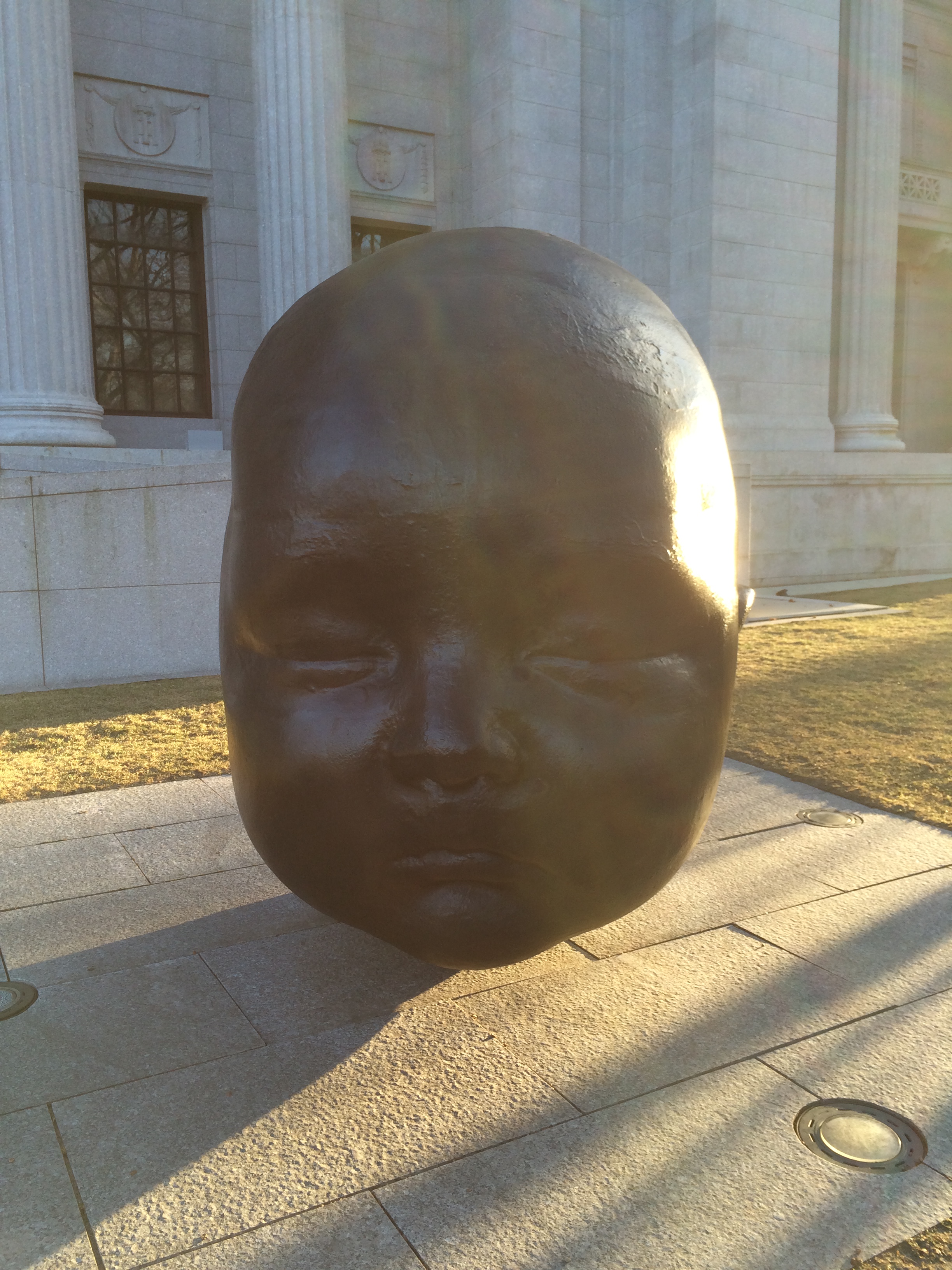
And here’s one of a pair of weird sculptures now displayed at either side of the museum’s Fenway entrance.  They’re called Night and Day and they’re by a contemporary Spanish painter. This one, with her eyes closed, is night:

2015-01-02 15.27.58