But that would be too easy: Dan Brown’s “I could kill you now, Mr. Bond” problem

The Heat is a hilarious movie that doesn’t bother much with plausibility. Towards the end Sandra Bullock and Melissa McCarthy track down the bad guys to a warehouse, kill a few of them, but then get captured by the #2 bad guy.  He could simply shoot them, of course, but he decides to tie them up and torture them first.  Oh, no!  The torture is about to begin when he is called upstairs to a meeting with the #1 bad guy.  So Sandra and Melissa get to exchange some snappy dialog, figure out how to untie themselves, and carry on with the plot.

This is a standard action movie sequence.  The hero doesn’t get killed as the climax approaches; he gets tied up.  My friend Craig Gardner calls this the “I could kill you now, Mr. Bond” moment.  The evil mastermind has Bond in his clutches, but his hubris makes him say something like: “I could kill you now, Mr. Bond.  But that would be too easy.  Instead, I will let you watch as I carry out my plan for world domination. And then you will die a slow, horrible death.”

The evil mastermind’s hubris always leads to his downfall in these movies, of course.  And in the meantime we get to see the hero extricate himself from a difficult situation just in the nick of time to save the world.

Dan Brown’s Inferno is an action novel that features a standard evil mastermind with plenty of hubris.  Stripped of its endless lessons about art and literature and history and geography, it’s a James Bond novel.  Except that Brown makes a lot of odd plotting decisions that, for me at least, screw up this basic plot structure completely and fundamentally ruin the novel.  Spoiler alert: don’t read on if you are going to care about this plot:

  • First and foremost, the entire plot is predicated on the evil mastermind’s hubris, not just the climactic scene where he decides to keep the hero alive.  Nothing that happens in the book has to happen, except that this guy decides to leave some clever clues behind, mainly because he can.  He could simply have carried out his evil plan without telling anyone.
  • Second, and almost as bad, all the hero’s running around trying to stop the evil plan doesn’t amount to anything whatsoever because the evil plan has already successfully taken place by the time the novel starts.  We just don’t find out until page 400 or so.  So the action is doubly pointless.  Robert Langdon has raced around Florence and Venice and Istanbul for absolutely no reason.
  • Next, the evil mastermind is dead by the time the plot starts.  So there is no opportunity for a climactic confrontation, and his explanations for what he is doing all take place in flashback.
  • Finally–and I find this deeply weird–Brown seems to agree with the evil mastermind.  Well, Brown seems to be saying, his methods may not have been the best, but his analysis of the overpopulation problem was accurate, and obviously something more needs to be done . . .   He never allows any of the good guys to offer a convincing rebuttal to that analysis, although surely one exists (I could do a better job than the good guys, frankly).

So we spend the novel rooting for Langdon to succeed, but ultimately we find out that he couldn’t have succeeded, and we probably wouldn’t have wanted him to succeed.  What a letdown.

Cheers!

The recent annual report from WordPress tells me that Into the Mystic Pizza was my second most popular post of the year.  Who coulda known?  That reminded me I haven’t written about a more recent (and shorter) road trip, to the Cheers bar at the foot of Beacon Hill (across from the Public Garden) in Boston.

I never watched the TV show very much, but oddly my kid and his fraternity brothers got on a Cheers kick via Netflix streaming.  So we agreed to take a bunch of them to the bar for his birthday.

Unlike the Mystic Pizza restaurant, the Cheers bar wasn’t the inspiration for the series, and wasn’t even named Cheers when the show started — its original name was the Bull & Finch, presumably playing on the name Charles Bulfinch, who was the architect of the Massachusetts State House, just up the street from the bar.  The show just used the bar’s exterior for some establishing shots.  The owner subsequently decided he’d make more money capitalizing on the TV show’s success, so he changed the name (and added a second location at the touristy Faneuil Hall Marketplace).

Here’s the exterior (not my shot, since we were there at night):

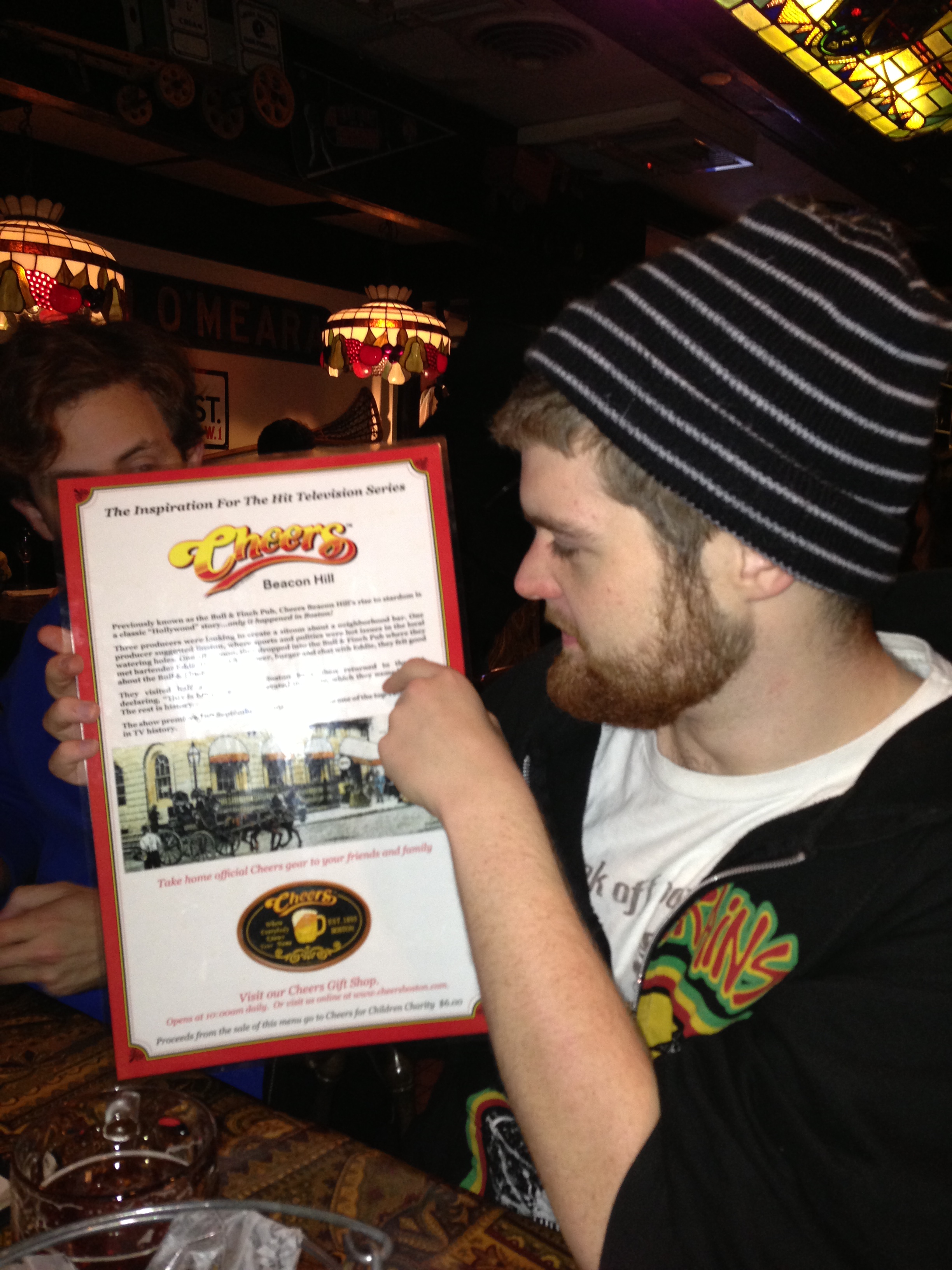
The interior doesn’t look anything like the TV set, of course.  And nobody knew our names.  But it had a sports bar vibe.  The Celtics game and the BC-Notre Dame game were on the many TVs, which was way better than the endless loop of Mystic Pizza you have to endure down in Connecticut.  The menu says that the bar is the inspiration for the hit TV series.  Well, that’s a stretch.

IMG_0128

The menu was Cheers-themed.  A couple of folks decided to have Norm burgers, which did not look especially healthful to me, even with lots of ketchup:

James and Normburger

If you finish the Norm burger (including the fries) you get an award of meritorious achievement. Here my son and his fraternity brother display their certificates.  Sure makes a parent proud!

Normburger awards

Like the Mystic Pizza restaurant, the bar has a small shop for buying merchandise, featuring everything from shot glasses to onesies (“I don’t even know my name”).

The bar isn’t really worth a road trip — it wasn’t even worth a drive in from the suburbs.  The food is average, the ambiance nothing special.  But if you want an eating certificate, I guess you could do worse.

“The Words”: What would you do to become a successful novelist?

The Words is a movie about writers and writing.  Not a very good one, alas.  The basic plot is straightforward: an unsuccessful writer comes across a manuscript in an old briefcase he buys in Paris.  The manuscript is brilliant.  He passes it off as his own and becomes famous.  Then the real author confronts him, and complications ensue.

Except they don’t, really. The complications are actually in the narrative structure.  The unsuccessful writer (played by Bradley Cooper, of all people) is just a character in a novel written by a successful novelist (played by Dennis Quaid, of all people), who is narrating the story to a rapt audience.  By the end we are made to wonder if the successful novelist is really writing about an episode in his own writing career–did he, too, get his start by stealing someone else’s work?  The writers seem to think it’s sufficient to hint at this possibility without resolving the question.  I guess they deserve some credit for not going in for cheap melodrama.  But the plot is filled with so many holes and absurdities that it doesn’t really matter.  I lost interest early on.

Part of the problem is that it’s really difficult to dramatize a writer on screen.  Writers, and the writing life, are just too boring.  The only interesting portrayal I can recall is in The Wonder Boys.  Let me know if I’ve missed any.

But I did find the movie’s central premise poignant. In this post I pondered Oliver Sacks’s self-threat to commit suicide if he didn’t finish a book in ten days, and I felt a twinge of sympathy. Here I pondered a young writer who evidently plagiarized parts of her first novel, and I felt a twinge of sympathy.  In the movie, the unsuccessful writer has poured three years of his life into a novel that is supposedly pretty good but completely unsaleable.  Now he risks his career, his self-respect and, ultimately, his marriage to achieve what he has always dreamed of–to win the awards, to be on the front page of the Times book review, to be something more than just another unsuccessful writer with a boring job at a publishing house, his nose pressed up against the window as he gazed in at the powerful and the talented and the just plain lucky.  And I suppose yet again I felt a twinge of sympathy.  If only the movie had made more of that . . .

If “Love Actually” is so bad, why do I have to watch it every year?

My lovely wife was getting nervous as Christmas approached: Love Actually wasn’t available on Netflix streaming or Verizon on-demand. So finally we had to buy the DVD from Amazon (with faster shipping to make sure it arrived before Christmas).  This means we need never worry that we’ll be without Love Actually when we need it.  Phew.

The thing is, every year her complaints about the movie increase.  Every year she notices more implausibilities and other assorted irritants to raise her ire.  Here are a few.  (I left out many more in the interest of brevity.)

  • Why can’t any of the men in this picture close the deal with the woman they want? ? Even Claudia Schiffer can’t make Liam Neeson ask for a playdate, coffee date, anything?  A porn star stand-in can’t ask out a costar?  Mr. Underpants can’t ask out Laura Linney in 2 years, 7 months?  Colin the caterer is the only one who can open his mouth and flirt with a woman.
  • Why don’t most characters wear warm clothing outdoors? 
  • Why would Keira Knightley’s wedding video be ruined?  A pro uses two cameras.
  • Why was the prime minister home alone on Christmas eve?  Why couldn’t he get the address of a recent employee by phone?
  • What’s up with the all the fat jokes?  Natalie, Aurelia’s sister, “my fat manager,” and so on. Is it a feel-good movie or what?

None of these problems keep her from watching, though. Because, you know, Hugh Grant.  And, especially, Bill Nighy.  Here is a writer in Salon making the case that Love Actually is the worst Christmas movie ever.  She calls it “demoralizing, misogynistic holiday twaddle.”  I dunno.  I guess I’ll have to see it a few more times to decide if I agree.

Into the Mystic Pizza

Next year will be the silver anniversary of the release of the movie Mystic Pizza, and we got a head start on the worldwide celebrations by taking a trip down to Connecticut to see the original pizza shop that inspired the movie, still doing business under the same ownership.

We re-watched the movie the night before our trip.  It works about as well as it did first time around.  Cute, endearing, occasionally pretty funny.  It was never especially believable, and the passage of time hasn’t helped this much.  You give the babysitter a glass of wine before she drives home — really?  You’re starting at Yale in a couple of months and you still don’t know how you’re paying for it — really?

None of the stars made it big except, of course, for Julia Roberts.  And then there was the baby-faced Matt Damon in his first movie role, showing up for about ten seconds and one line.  But he nailed it!  Everyone has had reasonable careers, though, especially Vincent D’Onofrio and Conchata Ferrell.

Anyway, here is what the Mystic River looks like, facing downtown from the Mystic Seaport Museum:

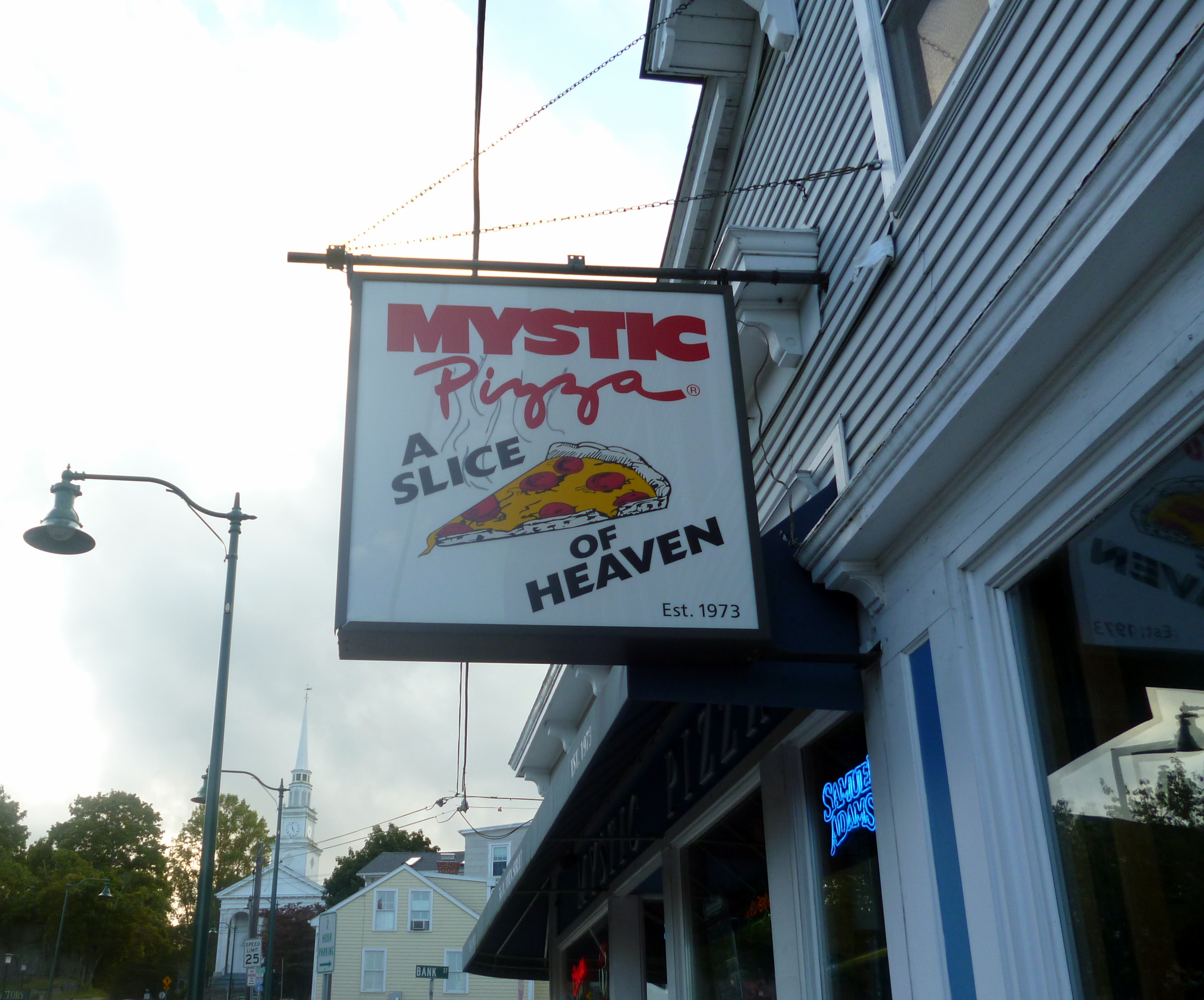
And here’s the iconic Mystic Pizza sign:

The movie didn’t use the actual pizza shop, you’ll be sorry to learn.  If you want to really get into the specific locations used in the movie, you need to go to this amazingly encyclopedic post on the site Road Trip Memories.

Here’s the interior of the current pizza shop. The movie appears to run on a continuous loop on the back wall.  When I took this photo, the final scene of the movie was playing, with the three girls on the back deck of the pizza shop after the wedding.  Moments later, we were back to the opening credits.  I imagine that may quickly get old for the employees.

Here is a scene of the interior used in the movie itself:

At the real Mystic Pizza, the pizza is great; the t-shirts, not so much.

And here is Van Morrison with the last word:

“Maine,” “Sunrise,” and Verisimilitude

Verisimilitude is tricky.  I find myself caring deeply about how realistic a work of art is in some contexts, not at all in others. A couple of evenings ago I watched the silent film Sunrise, then started the contemporary novel Maine, and I had completely opposite reactions to their lack of verisimilitude.

Sunrise, subtitled A Song of Two Humans, came in fifth in the recent poll of the greatest movies of all time.  It was made in 1927 by the director F. W. Murnau (working in Hollywood for the first time);  Murnau also directed the silent vampire film Nosferatu.  Sunrise is a sweet love story; it is also completely bonkers.

The characters have no names.  The man has fallen in love with the Woman from the City.  Following an unbelievably awesome tracking shot, he meets her by the shore.  She wants him to come to the City with her.  But what about his wife?  Well, you should drown her!

Drown your wife, already!

Er, isn’t there a less drastic approach?  Like, er, divorce?  And, er, what about the man’s baby?  No matter!  He must drown his wife!  So he trudges around thinking about drowning his wife.  Apparently Murnau made the actor wear lead weights in his shoes so he’d look like a man thinking about drowning his wife.  Not that his wife notices.  She tells her maid: “Yay!  We’re going out for a boat trip!  Don’t wait up for us!  Someone else will do the chores on the farm!”  And so on.

But, you know, it’s a great movie.  I wouldn’t put it in my top ten list, but many images from it are going to stay with me.  I haven’t watched a lot of silent movies, but Netflix and Turner Classic Movies are helping to remedy the gap in my education.  The ones I’ve seen seem much like grand opera — big emotions, very static, and completely unrealistic.  (I love it in opera when you get big arias from characters who have just been suffocated, as in Aida and Rigoletto.)  You just have to go with the flow.

And then there’s Maine.  It’s a big, realistic novel about three generations of an Irish-Catholic family with a summer home in Maine.  The structure is to alternate chapters from different points of view among four female characters representing each of these generations.  You see each character in the present, but their memories fill in seventy years or so of family history.  A reasonable structure.  And the characters draw you in–it doesn’t take long for you to want to find out how everything turns out, even though the point-of-view women characters are either jerks or idiots.  But in a novel like this, verisimilitude counts for a lot.  There isn’t much plot–there is just life as it is lived.  And here, the author makes enough mistakes in the parts of life that I know something about that it really interferes with my enjoyment of the novel.  I don’t know about vermiculture in California, or the life of young singles in Manhattan (two areas that the novel covers), but I do know about Irish-Catholic families around Boston, and here I think the author just doesn’t have things quite right.  A few examples:

  • She has the grandmother going to daily 10:00 Mass in her summer home.  But parishes don’t have daily 10:00 Masses anymore.  (And it just takes you a minute to look this up on the Internet.)
  • The grandmother’s parish in her hometown of Canton, MA has closed, so she goes to Mass in Milton, instead.  That’s nuts.  Why would she drive all the way to Milton to go to Mass?  There are plenty of Catholic churches closer to Canton than that.  (The church she would be attending in Milton was the church where I was married.)
  • The grandmother’s son is supposed to have graduated sixth in his class from Notre Dame.  But I’ve never heard of any university publishing a rank in class like that.
  • One of the daughters complains that the son got sent to an expensive private school, while they had to go to public school.  Presumably they went to Canton High–a pretty good school!  And the son went to B. C. High–also a good school!  But not that much better, and actually not that expensive–I happen to know that tuition was $400 per year in the time period when this took place.  Anyone who lived in Canton could easily afford it.

And so on.  OK, all this stuff is trivial.  But it’s more annoying than the more idiotic lack of verisimilitude in Sunrise, because Sunrise doesn’t even pretend to be realistic.  I don’t think these glitches make Maine a bad novel, but the author could have done a little more research and made it a much better one.

“Hope Springs” and the most exciting football game ever played

I went to watch Hope Springs the other day.  Meh.  It has three A-list stars (Meryl Streep, Tommy Lee Jones, and Steve Carrell) doing the best they can with a C-list script.  Maybe B-minus.  But it, and the beginning of the football season, reminded me of the most exciting football game ever played.

The game took place on November 23, 1968.  Harvard and Yale were playing for the Ivy League title at a standing-room-only Harvard Stadium.  Both teams were undefeated, but Yale, featuring players like Calvin Hill (who later played for the Dallas Cowboys) was a big favorite.  Yale raced to a 22-0 lead, and led 29-13 with 42 seconds left.  Then Harvard scored a touchdown, and of course went for the two-point conversion.  They made it — down by eight.  As expected, an on-side kick.  Harvard recovered.  Another touchdown with no time remaining.  A two-point conversion — a pass to the tight end, Pete Varney (number 80)!  Final score: Harvard 29, Yale 29.

The Harvard Crimson immortalized the game with this headline:

I was at that game along with my lovely girlfriend (now my lovely wife), standing at the top of the stadium overlooking the end zone at the closed end of the stadium, where all the action took place at the end of the game.  It doesn’t get any better than that/

Tommy Lee Jones was there too, playing on Harvard’s offensive line.

Four years ago Kevin Rafferty released a documentary about that game, fittingly titled Harvard Beats Yale 29-29.  It is fabulous (the New York Times reviewer called it “preposterously entertaining”).  When the movie first came out I it at the Brattle Theater in Harvard Square with a friend who had watched the game from the Yale side of the field; that was the right place to see it, but you can, and should, stream it from Netflix.

The movie goes back and forth between the broadcast video of the game (a local production featuring the beloved Boston sportscaster Don Gillis) and interviews with players on both teams.  You start by thinking it’s just going to be an exercise in nostalgia, but by the end it has become way more than that, as all these successful men reflect, with a mixture of humor and regret and wonder, on those unforgettable hours in their lives so long ago.  Some of them (uniformly on the Yale side) turn out to have been pricks back then, and they’re still pricks now. Others seem are funny and, yeah, lovable.

Jones is interviewed, and he is terribly serious as he reflects on what it was like to be out there on the field as the tension mounted at the end of the game, and you realized how critical it was not to make a mistake.  One Yale player sheepishly reflects on his one claim to fame back then–for a while he dated a Vassar undergraduate named Meryl Streep.  (And that’s where I made the connection between Hope Springs and The Game.)

There are other connections with famous people.  A Yale player had been George W. Bush’s roommate (the filmmaker himself is Bush’s cousin).  Famously, Jones’s roommate at Harvard was Al Gore.  The Yale quarterback, Brian Dowling, was the prototype for the character B.D. in Doonesbury; Gary Trudeau started a version of the comic strip when he was at Yale.

But the connections aren’t what matter.  What matters are the people.  And The Game.

Our Jordanian correspondent on Ramadan — plus, when we come back more of our exclusive Olympics coverage

In less than two weeks our intrepid Jordanian correspondent will be rotating stateside to take up the prestigious Somerville/Medford assignment.  Meanwhile, here are some of his observations on Ramadan.

During the parade of the athletes in the opening ceremony, the NBC announcers mentioned the problem of Ramadan occurring during the games.  Of course, they couldn’t say “Some of the Muslim athletes are totally blowing it off because winning a medal is the most important thing in their lives”; they simply allowed as how some of them are postponing their fast till after the games.  Here‘s an article about the various complexities the Olympics have to deal with when it comes to religion.

As part of our training for the Olympics we re-watched Chariots of Fire.  Some utterly random comments:

  • The movie hasn’t aged especially well, or maybe I have just become bored with feel-good sports movies.
  • One of the many funky (and endearing) things about Friday’s opening ceremony was the decision to give Rowan Atkinson five minutes of prime time to do a spoof of the movie’s iconic music and opening.  Does the entire world think Rowan Atkinson is as funny as I do?  Or did people in India or China watch the skit in utter bafflement? Anyway, here it is:
  • I once saw Simon Rattle (the guy conducting the Chariots of Fire theme) conduct the Los Angeles Philharmonic. The LA audience was getting restless during a bleak Shostakovich symphony (is there any other kind?) and he turned around and glared at them during the performance.  I guess everyone doesn’t like Shostakovich as much as I do.
  • Does everyone watch old movies the way I do, with IMDB ready at hand?  The stars of the movie mostly have had solid careers since then, but none really broke out.  I was sad to see that Ian Charleson, who played Eric Liddell and was probably the best actor in the movie, died of AIDS a few years later–the first celebrity death in the UK openly attributed to AIDS, according to Wikipedia.  IMDB tells me that Kenneth Branagh and Stephen Fry were both extras in the movie, but I couldn’t pick them out.
  • Eric Liddell, the Scottish athlete who wouldn’t run on Sunday, became a missionary to China and is now on the calendar of saints for the Episcopal Church of the USA–the day after John Henry Newman, who converted from Anglicanism to Catholicism, and two days after Frederick Douglass.  I had no idea the Episcopalians had such an interesting calendar of saints.  Yesterday they honored Bach, Handel, and Purcell.
  • The religion/Olympics conflict goes back to the first time the Olympics were held in London, in 2008.  Here is the famous photo of the American hurdler Forrest Smithson holding a Bible while running to protest the scheduling of races on Sunday.  Apparently this was a posed photograph, and he didn’t actually run his race with Bible in hand.  He won the gold medal in a race held on Saturday.

There, that about does it for today’s Olympic coverage.


Danny Boyle, 18 years earlier

In 1994, he was directing this:

His first feature, which won the BAFTA for best film in 1005.  For no particular reason I saw the movie on DVD a few weeks ago.  It features an impossibly young Ewan McGregor and as gruesome a plot as you could imagine.  It was great, in an inhuman sort of way–all the characters turned out to be creeps.  Now he’s directing Queen Elizabeth and her corgis.

The opening of the Olympics was fine, if you like watching overwhelming spectacles on a little TV.  I don’t suppose Danny Boyle could do anything about Matt Lauer and Bob Costas, who were both insufferable–they seemed to be delighted that they had no idea who Tim Berners-Lee was.  The thing had everything under the sun–including, at the climax, a Pink Floyd song that seemed a little inappropriate to me.  But maybe I just don’t get Pink Floyd: