Write a review! Tag a tag!

Help a struggling artist!

If you have read Summit, want to consider reviewing it on Amazon (here) or Barnes & Noble (here)?  (Or both.)  You don’t have to have read the ebook version.  You don’t have to have bought the book from Amazon or Barnes & Noble.  If you want to give it four or five stars, that would be great.  If you want to give it fewer than three stars, well, let’s talk — I promise to do better next time!  The more detailed the review (in my opinion), the better.  Amazon requires at least 20 words — they want something more than a few adjectives and exclamation points, apparently.

Another thing you can do is add customer tags — on Amazon, in the area labeled “Tags Customers Associate with This Product.”  If you like the tags that are already in place for Summit, you can check the boxes next to them.  Or you can add your own.  The idea (I’m told) is that the more votes a book gets for a particular tag (say, “psychic” and “thriller), the more likely it will show up in listings for that tag.

That tag area is just below the “More About the Author” area, which will take you to the Richard Bowker author page on Amazon.  I’m still working on setting that up.  You can go to that author page directly by clicking here. This page in turn (I just noticed) links to a shopping-enabled version of my bio on Wikipedia (I really should fix the errors on that page).  Isn’t the Internet wonderful?
More on Ebook Pricing

I’m now pondering what to charge for Pontiff.  The calculus is a little different from what it was for SummitSummit is available from Amazon for a pittance as a used paperback, so the ebook version has some competition; Pontiff doesn’t have that problem (alas).  So that’s an argument for a higher price for it.

Also, Jeff Carver points me to this article, which suggests that ebook pricing is trending upward, with less price resistance from readers than I would have expected.  The author’s suggested pricing for a book like Pontiff would be about $7.99, which seems awfully high to me.  But one of the benefits of ebooks is that it’s easy to tweak their pricing and see what happens.  You can put a book on sale or even give it away with a few keystrokes.  So that’s the next decision to make….

Two Months of Blogging

Today is the two months’ anniversary of this blog.  Here are some thoughts:

  • Rule #1 of fiction writing (it’s also Rule #2 and Rule #3) is “Write every day.”  This appears to be true of blogging as well.  One big difference between blogging and writing fiction is that embedding a YouTube video counts as blogging; this is not true of fiction-writing.  Another difference is that, if you don’t blog constantly, your audience starts dropping pretty quickly.  There are a bazillion other blogs out there that people can waste their time reading.
  • I think it’s important to have some variety in your blog posts.  I worry that potential readers may say: “Dear God, not another post about cosmology and religion.  Why doesn’t he read more 900-page Japanese novels and write many many posts about them?”  This is a valid criticism.  In particular, there hasn’t been one item about the Red Sox.  I think about the Red Sox way more than I think about cosmology or Haruki Murakami.  This needs to be addressed.
  • I don’t understand WordPress’s business model.  It appears to owe something to the underpants gnomes.  Phase 1 is “Provide all kinds of great free software and lots of storage.”  Phase 2 is “Profit!”  Phase 2 is ???.  So far, out of pure vanity I have paid WordPress a pittance to register the name richardbowker.com instead of richardbowker.wordpress.com.  And that’s it — everything else has been free.
  • I should probably experiment more with the look and feel of the blog.  I like the WordPress theme I’m currently using, but they make it really easy to switch to a new one.  And there are limitations with the current theme.  For example, if you click on Books up at the top, you see links to pages about my books.  But the longer titles spread out onto two lines, so it looks like I’ve written a book called “Forbidden” and another one called “Sanctuary”.  I don’t know how to fix that.  So don’t be surprised if this place undergoes a total renovation at a moment’s notice.

Feel free to tell me how things could be improved around here.

Vatican Intrigue: Life Imitates Art

Pontiff is about a plot to kill the pope.  Mixed into this a complicated subplot about financial misdealings and corruption in the Vatican.

So here we have screaming headlines about a plot to kill Pope Benedict

And here we have the New York Times reporting about a  leaked documents detailing financial misdealings and corruption in the Vatican.

You’d think they got their hands on an advance copy of my novel!

Of course, art is also imitating life, because there were financial misdealings and corruption at the Vatican Bank in the 1980s.  And papal assassination attempts are nothing new: John Paul II was shot, and there have been no end of conspiracy theories about the sudden death of John Paul I a month into his reign.  (The most likely explanation for discrepancies in the Vatican’s reports of his death is that they thought it unseemly that his body had been discovered by a nun. Quelle horreur!) There are some strange goings-on in Pontiff, but there are strange goings-on in the Vatican all the time.

Pontiff upcoming

The next novel to turn into an e-book is Pontiff.  Those of you with the collected works of moi displayed proudly on your bookshelf will search them in vain for Pontiff. (Maybe I’ll talk about that some time.), so buying the e-book is the only way to get your  hands on the thing.  Like most of my stuff, it’s, like, a pulse-pounding thriller with twists and turns galore, plus some philosophical nattering on the margins.  Also, it has the best ending I ever wrote.

Maybe the second best.

Those of you who have been paying attention may have noticed a little, er, skepticism about religion popping up here and there.  So what’s up with writing a novel called Pontiff?  It’s another instance of writing about what you don’t know, I think.  I don’t have a religious bone in my body, but I find the psychology of religious belief fascinating, and writing fiction gives me a chance to imagine what it would be like to devote yourself to that belief.

There are all kinds of religious characters in Pontiff.  The title character, for example, is the first African pope, tortured for his faith in some unnamed African dictatorship and suddenly finding himself a compromise choice for the papacy.  That’s an imaginative stretch.  But the real imaginative stretch was the protagonist, Father Joe Hurley, who grew up in the Boston suburbs and left behind a job on Wall Street because he couldn’t shake the idea that he had a vocation.  Who does that anymore?  Well, some people clearly do.  Why?  Well, let’s write a novel and find out.  And, of course, as novels are supposed to do, we set up some interesting challenges to Hurley’s beliefs and his vocation (most prominently, a beautiful Boston policewoman) and see how he reacts.

Write About What You Don’t Know

Conjuring up life in a foreign land is one part of writing that is exciting and fulfilling.  But the most fun is conjuring up a character who is nothing like you — who is nothing like anyone, really.

Daniel Fulton in Summit is a brilliant, eccentric pianist who has turned his back on public performance, instead sitting around his messy home and playing the piano whenever it pleases him.

Glenn Gould was a brilliant, eccentric pianist who turned his back on public performance . . .

Coincidence?  I think not.

The back stories are completely different, of course.  Fulton stopped playing in public for reasons that make sense in the context of the novel’s plot.  Gould stopped playing for his own combination of personal and philosophical reasons.  Once he stopped, he never returned to the stage.  Unlike Horowitz, unlike Weissenberg.  Unlike Daniel Fulton.

In general, concert pianists are a breed apart, even among musicians.  Music is almost always a group endeavor.  Almost no other musician goes before the public all by himself — without even sheet music to aid him.  It’s just him and his instrument — and the long history of other great performers, other great interpretations of the same standard repertoire, against which his audience will judge him.

When you write about a concert pianist, you are really writing about what you don’t know, and what you cannot know.

This is all just an excuse to embed this video of Gould performing — to an audience consisting apparently of his dog and, maybe, a couple of birds outside his window.  What has always been astonishing to me about Gould is the absolute clarity of the voices when he plays counterpoint, as if each hand was controlled by a separate brain. (And, even in his recordings, there was the annoying humming, which he was never able to control.)

What kind of cigarette would a Soviet spy smoke?

I don’t know, but I used to.

One of the joys of writing a book like Summit is that you get to research stuff like that.  One of the resulting temptations is to try to fit every last bit of research you did into the novel.  You want to show off all the shiny pieces of geography and cuisine and cultural ephemera that you so laboriously picked up.  It’s not hard to spot this in some novels.  In some cases, you wonder if the author set a scene in a particular locale so that he could deduct a vacation as a business expense — I really went to Jamaica to get local color for my novel, not to lie on the beach.

The goal, of course, is to make the novel’s world come alive for the reader.  Throwing in the names of Russian cigarettes and cars and subway stops helps, but of course there’s way more to it than that.  The key is to get inside your characters and figure out how they interact with this world — not just what they smoke, but why they smoke.

Of course, you’re going to get some things wrong.  I was told that Summit was extremely accurate in its depiction of the Soviet Union, but I had a character wearing the wrong kind of coat in one scene.  How did that happen?  I wrote down enough notes about Soviet clothing!

Does a lapse in verisimilitude matter?  Not to the vast majority of readers, who have no way of telling, and are just going to take the author’s word for it.  But it mattered to me.  You want to do your job right.

Summit Available on Amazon and B&N!

The Kindle edition is available here.

The Nook edition is available here.

I’ll get it onto other sites sooner or later.

I’m charging $2.99, which I figure is somewhere between “It’s so cheap there must be something wrong with it” and “It’s so expensive it can’t be worth it”.

Don’t be tempted to buy the used paperbacks also on offer.  They won’t give you the same quiet sense of satisfaction you’ll get knowing that some of your money is going to the author in return for his hard work in perpetrating the novel.

Next up, Pontiff!

Publishing an e-book

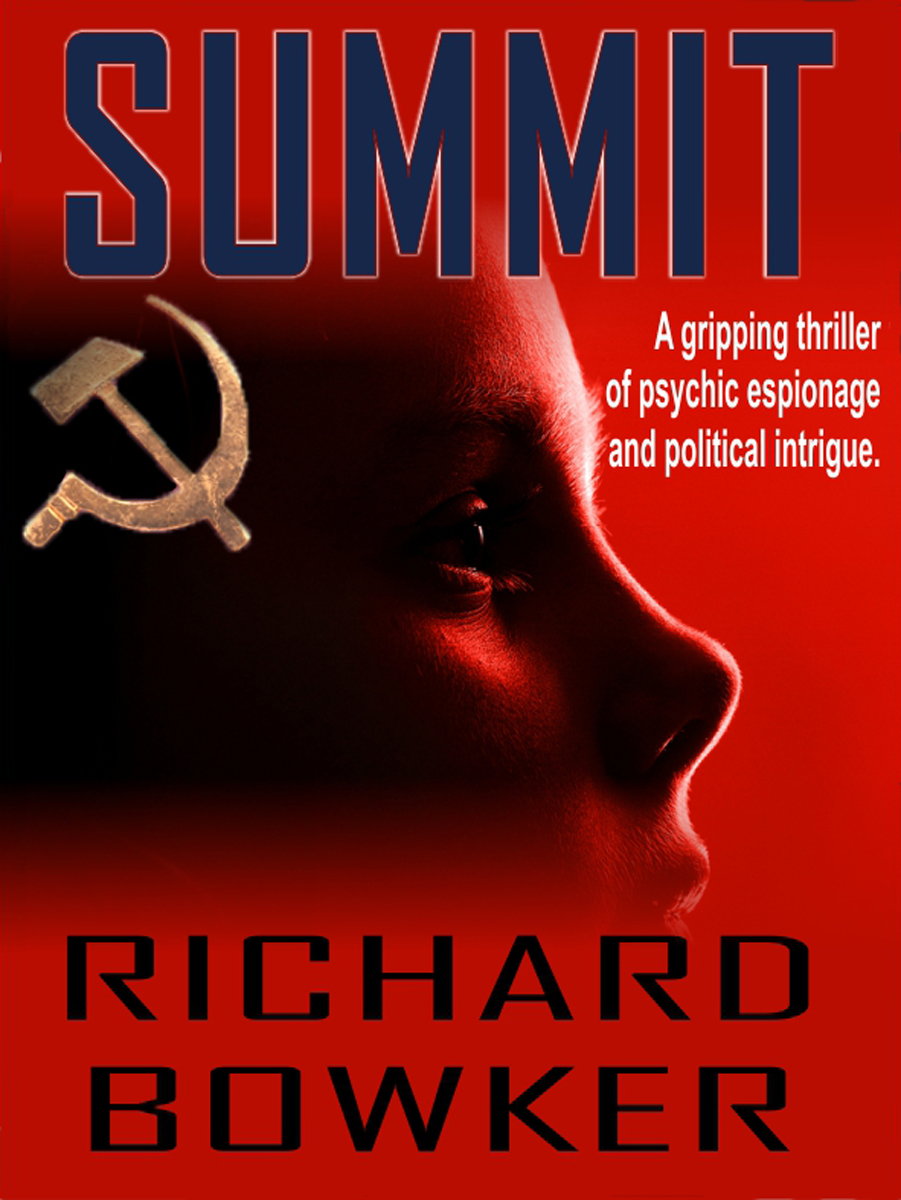
Well, it just doesn’t seem to be that hard.  Surprisingly, the hard part seems to have been writing the book in the first place. Here is the cover:

Summit

Actually, the cover was kinda hard, too.  And okay, I had help.

Amazon and Barnes & Noble are currently pondering whether I’ve made any mistakes.  If I haven’t, the thing should show up in their catalogs in a day or two.

How much would you pay for an e-book?

I’ve got to figure out my pricing before very long.

Seems to me that publishers’ prices for e-books are stupidly high.  Presumably they don’t want to set them so low that they cannibalize their hardcopy sales (and annoy their retailers).  But that’s not a problem I have.

One theory I’ve heard is that buying an e-book is an impulse purchase, and you want to set your price low enough to encourage that sort of irresponsible behavior.  What price would make you act irresponsibly?

(Of course, a price of $0.00 is not unheard of.  That may increase my readership, but it won’t make me wealthy beyond the dreams of avarice.)