Print on Demand pricing

One thing I’ve noticed in my brief experience with Print on Demand publishing: Amazon seems to vary its pricing constantly.  The list price of the book (set by my publisher) is $15.99.  When I bought the book from Amazon last Saturday, it cost me about $15.50.  When it arrived on Wednesday, I checked, and Amazon was charging $12.89.  Today they’re charging $14.39.  Meanwhile other vendors (available via Amazon) are charging from $12.04 to $13.55 (plus $3.99 shipping and handling).  Barnes & Noble is charging $12.89.  It’s entirely possible that I’m the only one who has bought the book so far, and that is somehow making Amazon decide to raise its price.  Come on, people!

Every vendor is claiming that the book is “in stock.”  What that means in this context, I suppose, is that they have access to the book via Lightning Source, the book manufacturer.  They obviously don’t have the physical book on their shelves.

By the way, the unit cost my publisher will charge me is $5.77 per book, plus shipping and handling.  The cost to me for a carton (24 books) comes out to $7.77 per book.

I was sorta hoping the book would be available via Paige M. Gutenborg, the POD machine at Harvard Bookstore in Cambridge. Alas, she only seems to handle books from Google Books. Here’s what Paige looks like:

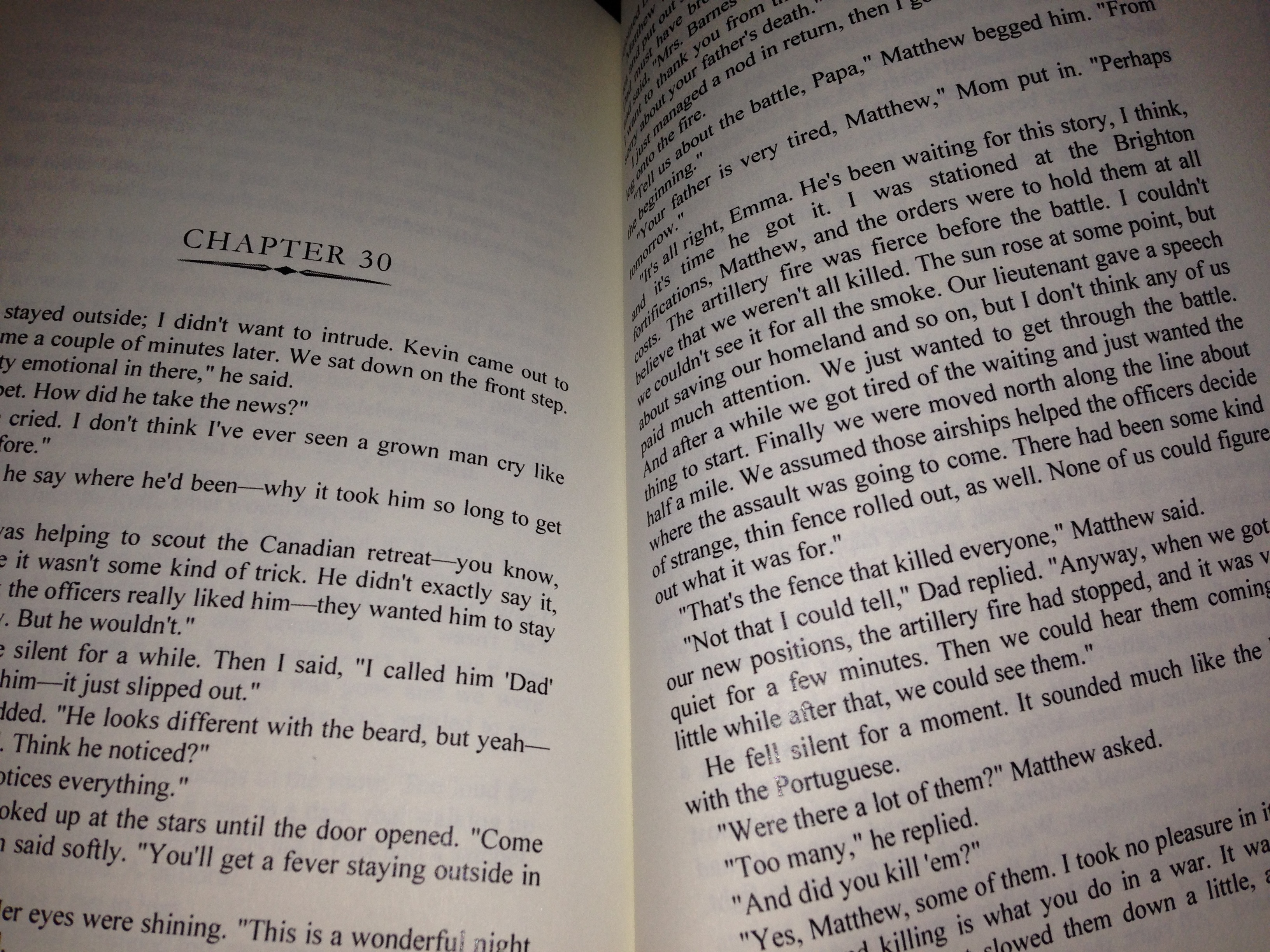
Photos of my Print on Demand book

This is what the book looks like.  For some background, see this post.

Here’s the cover:2013-12-04 21.38.11And the back cover (somehow the angle makes it looks like there are no pages–but there are!):2013-12-04 21.38.42And the inside:2013-12-04 21.39.04I dunno.  Looks just like a real book to me.


POD is PDQ

To check out the Print On Demand version of The Portal, I placed an order for it from Amazon on Saturday, with my two-day Amazon Prime shipping.  It arrived today, Wednesday.  So they were able to print the book  on Sunday (I guess) and ship it to me on Monday.  And it looks great!

I’m going to buy a bunch for my own use direct from the publisher.  I should be able to undercut Amazon’s prices significantly, although I don’t know about two-day shipping.  If you’re interested in buying one from me, let me know in comments or somewhere.  The advantage to buying it directly from me, in addition to the price, is that you can get my autograph in it.  Which is, of course, priceless.

Is Jeff Bezos the antichrist? Or maybe just one of the four horsemen of the Apocalypse?

Jonathan Franzen isn’t sure.

In an article for Guardian Review before the publication of his new book, The Kraus Project, he writes: “In my own little corner of the world, which is to say American fiction, Jeff Bezos of Amazon may not be the antichrist, but he surely looks like one of the four horsemen. Amazon wants a world in which books are either self-published or published by Amazon itself, with readers dependent on Amazon reviews in choosing books, and with authors responsible for their own promotion.”

He goes on to say:

“As fewer and fewer readers are able to find their way, amid all the noise and disappointing books and phony reviews, to the work produced by the new generation of this kind of writer, Amazon is well on its way to making writers into the kind of prospectless workers whom its contractors employ in its warehouses, labouring harder for less and less, with no job security, because the warehouses are situated in places where they’re the only business hiring.”

This is the dystopian vision of Scott Turow and the Author’s Guild, where every move that Amazon makes is greeted as the next step towards the end of literature as we know it.  And I just don’t get it.  Amazon, and the e-book revolution, have certainly made publication more democratic.  It’s now open to anyone, which of course means there will be more junk available.  But do these folks really believe that there will be no way for readers to distinguish the good writers from the bad?    My novel Senator has a bunch of reviews on Amazon, and the review deemed most helpful by readers also happens to be (in my opinion) the best of the bunch.  Read that review, and you’ll get as good a sense of the novel as any newspaper review.

Further, do they really think that, even if Amazon controlled the entire publishing industry, it wouldn’t have an incentive to find and publish great books? And do they really think that Amazon can control the entire publishing industry?  Jonathan Franzen is a world-class writer with a large following.  If he wanted to bypass Amazon and self-publish on jonathanfranzen.com, he could do it.  Or, he could start his own publishing house, giving his imprimatur to the kind of fiction he thinks the world wants; no one is going to stop him, and the barriers to entry are minimal.

I’m also a little baffled by this view that Amazon is destroying the financial prospects of good writers.  Writers have no financial prospects!  They have never had any financial prospects!  If anything, Amazon has opened the doors to a whole class of writers who were shunned by the traditional publishing industry but now at least have a chance at reaching an audience, thanks to the Internet.

Finally, I just want to say that the Red Sox are back in the playoffs thanks to a complete-game victory by John Lackey.  And that’s one of those sentences I never thought I’d write.

Apple loses its e-book antitrust suit

The judge has ruled against Apple in the suit that the Justice Department brought against it.  Now there’ll be another trial for damages.  And Apple has vowed to appeal.  So nothing is really decided.  But hey, we all know Apple is guilty!

Here is the graphical evidence of what happened to e-book prices when the major publishers, in collusion with Apple, forced Amazon to go to the agency model, thereby ending price competition among e-book vendors:

Prices went up two dollars or more per book overnight.  The exceptions were Random House and all the little publishers; none of them were party to the collusion. Thanks, Apple!

Amazon buys Goodreads — should I care?

I have never paid much attention to Goodreads, but it seems like a fine idea for a web site — a place where readers can go to rate books, swap recommendations, discover what their friends are reading, and so on.  So now Amazon has scooped it up, and the Authors Guild isn’t happy. Here‘s Scott Turow, the Guild president:

“Amazon’s acquisition of Goodreads is a textbook example of how modern Internet monopolies can be built,” said Scott Turow, Authors Guild president. “The key is to eliminate or absorb competitors before they pose a serious threat. With its 16 million subscribers, Goodreads could easily have become a competing on-line bookseller, or played a role in directing buyers to a site other than Amazon. Instead, Amazon has scuttled that potential and also squelched what was fast becoming the go-to venue for on-line reviews, attracting far more attention than Amazon for those seeking independent assessment and discussion of books. As those in advertising have long known, the key to driving sales is controlling information.

This seems pretty odd.  In what sense did Amazon scuttle the potential for Goodreads to become an online vendor?  This was Goodreads’ decision, not Amazon’s.  If that wasn’t the direction they wanted to take their business, well, frankly I think they’re pretty smart.

Should we be worried that Amazon will “squelch” Goodreads’ reviews and online community? That would be insane — that’s what Amazon is buying. The more people who go there and talk about books, the more books Amazon will sell.

What Amazon will presumably squelch are links from Goodreads to other booksellers.  Goodreads has a “Get a copy” feature that links out to different online vendors, allowing you to go directly from the Goodreads page for a book to the bookseller of your choice.  I assume this feature will go away, and you will only be directed to Amazon (as is the case with IMDb, another Amazon subsidiary).  How important is that to the Goodreads community?  I guess we’ll find out.  But if it’s really important, someone will start a new online community; it’s not like the barriers to entry are particularly high.  And it’s not like the lack of a link to Barnes & Noble, say, will make it a lot more difficult for a Goodreads user to buy a book from them instead of Amazon.  We’re talking about about a couple additional mouseclicks here.

The Authors Guild seems to have a deep fear of Amazon’s potential monopolistic power; they also came out against the Justice Department’s suit against Apple and the major book publishers for (essentially) price fixing.  The Guild was arguing that readers should pay higher prices for ebooks to guard against the potential of an Amazon ebook monopoly.  I’m not convinced Amazon is the threat the Guild thinks it is.  I have no doubt that Amazon would like to corner as much of the online bookselling market as they can; I just don’t see how they can keep other smart, nimble vendors out of that same market.

I get a two-star customer review on Amazon, and I brood about the nature of fiction

Here I described a review of Senator that started badly but it ended up full of praise.  I love trick endings like that!

But now I’ve got a review of Dover Beach that goes in the opposite direction.  Look:

Great plot…..excellent writing……FINALLY a believable private eye……interesting, unforgettable characters…..surprising twists……All this to say that I believe here is an author we will hear more from in the future.

So why did I give it only 2 stars? Because of his world-view. His main character is living in a destroyed world as a result of nuclear war — yet Bowker thinks humanism is going to rebuild it all????

Have long though[t] that good Science Fiction asks the right questions, but am afraid Bowker comes up with wrong answers. I don’t buy the humanist philosophy and if his next book has “Humanistic Science Fiction” on the cover I for one won’t be spend[ing] a dime on it.

I guess we shouldn’t have put that quote from Locus (“Humanist science fiction of a high order”) on the cover!  But anyway, I was brooding about that four-question-mark question in the review’s second paragraph.  Do I believe what the reviewer says I believe?  I do not.  But further, I have never even considered the question.  Even further, if the novel suggests that I have an opinion about the matter–or about anything, in fact–I’d consider that a flaw.  The purpose of fiction is to give pleasure, not to give answers–to strive for beauty, not for truth.  For me, the pleasure of Dover Beach was in plopping down a conventional literary genre in an unconventional setting, and exploring the tensions that resulted.  This may cause notions of humanism to creep in, because private eyes deal with human-scale issues.  But the private eye in Dover Beach isn’t going to save the world he inhabits–he is lucky if he’ll be able to save himself.

This gives me a chance to copy John Keats’s definition of negative capability, which we should all read every year or so:

At once it struck me, what quality went to form a Man of Achievement, especially in literature, and which Shakespeare possessed so enormously- I mean Negative Capability, that is when man is capable of being in uncertainties. Mysteries, doubts, without any irritable reaching after fact and reason — Coleridge, for instance, would let go by a fine isolated verisimilitude caught from the Penetralium of mystery, from being incapable of remaining content with half-knowledge. This pursued through volumes would perhaps take us no further than this, that with a great poet the sense of Beauty overcomes every other consideration, or rather obliterates all consideration.

Words for a writer to live by.

Here’s a five-star review to make me feel better:

What a treasure. Amazing how smoothly this author leads the reader into his jagged, apocalyptic world to reveal what evil lurks in the hearts of men, and leaves you to decide if such a world is worth saving or even living in. I was particularly impressed with his skill at giving you his characters bit by bit throughout to let them become gems of many facets, like a skilled diamond cutter. This is one P.I. whom you will never forget.


Amazon has a patent on selling used ebooks — are we doomed?

A few months ago I vented about the possible advent of a market for used ebooks, which (if legal) would doom the quaint custom of writing in return for money. Now it turns out the Amazon has patented a way to create a digital marketplace for ebooks and other kinds of digital objects. As this Wired article describes it, the mechanism would be similar to the one used by Amazon’s Kindle e-book lending process.  When you lend the ebook book, your access to it is cut off for the term of the loan.

The proposed used digital marketplace would take that one step further. Instead of loaning the access rights of an e-book, music file, video or application, in exchange for some cash, the original owner of the digital file would transfer the rights to use that file to another party permanently.

If the file were downloaded to a device, after the sale, the original owner would be unable to access the file. the data would still be on the device until deleted by the original owner, but access to the contents of that file would be turned off.

The Wired article floats various theories about what Amazon is up to here.  The one that makes most sense to me is that this is just another way for Amazon to bypass traditional book publishers and record companies. For authors to get a cut of the resale money, they might have to deal directly with Amazon, rather than via a middleman.  I can’t imagine that Amazon wouldn’t offer some kind of royalty on these resales, because then they risk having top authors simply refuse to publish their works for the Kindle.  But I could be wrong–nothing seems to have stopped Amazon from selling used print books.  And, as the Wired article points out, used ebooks aren’t going to have dogeared pages or ripped covers.  They’d be just as good as the new version, only cheaper.  Who wouldn’t like that–except the starving author?

Amazon Author Central: Tracking your ignominy in real time

Want an easy way to feel like a failure?  Become an author and check out Amazon Author Central, which provides a wealth of statistics about how badly your books are doing.  The depressing news is updated hourly, so you can check back multiple times during the day to increase your feelings of worthlessness.  Here, for example, is a snapshot of how I stack up against other fiction writers over the past month.  The trend slopes upward a bit, but in a fairly narrow range of mediocrity.

ScreenHunter_05 Feb. 02 10.30

Amazon also offers graphs by category (I’m close to breaking into the top thousand in science fiction!) and by individual book. In the old days, authors would get their bad news via semiannual unintelligible statements from publishers.  Are we better off today?  I suppose. Theoretically, you could use all this information to plot your marketing strategies or judge their effectiveness, if you’re the sort of author who has marketing strategies.  But mostly it’s just another way of wasting your time when you should be working on your next book.  After all, that’s the one that’s going to make you famous!

Should we be worried that Jonah Lehrer’s ebook has melted into air, into thin air?

. . . and leaves not a rack behind?

Jonah Lehrer, you may recall, is the young author who made up some Dylan quotes in his book Imagine and was caught self-plagiarizing on his New Yorker blog and elsewhere.  See here and here.  It’s not a good time to be Jonah Lehrer.

Imagine, not surprisingly, has been withdrawn from the market, without any online explanation of what happened.  Now an Atlantic writer worries that the disappearance of the ebook from ebook shelves is a bad thing.

There are now links to used copies on both Amazon and Barnes & Noble; original links to the items are still inactive, and at the original time of writing, there were no links at all, used or no. Lehrer’s author site on Amazon still does not link to any of the marketplace vendors.

She connects this situation to the time Amazon disappeared copies of some editions of Orwell novels from readers’ Kindles because of copyright violations.

When Orwell pulled a Kindle disappearing act, David Pogue called Amazon’s actions, “ugly for all kinds of reasons.” Even though (as far as I know) no purchased copies of Imagine have disappeared off of electronic readers, the ugliness is just as strong in the current reaction to Lehrer’s missteps. It is worrisome that the book has virtually disappeared from the most prominent online retailers—and the publisher itself. A simple note saying that sales have been halted pending further verification, or something to that effect, would have been a much more honest, transparent solution. When contacted for comment on the specifics of the decision, Amazon stated simply that, “At Houghton Mifflin Harcourt’s request, we halted sales of ‘Imagine’ in all formats.” No reply was made to the specific issue of how the request was handled. HMH did not provide a response, nor did Barnes and Noble.

To me, this seems like much ado about nothing (to bring Shakespeare into the post again).  Imagine is still easily available as a used hardcover on the Internet.  No one has removed the existing ebooks from peoples e-devices.  So Imagine is certainly leaving a rack behind. (In this sense a rack, the Internet tells me, is a fast-moving cloud, a vapor.)

I suppose in some ways it’s easier to disappear ebooks than to destroy physical books, but as readers at Andrew Sullivan’s site point out, in other ways it’s much easier to save an ebook, if you think it’s worth saving:

Jonah Lehrer’s book was bought and downloaded by thousands of readers before it was recalled. The tools to remove an e-book’s DRM encryption are freely available and trivial to use, even for a low-tech buyer with a cheap PC. Once the book is decrypted, it’s just another file on a computer, as easy to copy and send around as any photo or Microsoft Word document. E-book files are tiny compared to other commonly-pirated media like movies and music; most are under 10 megabytes, which is small enough to send as an email attachment. And if they’re stripped of their fancy formatting and converted into plain text, they get even smaller. Project Gutenberg’s entire collection of over 40,000 public-domain titles would fit comfortably on an average iPod.

And then there are the increasing numbers of ebooks (like mine) that don’t even have DRM.  I’m basically trusting that most people aren’t jerks.

And here’s another angle: I wonder if Lehrer would have any difficulty getting the rights to Imagine back from the publisher.  If he did that, he could get rid of the made-up stuff, write a new introduction explaining that the devil made him do it, mistakes were made, or whatever, and sell the ebook for $2.98 or some other fraction of the publisher’s original ebook price.  I’m sure he’d sell a bunch of copies!  Step 1 in his rehabilitation.

When I started my ebook venture, I went looking for an unpublished novel of mine that I thought might be worth self-publishing as an ebook.  Couldn’t find the hardcopy.  Could only find softcopy of the first draft.  Yikes!  I vaguely remembered sending a copy to my friend Jeff, so I dashed off a desperate email.  Twenty minutes later I had my novel back.

Computers are our friends.