Writers in movies: Their Own Desire

Another in a series.

Their Own Desire is a 1929 movie starring Norma Shearer. Here’s the Wikipedia synopsis:

A young woman is upset by the knowledge that her father is divorcing her mother in order to marry another woman. Her own feelings change, however, when she falls in love with a young man who turns out to be the son of her father’s new love.

First thing’s first: this movie is terrible.  Norma Shearer chews enough scenery to get an Academy Award nomination (she lost to herself, for The Divorcee, so I guess she couldn’t feel too bad about the defeat).  But the plot is primitive, and everyone else in the case is pretty bad, particularly Robert Montgomery as her love interest, maybe because he has to say lines like this, at a moment of high drama:

I’ve got the little ol’ canoe down at the landing; let me run you over to the little ol’ love nest.

The writer in the movie is Norma Shearer’s father, who splits his time between writing novels and playing polo at his club.  Apparently those were the days when writers belonged to clubs, and polo was a thing they played there.

The only reason why Dad is a writer and doesn’t have some other high-class occupation is so that to movie can include a scene where he describes to Norma Shearer the plot of his latest novel, which involves a 45-year-old married man falling in love with another woman.  Our heroine’s response is to laugh at the very idea of an old man like that falling in love.  Little does she know that the novel is based on her father’s own life, and soon frumpy old Mom will be dumped for the glamorous Mrs. Cheevers.  Irony!

Their Own Desire is bad, but still I’d rather watch a bad movie from 1929 than a bad one from 2014.  The past is a different country, and it’s interesting to pay a visit now and then.

What should we do when an artist is a creep?

It doesn’t get much creepier than this:

What’s your favorite Woody Allen movie? Before you answer, you should know: when I was seven years old, Woody Allen took me by the hand and led me into a dim, closet-like attic on the second floor of our house. He told me to lay on my stomach and play with my brother’s electric train set. Then he sexually assaulted me. He talked to me while he did it, whispering that I was a good girl, that this was our secret, promising that we’d go to Paris and I’d be a star in his movies. I remember staring at that toy train, focusing on it as it traveled in its circle around the attic. To this day, I find it difficult to look at toy trains.

It makes me happy when a writer (or anyone else)  I admire turns out to be a nice person — Stephen King, say, or Bobby Orr.  But ultimately it doesn’t matter.  As far as I can tell, John Updike was a much nicer human being than Philip Roth.  But I’d much rather read a Philip Roth novel.  The more you learn about Charles Dickens and the way he treated his wife and children, the less you’re going to like him.  Woody Allen apparently should be in prison, as should Roman Polanski.  And probably any number of other folks whose works I admire.  I don’t think Blue Jasmine or any other Woody Allen movie was worth Dylan Farrow’s happiness, and I won’t be rooting for Woody Allen at the Oscars. But ultimately we engage with the work of art, not the artist.

Writers in moves: Leave Her to Heaven

This is my second offering in this series.

Leave Her to Heaven was a popular film noir (beautifully filmed in Technicolor, actually) from 1945.  Here is IMDB’s summary:

A writer meets a young socialite on board a train. The two fall in love and are married soon after, but her obsessive love for him threatens to be the undoing of both them and everyone else around them.

Gene Tierney is the psychopathic socialite; Cornel Wilde is the writer.  The premise is fine, and Gene Tierney is great (and gorgeous).  The problem I had with the movie was that the Cornell Wilde character is a complete drip, and Cornell Wilde isn’t enough of an actor to make us care about him.

The fact that the main character is a writer is of little significance to the plot.  It mainly allows Wilde and Tierney to meet cute — he sees her reading his novel on a train.  This lets him quote a line from the novel to her:

When I looked at you, exotic words drifted across the mirror of my mind like clouds across the summer sky.

Oh, dear.  I’m pretty sure it’s always a mistake to quote from a fictional writer’s work in a movie.

(As an aside, on a plane once I sat across from a woman  who was reading something I had written — not one of my novels, alas, but a work-for-hire I had perpetrated for a high-tech company.  When I mentioned the coincidence to her as we deplaned, she was signally uninterested.  At least she wasn’t a psychopath.  I think.)

After the train scene, we just see Wilde occasionally pecking away at an old-fashioned manual typewriter, always wearing a writerly jacket and tie. There is no discussion of the creative process; there is no angst over deadlines; he finishes the book, and one day a copy arrives in the mail.  Writing novels is just what he does, because he comes from Boston, don’t you know, and went to Harvard.

I’ll just add that the trial sequence, featuring Vincent Price as the DA who was also Gene Tierney’s scorned lover, is about as over-the-top ridiculous as anything I’ve seen recently.

Writers in movies: Love Actually

It seems as if I’ve been seeing a lot of writers portrayed in movies lately.  Here I mentioned the difficulty of portraying the writing life on film: it’s just too boring.  But that doesn’t keep screenwriters from trying.  Screenwriters should at least get the details right, but those details generally seem to escape them as well.

Let’s start with Love Actually, which features Colin Firth as a hack novelist falling in love with his Portuguese house cleaner.  (This comes in eighth out of the nine plot lines in the movie, according to this post; I’d rate it a little higher.)  In the plot, very little is made out of his being a writer — it just seems to be there to set up the scene in which a gust of wind blows his manuscript pages into a pond, forcing him and the maid to strip to their underwear and hop into the pond to rescue them.  This of course makes them fall in love.

Fair enough — the maid looks pretty good in her underwear.  But the setup is stupid.  I suppose we can believe that a hack writer in 2003 wouldn’t be using a computer.  But apparently we’re also supposed to believe that he wouldn’t be making daily copies of his manuscript pages, in an era of cheap home photocopiers.  And that’s just idiotic beyond words.  This isn’t something he’s doing for creative expression; it’s his job.  I haven’t seen anyone remark on this scene; Love Actually offers far easier targets for criticism.  But this one never fails to irk me when I’m forced to endure our annual holiday viewing.

Love Actually is ten years old, but I still have to keep watching it

The DVD has been placed next to the DVD player.  I have been informed that the annual event will take place Sunday or Monday evening.  I can’t wait to experience yet again what has been called “the apex of cynically vacant faux-motional cash-grab garbage cinema”.  (I don’t know what faux-motional means, but it sure doesn’t sound good.)

Last year I had my say about Love Actually, and this year everyone seems to be piling on.  The film critic of The Atlantic calls the idea of watching the movie every years as a holiday tradition “utterly insane” and goes on at novella length about how anti-romantic it is.  He has good things to say about a couple of the subplots, but then:

As for the rest of the film—which is to say, the bulk of the film—I think it offers up at least three disturbing lessons about love. First, that love is overwhelmingly a product of physical attraction and requires virtually no verbal communication or intellectual/emotional affinity of any kind. Second, that the principal barrier to consummating a relationship is mustering the nerve to say “I love you”—preferably with some grand gesture—and that once you manage that, you’re basically on the fast track to nuptial bliss. And third, that any actual obstacle to romantic fulfillment, however surmountable, is not worth the effort it would require to overcome.

All of which is undoubtedly true, but geez, it’s also true of just about any romantic comedy that comes out of Hollywood.  At least in Love Actually some of the romances actually fail.

Which is to say that I’m beginning to feel a bit of sympathy for the movie, even if I’m not exactly looking forward to seeing Liam Neeson’s kid running endlessly through Heathrow to say goodbye to his ten-year-old beloved.  There’s always Hugh Grant dancing, and Emma Thompson crying, and Keira Knightley looking pretty, and Bill Nighy being Bill Nighy.

In a recent Boston Globe readers poll, Love Actually came in fifth on the list of favorite Christmas movies, tops among modern films except for the sublime Elf.  Is it possible the readers know something the critics don’t?

“The Words”: What would you do to become a successful novelist?

The Words is a movie about writers and writing.  Not a very good one, alas.  The basic plot is straightforward: an unsuccessful writer comes across a manuscript in an old briefcase he buys in Paris.  The manuscript is brilliant.  He passes it off as his own and becomes famous.  Then the real author confronts him, and complications ensue.

Except they don’t, really. The complications are actually in the narrative structure.  The unsuccessful writer (played by Bradley Cooper, of all people) is just a character in a novel written by a successful novelist (played by Dennis Quaid, of all people), who is narrating the story to a rapt audience.  By the end we are made to wonder if the successful novelist is really writing about an episode in his own writing career–did he, too, get his start by stealing someone else’s work?  The writers seem to think it’s sufficient to hint at this possibility without resolving the question.  I guess they deserve some credit for not going in for cheap melodrama.  But the plot is filled with so many holes and absurdities that it doesn’t really matter.  I lost interest early on.

Part of the problem is that it’s really difficult to dramatize a writer on screen.  Writers, and the writing life, are just too boring.  The only interesting portrayal I can recall is in The Wonder Boys.  Let me know if I’ve missed any.

But I did find the movie’s central premise poignant. In this post I pondered Oliver Sacks’s self-threat to commit suicide if he didn’t finish a book in ten days, and I felt a twinge of sympathy. Here I pondered a young writer who evidently plagiarized parts of her first novel, and I felt a twinge of sympathy.  In the movie, the unsuccessful writer has poured three years of his life into a novel that is supposedly pretty good but completely unsaleable.  Now he risks his career, his self-respect and, ultimately, his marriage to achieve what he has always dreamed of–to win the awards, to be on the front page of the Times book review, to be something more than just another unsuccessful writer with a boring job at a publishing house, his nose pressed up against the window as he gazed in at the powerful and the talented and the just plain lucky.  And I suppose yet again I felt a twinge of sympathy.  If only the movie had made more of that . . .

If “Love Actually” is so bad, why do I have to watch it every year?

My lovely wife was getting nervous as Christmas approached: Love Actually wasn’t available on Netflix streaming or Verizon on-demand. So finally we had to buy the DVD from Amazon (with faster shipping to make sure it arrived before Christmas).  This means we need never worry that we’ll be without Love Actually when we need it.  Phew.

The thing is, every year her complaints about the movie increase.  Every year she notices more implausibilities and other assorted irritants to raise her ire.  Here are a few.  (I left out many more in the interest of brevity.)

  • Why can’t any of the men in this picture close the deal with the woman they want? ? Even Claudia Schiffer can’t make Liam Neeson ask for a playdate, coffee date, anything?  A porn star stand-in can’t ask out a costar?  Mr. Underpants can’t ask out Laura Linney in 2 years, 7 months?  Colin the caterer is the only one who can open his mouth and flirt with a woman.
  • Why don’t most characters wear warm clothing outdoors? 
  • Why would Keira Knightley’s wedding video be ruined?  A pro uses two cameras.
  • Why was the prime minister home alone on Christmas eve?  Why couldn’t he get the address of a recent employee by phone?
  • What’s up with the all the fat jokes?  Natalie, Aurelia’s sister, “my fat manager,” and so on. Is it a feel-good movie or what?

None of these problems keep her from watching, though. Because, you know, Hugh Grant.  And, especially, Bill Nighy.  Here is a writer in Salon making the case that Love Actually is the worst Christmas movie ever.  She calls it “demoralizing, misogynistic holiday twaddle.”  I dunno.  I guess I’ll have to see it a few more times to decide if I agree.

Into the Mystic Pizza

Next year will be the silver anniversary of the release of the movie Mystic Pizza, and we got a head start on the worldwide celebrations by taking a trip down to Connecticut to see the original pizza shop that inspired the movie, still doing business under the same ownership.

We re-watched the movie the night before our trip.  It works about as well as it did first time around.  Cute, endearing, occasionally pretty funny.  It was never especially believable, and the passage of time hasn’t helped this much.  You give the babysitter a glass of wine before she drives home — really?  You’re starting at Yale in a couple of months and you still don’t know how you’re paying for it — really?

None of the stars made it big except, of course, for Julia Roberts.  And then there was the baby-faced Matt Damon in his first movie role, showing up for about ten seconds and one line.  But he nailed it!  Everyone has had reasonable careers, though, especially Vincent D’Onofrio and Conchata Ferrell.

Anyway, here is what the Mystic River looks like, facing downtown from the Mystic Seaport Museum:

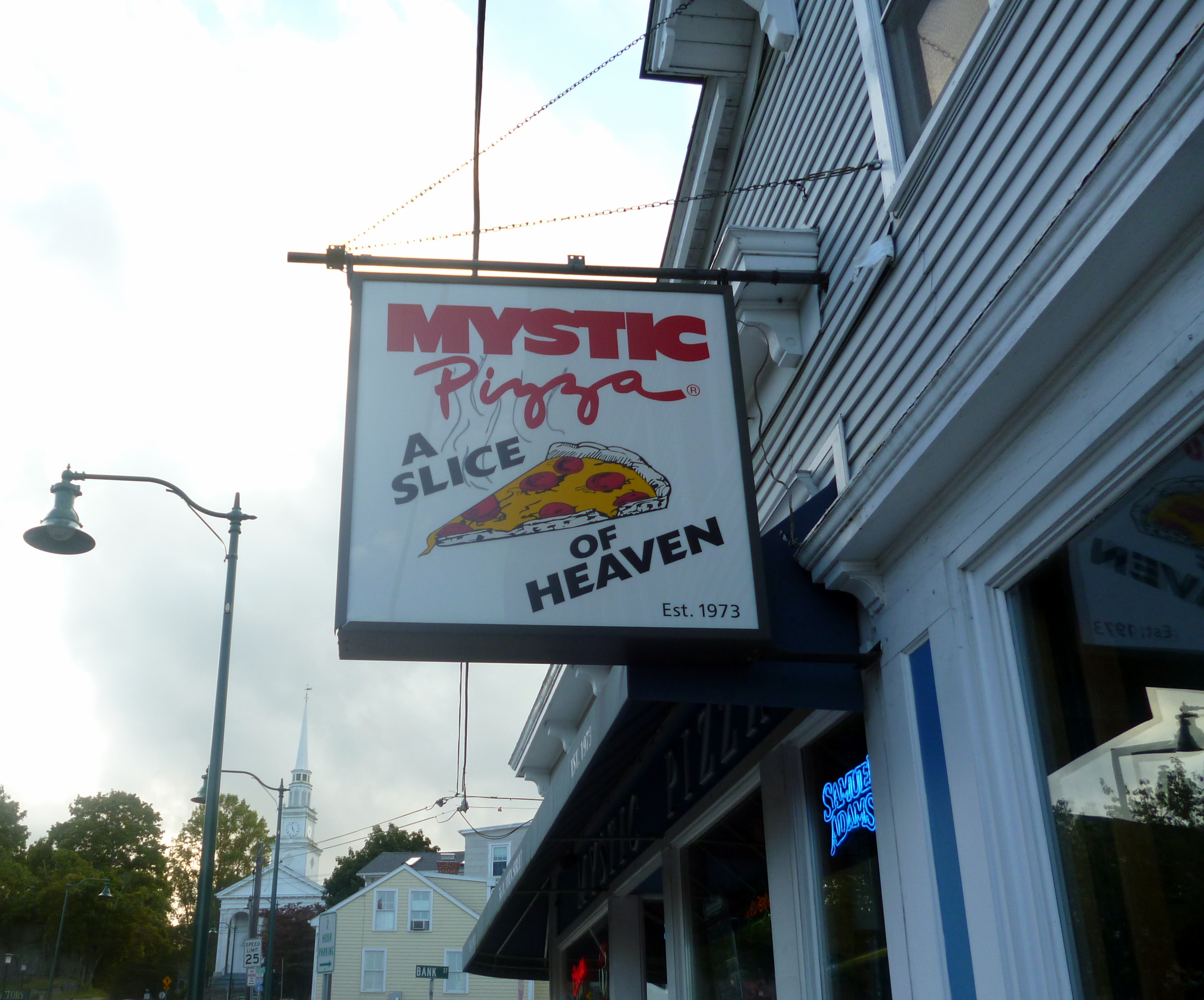
And here’s the iconic Mystic Pizza sign:

The movie didn’t use the actual pizza shop, you’ll be sorry to learn.  If you want to really get into the specific locations used in the movie, you need to go to this amazingly encyclopedic post on the site Road Trip Memories.

Here’s the interior of the current pizza shop. The movie appears to run on a continuous loop on the back wall.  When I took this photo, the final scene of the movie was playing, with the three girls on the back deck of the pizza shop after the wedding.  Moments later, we were back to the opening credits.  I imagine that may quickly get old for the employees.

Here is a scene of the interior used in the movie itself:

At the real Mystic Pizza, the pizza is great; the t-shirts, not so much.

And here is Van Morrison with the last word:

Bishops and nuns, then and now

I recently watched Come to the Stable, a 1949 Loretta Young movie about a couple of French nuns who get it in their heads to come to New England and build a hospital for sick kids in a town called Bethlehem.

I didn’t go to the movies much as a kid, and that’s probably why I still remember seeing this movie on the big screen.  I have no idea why it was playing in a movie theater–I wasn’t around in 1949, so it had to have been a special showing of some kind.  I couldn’t have been very old, because I can remember being confused by the location–could there really be two places called Bethlehem?  That didn’t seem right.  Anyway, the movie is in the tradition of 1940s Catholic movies like Going My Way and The Bells of Saint Mary’s.  The nuns (Young and Celeste Holm) are holy innocents who get their way by being holier and more innocent than everyone they encounter, including the soft-hearted mobster who owns the land they need for the hospital and the practical bishop who has to approve their harebrained scheme.

Come to the Stable was nominated for a bunch of Oscars–most of them baffling.  Back then, you were apparently guaranteed of a nomination if you appeared in a habit. (Elsa Lanchester, playing a local artist, also got a nomination for looking ditzy in a few scenes.  Claire Boothe Luce, the conservative Catholic playwright/politician, got a nomination for the dopey story.)  Seems to me that this sort of movie must have done a lot to pave the way for the country to elect a Catholic to the presidency.  The Church wasn’t this secret foreign power intent on subverting American values–it built hospitals for sick kids!

The movie seems hopelessly quaint nowadays.  I don’t think the story would work on the Hallmark channeI.  I was particularly struck by the way the nuns genuflected and kissed the bishop’s ring every chance they got.  Does anyone still do that?  It was a given that the nuns owed the bishop absolute and unquestioned obedience.  It was a given that nuns would be so unworldly they wouldn’t know what a parking ticket was, even though one of them had grown up in Chicago and the other had been a tennis champion.

So here is an American bishop nowadays:

The first American bishop criminally charged in the clergy sex abuse scandal was found guilty Thursday of a misdemeanor count of failing to report suspected child abuse, a conviction that extends the struggle of Roman Catholic leaders to restore trust in the church.

Bishop Robert Finn was acquitted on a second count. He received two years of probation, but that sentence was suspended and will be wiped from his record if he adheres to a set of conditions that include mandatory abuse reporting training, setting aside $10,000 in diocese money for abuse victim counseling, and instructing all diocesan agents to report suspected criminal activity involving minors.

And here is an American nun, Sister Simone Campbell, who recently spoke at the Democratic National Convention:

And at a convention that is revolving largely around an alleged GOP-led “war on women,” Campbell is a poignant feminist symbol. She has stood up to the Vatican’s criticisms of American nuns for what the church says is their fixation on progressive advocacy at the expense of promoting socially conservative positions.

“We’re certainly oriented toward the needs of women and responding to their needs,” she told Colbert in June, defending the nuns against the Vatican. “If that’s radical, I guess we are.”

It’s lot different from the post-war fantasy world of Come to the Stable.  And I think that’s all to the good.  We shouldn’t be afraid to arrest bishops who don’t protect the children in their diocese.  And we should listen to nuns who have something important to say.