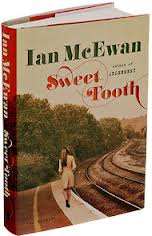
Any Ian McEwan fans out there?

Ian McEwan is a superb writer, and his subject matter is the sort of thing I’m attracted to: murder, science, espionage, literature.  I’ve read most of his novels, and each one of them leaves me feeling dissatisfied for one reason or another.  The latest is called Sweet Tooth (bad title), which is kinda sorta an espionage novel set in the England of the 1970s.  I raced through it, but I was thoroughly annoyed by the end.  Here’s why:

  • Despite being set in England’s MI5 and filled with espionage types, the book is really light on plot.  Not much actually happens.
  • In reality, the focus turns out to be on a fairly uninteresting love triangle among three not very sympathetic people.
  • The novel ends with a post-modern twist.  (McEwan did something similar in Atonement.)  Time was I was very much in favor of post-modern twists.  My tastes have apparently changed, or maybe McEwan just didn’t pull this one off.  In this case, it just made me want to toss the completed book against the nearest wall.

The novel got lots of rave reviews from critics, but on Amazon it has a relatively modest 3.5 rating (by contrast, my novel Senator has, ahem, a 4.3 rating and Dover Beach a 4.1). Lots of people seem to share my reservations.

What I liked about the novel was its wonderfully detailed depiction of England in the 1970s. On the other hand, the couple of times McEwan wrote about something I’m familiar with, he got it wrong.  (No one “takes a legal degree from Harvard” — at least, not back then.)  Kinda shakes your confidence.

The best books I read in 2013

I don’t read anywhere near as much as I’d like to.  Here’s a brief list, more or less in order, of my favorites from 2013, most of which came out in earlier years.

  1. The Immortal Life of Henrietta Lacks (audiobook) — A wonderful mixture of science, sociology, and human interest, beautifully narrated.
  2. Pride and Prejudice (e-book) — Filling a gap in my education here.  I probably would have enjoyed it better in a print version, but it was wonderful nevertheless.
  3. Let’s Explore Diabetes with Owls (audiobook) — David Sedaris has turned himself into a national treasure.  His essays are funny on their own, but even better when he reads them.
  4. Olive Kitteridge (print book) — How come no one told me about this novel, which won the Pulitzer Prize a few years ago?  It suffers a bit from being a series of interconnected short stories (like Winesburg, Ohio) rather than a true novel, but it’s still moving and beautifully written.  On the other hand, I tried listening to Elizabeth Strout’s latest novel, The Burgess Boys, and gave up on it for various reasons.
  5. Lawrence in Arabia (audiobook) — A long, engrossing look at the Middle East during World War I.  (It helps that I have a kid living over there now, in a country that didn’t exist back then.)  I should have read it rather than listened to it, since I wanted to study maps, see photos of the characters, etc.
  6. The Particle at the End of the Universe (print book) — I cannot understand physics, but I like to try.  Sean Carroll is a very engaging writer who really understands stuff like the Large Hadron Collider and the Higgs Boson, to the point where I could delude myself into thinking this stuff finally made sense.
  7. The Signal and the Noise (audiobook) — I love Nate Silver’s 538 blog, and this book was pretty good too — a look at how prediction works (and doesn’t work) in various fields.  Again, I should have read it rather than listened to it — there were too many graphs I wanted to look at rather than have the narrator describe them to me.
  8. Telegraph Avenue (e-book) — Not Michael Chabon’s best novel, but still very enjoyable.
  9. Why Does the World Exist: An Existential Detective Story (e-book) — For some reason I’m interest in why the world exists.  I enjoyed this book a lot, although it also annoyed me a lot.  Here is my moderately clever review written with the limited vocabulary of Up Goer Five.
  10. The Annotated and Illustrated Double Helix (print book) — Filling another gap in my education.  The annotations and illustrations added considerably to my enjoyment of what by now is a familiar story.  On its own, Watson’s narrative wasn’t as interesting as The Immortal Life of Henrietta Lacks.

Other books I enjoyed: Lee Child’s One Shot and Gary Shteyngart’s Super Sad True Love Story.  I most emphatically did not enjoy Thomas Kyd’s Spanish Tragedy.(including the parts supposedly written by Shakespeare) or Lee Child’s A Wanted Man. Neither Kyd nor Child (hmm, that’s an odd juxtaposition) will care.

What books do you pretend to have read?

Book Riot did an informal poll of its readers about books they pretend to have read.  Here are the top 20:

  1. Pride and Prejudice by Jane Austen (85 mentions)
  2. Ulysses by James Joyce
  3. Moby-Dick by Herman Melville
  4. War and Peace by Leo Tolstoy
  5. The Bible
  6. 1984 by George Orwell
  7. The Lord of the Rings by J.R.R. Tolkien
  8. The Great Gatsby by F. Scott Fitzgerald
  9. Anna Karenina by Leo Tolstoy
  10. Catcher in the Rye by J.D. Salinger
  11. Infinite Jest by David Foster Wallace
  12. Catch-22 by Joseph Heller
  13. To Kill a Mockingbird by Harper Lee
  14. Fifty Shades of Grey by E.L. James
  15. Jane Eyre by Charlotte Bronte
  16. Crime and Punishment by Fyodor Dostoevsky
  17. Wuthering Heights by Emily Bronte
  18. Great Expectations by Charles Dickens
  19. Harry Potter (series) by J.K. Rowling
  20. A Tale of Two Cities by Charles Dickens (21 mentions)

“Pretend to have read” is a slippery category — Pretend to whom?  Your snobby literary friends?  Your co-workers standing around the water cooler?  Your girlfriend the English major who won’t sleep with you if you haven’t finished Ulysses?  Does anyone really care nowadays what you’ve read and what you haven’t read?  Presumably the folks that Book Riot readers hang out with do.

Can you spot the one that isn’t as classic-y as the rest?  I thought you could.  As the Book Riot writer suggests, presumably people pretend to have read Fifty Shades of Grey so they don’t get left out of interesting conversations.

Of the books on the list, I haven’t read Pride and Prejudice and Wuthering Heights (among the nineteenth century classics), and Fifty Shades of Grey and The Infinite Jest (among the recent novels).  I’ve dipped into the Harry Potter books with my kids, but haven’t read any of the novels straight through.

There, I’m glad I could finally get that off my chest.

I really don’t care what Harry Bosch had for dinner

I like to listen to Harry Bosch novels on my endless commute.  They don’t require deep thinking, and the narrators are really good. One problem with audio books, though, is you can’t skim.  And there are lots of times in a Harry Bosch novel where I really want to skim.

I won’t bother discussing the endless descriptions of Bosch listening to CDs of jazz performances.  These are by definition boring.  Instead I want to talk about the endless descriptions of the restaurants he goes to and what he orders and what toppings he has on his pizza and how much macaroni and cheese is left over after dinner with his daughter and ARGGH!  Make it stop!

There is, I’m sure, a rationale for this obsession with Harry Bosch and food.  Presumably Connelly wants to show us how cops live in present-day LA.  Here are their hangouts.  Here’s where they eat when they go to court or the shooting range or the forensics lab.  And here’s the kind of food a typical cop likes to eat.  But I don’t care.  Just tell the story.

I have a personal rule for writing that says I don’t put in anything that I’m unlikely to read in someone else’s novel.   Five hundred words about a sunset?  No thank you.  How well a certain Merlot goes with steak tips?  Spare me.  Nothing about women’s shoes.  And, of course, nothing about jazz.  Never, ever, anything about jazz.

Know what Dan Brown needs?! The interrobang!!!!

The interrobang is almost a real thing, and Dan Brown is successful enough to demand that his publisher give him a font that includes one, like so:

His breathless, italics-laden style is what the interrobang was designed for.  Here are some random examples from Inferno:

What the hell do they think I did? Why is my own government hunting me?!

Here he needs interrobangs in consecutive sentences:

Has the speech been canceled?! The city is in near shutdown due to the weather . . . has it kept Zobrist from coming tonight?!

This example is in Italian, although the translation apparently doesn’t require one:

“Lei è Robert Langdon, vero?!” You’re Robert Langdon, aren’t you?”

Here Brown reverses the order of the punctuation marks, for some reason that is too subtle for me to make out.  Perhaps we need a banginterro for this usage:

He turned to the woman. “How do we get up there!?”

Somewhere I learned the rule that a writer should avoid exclamation points: your prose should convey the excitement, not your punctuation. But Dan Brown doesn’t need such lessons; he needs the interrobang.

By the way, let’s not confuse the punctuation mark with this local band that I’ve actually heard play (and some of whose members have hung out at my house).  Or this other band with almost the same name.  With so many great names for bands floating around the universe, why is this happening?

What’s the best book you couldn’t finish?

Goodreads has a list of the top five books that people couldn’t finish:

Hmm.  I’ve already posted about my inability to finish Atlas Shrugged. Its popularity makes me realize there is a limit to my ability to understand human nature.  I re-read Moby Dick a couple of years ago; I finished it, but I have to admit it was a struggle — too much stuff about whaling!  Ulysses is not a book you’re going to get through without a large commitment of time and effort; plus, you’re going to need some help.  But it surely repays the effort.  I have no idea why anyone would have any difficulty finishing Lord of the Rings or Catch-22.

I suppose the most important book I haven’t been able to finish is Proust’s Remembrance of Things Past (if you consider that a single novel).  I forced myself to read Swann’s Way a few years ago, but I hated every minute of it.  I also couldn’t make it through anything by Thomas Mann except Death in Venice; I only finished that one because it was so short.

There are plenty of lesser novels that I haven’t finished, and I get more impatient as I grow older.  I did manage to finish Dan Brown’s Inferno, though, and I’ll blog about that when I gather up my courage.

Dan Brown’s Inferno: Round 1

I have finally gotten up my nerve and started reading a Dan Brown novel.  I’m 40 pages into Inferno, and I haven’t thrown the book across the room yet.  So that’s good.

On the plus side, Brown clearly knows how to write a plot-driven thriller.  The action is standard superhero stuff, involving amnesia and a nameless villain and a shadowy organization known only as The Consortium, but it’s not so ridiculous that I don’t want to find out what’s going on.  And his style is OK: he still has to tell us the exact size of Brunelleschi’s Dome in Florence, but the “index-card” writing isn’t as blatant as in the sample chapter I read of one of his earlier books.

On the minus side, the one thing I know something about so far, Brown didn’t get right.  And that makes me wary about Brown’s mastery of detail.  He has his Harvard professor hero, Robert Langton, wake up in a hospital with amnesia. The doctor asks him where he thinks he is.  The last thing he can remember is walking across the Harvard campus, so he guesses: “Massachusetts General Hospital?”  There are two things wrong with that answer.  First, if you’re from around here, you’d simply say “Mass General.”  No one says “Massachusetts General Hospital.”  Second, he’d know if he had a medical problem at Harvard he’d end up at Mount Auburn Hospital, just down the road in Cambridge.  But of course that’s a much less interesting answer than the world-famous hospital a few miles further away.

And then there is the doctor.  OK, she’s beautiful, and also lissome (which is a dopey word), and she drops everything to save Langton’s life when the spiky-haired female assassin (who was probably also lissome) starts shooting the place up.  That’s pretty standard.  But does she also have to have an IQ of 208?  Did she also have to play Puck in Midsummer Night’s Dream at the age of five?  Realism clearly isn’t what Brown is after here (although he index-cards a couple of real child prodigies that Langton happens to know about).  At that point you have to decide you’re just going to go with the flow.  Or you throw the book across the room.

Did I really read that book?

A while back I read The Good Soldier.  As I did, I kept having the feeling that I had read it already.  But this was never more than an occasional niggling at the back of my mind — a scene, a character would seem vaguely familiar, but then for long stretches the feeling would disappear.

Maybe I did read The Good Soldier, and its memory simply disintegrated in my brain over the years.  I didn’t like it this time around, and it’s unlikely to have made much of an impression on me in high school or college, when I was vacuuming up novels daily.  But it’s also possible that I didn’t in fact read it — that the scenes and characters just reminded me of something else, also now lost.  Beats me.  Memory, modern science tells us, is fragile and unreliable.  We don’t know what we think we know.  (This recent Radiolab podcast tells the story of a woman who confidently identifies the man who had brutally raped her, only to find out years later that she had been mistaken.)

All of this is by way of an introduction to the following lovely review of The Distance Beacons from a very perceptive reader named D. Jensen:

What I can’t believe is that no one else has reviewed this book. Perhaps it is because this is the second (and hopefully not the last) that Bowker has offered us.
It has been a long, long time since I read this book, but I do remember it as a better than “a good ‘un”.

Walter Sands, the only P.I. in a post-apocalyptic (no longer United) States is asked to search for a rebel organization that is threatening to assassinate the President when she comes to Boston to campaign in favor of the New England states to rejoin the union.
Along with his friends and roommates, Walter uncovers much more than he or his employer expect.

Another great read from Bowker. I think that I like it that he never really describes the nuclear war that created this future mish-mash country. It was what it was and now the survivors are just trying to rebuild their lives and perhaps a country that may or may not resemble the earlier version. There is no sweeping view of this time; there is just the observations of the people “on the ground” so to speak. Bowker knows how to keep the characters relevant and relate-able and how to build the tension in the story to keep the reader turning pages–or flipping screens.

Worth the time where so many are not.

It’s all so very true!  Except for the part where he (she?) says “It’s been a long, long time since I read this book.”  As I may have mentioned here, The Distance Beacons was written a while ago (with a different title), but it ended up in a carton in my basement after Bantam declined to print a sequel to Dover Beach.  No more than half a dozen people read it back then, and it’s only the e-book revolution that has allowed it to see the light of day now.  D. Jensen is having a Good Soldier moment.

Unless, you know, my memory is playing tricks on me.

In which I contemplate my eternal damnation

During my early morning run the other day I was thinking about this post, where I suggested that, according to standard Catholic doctrine, a pretty large percentage of Americans over the past forty years were prime candidates for eternal damnation.  And it occurred to me that, according to the standard doctrine I learned growing up, I’m going to hell too, along with a large chunk of the people I know.  Not because of anything to do with abortion, but because I was given the gift of faith and rejected it, turning my back on God’s love.

Hell doesn’t come up much nowadays–I’m sure parts of the Church find the fire-and-brimstone stuff embarrassing.  This Times article (“Hell Is Getting a Makeover”) points out that the latest Catholic catechism contains only five paragraphs about hell in a 700-page book.  And the pain of hell, we now believe, is not physical but mental:

Hell is best understood as the condition of total alienation from all that is good, hopeful and loving in the world. What’s more, this condition is chosen by the damned themselves, the ultimate exercise of free will, not a punishment engineered by God.

Of course, to get to this spot, the theologians have to go the “Jesus’ words shouldn’t be taken literally” route, since Jesus had lots to say about unquenchable fire and the weeping and gnashing of teeth and so on.  But that’s theology for you.

In any case, hell is still real, and apparently I’m going there.  Maybe I’ll contemplate Pascal’s wager on my deathbed–but I doubt it.

And I can’t help thinking that the sermon in Joyce’s Portrait of the Artist as a Young Man is a far more interesting vision of hell than the etiolated modern view.  Here is just a taste.

The horror of this strait and dark prison is increased by its awful stench. All the filth of the world, all the offal and scum of the world, we are told, shall run there as to a vast reeking sewer when the terrible conflagration of the last day has purged the world. The brimstone, too, which burns there in such prodigious quantity fills all hell with its intolerable stench; and the bodies of the damned themselves exhale such a pestilential odour that, as saint Bonaventure says, one of them alone would suffice to infect the whole world. The very air of this world, that pure element, becomes foul and unbreathable when it has been long enclosed. Consider then what must be the foulness of the air of hell. Imagine some foul and putrid corpse that has lain rotting and decomposing in the grave, a jelly-like mass of liquid corruption. Imagine such a corpse a prey to flames, devoured by the fire of burning brimstone and giving off dense choking fumes of nauseous loathsome decomposition. And then imagine this sickening stench, multiplied a millionfold and a millionfold again from the millions upon millions of fetid carcasses massed together in the reeking darkness, a huge and rotting human fungus. Imagine all this, and you will have some idea of the horror of the stench of hell.

But this stench is not, horrible though it is, the greatest physical torment to which the damned are subjected. The torment of fire is the greatest torment to which the tyrant has ever subjected his fellow creatures. Place your finger for a moment in the flame of a candle and you will feel the pain of fire. But our earthly fire was created by God for the benefit of man, to maintain in him the spark of life and to help him in the useful arts, whereas the fire of hell is of another quality and was created by God to torture and punish the unrepentant sinner. Our earthly fire also consumes more or less rapidly according as the object which it attacks is more or less combustible, so that human ingenuity has even succeeded in inventing chemical preparations to check or frustrate its action. But the sulphurous brimstone which burns in hell is a substance which is specially designed to burn for ever and for ever with unspeakable fury. Moreover, our earthly fire destroys at the same time as it burns, so that the more intense it is the shorter is its duration; but the fire of hell has this property, that it preserves that which it burns, and, though it rages with incredible intensity, it rages for ever.

That should’ve kept those Irish lads on the straight and narrow!

Bad Reviews 2: The Alix Ohlin Story

Here we pondered a bad review of Lawrence Krauss’s A Universe from Nothing in the New York Times.

The latest kerfluffle is about an especially scathing review in the Times of Alix Ohlin’s latest books — a novel called Inside and a volume of short stories, Signs and Wonders. I’ve never heard of Ohlin, but her books have A-list publishers — Knopf and Viking — and bunches of good reviews and blurbs.  The review is by William Giraldi, whom I’ve also never heard of.  He’s published a novel called Busy Monsters.  So what’s up?  The review is online, and here’s the first paragraph:

There are two species of novelist: one writes as if the world is a known locale that requires dutiful reporting, the other as if the world has yet to be made. The former enjoys the complacency of the au courant and the lassitude of at-hand language, while the latter believes with Thoreau that “this world is but canvas to our imaginations,” that the only worthy assertion of imagination occurs by way of linguistic originality wed to intellect and emotional verity. You close “Don Quixote” and “Tristram Shandy,” “Middlemarch” and “Augie March,” and the cosmos takes on a coruscated import it rather lacked before, an “eternal and irrepressible freshness,” in Pound’s apt phrase. His definition of literature is among the best we have: “Language charged with meaning.” How charged was the last novel you read?

That paragraph was written by a guy who is trying way too hard.  To all you would-be writers out there: Take my advice and never use a phrase like “the cosmos takes on a coruscated import it rather lacked before.”  Your readers will be forever grateful.

Giraldi’s complaint about Ohlin’s work is that it “enjoys the complacency of the au courant and the lassitude of at-hand language.”  And he gives plenty of examples.  She describes teeth as white; people’s hearts sink and sing; she uses clichés like “Nice guys finish last.”

So anyway, thanks to Amazon, I was able to take a look inside Inside.  And the

Alix Ohlin, apparently dreaming up banal things to write

first chapter was, well, pretty good.  She sets up an interesting situation and draws a couple of interesting characters.  A young female psychotherapist goes out cross-country skiing and literally runs into a guy who has apparently just tried to hang himself.  She takes him to the hospital; she takes him back to his apartment afterwards; she takes an interest.  The dialog is snappy and occasionally unexpected, and the language was cliché-free; no one’s teeth are white in Chapter 1.

So then I looked at Giraldi’s novel. It too has good reviews and a mainstream publisher.  But he tries too hard.  He describes someone as “heaving his psychosis our way, sending bow-tied packages, soilsome letters, and text messages to the bestial effect of, If you marry that baboon, I’ll end all our lives.”  Soilsome?  WordPress’s spellchecker doesn’t recognize that word, and neither do I.

His novel is probably fine, too — it just inhabits a different universe from Ohlin’s.  He will claim it’s a better universe; he’ll claim he has Thoreau and Pound on his side (neither of whom wrote any novels that I can recall).

So why would the New York Times assign Ohlin’s books to be reviewed by someone you can be reasonably confident is going to hate them?  Dunno.  Why bother?  And, if you’re Giraldi, why write a review that makes you look like a dick? How is this going to help your career?

Here’s a balanced article in Salon about how to write a bad review. It ends with this advice:

In the end, the literary world is basically a small city. We could maybe all comfortably occupy Madison, Wisc. And so a book review is not being read in a vacuum: when you angrily eviscerate somebody’s work, you are shitting where you eat. It is important both to support each other and criticize each other, and to find ways to do both, respectfully and constructively. This means thinking things through before you open your piehole, whether it’s on Twitter or in the pages of the Times. Is that so hard?

Sounds right to me.