I thought my novel was going to Oakland, but instead it ended up in Auckland

We were discussing the conclusion of my novel in my writing group. The novel had taken a bit of an unexpected direction.  Well, more than a bit.  How had it ended up in a woodshed in the wilds of a parallel-universe Scotland?  Where did that come from?  Jeff said: “It’s like that guy who got on a plane thinking it was going to Oakland, but instead he ended up in Auckland.”

That really happened, and the Internet will never forget.  And now I won’t, either.

A nice review for “The Portal”

On Amazon:

The book is primarily written for the pre-teen or early teenager, I believe anyway, but I really enjoyed it. The characters pre teens in their world, were transferred to another world, in a different time, to a war torn New England where New Portugal and New Canada were going to attack New England. The boy’s, in conversation with army officers, gave ideas to the Army of New England for weapons that could change the outcome of the war. I haven’t enjoyed a simple, nonsexual, non-cussing book in a long time such as this book is. I recommend this to any boy, I’m not sure about girls since there aren’t many girl characters in it. There is a message in it about family, even families who might have issues and personality problems; about loneliness and familial love; about goodness and evil; about prayer in time of despair. It is not a God book, but it has a spiritual bent, especially when the war starts. For the most part, the main characters are all honorable, even those characters who might seem to be dishonorable, especially those who have come in contact with our two hero’s, in both worlds.

I can’t recommend this book enough.

That sounds about right!

I just hope the reader doesn’t try out some of my other novels, which fall pretty clearly in the “cussing” category, as several annoyed commenters have pointed out.

World-building and storytelling

Posting has been light while I’ve tried to meet my goal of finishing the first draft of my novel in six months.  I probably won’t make it, but I’ll come close.

This is a sequel to my novel The Portal, and the experience of writing it is interestingly different from my previous effort: writing another novel in The Last P.I series, which turned out to be Where All the Ladders Start.  Both novels are science fiction, but Where All the Ladders Start uses a future world (and a set of characters) that I’ve already created. The challenge in writing it was coming up with another mystery plot (or two) for my protagonist to get involved in.

The sequel to The Portal takes place in a parallel (or alternative, or maybe alternate) universe.  It’s an adventure story rather than a mystery, so the plot doesn’t have to be as tightly wound as that of Where All the Ladders Start.  But I have to do a whole lot of world-building for it, and that offers its own difficulties.  There are two things that have been happening in the course of the first draft:

First, I keep coming up with new ideas about the world.  Some are just local color to give the novel added depth; others are dictated by the plot (which, as usual, has veered off in unexpected directions as I write).  All that stuff needs to be worked into the second draft. This is pretty much business as usual.

Second, and more interesting, there’s material I wanted to work into the novel, but I never seemed to find the right place for it.  Now what?  Will I have better luck in the second draft?  The problem I’m having is the world-building does not always play well with storytelling.  For example, at one point in the draft I thought I had reached a good spot in the book where a character could spend a few pages giving some needed background, but my writing group gave the scene a unanimous thumbs-down: it slowed the action too much, I was informed.  Ditch the exposition and ramp up the conflict. The best science fiction novels make integrating the description of the fictional world with the action of the plot seem natural; but it’s hard work.  At least for me.  The challenge of the second draft is going to be making that hard work look effortless.

Leonard Nimoy

As a science fiction writer, I guess I should say a few words about Leonard Nimoy.  Star Trek was a pretty cheesy show, but the character of Spock was inspired, and Nimoy’s portrayal of him was the best thing about the show.  There can’t really be a second act after that, but Nimoy seemed to conduct the rest of his career with dignity.

In particular, I used to like his opening narration for IMAX movies at Boston’s Museum of Science.  He grew up in the West End, not far from the museum, so it was a great choice. (He attended high school at Boston English; decades after him I attended Boston Latin, across the street from English on Avenue Louis Pasteur.  We looked down on the English kids because we were jerks.)

Nimoy isn’t remembered for his singing, but what the heck, here he is doing his best to get through “Proud Mary”:

Fine, he’s no Tina Turner, I get it, but at least he’s better than William Shatner attempting, say, “Lucy in the Sky with Diamonds” from his immortal album “The Transformed Man”:

The New York Times obit of Nimoy refers to these as “marvelously dreadful period artifacts,” which sounds about right.

Here is my friend Jeff Carver’s lovely tribute to Nimoy.

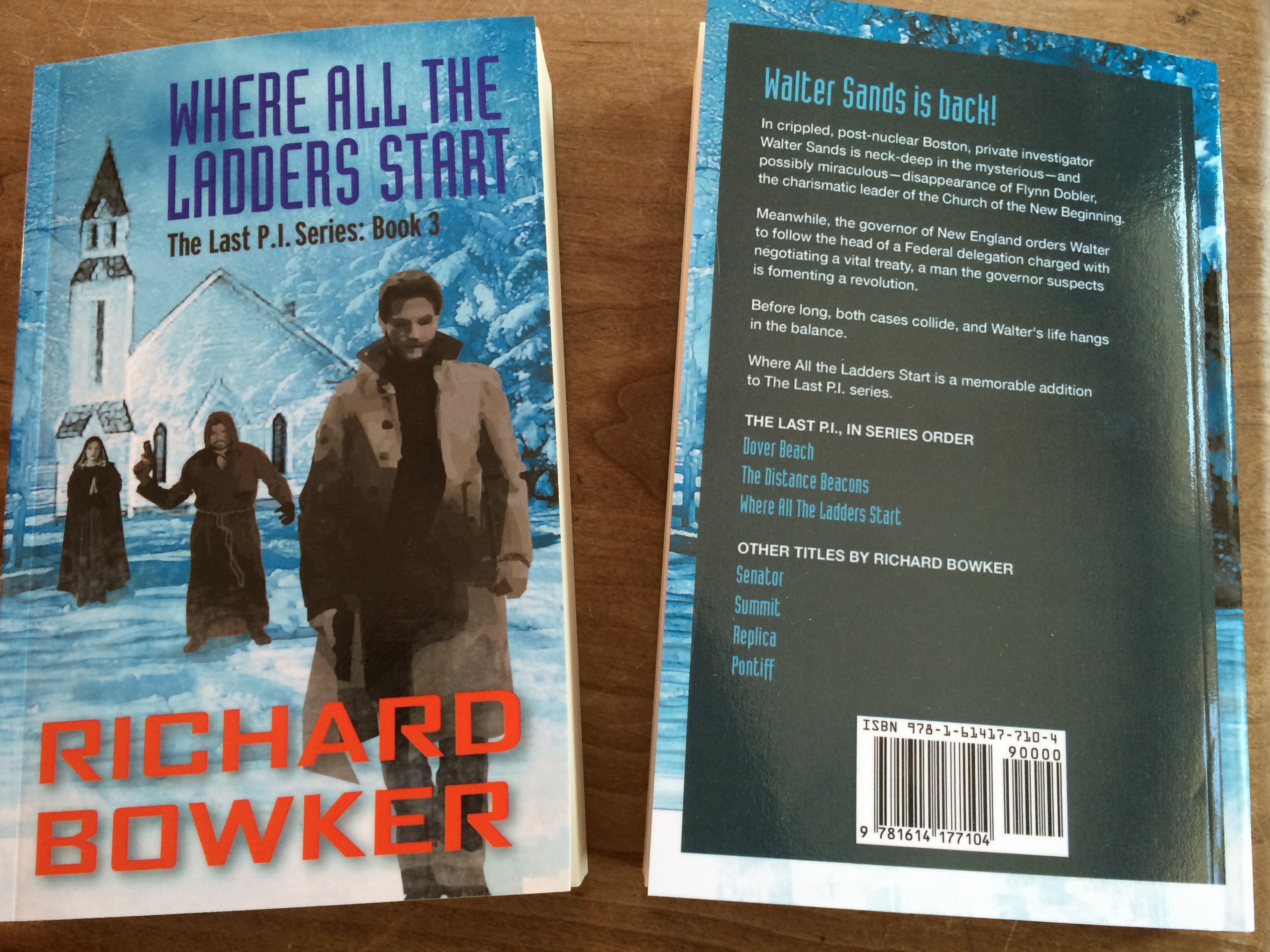
“Where All the Ladders Start”: The printed books have arrived!

Here’s what the book looks like:

2015-02-21 07.20.54

I’m all in favor of ebooks, but physical books do seem more “real,” don’t they?

But here’s the problem you run into with printed books: My publisher got complaints about the point size of the font they use, so they upped it from 10-point to 12-point.  This means that, instead of being about 300 pages, the book ends up being a lengthy 392 pages. Which means that they have to charge more for it than, for example, The Portal: $17.95 retail.

I can get you a discount, though.

My novel “Dover Beach” is available for $0.99!

While I’m shilling for my books here, I should mention that the first book in my Last P.I. series, Dover Beach, is available on Amazon for a mere $0.99.  That’s like almost free!  The idea here, of course, is to get you into the series so you’ll buy Books 2 and 3.  Did I mention that Book 3, Where All the Ladders Start, is available now?

DOVER-BEACH-COVER1L

(There’s a certain amount of snow in Dover Beach, as I recall, but it’s not that bad.  Really it isn’t.)

Here’s a customer review:

Richard Bowker presents an awesome look at the role of a P.I. in a post-apocalyptic world. My first reaction was what on Earth would the remains of society need a Private Investigator for—it’s unlikely a P.I. would be hired to checkout phony insurance claims when there ain’t no more insurance companies. Richard builds a compelling plot with polished nuances sparkling for the reader. The plight of the survivors in Boston is rather frightful. The contrast between the shattered United States and merry old England is striking. He provides a nicely developed depth to his cast of players, and with all things considered, their surroundings are believable. I liked how he addresses real world money issues and there isn’t a P.I. with a pocket full of cash—but a meal at a London McDonalds is affordable. Richard did a marvelous job of resolving all the dangling loose ends—including a few dangling parts the reader doesn’t suspect are dangling—so to speak.

My new novel “Where All the Ladders Start” is available now!

My new novel Where All the Ladders Start is out on Amazon, Barnes & Noble, Google Play, and other fine ebook retailers.  For those of you who haven’t been paying attention, it’s the third book in my Last P.I. series, which also includes Dover Beach and The Distance Beacons. In this one, our hero, Walter Sands, investigates the disappearance of the charismatic leader of the Church of the New Beginning. Twists and turns ensue, along with lots of humor and a few Deep Ideas.

Ladders cover final jpeg

(Note to local readers: even though there is snow on the cover, no shoveling takes place in the novel, and only a small amount of dangerous driving.  This is the nice kind of snow, not the kind of never-ending, soul-destroying snow that is falling as I type these words.)

The ebook is priced at a mere $4.99.  A print version will be available shortly.  If you want a print copy, let me know and I can send you an autographed copy at a discount.

Two readers have already left reviews of Where All the Ladders Start.  Here’s the first, which was up before I even knew the book was available:

fantastic series, rich characters, read this, read the whole series!

it may seem like hyperbole but I LOVE the characters and ideas that roam the world they are set in, and so should you. give this a try!

And here’s the second:

Most excellent.
I look forward to the next in the series.

So I really don’t see why you don’t just go buy the book right now.  You don’t even have to go out into the snow!

My own Imitation Game

Went to see The Imitation Game, and it’s pretty good!  Alan Turing was, of course, a seminal figure in computer science, and his imitation game, or Turing Test, provides an interesting way of thinking about artificial intelligence.

It turns out that I include a Turing Test in my novel Replica.  Here’s the setup: After an assassination attempt, President Randall Forrester has ordered the kidnapping of brilliant scientist Shana York so that she can create an android replica of him to take his place at public events.  Now she is holding a Turing Test to see if Forrester’s frightened aide, George Hunt, can tell the difference between the real president and the fake one.  The scene begins with Forrester confronting his replica, and continues with the test.

The door opened, and Forrester stood there, grinning. The grin disappeared as his eyes met those of his replica. Shana felt the android’s hand slip from her shoulder.

They looked like twins reunited after a lifetime—except there was no joy on their faces, only a kind of frightened fascination. Neither spoke.

“Do you still want the test?” Shana asked after a while.

Forrester glanced at her irritably, as if she had intruded on Replica coversomething that didn’t concern her. He managed a cold smile. “Of course. I just felt like spending a quiet moment ahead of time with my friend here. I must say he’s a handsome fellow.”

“You should check out the size of his ego, too.”

The smile didn’t waver. “That’s precisely the sort of thing I will be checking out,” he said. He advanced into the room. Shana had been obsessed with the man for so long that it wasn’t even disconcerting to be in a room with two of him. There could have been a dozen Forresters, and they would only have seemed natural projections of her state of mind.

Forrester went right up to the android, reached out a hand, and stroked his jaw. The android didn’t move. “He came from a scraping they took of the inside of my cheek,” Forrester said. “Is that a miracle or an obscenity? Both, undoubtedly. How does it feel to be an obscenity, my friend?”

The android didn’t reply.

Forrester looked at Shana. “What is he, the village idiot? That’s not the way I would act if someone insulted me.”

“He does what I tell him to do,” Shana responded. “If you want him to act like you, I’ll tell him to.”

“I see.” He turned back to the android. “If Ms. York told you to jump headfirst out the window, would you do it?”

The android slowly nodded.

Forrester laughed. “Ever get the temptation, Ms. York?”

“Yes, but I manage to remind myself that he isn’t you.”

“Of course. You know, I had you pegged from the start, Ms. York. But enough. Why don’t you run ahead while I make sure my friend’s tie is knotted properly and his hair is combed just like mine. I’m dying to find out how well George does in picking out his boss.”

Shana didn’t like leaving the android alone with Forrester, but that was stupid; soon enough she hoped to leave him for good. “All right. When you get downstairs, Randall,” she said to the android, “you are the president. Understood?”

“Understood.”

Shana left them and went down to the hot, dusty parlor where Hunt was sitting in a wing chair covered with a graying sheet. “A few minutes,” she said.

He nodded, and they waited in silence.

When the two of them finally came downstairs, Shana could feel Hunt become tense. Twice as many Forresters to be afraid of. She tried to pick out the real one. She couldn’t. “Well, George, are you ready?” one of them said. “Be careful, your job depends on this.”

The other one said, “That was clever. That was really clever.”

The first one’s smile faded a little. “Don’t patronize me, you zombie.”

“Oh, I get it—you pretend you’re me losing my temper. Too facile. You’ll have to do better than that.”

The first Forrester swiped at the dirty sheet covering the couch and sat down. “I don’t see why we have to do this in filth,” he muttered. “Come on, George. We’ll stop bickering if you ask us something penetrating and clever.”

Shana turned to Hunt. He looked as if he were about to become ill.

“Come on, George,” Forrester-standing-up said. “We can’t spend the entire campaign here.”

“Tell me about our education policy in the second administration,” Hunt offered.

“Oh, George, how dull. You helped write the plank, of course. For one thing, we’re going to propose a stiff tax on automated equipment designed to replace humans. We’ll use those funds to establish retraining programs for laid-off workers. We’ll also provide bonuses and other incentives for people who retrain as teachers. That way, we’ll provide both a disincentive for layoffs and a boost for education.”

“He could’ve got that answer out of The New York Times, George,” Forrester-on-the-couch remarked. “You and I know what we’re really up to. These disincentive laws are just window dressing. If we get the kind of majorities in Congress we expect—”

“I see the game,” Forrester-standing-up interrupted. “Take whatever I say and go it one better. Why don’t you ask him a question and let me act smug and superior.”

“Don’t interrupt me,” the other one said. “I don’t allow zombies to interrupt me.”

Forrester-standing-up turned on Shana, the veins in his forehead bulging. “Is that all you’ve managed to accomplish here—to teach this thing how to insult me?”

“Bravo!” the seated Forrester shouted. “What you’ve actually taught him is a good imitation of me with my dignity wounded.”

“Oh, now you’ve got him judging my performance.” He mopped his brow. “Come on, George. The test is over. Surely you can make up your mind by now.”

“Now he’s acting decisive and presidential, George. ‘The war is over and I’ve won.’ Notice that the creature still hasn’t shown that it knows anything. Keep going, George. Ask obscure questions. Probe. You can do it.”

“I can’t,” Hunt said softly.

“What’s the problem, George?”

“Don’t let him browbeat you, George.”

“Oh, for God’s sake, George.”

Hunt looked at Shana. “I can’t stand any more,” he said.

“You don’t know which is which?”

He shook his head. “Do you?”

“No.”

“What do you mean you don’t know?” they both shouted in unison.

Shana walked behind the two Forresters, who both turned and glared at her. She put her hands behind each one’s head. When she touched the one who was seated, he suddenly smiled, and she smiled back. She gave a slight tug, and he slumped forward. She held out the cartridge to the one who was standing up. “Here you are, Mr. President,” she said. There was the slightest emphasis on the word you.

The room was silent. Forrester ignored the proffered cartridge. Shana stood behind the android, her free hand on his shoulder. He was soaked with sweat, and so was she.

Then Forrester started to laugh, so loud the furniture seemed to vibrate with his merriment. “You really couldn’t tell, could you, George?”

Hunt shook his head.

“Well, the joke’s on me, obviously. Fifty-four years of developing a personality, and here Ms. York comes along in a few months and duplicates it. What do you think of that, George?”

“It’s what you wanted, isn’t it?”

“Oh, absolutely, I’m delighted. Congratulations, Ms. York.”

Shana didn’t respond.

“Suddenly modest, are we? Most commendable. Anyway, you’ve done it. So let’s get started, shall we, George?”

“Right away?”

“Why not? Let the android give that damn speech in St. Louis tonight. What’s after that?”

“Breakfast meeting in Atlanta, news conference at the White House.”

“I should do the news conference, I suppose. I can come back here for the substitution, and you can update me on what went on. Any problem with that?”

Hunt shrugged and looked at Shana. “Can you get him ready?”

Shana breathed deeply. “It’ll take a while. I’ll have to implant some memories to give him a reason for being here. Any ideas?”

“Oh, George brought me here to check the place out for campaign strategy sessions,” Forrester suggested. “Can you make him believe that?”

“If you give me some time.”

“Yes, well, George will wait for you. I have better things to do.”

“And afterwards I’m free to leave?”

“Oh, of course. I’m sure George has worked it all out. And, Ms. York, let me just say how much I’ve enjoyed our little meetings.”

“You’re too kind,” Shana replied. She bent down and reinserted the cartridge in the android’s skull. “Let’s go upstairs,” she murmured to him.

“And don’t jump out any windows, my friend,” Forrester added. “I need you.”

The android ignored him and followed Shana.

Okay, it’s not exactly the way Turing imagined it.  But, hey, it’s a novel!

Eternity’s End

My friend Jeff Carver has been running a highly successful BookBub promotion of his epic Nebula-nominated science-fiction novel Eternity’s End. Only 99 cents!  But hurry–this is the sale’s final weekend!

Here’s the star-spanning description:

The Flying Dutchman of the stars! Rigger and star pilot Renwald Legroeder undertakes a search for the legendary ghost ship Impris—and her passengers and crew—whose fate is entwined with interstellar piracy, quantum defects in space-time, galactic coverup conspiracies, and deep-cyber romance. A stand-alone Star Rigger novel, and an excellent starting point for readers new to the Star Rigger Universe. A Nebula Award finalist, from the author of The Chaos Chronicles.

I have always wanted to write novels about interstellar piracy, quantum defects in space-time, galactic coverup conspiracies, and deep-cyber romance.  But somehow Jeff always beats me to it.