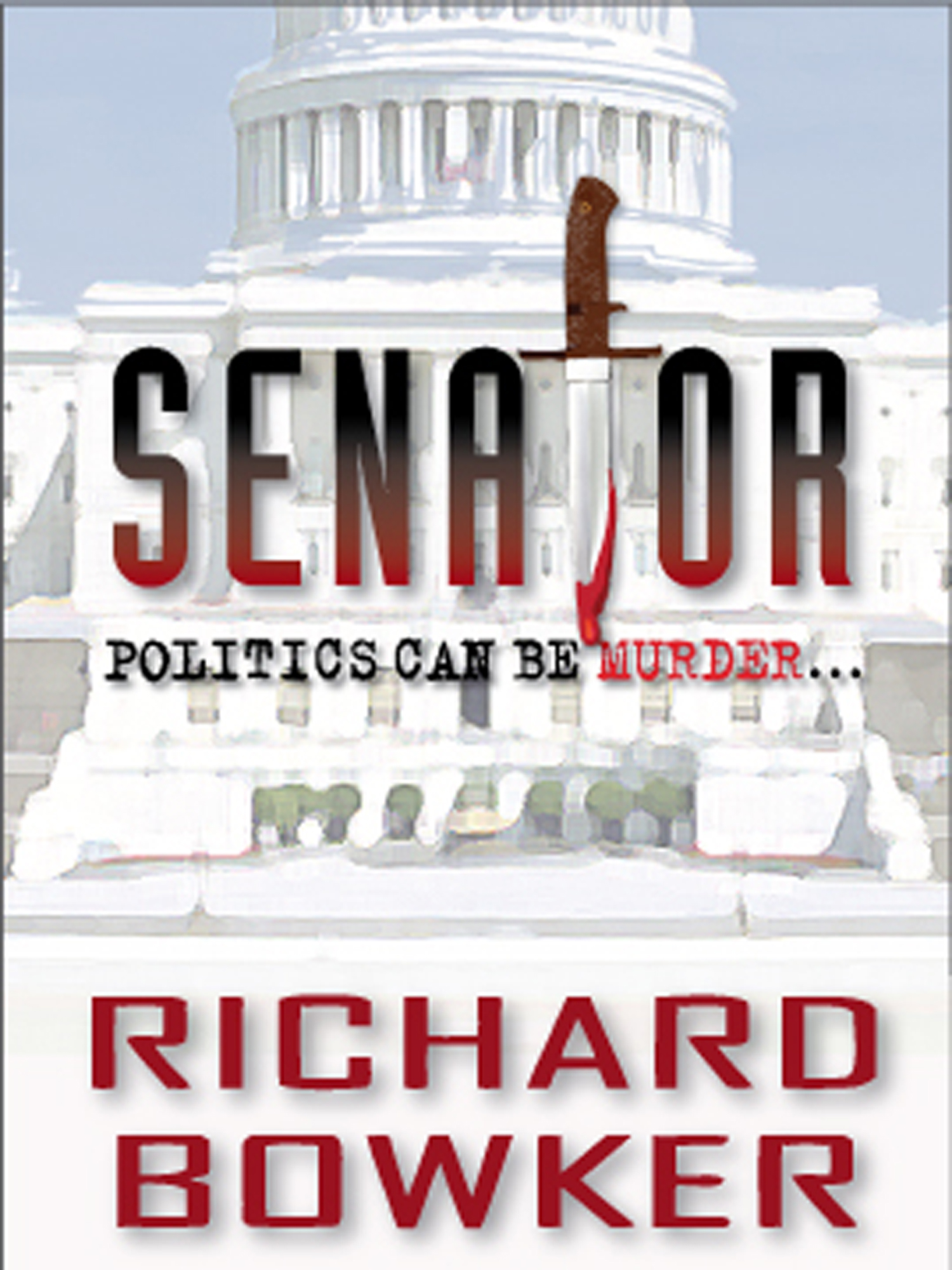
Help me make Senator free on Amazon!

Just follow these easy steps.  You owe it to me.  Okay, you don’t owe me nothin’, but I’d certainly appreciate it!

1. Go to Amazon’s Senator sales page by clicking this link.

2. Scroll down to PRODUCT DETAILS and click on tell us about a lower price.

3. On the next screen, click the circle nest to Website (Online).

4. In the box next to URL: paste this link: http://itunes.apple.com/us/book/senator/id546721642?mt=11

5. In the price box enter 0.00.

6. Click Submit Feedback.

7. When the Close Window button appears, click it.

8. Repeat as often as you like, starting with step 2.

Note that Amazon is already discounting the book to 99 cents.  But free would be better.

And even better would be if you could leave a glowing review for the book if you’ve read it (and especially after you’ve downloaded it, because that makes you a “verified purchaser”).

Thanks!

iBooks? My books! ebooks? Free books!

Update: In comments, Jeff provides the magical link to Senator in the iTunes library.  He also reminds me to tell folks to go to the Senator page on Amazon and inform them that you’ve found Senator for a lower price elsewhere.  That’s how a book gets to be free for the Kindle–you can’t just tell Amazon to give it away.

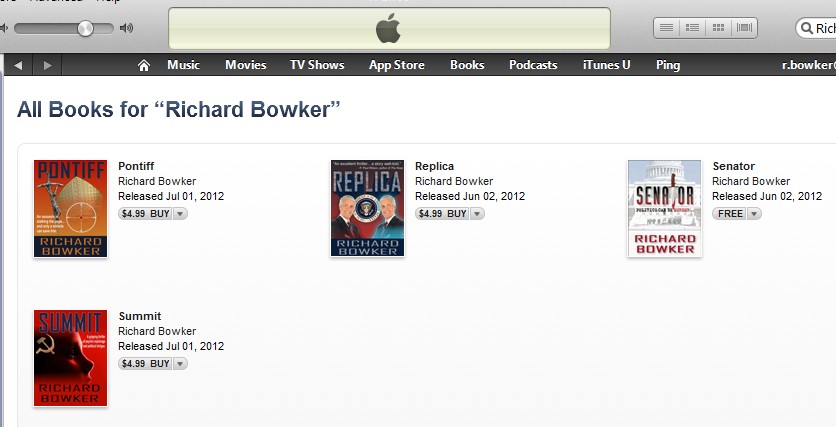
The four novels I have so far released in ebook format are now available on Apple’s iBook store.  Yay!  I don’t know how to link to these guys, but here’s what they look like in iTunes:

Eagle-eyed readers will notice that Senator is free.  That’s right–for a limited time only, it’s available for insanely low price of zero dollars and zero cents.  That’s pretty darn cheap!  At this price, quantities can’t last, so you’d better pick up yours quickly, before Apple runs out.

For those of you who picked up Senator at a higher price, my apologies.  As I noted here, we’ve made some changes to our business model.  I’m using an outside publisher to get my stuff onto sites like iBooks, as well as to goose sales generally.  A standard way to do that is to give a book away and get people hooked so that they’ll buy the others.

Anyway, here is the great (and tragic) Phil Ochs singing his great song “Changes,” just a couple of years before his death.  In a kinder, fairer world, Phil Ochs would have been as long-lived and honored as Dylan.

Rules for writing — Rule 3: Rewrite

This is another in my random series of rules for writing, designed for for those among us who aren’t geniuses and therefore don’t get to make our own rules.  This means you.  And me.

Let’s distinguish rewriting from revising.  Revising is when you tinker with stuff you’ve already written.  That’s fun!  Rewriting is when you throw away what you’ve written and start over again.  Start a new computer file.  Go through the whole story or novel again, typing it from scratch.  That can be intimidating.  It can be overwhelming.  It can feel like a complete waste of time, when you encounter paragraph after paragraph that, as far as you can tell, doesn’t need to change.  Why bother?  There are more novels to be written.  The Red Sox are on TV.

In my post about outlining, I stole an image from E. L. Doctorow of writing as a car journey in the darkness, with only your headlights to guide you as you make your way towards your destination.  What happens when you reach that destination?  Do you really want to start the journey all over again?

Well, yes, you do.  If you’re like me, you accumulate notes during your journey — should have made a left turn here, should have driven a little faster in this stretch, should have taken a shortcut to totally eliminate that stretch. Some of these notes may be the basis for revisions, but often they call for much more.  Generally, for me, they accumulate to the point that I need to start from the beginning.

The most obvious example of this was when I figured out that I had come up with the wrong murderer in Senator.  That required rejiggering the whole novel.  Everything needed to be recalibrated, from the opening sentence to the ending.  I’m currently rereading my novel Dover Beach, and I recall one ultimate plot twist that I figured out only when I had finished the first draft.  Without the twist, something basic about the book was out of whack.  The twist occurs at the very end, but I needed to prepare for it throughout the plot.  I can no longer tell exactly where I made the changes, but I figure that’s a good thing — everything in the final product needs to be seamless.

Rewriting is less fun than revision, because it’s more work.  But I find it deeply satisfying.  And it goes much faster than the first draft, which is what causes me to sweat blood.  I have never done more than three drafts — but maybe my work would be better if I had!  At some point I’m content to take the latest draft and revise it.  And revise it, and revise it.

And still I can look at it later and see where the thing has still fallen short.  Here is the famous quotation from Paul Valéry:

A poem is never finished, only abandoned.

This applies to novels, as well, except you have a hundred thousand words to tinker with instead of a hundred.  You can tinker forever, so at some point you have to stop.  But if you stop too soon, you’re not doing your story, or yourself, justice.

Where should you write?

I was reminded of this question when I viewed this troubling video from John Klobucher, who has started an interesting writing project at his very fine blog Lore of the Underlings:

If I correctly understand this video, he writes his novel while he’s driving his car.  How does he pull that off?  Does he encounter a lot of red lights?  Or empty stretches of highway? Should we find out what his route is so we can avoid it?

So that’s deeply concerning from the perspective of automotive safety.  But on the other hand, good for him!  This is one man’s approach to following Rule 0.  If the only time you have to write is while you’re driving, just make it work. I wrote a good chunk of Senator while commuting on a subway train.  If I couldn’t find a seat, I would stand at the end of the car so that I could lean against the emergency door and have both hands free to hold my notebook and scribble.  I remember reading about Joseph Conrad finishing Lord Jim or some other novel while watching over his daughter as she recovered from a disease.  I’ve heard of people writing while waiting for their kids to finish soccer practice. You do what you have to do.

So now on to Aristotle.  (I don’t know where he wrote, but he sure managed to write a lot.)

Readers of this dispiriting blog may recall that while I drive I listen to online courses downloaded from iTunes University.  Lately I’ve been listening to an Open Yale course called The Philosophy and Science of Human Nature. I recommend it!  The professor is currently doing a deep dive into Aristotle’s Nichomachean Ethics.  (I don’t know much about the Nichomachean Ethics, but I love saying the words out loud.)  Anyway, one of Aristotle’s points is that virtue is a matter of habit.  If you want to be just, get in the habit of doing just things.  If you want to be a harpist, practice playing the harp — over and over again. As Wikipedia puts it:

People become habituated well by first performing actions which are virtuous, possibly because of the guidance of teachers or experience, and in turn these habitual actions then become real virtue where we choose good actions deliberately.

Seems to me that this applies to writing, too.  (Whether writing itself is virtuous is a whole nuther question.)  You become a writer by writing; everything else (reading, research, note-taking, making up great stories in your head, talking to your friends about those great stories) is beside the point.  In my long-running writing group, we once had a come-to-Jesus meeting to try to help the folks in the group who weren’t producing anything to get started.  This had the predictable effect of making some people feel really bad about themselves.  One of them said, “You know, my whole life I’ve thought of myself as a writer, but I’ve never really written anything.”  This has always struck me as a desperately sad statement.  What, after all, was stopping him?  It wasn’t like he wanted to become an astronaut.  All he had to do was pick up a pen and start writing. This wouldn’t have made him a published writer, but none of us have much control over that.

So don’t be like him.  Be like John Klobucher instead.  Get in your car and start writing!

“If I had a sister like you, I would have killed myself, too.”

Those South Boston folks have a way of cutting to the heart of the matter.

However, with Connors’s reference to the 1984 death of her brother, David, Greig’s composure crumpled. She gasped when Connors spoke and then put her hands to her face and mouth – and started to cry. It took her several minutes to regain her composure.

In March, Greig said in open court that she had sought psychiatric counseling after her brother shot himself to death.

This was the only remark from the victims that caused Catherine Greig any visible emotion at her sentencing yesterday.

The mugshot

The whole Whitey Bulger saga is too improbable for fiction, but Greig is one of the most improbable characters in it.  She was Bulger’s second choice to accompany him in his life on the lam.  He first left town with his “common-law wife,” Theresa Stanley.  But Stanley decided she’d rather be with her children, so Bulger turned to Greig, his emergency backup girlfriend.  And she apparently didn’t give a second thought to dropping the rest of her life so that she could go on the run with the mobster.  She took  care of him for 16 years.  And now she doesn’t even get her on Wikipedia page, only a section in Bulger‘s.  And eight years in prison in which to reminisce about all the good times she had with her man:

The man once suspected of gallivanting through Europe had been holed up in the same rent-controlled apartment for at least 13 years, staying up late into the night watching television in his living room with black curtains drawn. When he finally went to bed, the aging gangster slept alone in the master bedroom – windows covered in opaque plastic sheeting – while his girlfriend used the guest room.

I dipped into this world just a little bit in Senator (did I mention that the ebook is now available?).  The IRA gun-running subplot is loosely based on the story of the Valhalla, recounted here. The book I read about the Valhalla suggested that a young guy who was a member of Valhalla’s crew and later disappeared had been murdered by British spies.  We now know he was tortured and killed by Bulger and his cronies because he was a snitch.

Great guys.

Senator now available from Amazon, Barnes & Noble!

Senator is now available from Amazon and Barnes & Noble for the egregiously low price of $4.99.

Senator is a meditation on family, loyalty, and politics, wrapped up in a complex murder mystery that takes place during a grueling political campaign.

The cover is by the great Jim McManus.

Here is the first chapter.

***********

I am a politician.

I stare at the blank screen, and that is the first thing I can think of to write.

It’s astonishing, really. I have never thought of myself as a politician. I certainly didn’t plan to become one. Even as I campaigned, as I shook hands and kissed babies, gave canned speeches and attended endless fund raisers, it didn’t occur to me that these activities were defining me; I always thought of them as simply a means to an end. Until now. Now, when it has all changed forever.

I’m a politician, and I have just finished the toughest campaign of my life. But it isn’t just the campaign I want to write about in this unfamiliar room, on this intimidating machine. Because I want to be something more than a politician, and that will require an understanding of far more than the mechanics of running for public office. It won’t be easy to find that understanding.

But this is where I have to start.

* * *

The battle had been shaping up ever since Bobby Finn announced in late spring that he was going to run against me, but the public didn’t pay attention until after the primary. Couldn’t blame them; we were both lying low—raising funds, doing research, plotting strategy. Neither of us had opposition in the primary, so we spent our time stockpiling ammunition; better to do that than to use it up early and risk having nothing left for the final struggle.

But even when we started in earnest, people were slow to react to the legendary confrontation. The pros blamed it on the weather. It was a soggy September. Flights were delayed, parades canceled; people at factory entrances and subway stops rushed past us to get out of the perpetual rain. Even indoors the crowds were small and inattentive, worried more about whether their basements were flooding than about who would get their vote for senator. Maybe after the baseball season, the pros thought. Eventually they would have to take an interest.

Eventually they did, but Lord, it wasn’t the way I wanted.

I may as well start with the Friday evening it all began. Just another speech—this one to the Newton Republican Women’s Club. Not an especially important event; I was preaching to the converted, and there were only a couple of local reporters there to take my message to the masses. My mind was far away, but still, it went well; the fine ladies laughed at the jokes and applauded at the proper places and were generally thrilled to be in my presence. A politician is an actor whose performance never ends.

Kevin Feeney was with me. It was his job to grab me away from the fine ladies as soon as possible after my speech. Let them blame him, not me, for not staying longer. Sorry, ladies. I’m a slave to my schedule, and Kevin is its keeper.

He did his job—he always does—and together we headed out into the fog and drizzle. He held an umbrella over the two of us as we stood in the parking lot. “Let me drive you home, Senator,” he said.

“Don’t be silly. What’ll we do with the extra car? Take the night off. Relax.”

“You should have let me drive you here.”

By using my own car, I had provided the evening with a logistical complication that Kevin found unnerving. He was supposed to take care of me, and I wasn’t cooperating. “I managed to get here by myself, Kevin,” I said. “I’m sure I can make it back. Go home. Introduce yourself to Barbara and the kids. I’ll see you in the morning.”

Kevin still didn’t look happy. His wife and children came in a distant second in his loyalties. But I wasn’t going to argue with him; I had more important things to do. I got into my Buick and opened the window. “Go home, Kevin,” I repeated. And then I left him standing forlornly in the parking lot.

I didn’t feel sorry for him; in fact, I didn’t give him another thought. Kevin would always be there. I drove along Commonwealth Avenue, an oldies station on low, the windshield wipers keeping time with Neil Sedaka. Generally I like driving alone—offstage, if only for a while. But tonight the pleasure was soured. I had a problem, and I had to solve it by myself.

At a stoplight I picked up the car phone and dialed a number. After the fourth ring the answering machine clicked on: “Hi, this is Amanda Taylor. I can’t come to the phone right now, but—” The light turned green, and I slammed the receiver down.

Maybe she’s there, I thought. Maybe she just isn’t answering.

But maybe it would be better if she weren’t there. I had a key.

Newton turned into Brighton, and the big old Victorian houses gave way to dorms and apartment buildings, laundromats and convenience stores and bars. I come from Brighton, but not this part; this was academic territory. First Boston College and then Boston University, the campus sprawling in urban disarray on both sides of the road for a mile or two before petering out in the dance clubs and record stores and pizza joints of Kenmore Square. To the right, the light towers above Fenway Park blazed in the darkness; the Red Sox were trying to get the game in despite the fog. Big advance sale, probably. I cursed silently: ten thousand extra cars in the neighborhood.

I made my way through the chaos of Kenmore Square traffic and into the Back Bay, where Commonwealth Avenue became elegant once again. I didn’t pay attention to the stately elms and old brick town houses, though; like everyone else in the Back Bay, I was looking for a place to park.

The best I could find was a “residents only” space on Gloucester Street. I decided that I didn’t have a choice, so I pulled into it. I got out of the car and opened my umbrella. At least the fog would make it less likely that I’d be recognized; I didn’t need a conversation about abortion or someone’s Social Security benefits just now. I started walking.

If she was there, what would I say? It was important not to lose my temper. I didn’t need an argument. Above all, I didn’t need her angry at me. And I did need to know what was going on.

If she wasn’t there, I would have to wait for her. This couldn’t be put off.

The building was on Commonwealth, between Gloucester and Fairfield. Out front a low hedge surrounded a magnolia tree, glistening in the light from an old-fashioned streetlamp. Black wrought-iron bars enclosed the windows in the basement and first floor. In the basement I could see the flicker of a TV through the bars. A woman approached, walking a Doberman. The Doberman paused at the streetlamp; the woman stared at me. Where had she seen that face before? I hurried up the front steps and inside.

I closed the umbrella and glanced around. A row of mailboxes to the right. On the wall next to them, a handwritten notice about a lost cat. On the floor beneath, a few faded sheets advertising a Scientology lecture. The ever-present smell of disinfectant. I had caught a whiff of the same disinfectant once in a bathroom at a fund raiser and found myself becoming aroused. I expect that will happen to me again someday. I rang her bell; no answer. I didn’t want to hang around the lobby. As usual someone had left the inner door unlocked. I opened it and hurried up the stairs.

I never took the elevator. You can avoid being seen if you pass someone on the stairs; it’s impossible in an elevator. I took out my keys and started looking for the one I wanted. By the time I reached the third floor, I had found it. The door was there in front of me. My heart was pounding—from racing up the stairs; from the tension of the coming confrontation. I put the key into the lock, and that’s when I knew that something was wrong.

The wood around the lock had been splintered and gouged, as if someone had attacked it with a hammer. I tried the knob; the door was locked. I turned the key, and the door swung open.

“Amanda?” I called out, closing the door behind me.

No answer. I moved into the living room. My heart sank. The place had been ransacked: books and tapes and compact disks pulled off shelves, papers scattered on the rug, the glass coffee table upended. A spider plant lay on its side, its pot cracked, dirt trailing from it like blood from a wound. “Amanda?” I whispered, a prayer now: She wasn’t here; she was at a friend’s place; she was at the police station. “Amanda?”

On the floor next to the bookshelves I saw several large shards of glass. It took me a moment to recognize them; they were the remains of her crystal ball. “I wish I knew where all this was going to end up,” she had said to me once, smiling wistfully. “I wish I had a crystal ball I could look into and see the future.” So I had bought one for her. A joke. It was the only present I had ever given her. It had never done her much good, and now, shattered into a dozen pieces, it looked more useless than ever.

I wanted to run away. I wanted to rewind the tape and start over again. This wasn’t it. The scene was supposed to be entirely different. She should be standing here, beautiful, frightened, apologetic. She had made a mistake. She could explain everything. Nothing for me to worry about.

But my will wasn’t strong enough to change reality, and I knew that running away would only make things worse. So I forced myself to move through the apartment, pleading with God to make it empty.

Her bedroom seemed untouched. So was the bathroom. The little second bedroom she used for an office was a mess; the desk drawers were all open, and her floppy disks were scattered on the floor like shingles ripped from a roof by a hurricane. But her computer was on, humming softly in the silence. On the screen, white words against a black background. I stepped into the room and read the words:

she had to die she had to die she had to die she had to die she had to die she had to die she had to die she had to die she had to die she had to die she had to die she…

They swam in my vision; they merged and twisted as I stared at them and tried to change their meaning. They are only words, I thought. Words can lie. Or they can just be words, sound without content, a speech to nice Republican ladies.

One last room.

I walked past the words and into the kitchen, and that’s where I found her.

She was sprawled on the black tile floor. Her white shirt was torn and bloody; her eyes were open, and they stared unblinking at the ceiling. They seemed amazed that this was the last thing they would see. I reached down and touched her wrist; she was cold.

I looked around wildly. Was her murderer lying in wait for me as well? But I had searched already; I was alone. I closed her eyes, and then I closed my own, slumping down beside her on the floor. The apartment, the city were silent; the only sounds were the hum of the computer in the next room and the thumping of my heart. She was cold. She was dead.

Amanda.

At that moment I would have given back everything I had accomplished, everything I had achieved, for Amanda to be alive again.

But it wasn’t going to happen. My life ticked inexorably onward, and gradually my grief yielded to the pressures of the moment. After a while I forced myself to open my eyes. I haven’t been to a great many crime scenes in my life, but I’m not unfamiliar with murder. I tried to look at Amanda clinically. No rigor mortis, so she’d been dead less than eight hours. On the floor, the bottom of her arm was purplish from the blood settling there, so lividity had started. That meant she’d been dead at least a couple of hours.

Someone had murdered Amanda in the late afternoon.

And I thought: Exact time of death is going to be important.

Her clothes were intact, except for where she had been stabbed. At least she hadn’t been raped, thank God. There was a bruise on her right forearm—where her attacker had held her? There were cuts on her hands and arms—where she had tried to defend herself?

On the floor near the sink I saw a kitchen knife, its blade dark with dried blood. I recalled using that knife to chop celery one evening.

Oh, Lord, I thought: fingerprints. And then the pressures started to overwhelm me. I had to do something. I was in terrible trouble.

I crawled over to the knife. I took out my handkerchief and wiped the handle—

—and immediately felt stupid and evil. It had been months since I had used the knife. My fingerprints couldn’t possibly have been on it. What mattered more: saving my career or finding out who had murdered Amanda?

But then I realized that finding out who had murdered Amanda was just as likely to end my career as having my fingerprints on the knife. This murder couldn’t be a coincidence.

So what should I do? Run away? Go outside and howl in the fog? I couldn’t think of anything that would help. I don’t deserve any credit for it, but finally I decided to do what civilization had taught me to do. I went into the bedroom and called the police.

I gave the dispatcher the address and told her there had been a murder. She asked for my name, and I gave that to her as well. She didn’t seem surprised. There are plenty of James O’Connors in Boston.

Then, continuing to be responsible, I called Harold White. No answer. I tried Roger Simmons next. He was home. “Hi, Roger. Jim.”

“Jim, how are you? What can I—”

“I’m at a murder scene, Roger. I discovered the body. I just called the police. They haven’t arrived yet.”

“Jesus Christ,” he whispered.

“I need you,” I said. I gave him the address.

“Jim,” he said, “I’m not sure I’m the person you want. You know I haven’t done criminal in—”

“That’s okay. Between the two of us it’ll all come back. And get hold of Harold if you can. He isn’t answering.”

“All right, but—”

I hung up. I didn’t feel like chatting with Roger.

I sat on the edge of the bed and looked around. Lights were on, I noticed: in the living room, here in the bedroom. Did that mean she had been alive into the evening? The time of death matters.

But it had been foggy all day, and the apartment was dark anyway, so—

So what? Amanda was dead.

I looked down at the black comforter on the bed. Black comforter, black rugs, white walls. “Why is everything black and white?” I asked her the first time I saw her apartment. I was nervous; I needed to talk.

“I have no style,” she said. “Decorating’s easier if you stick to black and white.”

I didn’t believe her. She oozed style. “I think it’s because you’re a journalist,” I said. “Journalists like extremes. Good guys and bad guys. Saints and sinners.”

“All right,” she said. “Have it your way.”

“So am I a good guy or a bad guy?” I persisted.

And then she smiled at me. That sensuous, knowing smile, the smile of a prom queen watching the gawky boy try to ask her for a dance. “I don’t know,” she said. “But I intend to find out.”

The words were filled with menace in the remembering. I thought of her white shirt, now stained red. I thought of her white skin turning purple against the black floor. I heard sirens.

I thought of what I had come here to find out. Too late for that now. If it was here, hidden somewhere in the computer or the pile of floppy disks, I was ruined. But I thought: At least I can’t let them find out we were lovers.

We had been careful, I knew. No presents, no mementos. No risks. Was there anything—

Yes. A Polaroid snapshot we had taken with a timer one night after a bottle of wine: the two of us kissing openmouthed on the edge of the bed. Where I was sitting now. We didn’t stop kissing when the flash went off and the camera spat out the photo. Afterward I suggested that we burn it, but she refused. “I need something to remind me of you when you’re not here,” she insisted. Were those words another lie? I hadn’t thought so at the time. She kissed me again, and I didn’t object when she kept the photo.

She had put it in the drawer of her night table, beneath her birth control pills. Could it still be there? Perhaps she had thrown it away in anger or despair; more likely she was saving it for evidence. I opened the drawer. The pills were where I remembered them; I picked them up, and there was the photograph. I stuck it in my pocket without looking at it. And then I held my head in my hands and started to cry for the first time since I was twelve years old.

Rule 37: Use names that don’t confuse your reader

You’ll notice that I have skipped ahead from Rule 0.  Like NCIS Special Agent Gibbs, I won’t dole these rules out in numerical order. The numbering should reflect the rule’s overall importance, I guess.

I was reminded of this rule when I was rereading Senator and I noticed that I had one character named Danny and another character named Denny.  Why did I do that?  Danny is a major character — the Senator’s brother; Denny is a staffer who appears in a couple of minor scenes.  The chance that the reader will be confused is slim; but still, that’s the sort of thing a writer should avoid.

You don’t want to risk confusion with last names either.  A rule of thumb is to avoid having two characters whose last name starts with the same letter: Maloney and Mackey, for example.  That’s hard to manage in a novel with a large cast, but you can vary the number of syllables and the vowel sounds: Maloney and Meade, let’s say.

Another subrule is to be careful if you refer to a character in a lot of different ways: Katherine and Kate and Mrs. O’Connor, for example.  You sometimes need to do that in dialog or when you’re using multiple points of view, but it can be troublesome for the reader.  Think of those Russian novels where a character is Vladimir Vladimirovich in one scene and Volodya in the next; this problem crops up in Summit.

A couple of related rules, which don’t merit a number:

Don’t end a character’s name with an “s” — this gets awkward if you have to use the possessive.  Senator O’Connor’s ex-law partner is named Roger Simmons.  Again, why did I do that?  Now I have to write a phrase like “Simmons’s wife,” which sounds awful, or recast the sentence to avoid the possessive.  In this case, it’s a first person narrative, so the senator always refers to him as “Roger,” which mitigates the damage.

Don’t use an ethnic name unless the ethnic identity is part of the characterization. The reader is going to expect that. The police lieutenant in Pontiff is named Kathleen Morelli.  The fact that she has an Irish first name and an Italian last name has some significance to who she is, and I have to draw that out at some point in the novel.  Senator Jim O’Connor’s Irishness is a part of his identity, although I think the publisher made too much of it with the bleeding shamrock on the book’s cover.

A big problem with names (at least for me) is that a character’s name quickly become deeply entwined in his or her characterization, and if I finally notice a problem — like the final “s” in Roger’s name — it’s hard for me to do anything about it.  He just feels too much like a “Simmons” to me.  Which is odd, because “Roger Simmons” is an utterly bland name.  It’s not like Pecksniff or Gradgrind or a hundred others out of Dickens.  Of course, Roger Simmons is an utterly bland character compared to anyone in a Dickens novel.  But he’s my character, and that’s his name.

Chekhov’s gun (and why it matters)

I’ve been rereading Senator and, as with Summit, I found myself a little hazy about some details of its complex plot.  Fairly early in the book, the senator comes across a gun in a drawer in his wife’s dresser.  And my first thought when I read this scene was: Yikes, I hope I didn’t break Chekhov’s rule about guns!

I don’t know if they teach this rule in graduate fiction-writing programs, but they should — it’s that basic.  And, wouldn’t you know, Wikipedia has an entry about it.  Apparently Chekhov stated the rule about four different ways, but his point is clear: If you introduce a gun in a story, you better use it before the story is over.  If you don’t use it, that’s not exactly a plot hole, but in some basic way you haven’t played fair with the reader (or playgoer).

The converse of this is also true: If a character uses a gun near the end of a novel, you better have introduced that gun earlier in the plot.  You can’t just say: “He recalled that his wife had a gun in a dresser drawer that she kept there for protection, so he went upstairs and got it.”

Of course, the rule isn’t just about guns.  In a meeting with his campaign staff after discovering the murder that starts off the novel, the senator notices a bruise on the arm of one of his trusted lieutenants.  If the narrator notices a bruise on someone’s arm, that bruise had better have some significance later on in the story.

So, did I break Chekhov’s rule in Senator?  Ha!  Wouldn’t you like to know!  Coming soon to an ebook store near you….

(By the way, any day now I’m going to start setting down my rules for writing.  None of them are as good as Chekhov’s gun rule, though.)

Damned if I know who killed the chauffeur

Writers are sensitive souls.  When Senator came out, Publishers Weekly gave it a rave review, saying, among other kind things: “The plot remains practically bulletproof, right up to the surprising ending.”  So of course my response was: “Waddaya mean, practically bulletproof?”  I spent many exhausting hours bulletproofing that plot.  Show me the holes!

Mysteries need to play fair with their readers.  You’ve got to give them a fair chance to identify the murderer.  You can’t hold too much back, and ultimately you have to explain everything.  This is not easy, especially with a complex mystery where everyone turns out to be a suspect except the family cat (and I wasn’t sure about her for a while).

This reminds me of the famous story about the movie version of Raymond Chandler’s The Big Sleep. The screenwriters (who included William Faulkner and Leigh Brackett, who later wrote The Empire Strikes Back), couldn’t figure out one plot point, so they wired Chandler to ask: “Who killed the chauffeur?”  Supposedly Chandler wired back: “Damned if I know.”

There are lots of great mystery writers around, but I have difficulty reading them for pleasure–I find myself paying too much attention to the craft.  When I read a novel like 1Q84, on the other hand, it’s purely for pleasure–Murakami’s craft belongs in another literary universe altogether.

One odd thing about the plotting of Senator: when I first outlined the novel, I got the murderer wrong.  At one level, this doesn’t make any sense; I’m the writer, I get to say whodunnit.  But ultimately I understood that the whole novel was pointed towards someone else as the guilty party; in fact, the story made no sense without a climactic scene that was at least three plot twists away from the original person I had fingered for the crime.

That, by the way, is what makes writing really worth while.

“I’m dying — but first let me tell you my life story”

One of the first things you have to figure out when writing a novel is its point of view.

This usually isn’t hard — there just aren’t that many standard options for genre fiction.  For thrillers, a typical choice is a floating third-person point of view — the writer puts you in the head of one character, then another, then another, and that propels you through the story.  That’s the point of view I used for Summit and Pontiff. For mysteries, the typical choice is a first-person or limited third-person point of view.  The writer puts you in one person’s head as he or she tries to figure out the puzzle, and you try to figure it out along with that person.  I use a first-person narrative for Senator and Dover Beach (which is essentially a private-eye novel).

Sometime after I completed the first draft of Senator I decided I needed to tweak the point of view a bit.  It’s still told in the first person, but there is a structure to the narrative; I introduce a framing device.  The senator is typing his story into a computer.  He is writing the story for himself — to try to understand who he is.  As the story starts, we don’t know where he is, or what he’s up to.  Is he hiding from the police? We occasionally see scenes of him in this environment.  They’re written in the first-person present tense, while the bulk of the novel is in the standard past tense.

Essentially, the story is told as a formal flashback — starting at one point in time and then looking back to the events that led to that point in time.  Movies use flashbacks all the time.  (Watching old movies from the 40s and 50s, I sometimes get the impression that there was a law back then mandating the use of flashbacks.  The most recent one I watched was Mildred Pierce; the most famous flashback movie is obviously Citizen Kane.)  In novels, flashbacks just naturally flow into the narrative.  A character is introduced into the narrative, and the writer flashes back to tell his life story, or how he met the protagonist, or whatever.  A first-person narrative is by its very nature a flashback, but we typically don’t see that exact point of time at which the narrative is being told.  When you think about it, this is kind of weird — when does the private eye find the time to narrate the stories of his cases?  Why is he bothering to tell us these stories?

I decided to use the formal flashback structure in Senator because that weirdness was bothering me.  Why is a busy politician telling this story?  The concern I had (and, actually, I still have) is that some people might find the framing device — the senator trying to understand himself — to be borderline pretentious for what is at its core a murder mystery.  Maybe it should be reserved for Citizen Kane and friends.