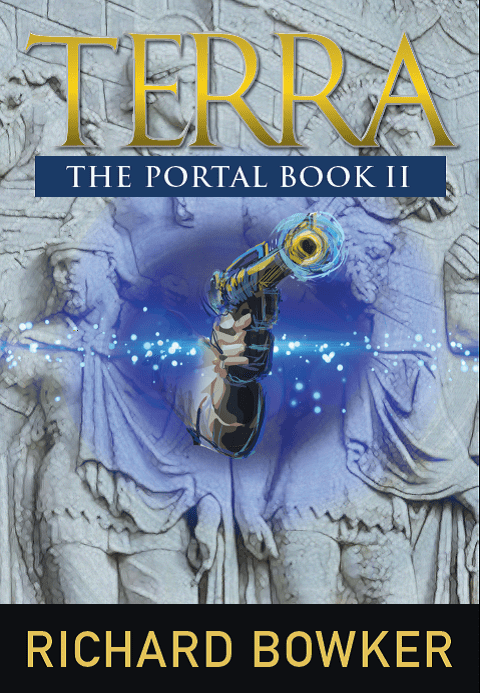
Terra now available on Kobo, Google Play, iTunes…

For those of you who like to take less-traveled roads, my new novel Terra is now available on Kobo, Google Play, and iTunes.  I’m not sure what’s taking Barnes & Noble so long.

Here’s an article about the market shares of ebook vendors.  iTunes has 11% of the market; Barnes & Noble has 8%; Kobo has 3%; Google Play has 2%; Amazon has almost all the rest.  Oddly, most of my sales come from Barnes & Noble.  I do see a smattering of sales from the other vendors not named Amazon.

I will now start reminding people that customer reviews are the life’s blood of book sales.  So far Terra has none.  I expect that they may be hard to come by, since the novel will be of most interest to folks who have read The Portal.  So it’s all the more urgent for me to browbeat you into both reading and reviewing the thing.

Here’s the plot summary and first chapter.

“Terra” is now available from Amazon!

It took longer than I expected — but Terra is finally here.

Terra is the sequel to my novel The Portal; it extends and deepens the story of Larry Barnes and the cosmic gateway he has discovered to parallel universes.  Here’s a summary, along with the first chapter.

Terra cover

The ebook will be available on Barnes & Noble and other online vendors before long.  A print version will show up shortly thereafter.

By the way, if you read the marketing description of Terra on Amazon, you’ll notice a reference to the next book in the series, which is called Barbarica.  Don’t hold your breath waiting for it to appear, though; I’m about a quarter of the way through the first draft.

The Girl on the Train; also, chapter titles

Everyone seems to love The Girl on the Train.  It was a number one best seller; it’s being made into a movie; it’s on Obama’s summer vacation reading list.  So fine.  I just read it on my summer vacation.

The first thing I noticed is that the author used the technique I have settled on for my new novel: the point-of-view character is identified at the beginning of each chapter (along with the date and time of day).  I have become a little dubious about this technique since my
writing group reviewed my latest chapters, and Jeff pointed out that I hadn’t correctly established my point-of-view character in one of them.  “But I don’t need to,” I said.  “The point-of-view character is identified in the chapter title.”

“Oh,” Jeff replied.  “I hadn’t noticed that.”

So maybe I need to remove the “Chapter” designation; maybe I need to make the name of the character bigger.  That’s what Paula Hawkins does.  It’s probably all that stands between me and a deal for a major motion picture.

Anyway, her novel is well written and cleverly constructed, but I ended up being pretty disappointed.  Here are the problems I had with it (moderate spoiler alert):

  • I figured out who the murderer was pretty early on.  I kept expecting there would be a further twist, but the twist never came.
  • The critical event in the plot is witnessed by one of the narrators, but she doesn’t remember what happened because she was having an alcoholic blackout.  Or perhaps it didn’t happen.  Or perhaps she remembered it incorrectly.  But finally she remembers it, and that solves the mystery.  Meh.
  • One of the other narrators solves the mystery because the murderer unaccountably holds onto a key piece of evidence against him.  Phooey.
  • The climax is straight out of a Lifetime movie.  Woman finally realizes that the man she loved is really a lying cheating murdering psychopath.  The man comes after her.  Can she summon up the moxie to defeat him?  Ugh.

But really, her chapter titles are pretty good.

The Bad Sex award

The Bad Sex award for 2015 was given out last December.  Guess I missed it.  Here’s an interesting article in The Guardian about it.  The British award is given out for badly written erotic passages in otherwise good novels.  The winner was the singer Morrissey for a ridiculous passage in his novel List of the Lost.  The article makes the point that fear of being nominated for the award may actually be having a beneficial effect on literature, at least in the UK:

Grandees of the English novel are now hardly ever shortlisted because even the likes of Ian McEwan and Howard Jacobson now eschew sexual description, quite possibly in part due to awareness that such scenes could be performed to a baying, champagne-guzzling audience at the In And Out club the following December; and newcomers emerge from their creative writing degrees equally convinced that they’re best avoided.

I find writing a sex scene to be difficult.  Here’s the problem: a sex scene in most novels tends to be important; something major is happening to central characters.  (If they’re not central, why are you showing them having sex?)  Important scenes require vivid writing; you can’t just say: “They went into the bedroom, took their clothes off, and made love.”  So you want to ramp up the prose.  But what can you say about sex that hasn’t already been said?  You start reaching for metaphors, and before you know it you’re heading towards a Bad Sex nomination.

The thing to do, I think, is to focus on the characters’ reactions to what is happening, their emotions, rather than physical description.  Because the characters are what matter, after all; not the sex.  So sex scenes become exercises in characterization, not description.

By the way, Lee Child wants no part of writing sex scenes in his Jack Reacher novels.  He usually summarizes them briefly after the fact.  It had been good, Reacher thought.  It had been very good.  This is actually a good approach for Child.  A very good approach.  I wish he’d use the same approach for exploding brains and the like.

Free ebooks in return for reviews: Some results

It’s becoming harder to get customer reviews for books nowadays.  That’s probably related to the general downturn in the ebook market.  Here I mentioned a program, run by my epublisher, to give away ebooks in return for honest reviews.  Once you sign up, you start getting a weekly eZine containing a list of books you can download for free.  Download a book, read it, and leave a review.

This model seems to be OK with Amazon, which has cracked down on some aspects of the customer review racket.  It appears to be a requirement to state that you got the book for free in return for an honest review.

Anyway, the approach is working for my novel Where All the Ladders Start.  Most reviews are pretty terse, like this one:

I received this book for an honest review. I loved this book. The plot and characters were amazing.

Well, what more do you need to say?  But wait!  It turns out that Laura Furuta has more to say!  Namely:

When I first started reading this story I was not really sure what to expect. I read the description and was thinking it was just another mystery book. I was wrong! This is a story about a P. I. who works in an America that has been changed. Not only that, also there are forces at work that are determined to see he fails with his latest case. I really enjoyed the story from the first chapter to the very ending page. It has the right combination of mystery and plot to keep you guessing. The characters also really shine as well. The main characters are very well written and even some of the secondary ones you will remember and love. This is one book that I recommend if you love mysteries. It will keep you guessing. I received a copy of this book from eBook Discovery in exchange for an honest review.

Even better!  Now all I need is a few more sales . . .

Here’s the cover, in case you forgot what the thing looks like:

Ladders cover final jpeg

Writers in the movies: “Trumbo”

One more in an apparently very occasional series.

Trumbo, of course, is the movie about Dalton Trumbo, the blacklisted screenwriter who wrote Roman HolidaySpartacus, and other major movies.  The film mostly focuses on his time on the blacklist, when he had to cobble together a living by writing scripts anonymously, with the screen credit going to fronts.

Bryan Cranston is fine as Trumbo, and I guess he deserved his Oscar nomination, but Trumbo struck me as being a very bland movie.  Trumbo is presented as a secular saint, with his opponents–Hedda Hopper, John Wayne–presented as purely evil.  The only flaw we see in Trumbo is when he gets cranky with his kids for not wanting to deliver some of his rewrites to a movie set–but he quickly repents and goes off to apologize to his daughter, who, like him, is devoted to the cause of justice for the downtrodden.  Couldn’t we at least have had a scene where he explains why he’s still a communist despite what was then known about Stalin?  Life and politics in the 1950s were more complex than this movie lets on.

If Trumbo soft-pedals its hero’s politics, it pretty much ignores his writing.  We see a scene from Roman Holiday and another from Spartacus, and we learn that Trumbo likes to write in the bathtub, but there’s virtually nothing about the craft itself.  Well, there is a scene where he and a blacklisted co-writer (played by Louis CK) discuss the plotting for a quickie called “The Alien and the Farmgirl”.  Why does the alien fall for the farmgirl?  Because he reminds him of his girl back home.  OK, then.

Too bad.  Trumbo seems like an interesting guy, and the blacklist is certainly an interesting subject.  They deserve a better movie.

Is the word “cachet” losing its cache?

Here is a Boston Globe article about the Donald Trump scandal of the day: buying a Tim Tebow helmet with funds from his charitable foundation, apparently in violation of IRS rules.  But why isn’t it on display in photos of Trump’s sports memorabilia?

One possible reason: the Tebow gear has lost some of its cache. In hindsight, Trump’s famous eye for a good deal seems to have deserted him on the night of the auction: as it turned out, he was buying Tebow gear close to its peak price.

What the heck is the word “cache” doing there?  Obviously they meant “cachet” — presumably they thought “cache” was like “cliché”, with an acute accent over the final “e”.

Turns out this isn’t random: Here is Fox Business wondering if the American Express Black Card is losing its cache.  They liked the word so much it appeared in the article’s title.  This Chicago real estate publication wonders if Park Tower has lost its cache.  It’s interesting, though, that the Globe article is reprinted from the Washington Post, which uses the correct word (online, anyway).

This (mis)usage isn’t anywhere near as common as the similar use of cliché as an adjective, on the model of passé.  That’s so cliché!  Here’s a grammarian who is OK with this:

By now, I think, “so cliche” seems normal to a lot of younger speakers and writers. And I have a soft spot for it myself, as I confessed in that 2003 column, because it’s such a natural choice:

Though cliche came into English as a noun, it retains its French form — and that form is a past participle, perfectly happy to be used as an adjective. English is full of such French words, some used as nouns (divorcee, souffle, negligee), others as adjectives (passe, flambe).

For me, that usage is like fingernails on a chalkboard.

Sequels

I’m finally getting around to reading Funeral Games, the last volume in Mary Renault’s trilogy about Alexander the Great.  It is wonderful.  And it addresses some issues I’m trying to solve while starting up my new novel, which will be a sequel to my upcoming novel Terra (which by the way, should be available in a matter of weeks.)

The first problem with writing a sequel is that you have to treat it as a stand-alone novel. You shouldn’t assume that the reader has read (or has remembered) the book to which it’s a sequel.

But there’s also a deeper problem.  Why are you breaking the story in two?  Why not write one long novel?  The sequel really needs to be somehow different.

What Renault did in Funeral Games is something I’ve decided to try in my own sequel. The predecessor to Funeral GamesThe Persian Boy, is a first-person narrative, told by a young eunuch named Bagoas who grew close to Alexander at the  peak of his glory.  But in Funeral Games, which tells the story of what happened after Alexander’s death, Renault gives us a panoramic multiple-third-person point of view.  We are now inside the heads of characters whom before we only saw from Bagoas’s point of view.  And Bagoas is now seen from their point of view.  The effect is to immediately deepen and broaden the story.  And changing the point of view also helps with the first problem — we get to experience events from the first two books in the point-of-view characters’ memories, so the backstory is established effortlessly.

Anyway, this is exactly what I’m trying to pull off in my new novel.  We’ll see how successful I am.  Renault set the bar very high.

Terra, Chapter 2

Here is the second chapter of my novel Terra.  (Here’s the first.)  I’m still not sure if I want to post the whole thing; let’s see where this goes.

=================

Chapter 2

I stared at her.  She was tall and slender, with short black hair.  I’m not really good at telling how old people are, but I guessed she might be about thirty.  She was wearing jeans and a down vest over a plaid shirt—the same outfit she’d been wearing at the 7-11.  She was very attractive.  She spoke English with the slightest bit of some kind of strange accent—just enough to tell you that she wasn’t from America.

Stranger danger, my mother would say.

But I felt safe—safe enough, anyway.  The woman’s eyes told me what I needed to know.  “Who are you?” I asked, although I thought I knew the answer.

“My name is Valleia,” she replied.

“And . . . you’re not from here.”

She nodded.  “I am not.”

“Why do you need my help?”

“Do you remember sitting in a dark church last Christmas Eve?  It was not far from here, but at the same time . . .  it was not here.  And a stranger appeared.  He explained some things to you, and he told you how to get home, when you thought you would never be able to.”

I remembered.  The preacher.  The traveler.  When I first saw him, he was giving sermons to people who weren’t very interested.  And then there was that Christmas Eve.  Listen to your heart, he had told me when I was trying to figure out whether I should leave that other world, or stay with a family I had come to love.

“Is he in trouble?” I asked.

Valleia nodded.  “He is.  Do you have time to listen to the story?”

“Sure,” I replied.

She got down on the ground and sat crossed-legged on the soggy leaves.  I sat opposite her.  She closed her eyes for a moment, and then opened them.  “His name is Affronius,” she began.  “Affron, for short.  Did he tell you anything about the world he came from?”

“Just a little.  He was a kind of priest, he said.  He and the other priests used the portal to go around to other worlds, other universes—’imparting wisdom,’ he said.  But they tried not to interfere, even though they knew how to cure diseases and everything.”

“Well, yes, that’s true, although Affron is much more interested in imparting wisdom than most of the rest of us.”

“He was kind of…odd,” I said.  “I liked him.”

“Many of us like him,” Valleia replied softly.

“What’s going on?  Why is he in trouble?”

“Because of his oddness, I suppose.  Larry, let me tell you about Terra.”

Terra.  I must have come across that word somewhere in my reading, because it didn’t seem totally unfamiliar.  But the word sounded so different, hearing it spoken by Valleia that afternoon, sitting on the damp ground in the woods behind my house.

“Terra is the name of our world,” Valleia went on.  “A big part of our world is ruled by a priesthood.  Affron is part of that priesthood; so am I.  Some of us travel to other worlds; many others stay behind and govern our empire on Terra.  This has been going on for centuries—ever since Via was discovered, really.

“What’s Via?”  Like Terra, the word seemed familiar.

“Ah.  I’m sorry.  That’s our name for what you call the portal  Anyway, there is a rule—Affron says he told you about it—that we are not supposed to change the worlds we visit.  We don’t tell them how to build weapons; we don’t cure their diseases; above all, we don’t talk to them about the portal.”

“Is that why he’s in trouble?  Because he talked to me?”

Valleia sighed.  “That’s what he’s accused of.  But . . . it’s complicated.  This shouldn’t really get him into trouble.  Others have done far worse things, without punishment.  But Affron has powerful enemies, and they see this as a way of defeating him.”

“Is he on trial or something?”

“Yes, Larry.  And Affron would like you to speak for him at the trial.”

“You mean . . . go to Terra . . . in the portal?

Valleia nodded.  “To Terra.  Just long enough to tell your story.  Affron has told it to me—you were trapped in another world, cut off from your family, with no hope of return.  It’s a powerful story.  Perhaps it will move the judges.  They are not easily moved, but we have to try.”

“What will happen to Affron if he’s found guilty?” I asked.

Tears suddenly began to swim in her glittering eyes.  “We cannot let that happen,” she said.  “We cannot let Affron die.”

“They’re going to put him to death?  That’s ridiculous!”

“I know.” she said.  “And we must do whatever we can to stop it.  Affron’s life—and the future of Terra—is at stake.”

“The future of Terra?”

“Ah, Larry, it is too complicated to explain, and we don’t have much time.  His trial is today.  We must leave now, if you are going to help.  I wanted to talk to you yesterday—to give you a chance to think about it—but I didn’t have a chance.  So I came back.”

I could feel my pulse racing.  This was the chance I’d been dreaming of—to get back in the portal and visit a different universe.  The preacher’s universe.

But I remembered when Kevin and I had stepped into the portal last time.  What could possibly go wrong, Kevin had said.  And then, of course, everything had gone wrong.

How did I know I could trust this woman?  Obviously she knew the preacher—Affron—but so what?  Should I risk my life on her say-so?

Valleia’s eyes were studying me, and I suddenly understood that she was scared.  Scared that I’d turn her down.

“Would I be able to come back at the exact moment I left?” I asked her.

She looked puzzled.  “What?”

“You know, like no time at all passes here in my universe, even though lots of time passes in the universe I go to.  That’s what happened before.”

“No,” she said.  “No.  That’s not what happens.”

Now I was puzzled.  “Sure it is,” I replied.  “I was gone for like three months before—I was in the other world from September to December—Christmas Day, actually, if you know what that is.  But when I came back, it was the exact same time I left.  Like I’d never been gone.”

Valleia shook her head.  “I don’t understand—it doesn’t work that way.  We’ll get you back here as soon as possible.  But time flows at the same rate in every universe.  If you stay three hours on Terra, you’ll return three hours later here on Earth.”

I didn’t understand either.  I knew what had happened to me.  “Maybe Affron did something?” I suggested.

She shook her head again.  “It’s not possible,” she stated.  And then she looked scared again, like she was losing the argument with me.  “You won’t have to stay long, Larry.  I promise.”

This was weird.  I had just told her it was possible.  Didn’t she believe me?

Knowing that I wouldn’t get back at the same time I left made it even harder to imagine going with her to Terra.  She could promise all she wanted, but it didn’t sound like she was in control of things.  If I didn’t get home till late at night or next morning, my mom would be a wreck.  She’d call the police.  She’d issue an Amber Alert or whatever it was.  Volunteers would be searching the conservation land.  I couldn’t do that to her, even to save Affron.

And when I finally did come back, what would I tell her and everyone else?  I’d have to make up some kind of excuse.  But what would it be?

It just didn’t make any sense.  I shook my head.  “I’m sorry,” I said.  “I can’t help you.”

“A few hours of your life, Larry,” she said.  “To save someone who saved you.”  She sounded desperate.

I shook my head.  “I just can’t,” I repeated.

We sat there on the leaves staring at each other.  And then Valleia started to cry.  Not in the histrionic way that Cassie cried, like whatever happened to her was the worst thing ever and we all had to pay attention—no, these were silent tears leaking out of her eyes.  Like she couldn’t help herself.

She didn’t wipe them away.

I thought: maybe she’s in love with Affron.  But that wasn’t my problem, was it?

I thought about my family.  Matthew would be playing his video game, just like yesterday.  Cassie was at rehearsal; Mom was in her home office; Dad was at work.  Pretty soon Mom would start making supper and Dad would come home, and we would talk about the day in the same old way.  Just like yesterday.  Just like tomorrow.  I hadn’t realized how much I loved my family until I almost lost them, back in the fall when Kevin and I were stuck in that other universe.

The universe that Affron had rescued us from.  Shouldn’t I rescue him?

That wasn’t what made me decide.  And it wasn’t Valleia’s tears.  And it wasn’t curiosity, exactly.  What was Terra like?  I’d love to find out, but . . .

It was the sudden sense that right here, right now, I was deciding my entire future.  I could go home and live my life in the usual way, and maybe it would be a great life.  Maybe I’d be rich and famous and happy and never cause my mother to worry.

. . . and I would regret forever that I didn’t take this one final risk.

I had this dizzying sense of  choices being made everywhere, by everyone—universes splitting and splitting again as people decided which kind of Doritos to buy, whether to bike to the harbor with Vinny or go home and write your composition, what show to watch, what college to go to, who to marry, where to live.

So many choices.  So many chances for regret.  I had to close my eyes to keep from falling over under the weight of the choices.

When I opened them, Valleia was still staring at me, puzzled.  She had wiped her tears away.  What had happened?  I sensed that maybe a lot of time had passed.

“Are you all right?” she asked.

I felt okay, I thought.  Maybe a little weird.  “Did you just . . . do something to me?” I said.

She shook her head.  “I did nothing, Larry.  You seemed to go into a trance.”

I’m not sure why, but I believed her.  This had all been inside me somehow.

It is only by living in doubt that we can reach certainty, the preacher—Affron—had told me.

It is only by setting out that we can finally return home.

I still didn’t know exactly what he had been talking about in his sermons.  But I know that he had been talking to me when he said: Listen to your heart.

I stood up.  I still felt a little dizzy, but I wasn’t going to lose my balance.  I was going to be all right.

I brushed some twigs off my pants, and then I said, “Let’s go.”

“Let’s go?” Valleia repeated.

“To the portal,” I said.  “To Terra.”

“Are you sure?”

I nodded.

She got up from the ground, smiled, and hugged me.  “Thank you,” she whispered.

Then she led me silently through the woods.  Finally she stopped in a clearing.

“Is it here?” I asked Valleia.

She nodded.  “It’s here.”

She walked slowly forward.  She let go of my hand, and then she stretched both of her hands out in front of her.

Something glowed a light blue beneath them.

This wasn’t what had happened to me when I entered the portal.  It had been completely invisible from the outside.

The blue light faded after a second and a long dark shape appeared, extending down to the ground.

“Are you ready?” Valleia asked.

Was I ready?  No, of course not.  I would never be ready.  But I nodded.

She went first, and I followed, leaving the woods, and my universe, behind.

When I had used the portal by myself, or with Kevin, its interior had been all foggy, like a bathroom after you’ve taken too long a shower.  But this time I thought I could make out curved walls, a little out of focus.  The air inside the portal was a little warmer than the air in the woods.

Valleia made some motions with her fingers, as if she was typing or playing the piano, using invisible keys.  The opening we had walked through disappeared.  On the opposite side of the portal, another opening appeared.

She touched my arm.  “Thank you, Larry,” she said again.

And then she reached out her hand to me.  I took it.  She led me out the opening in the far wall of the portal, and into her universe.


Terra, Chapter 1

Here’s the first chapter of my new novel, which is probably a couple of months away from actually appearing in print and ebook format.  It’s a sequel to The Portal.  It would help to read The Portal first, but I think I’ve filled in the backstory sufficiently that this isn’t strictly necessary.

******************

Home

Chapter 1

I was standing in the snack-food aisle of the 7-11 when I saw her.  Somehow I knew who she was—or what she was, really.  Even though she looked like everyone else, was dressed like everyone else.  There was something about her eyes, her gaze.   Something I remembered….

And she knew me, which was very strange.  “Larry,” she murmured.  “We’ve got to talk.”

But just then my friend Vinny Polkinghorne came up behind me and whacked my Red Sox cap off, and when I had picked it up the woman was gone.  “Cut it out, Vinny!” I said, but he just grinned.

I ran to the front of the store, but she wasn’t there, and I couldn’t leave the store without paying for my bag of Doritos, and when I had done that and gone outside, she wasn’t there either.  She wasn’t anywhere.

“What’s the matter?” Vinny asked. “Looking for someone?”

“No, I just—nothing.”

“Well, that’s stupid,” Vinny said.  “Can I have a Dorito?”

I handed him the bag.

“Let’s go hang out at the harbor,” he suggested, opening the bag and stuffing his mouth full of Doritos.

“Nah, I gotta get home.  I just remembered I’ve got a composition to write.”

“Stupid homework.”

“I know, right?  See you.”

Vinny handed the bag back to me, then got on his bike and rode off.  I got on mine and searched for the woman for a couple of minutes, but I didn’t spot her.  So I got off my bike and sat on a bench across from the Glanbury post office.  After a minute I took out my cell phone and called Kevin Albright.

I was still getting used to having a cell phone.  My parents had finally relented and got us all phones, even my kid brother Matthew, because everyone else in the world but us had one.  Also, I think they liked it that we were all getting along so much better, which was mainly due to me and the way I had matured.  My parents had no idea why I had matured, of course, and I wasn’t going to tell them.

“What’s up, Larry?” Kevin said.

“I’m pretty sure I just saw someone,” I replied.

“Someone who?”

“You know.  Like the preacher.  From, you know.”

“The preacher?  Where?  Was he, you know, preaching?”

“No.  And it was a woman.  I saw her in the 7-11.”

“Did you talk to her?”

“No.  But she knew me.  And she had those eyes.”  Those glittering eyes…

“What happened?”

“She knew me.  She said she had to talk, but then Vinny Polkinghorne showed up and started bugging me, and when I looked up she was gone.”

Kevin was silent for a minute.  Then he said, “You could be mistaken.  It could’ve been anyone.”

Kevin had never seen the preacher.  If he had, he’d know I wasn’t mistaken.  “What if I’m right?” I said.  “What if someone has come back?  What if the portal is here again?”

The portal.  Our secret.  The invisible device that took you to other universes—like the one we lived in but different, in little ways and big ones.  The device had taken Kevin and me to a universe where we’d ended up trapped for months, without cars or computers or phones, where we’d fought in a war and Kevin had come down with a strange disease and almost died.  And where I found another version of my family, different from mine but somehow the same.  A universe in which I had already died.

“The portal isn’t here, Larry,” Kevin said quietly.  “Why should it be here?  We’ve been back for months, and after we came back it disappeared—they took it away or moved it or something.  That’s all over now.”

“I don’t think it’s over,” I replied.

“You don’t want it to be over,” Kevin said.

“It doesn’t matter what I want.  I saw that woman.  She knew my name.”

“You saw someone.  But that doesn’t mean anything.”

“Yes, it does.”

“Whatever,” Kevin said, suddenly sounding bored.  “I’ll see you at school.”

“Sure.”

I put my phone away.  I was right; I knew that.  But I was thinking about what Kevin said.  You don’t want it to be over.  Was that true?  Maybe.  I didn’t run away from that woman when I saw her; I went looking for her.  That said something, didn’t it?

And I knew that Kevin may have sounded bored, but he wasn’t, not really.  He wanted to know what was going, too.

But maybe I wanted it a little bit more.

I rode my bike home.  My kid brother Matthew was playing a video game in our room.  Mom was in her office, working on one of those grant proposals she gets paid to write.  My older sister Cassie wasn’t home; she was in the play at the high school and stayed late every day rehearsing.  I sat in the living room and tried to concentrate on my homework.  It wasn’t any use, though.

Those eyes.

What did she want?  She knew my name.  We’ve got to talk.

I thought about the preacher.  He had called himself simply a traveler.  He was from one of those other universes.  They used the portal to travel around to universes like ours and give sermons to people who mostly paid no attention to them.  Seemed like a waste of time to me, but I guess he knew what he was doing.  He had helped Kevin and me get home, which he didn’t have to do, and for that I was grateful.

I wondered what universe he was visiting right now.

Dinner was the usual—Dad got home around six, and he wanted to know about everyone’s day while we ate spaghetti and meatballs.  Of course Cassie didn’t like the meatballs, but she was more interested in telling us about her rehearsal than complaining about the food.  She went on and on about who was messing up their lines and who didn’t understand their character and whatnot.  She didn’t have a very big part, but she was convinced that she should have the lead.  I overheard Dad tell Mom once that drama gave Cassie “an outlet for her histrionics.”  After I looked up the word, I decided he was probably right.

Matthew had a long, boring story to tell about his Social Studies project, which he was doing with his friend Zach and involved creating a display of agricultural products from different states.  Or something.

And then it was my turn.

“How was your day, Larry?”

“Fine.”

“What did you do?”

“Nothing much.  Hung out with Vinny.”

“How’s Vinny?”

“The same.”

What could I say?  Things were kind of boring.  Except for the thing that I couldn’t talk about.

After supper I went upstairs and surfed the net for a while.  Matthew asked me what I was doing, like he always does.

“What does it look like I’m doing?” I replied.  “I’m reading.”

“I know, but what are you reading about?”

“The multiverse.”

I thought that would shut him up, but it didn’t.  “What’s a multiverse?”

“There’s this theory that the universe we live in isn’t the only universe that exists.  There are lots of other universes—maybe an infinite number of them.  They call that the multiverse.”

“But that’s stupid.  There’s only one universe.  How could there be more than one?”

“Well, some really smart people think that’s not true.”

“How do they know?  Has anyone ever seen one?  Has anyone ever been to one?”

Sometimes I wanted to tell Matthew about my adventure, but why bother?  He wouldn’t believe me.  How could he?  From his perspective, I had never left—the months I had spent in that other universe had passed in no time on this one.  I couldn’t explain how.  And I couldn’t explain how the portal worked, when all the scientists said that the best we could do is maybe detect another universe somehow; we couldn’t actually visit one.  “No,” I said to Matthew, “no one’s ever been to one.  But no one’s ever been to the sun.  That doesn’t mean the sun doesn’t exist.”

Matthew pondered that, and then moved on.  “Did you know that California produces almost all the artichokes in America?”

“I did not know that, Matthew,” I replied.  “That’s very interesting.”

He looked at me suspiciously, sensing sarcasm, and then said, “Well, I think it’s interesting.”

“I’m going to look up some more artichoke facts right after I finish reading about the multiverse.”

“Shut up, Larry,” he said.  But I knew he wasn’t upset.

The next day at school Kevin cornered me in the lunchroom.  “It’s not here,” he repeated.

“Why do you keep saying that, like you know for sure?  You don’t know anything.  You’re just—” And then I figured it out.  “You’re worried you’ll have to make a choice,” I said.  “Go or stay.”

“Don’t be stupid,” he replied.

I had been by myself when I first discovered the portal, and I didn’t know what it was—just some invisible something that let me hide from the annoying Stinky Glover.  I used it fast—found myself in another universe, spent half an hour exploring a Glanbury that was kind of like the town where I really lived and kind of not, and then I came back.  It had been Kevin’s big idea to go into the portal again, this time with him.  And we landed in a very different, very scary place.  And it was Kevin who came to regret that decision even more than I did.

“Okay, Kevin,” I said.  “It was probably nothing.  I just got, you know, this vibe.  Plus, she knew my name.”

“Fine,” he said.  “But I don’t think you’re right.  What are the odds?”

I wanted to argue with him.  What did odds have to do with it?  The woman was looking for me.  Which meant she knew where she could find me.  Which probably meant she knew the preacher.

But why was she looking for me?

I decided I didn’t really want to argue with Kevin.  “Yeah, okay,” I said.  “I agree.  Sorry I even mentioned it.  Let’s hurry up and eat.”

We hurried up and ate, and we talked about other stuff.  But Kevin still looked worried.

After school I went home on the bus.  I didn’t really feel like hanging out downtown like I usually did.  I didn’t have much homework, so I went back to trying to understand the Wikipedia article on the multiverse.  Like Matthew, my father had noticed me reading about the multiverse once, and he’d gotten really excited, and he tried to explain to me about Everett’s many-worlds interpretation of quantum mechanics and the wave function collapse and other stuff I wasn’t ever going to understand.  I pretended to be interested—and I guess I was, sort of.  I knew that what happened to me and Kevin was real, but it was nice to know that there was science behind it—that smart people like my Dad could possibly believe it was real.

Anyway, I gave up on Wikipedia after a while and I decided to take a walk in the conservation land behind our house.  This was where I had found the portal back last fall.  Now it was spring, and the leaves were budding on the trees and the ground was a little muddy, so my mother would probably yell at me if I didn’t wipe off my sneakers before I went back in the house.  She used to be really worried about me wandering off by ourselves in the woods, but she’s calmed down a bit lately.  Apparently she has decided I’m not quite as stupid as she thought.

I found the spot where I had stumbled onto the portal when I was trying to get away from Stinky Glover.  I groped around to see if it was there.  It wasn’t.  That didn’t necessarily mean anything.  It could be anywhere. The preacher had moved it, back in the other universe.  And, like Kevin said, he—or someone—had taken it away from here sometime after we returned.  What did I know about portals?

I felt a surge of disappointment, though.  And I knew that Kevin was right.  I didn’t want it to be over.

And that’s when I heard the voice.

“Larry Barnes.”

It was so soft that at first I thought I was imagining it.  I couldn’t bring myself to answer.

“Larry,” the voice repeated.

I turned.  And she was there, standing among the trees, staring at me the way she had at the 7-11.

“Larry, I need your help.”