Dan Brown’s Inferno: Round 1

I have finally gotten up my nerve and started reading a Dan Brown novel.  I’m 40 pages into Inferno, and I haven’t thrown the book across the room yet.  So that’s good.

On the plus side, Brown clearly knows how to write a plot-driven thriller.  The action is standard superhero stuff, involving amnesia and a nameless villain and a shadowy organization known only as The Consortium, but it’s not so ridiculous that I don’t want to find out what’s going on.  And his style is OK: he still has to tell us the exact size of Brunelleschi’s Dome in Florence, but the “index-card” writing isn’t as blatant as in the sample chapter I read of one of his earlier books.

On the minus side, the one thing I know something about so far, Brown didn’t get right.  And that makes me wary about Brown’s mastery of detail.  He has his Harvard professor hero, Robert Langton, wake up in a hospital with amnesia. The doctor asks him where he thinks he is.  The last thing he can remember is walking across the Harvard campus, so he guesses: “Massachusetts General Hospital?”  There are two things wrong with that answer.  First, if you’re from around here, you’d simply say “Mass General.”  No one says “Massachusetts General Hospital.”  Second, he’d know if he had a medical problem at Harvard he’d end up at Mount Auburn Hospital, just down the road in Cambridge.  But of course that’s a much less interesting answer than the world-famous hospital a few miles further away.

And then there is the doctor.  OK, she’s beautiful, and also lissome (which is a dopey word), and she drops everything to save Langton’s life when the spiky-haired female assassin (who was probably also lissome) starts shooting the place up.  That’s pretty standard.  But does she also have to have an IQ of 208?  Did she also have to play Puck in Midsummer Night’s Dream at the age of five?  Realism clearly isn’t what Brown is after here (although he index-cards a couple of real child prodigies that Langton happens to know about).  At that point you have to decide you’re just going to go with the flow.  Or you throw the book across the room.

What this senate race needed was a good murder mystery

Like, er, this one.

Democrat Ed Markey has defeated Republican Gabriel Gomez for the right to represent Massachusetts in the U.S. Senate for the next 18 months or so.  My affluent little town, which is a couple of towns over from where Gomez lives, went 55-45 for Gomez, but turnout in the high school gym wasn’t that great:

2013-06-25 08.31.55

This was like a TV show that has lasted a season too long, and the replacement actors just don’t have the sizzle of the people they replaced: Markey came across as a standard-issue Democrat who has been in Washington too long, and Gomez came across as a standard rich Massachusetts Republican who has nothing to offer but vague promises about bridging the partisan divide.

Also, the Bruins lost, so who cares?  We’ll have to do this again next year, when John Kerry’s term is up, and maybe the Republicans will find a better candidate.  Maybe Scott Brown will have had enough of making easy money as a lobbyist and Fox News commentator.  Markey should be vulnerable, but other than Brown, Massachusetts Republicans don’t have much to offer.

Maybe the governor’s race will have a murder mystery.

Future perfect

The deeper I get into the novel I’m working on, the more irrelevant my outline, and my earlier chapters, seem to become.  I’m now closing in on the halfway point, and I’m in a chapter that I had no clue would need to be written when I began the book.

I am a big fan of rewriting, and I long to go back and set myself straight about how the beginning of the novel really needs to work.  But that’s stupid–in another 20,000 words I might have a totally new set of changes to make.  So I litter my text with bracketed editorial notes reminding me about what has to change in the next draft.  Today I realized that I had neglected to give one of my characters a last name–it hadn’t seemed necessary way back when I introduced him, but his role in the novel keeps growing.  So my note says: [Scott will have been given a last name when he is introduced.]

If I have my grammatical terms correct, the verb tense I am using in these notes is the future perfect.  And that seems about right.  Someday my novel will be perfect; just not yet.

Sparkly mayonnaise jars and modern art

During my recent trip to Boston’s Museum of Fine Arts I took this photo of modern food items treated somehow to make them sparkle:

2013-06-15 12.31.16

I’m guessing this is a trenchant commentary on American consumerism.  But I could be wrong–the artist might just enjoy making mayonnaise jars and cracker boxes sparkle.  In either case I’m a bit baffled by why these objects are in a major art museum.

Seems to me you go to a museum like the MFA to view objects that you’ll want to view again and again.  Like this happy, wise statue:

2013-06-15 12.40.22

Or this famous Renoir (sorry for the tilty iPhone):

2013-06-15 12.29.58

I don’t think I’m cut out to be an art critic.

A photo of a statue and a painting of a girl looking at the statue

The Boston Museum of Fine Arts has a cute effect in one of its galleries.  On one of the walls is a realistic painting of people gazing at the paintings and statuary in that very gallery.  In the painting you see a girl looking at a statue, with the statue itself standing just a few feet away from the painting.  Here’s a photo of the statue and, in the background, the painting of the girl looking at the statue:

2013-06-15 11.47.52

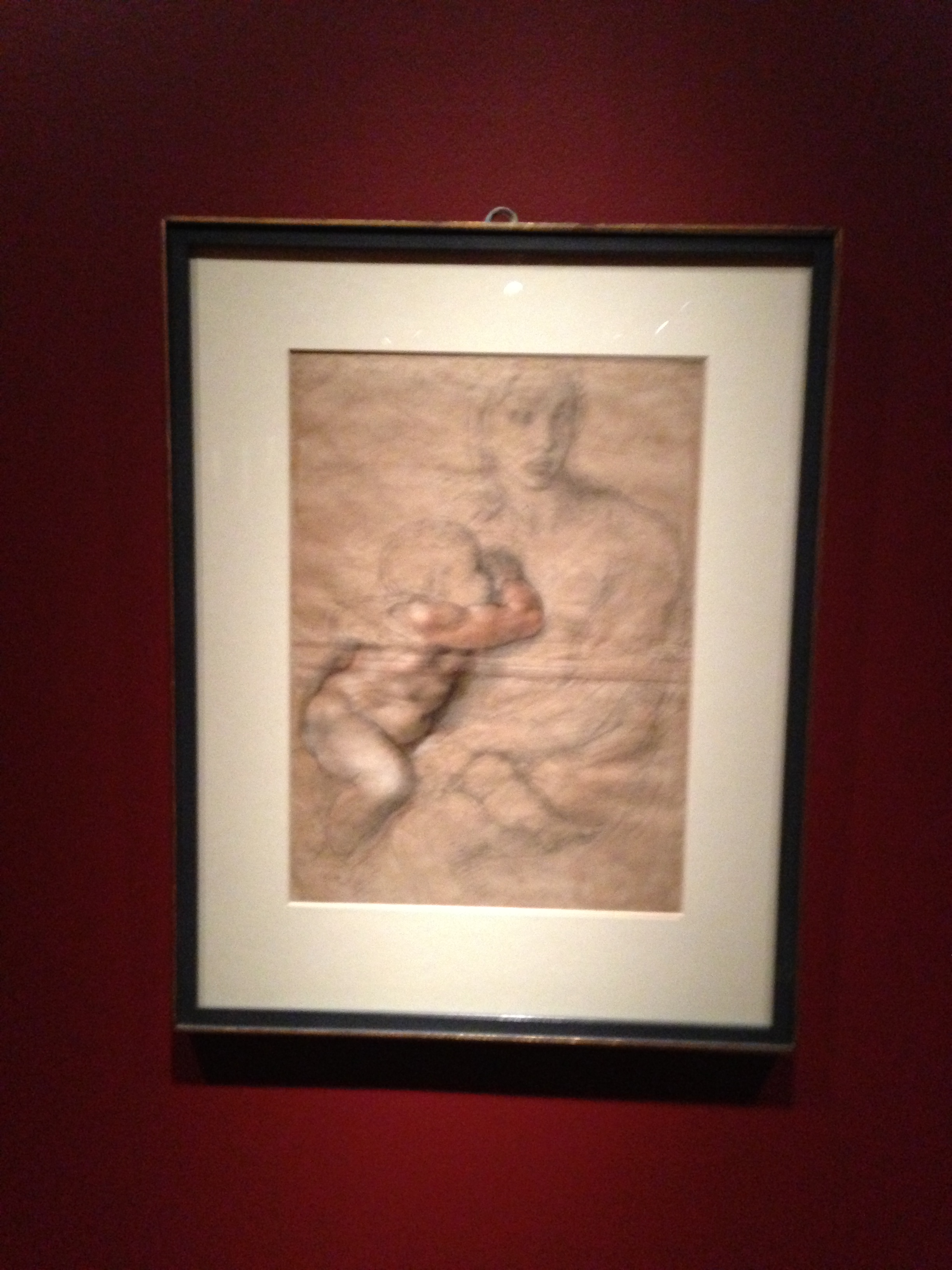
Michelangelo drawings at the Museum of Fine Arts

The drawings are on loan from the Casa Buonarotti in Florence. Okay, my photographs could have been better. What do you want for free?  The light was dim to protect the drawings.

Cleopatra was my favorite. Notice the asp encircling her like a necklace:

2013-06-15 13.19.35

Here’s a famous Madonna and Child. That’s one well-fed baby:

2013-06-15 13.17.27

And here is a study for the head of the Madonna in some painting:

2013-06-15 13.19.00

Is that province “restive” or “resistive”?

A Washington Post article reprinted in today’s Boston Globe refers to Pakistan’s Baluchistan Province as resistive.  But the same article in the Post itself uses the more expected word restive.  What’s up with that?

Restive is a tough word–it provides you with two different ways to get it wrong.  Language mavens will tell us that it isn’t a synonym for restless–it means “difficult to control,” not “fidgety.”  But I’ve also seen it used as a synonym for restful.  Here, for example, we have an online thread about what to do when you’re able to get to sleep but your sleep isn’t “restive.”

The Globe seems to want to eliminate the confusion by changing the word to resistive, presumably meaning resistant, which I suppose also fits Baluchistan.  The dictionary will give you that definition for resistive, but it seems to be used that way mostly in technical contexts.  Of course maybe the Globe didn’t make the change.  It’s also possible the writers themselves used resistive; the Post corrected it, but the Globe didn’t bother.  Either way, this is probably one of those substitutions that show a word is on the way out.  The Google Ngram Viewer tells us that restive peaked in popularity around 1930 and has been on a downward slide ever since.  It’s a useful word, but it’s time may have passed.

Who doesn’t like busts of Roman emperors from the Museum of Fine Arts?

As a pre-Father’s Day treat I went to Buston’s Museum of Fine Arts with my son (the good one, not the other one).  I took lots of random photos.  Here are three photos of Roman emperors, in descending order of greatness. Plus a goddess.

This is a well-known bust of Augustus as a young man (it’s an idealized likeness from after his death):

2013-06-15 12.51.32

And here’s a somewhat placid-looking Hadrian:

2013-06-15 12.56.00

And here is the loser emperor Balbinus, who managed to rule as co-emperor for three whole months before the Praetorian Guard offed him (238 AD was not a great year to be a Roman emperor):

2013-06-15 12.58.19

As a special bonus image, here is a statue of the goddess Juno, which I am told is the largest Classical marble statue in North America.  I should have my good kid stand in front of her to show you her size.

2013-06-15 12.45.07

As they are want to do

I came across this mangling of the standard “as they are wont to do” in an award-winning book published by a mainstream publisher and written by a Pulitzer Prize-winning author.  (On the same page “pretension” came out “pretention.”)  I don’t recall encountering this usage before, but a Google search turns up 382,000 of ’em.  Plus 2.6 million occurrences of its cousin “as is their want”–this one actually outpolls “as is their wont,” which garners only 558,000 usages. (Google helpfully asks me if it didn’t really mean to search for “as is their want.”)  So this is an idiom that seems to be having an identity crisis.  I have a pit in my stomach just thinking about it.

Is baseball exciting?

Well no, not particularly.

The Boston Globe recently ran an article about the increasing length of baseball games and what could be done about it.  I made some suggestions about ways to improve baseball a while ago.  Surprisingly, none of these suggestions have been adopted.  The article mentions a good rule they had in the minors for a while that I hadn’t heard of–a strike was called if a batter stepped out of the batter’s box if he hadn’t swung at the previous pitch.  Great idea!  Nothing came of it.  And nothing has come of the existing major league rule that a pitcher has to deliver the ball to the batter within 12 seconds if there’s no one on base.  Why don’t umpires enforce this rule?

Even at its best, baseball is a deliberate game, with far more pauses than action.  At two-and-half-hours the game is delightful; at three-and-a-half hours you can only have the game on in the background while you’re doing something else–blogging, for example (Aceves has just walked the bases loaded vs. Tampa).

And then there’s hockey.  Bob Ryan of the Globe said the last minute of Game 4 of the Bruins-Penguins series probably took two years off his life, and I have to agree.  Hockey has its own problems, but lack of action is generally not one of them.

Let’s see if I can survive the Stanley Cup finals.