Unknown's avatar

About Richard Bowker

Author of the Portal series, the Last P.I. series, and other novels

One final note on my Print on Demand venture

Ordered a carton of The Portal from my publisher last Saturday.  Lightning Source (the POD vendor) shipped the books on Wednesday.  They arrived on Friday.  Now they’re clogging up my kid’s empty bedroom while he’s off in the snowy Middle East.

There are now six vendors (besides Amazon) offering it for sale on the Amazon site. They’re all undercutting Amazon’s price of $14.10, but they all charge $3.99 for shipping/handling; you get free shipping from Amazon if you’re a Prime member. One vendor is offering a used copy, in good condition, for $999.11.  I wrote the book, and even I think that’s a bit excessive.

If you want one of mine, let me know.

Because grammar! Because Internet!

Here’s a linguistic development that so far seems to be confined to the Internet: the evolution of the word “because” into a preposition, typically used ironically. The Atlantic has a nice article about the phenomenon. The article refers to it as “explanation by way of Internet—explanation that maximizes efficiency and irony in equal measure.”

I’m late because YouTube. You’re reading this because procrastination. As the language writer Stan Carey delightfully sums it up: “‘Because’ has become a preposition, because grammar.”

The article notes that the usage conveys “a certain universality”:

When I say, for example, “The talks broke down because politics,” I’m not just describing a circumstance. I’m also describing a category. I’m making grand and yet ironized claims, announcing a situation and commenting on that situation at the same time. I’m offering an explanation and rolling my eyes—and I’m able to do it with one little word. Because variety. Because Internet. Because language.

This is a usage that currently feels too specialized to appear in everyday language or formal writing.  But it’s wonderful in the right context.

Print on Demand pricing

One thing I’ve noticed in my brief experience with Print on Demand publishing: Amazon seems to vary its pricing constantly.  The list price of the book (set by my publisher) is $15.99.  When I bought the book from Amazon last Saturday, it cost me about $15.50.  When it arrived on Wednesday, I checked, and Amazon was charging $12.89.  Today they’re charging $14.39.  Meanwhile other vendors (available via Amazon) are charging from $12.04 to $13.55 (plus $3.99 shipping and handling).  Barnes & Noble is charging $12.89.  It’s entirely possible that I’m the only one who has bought the book so far, and that is somehow making Amazon decide to raise its price.  Come on, people!

Every vendor is claiming that the book is “in stock.”  What that means in this context, I suppose, is that they have access to the book via Lightning Source, the book manufacturer.  They obviously don’t have the physical book on their shelves.

By the way, the unit cost my publisher will charge me is $5.77 per book, plus shipping and handling.  The cost to me for a carton (24 books) comes out to $7.77 per book.

I was sorta hoping the book would be available via Paige M. Gutenborg, the POD machine at Harvard Bookstore in Cambridge. Alas, she only seems to handle books from Google Books. Here’s what Paige looks like:

POD is PDQ

To check out the Print On Demand version of The Portal, I placed an order for it from Amazon on Saturday, with my two-day Amazon Prime shipping.  It arrived today, Wednesday.  So they were able to print the book  on Sunday (I guess) and ship it to me on Monday.  And it looks great!

I’m going to buy a bunch for my own use direct from the publisher.  I should be able to undercut Amazon’s prices significantly, although I don’t know about two-day shipping.  If you’re interested in buying one from me, let me know in comments or somewhere.  The advantage to buying it directly from me, in addition to the price, is that you can get my autograph in it.  Which is, of course, priceless.

Will texting change the meaning of the period?

Here’s an interesting article about a development I’ve noticed since I’ve started texting a lot with my kids.  Because I’m a writer and I’m fond of punctuation (and I don’t send hundreds of texts a day), I typically end my texts with a period, even though it’s a bit of a pain on an iPhone: you have to switch to a different “keyboard” first, so it takes two finger movements instead of one.  My kids typically don’t bother.  The article argues that including the period may convey something to the recipient that I certainly didn’t intend:

In most written language, the period is a neutral way to mark a pause or complete a thought; but digital communications are turning it into something more aggressive. “Not long ago, my 17-year-old son noted that many of my texts to him seemed excessively assertive or even harsh, because I routinely used a period at the end,” Mark Liberman, a professor of linguistics at the University of Pennsylvania, told me by email. How and why did the period get so pissed off?

Since the default in texting is to not include the final punctuation, people will want to figure out what message you’re sending when you do it.  And maybe they’ll assume you’re being harsh and parental, instead of just being an old fuddy-dud.  The writer points out:

[T]hese newfangled, emotional uses of terminal punctuation haven’t crossed over into more traditional, thoughtful writing. (I have used the period throughout this story, and I’m in a perfectly pleasant mood.) Perhaps one day it will, though, and our descendants will wonder why everyone used to be so angry.

It’s a good thing we won’t be around to find out.

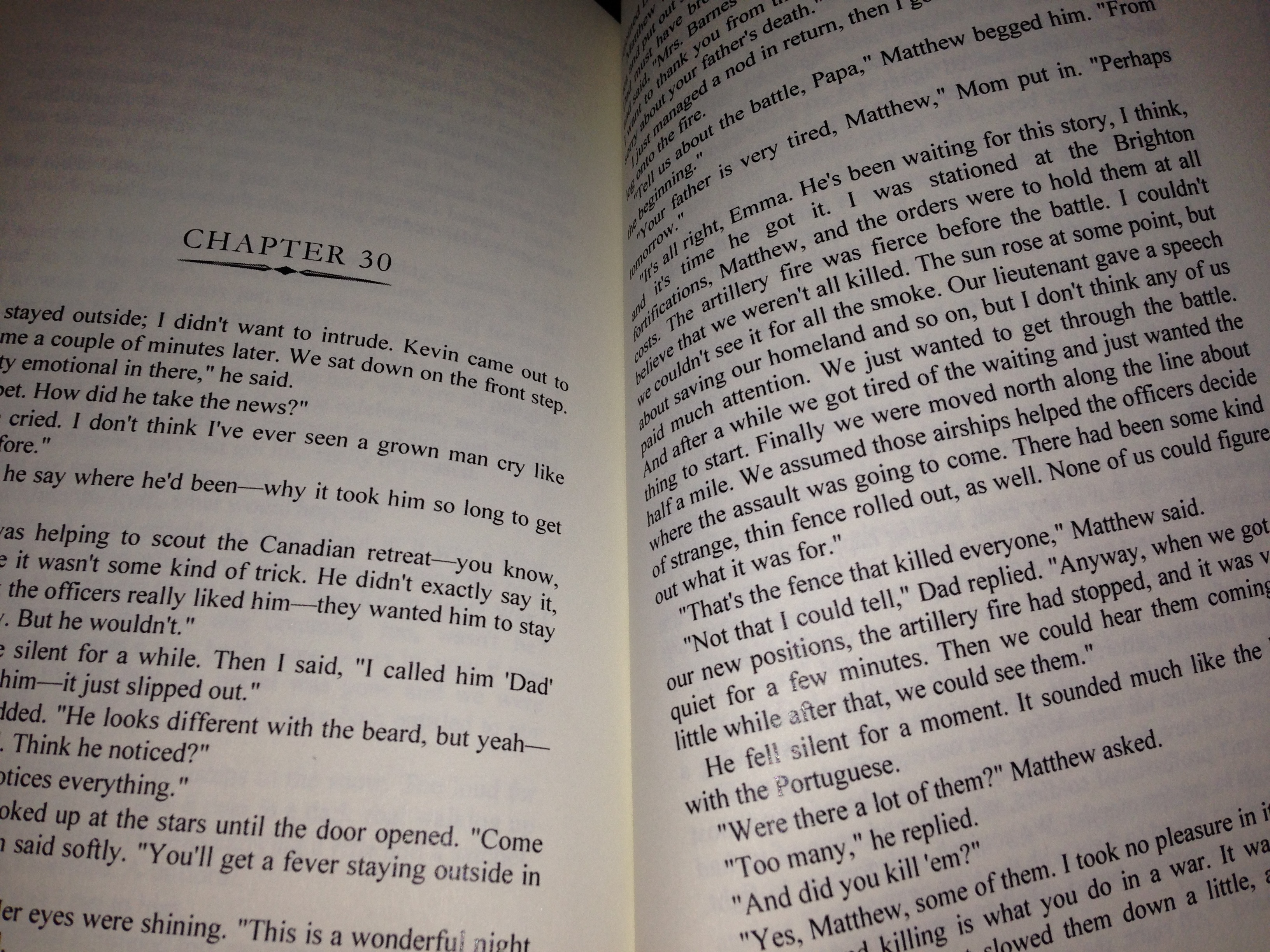
Print version of “The Portal” now available from Amazon!

Right here.  It’s more expensive than the e-book version, of course, but don’t you like the feel of a real physical book in your hands?  Also, don’t you think it would make a great Christmas present?  Actually, I’ve given this a lot of thought, and I can’t come up with a better Christmas present than this book.

OK, maybe a Samsung 40-inch 1080p 60Hz LED TV.  But just barely.

9781614174639

What’s your favorite new word? Selfie? Twerking?

The OED has named selfie its word of the year for 2013.

The publisher of the Oxford dictionaries said Tuesday that ‘‘selfie’’ saw a huge jump in usage in the past year, bursting from the confines of Instagram and Twitter to become mainstream shorthand for any self-taken photograph.

But the other finalists are also fine words in their own right:

The term beat other buzzwords including ‘‘twerk,’’ the sexually provocative dance move that got a huge boost in usage thanks to an attention-grabbing performance by pop star Miley Cyrus; ‘‘showrooming,’’ the practice of visiting a shop to look at a product before buying it online at a lower price; and ‘‘Bitcoin,’’ the digital currency that gained widespread media attention.

Also making the shortlist was ‘‘binge-watch,’’ a verb that describes watching many episodes of a TV show in rapid succession.

I’ll confess that I haven’t twerked, but the other words have all become part of my life.  One son posted a selfie on Facebook after he shaved off his beard. The other son has bought a Bitcoin, which is currently showing a 1000% profit; we had an interesting discussion about Bitcoin’s liquidity and volatility — how did he get so smart?  My lovely wife and I were showrooming for TVs at Best Buy recently.  And then there was the evening we were watching our third straight episode of “Homeland,” and we said to each other, “There’s got to be a word for what we’re doing….”

It’s interesting that WordPress’s spelling dictionary recognizes none of these brave new words.  Catch up with the times, WordPress!

Happy Thanksgiving!

Here’s your standard Thanksgiving hymn, sung half a century ago by Tennessee Ernie Ford and the San Quentin Prison Choir.  (I have always like the name “Tennessee Ernie”.  How come only Southerners get state nicknames?  You don’t hear of anyone name “Connecticut Ernie”.)

When I was in the seventh grade I attended Boston Latin School, the oldest public school in the country; its graduates include folks like Cotton Mather, Sam Adams, George Santayana, and Joe Kennedy.  We had a music class a couple of times a week, and the elderly teacher quickly sized us up and decided he had no interest in trying to teach us any music.  So instead he made us memorize song lyrics, including this hymn.  (I wonder if learning a hymn at a public school would be acceptable nowadays?)  More than once he would let us know that way back in the day Leonard Bernstein had been one of his pupils.  Clearly, none of us was going to be another Bernstein.

In which Jack Reacher starts to repeat himself

I liked One Shot,  the first Jack Reacher novel I read.  So I decided to try another — A Wanted Man.  I listened to this one.  And I was disappointed.

The narrator, Dick Hill, was fine, although he couldn’t do females very well.  He was hampered by a plot that required Reacher to talk with a broken nose, which got boring after a while.  Another problem — again, not the narrator’s fault — is that Child did a Dan Brown-worthy research dump in this novel, and I was desperate to skim through the unnecessary prose.  Did I really need to know how Denver got its name, when not a single scene in the novel actually took place in Denver?

But I had bigger problems with the story line.  One Shot was crisply plotted, I thought, even if the central mystery turned out to be pretty dull.  A Wanted Man aims higher — it involves the CIA and the FBI and Arab terrorists and what not.  But at some point we find out that pretty much everything that happened in the first, exciting part of the novel was in fact completely pointless. And when the solution to the mystery is finally revealed, it turns out to be completely idiotic. The Arab terrorists are doing something in a suburb of Kansas City that they could have done just as easily in a suburb of Mogadishu.

My biggest problem, though, was that once again all the plot machinery seems to have been put in place to give Reacher a chance to sneak into a secluded compound in the dead of night and, against impossible odds and perfectly legally, kill a bunch of bad guys in a bunch of interesting ways.  Is this how every Jack Reacher novel works?  I realize that genre novels in a series are supposed to be somewhat repetitive — that’s part of their appeal.  But I need a little more variety than this.  In addition, Child didn’t bother doing any characterizations of the people Reacher is killing, so the carnage feels much less consequential than in One Shot, where he gave us point of view scenes for most of the victims.  Finally, he pulls an “I could kill you now, Mr. Bond” with the hostage Reacher is saving — there is absolutely no reason for this guy to still be alive (and therefore no reason for Reacher to be risking his life to save him).

Blecch.  Someone please point me to a better Jack Reacher novel.  I’ll give him one more chance.