Unknown's avatar

About Richard Bowker

Author of the Portal series, the Last P.I. series, and other novels

Help me make Senator free on Amazon!

Just follow these easy steps.  You owe it to me.  Okay, you don’t owe me nothin’, but I’d certainly appreciate it!

1. Go to Amazon’s Senator sales page by clicking this link.

2. Scroll down to PRODUCT DETAILS and click on tell us about a lower price.

3. On the next screen, click the circle nest to Website (Online).

4. In the box next to URL: paste this link: http://itunes.apple.com/us/book/senator/id546721642?mt=11

5. In the price box enter 0.00.

6. Click Submit Feedback.

7. When the Close Window button appears, click it.

8. Repeat as often as you like, starting with step 2.

Note that Amazon is already discounting the book to 99 cents.  But free would be better.

And even better would be if you could leave a glowing review for the book if you’ve read it (and especially after you’ve downloaded it, because that makes you a “verified purchaser”).

Thanks!

Sam Harris is opposed to lying — go read his free ebook about it

I find that Sam Harris is always interesting, even when I disagree with him (and lots of people disagree with him about lots of things).  He has a post up on his site about Jonah Lehrer. In response to the Lehrer scandal, he has made his short ebook Lying available for free as a PDF for the rest of the week.  You’ll find a link to it in the Lehrer post.  I have started reading it, and his position on lying is pretty clear — he’s agin it.  My sense is that Harris is not an especially deep thinker, but he is a clear and graceful writer, so you may want to check out his book — it’s only about 60 pages.

I also have Harris’s book Free Will on my e-queue. He’s not necessarily agin free will, but I’m pretty sure he doesn’t think it exists.


What it’s like to be a young writer

Yesterday I mentioned the young Harvard writer, Kaavya Viswanathan, who apparently stole material for a YA novel she wrote in the summer after high school.  Here’s what she said in an interview on NBC:

All I can say is that I’ve read both of Megan McCafferty’s books, “Sloppy Firsts” and “Second Helpings” when I was in high school.  I think the first one came out when I was about 14, and I read both those books three or four times each.  I completely see the similarities, I’m not denying that those are there, but I can honestly say that any of those similarities were completely unconscious and unintentional, that while I was reading Megan McCafferty’s books, I must have just internalized her words.  I never, ever intended to deliberately take any of her words.

The Wikipedia article about her novel points out other similarities to other books from other writers.  They’re pretty obvious.  I don’t want to litigate this.  It could be that this was all a calculated attempt to craft a novel that would get her into Harvard and make a name for herself.  Her parents had hired some consulting agency to help with the college admissions process, and it sounds like she had a good bit of assistance, from them and others, in writing, packaging, and marketing the novel.  But I’d like to assume it was something entirely different — that this was a girl who was desperate to become a writer, and was just too young to pull it off by herself.

I’d like to think that because it feels awfully familiar to me.  Like a lot of would-be writers, I suspect, I wanted to become a writer from a very early age.  And, again, like a lot of those would-be writers, I had two major problems:

  • I didn’t know how to write.
  • I didn’t have anything to write about.

As a result, I had to live in other people’s imaginations.  And what a wonderful place that was!  I remember when I was about eleven years old reading a science fiction novel that I couldn’t get out of my head.  So I decided to write my own science fiction novel — in pencil, with my own hand-drawn illustrations.  The plot, as I recall it, was pretty much the same as that of the novel I had read, except that I was the hero.  I don’t think I got more than a few pages into the thing before I abandoned it.  It’s much easier to read than to write.

I got better at writing as I got older, but it was always hard to escape other people’s imaginations — they lived more interesting lives, thought more interesting thoughts, and could express themselves in more interesting ways.  I couldn’t compete.  So when I wrote a short story, it would come out sounding like an adolescent imitation of a Graham Greene short story, or an Isaac Asimov short story, or a Ray Bradbury short story.  What I wrote didn’t sound like me, because I didn’t yet have a sound.

So I can imagine an 18-year-old girl from India desperately wanting to write a novel about her life in America, but I can’t imagine her pulling it off.  Not without channeling all the authors she had read who had helped her make sense of her experiences, who had helped form her imagination.  And maybe what she wrote with the help (conscious or unconscious) of those authors was pretty good: it got her parents excited, it got her college admissions consultants excited, it got her an agent and some assistance in fleshing out her ideas, and before long everything spiraled out of control.  She was no longer just a kid dreaming of becoming a writer; she was a professional.  And that’s when her problems started.

That’s what I’d like to think.

Self-plagiarism is one thing; making stuff up is something else entirely

The last time we encountered Jonah Lehrer, he had been caught committing the odd crime of self-plagiarism.  Things have now taken a turn for the worse. In fact, his meteoric career has crashed and burned, as meteors tend to do, with the revelation that he fabricated Bob Dylan quotes in his book Imagine: How Creativity Works.  This time he ran afoul of the relentless reporting of a journalist and Dylan freak named Michael Moynihan, writing for Tablet magazine.  (Tablet‘s website has apparently also crashed and burned, and I can’t link to the article.)  Here is a report that quotes Moynihan:

I’m something of the Dylan obsessive — piles of live bootlegs, outtakes, books — and I read the first chapter of Imagine with keen interest. But when I looked for sources to a handful of Dylan quotations offered by Lehrer — the chapter is sparsely and erratically footnoted — I came up empty, and in one case found two fragments of quotes, from different years and on different topics, welded together to create something that happily complimented Lehrer’s argument. Other quotes I couldn’t locate at all.

He finally got Lehrer to confess.  The result: his book has been recalled, and he has had to resign from the New Yorker.

I imagine that Lehrer thought he could get away with his fabrications because book publishers don’t do the kind of obsessive fact-checking that the New Yorker is famous for.  But it’s a terrible risk to take, especially when you’re fabricating Bob Dylan quotes for a public with any number of Dylan obsessives in it.  As with the self-plagiarism, it seems to be a case of cutting corners.  At least he came up with what sounds like a sincere apology:

The lies are over now. I understand the gravity of my position. I want to apologize to everyone I have let down, especially my editors and readers. I also owe a sincere apology to Mr. Moynihan. I will do my best to correct the record and ensure that my misquotations and mistakes are fixed.

That’s pretty classy in a world of mealy-mouthed passive-voice pseudo-apologies. The classic in this genre is Newt Gingrich blaming his love of country for his adulteries:

“There’s no question at times of my life, partially driven by how passionately I felt about this country, that I worked far too hard and things happened in my life that were not appropriate.”

Things happened–lovely.  Anyway, this blog is primarily about fiction, and in fiction you don’t have to apologize for making stuff up.  On the other hand, you do have to apologize for stealing stuff.  Don’t steal stuff. It’s not worth the risk of getting caught, and the more successful you are, the more likely you are to get caught.  Here is the sad story of an overachieving Harvard student who plagiarized passages in a big-time young-adult chick-lit novel she wrote.  Wikipedia tells you much more than you want to know, comparing passages from her novel with similar passages from half a dozen others.  The really sad part of the story is that a few years after the plagiarism controversy her parents died in a plane crash.

I hope she gets over it.  I hope Lehrer gets over it, although I doubt he will.  From the New Yorker blog posts I read, I’d say the guy knows how to write.  He just lost sight of the rules.

Great Expectations and sad endings

Here we saw how Hemingway struggled with the ending to A Farewell to Arms. You need to get the ending right.

For some novels, the most important decision will be whether the ending is sad or happy.  You’d think this decision would flow inevitably from the story you’re telling.  In some cases, that’s true.  In a genre private eye novel, the private eye will crack the case.  In a genre romance, girl will get boy.  In mainstream Hollywood movies nowadays, you’re pretty much guaranteed a happy ending; otherwise the movie wouldn’t have gotten made.  But for lots of novels, the ending balances on a knife edge between life and death, marriage and loneliness, joy and despair.  That, in fact, is what keeps the reader reading.  The author gets to make the call.

The ending to Pontiff caused me the most problems in this regard.  Should girl get boy, when boy is a priest?  If so, does that qualify as a happy ending?  In any case, did the ending work–was it true to the story?  Lemme know! (There is another sad aspect of the story that involves the death of a character at the climax, and I really didn’t want to do it.  But my plot gave me no choice.)

King Lear‘s ending is so damn sad that even critics like Samuel Johnson thought it was unbearable. For 300 years, from the Restoration to the mid-nineteenth century, the only version performed was a revision by Nahum Tate in which Cordelia survived and married Edgar. We have seen evidence that Shakespeare revised the play, but the revisions, if anything, made the play’s ending sadder.

The most celebrated case of revising an ending to make it happier was Great Expectations.

Dickens’ original ending was bleak. The narrator, Pip, who has been in love with the unattainable Estella since he first laid eyes on her, meets her on the street many years later:

It was four years more, before I saw herself. I had heard of her as leading a most unhappy life, and as being separated from her husband who had used her with great cruelty, and who had become quite renowned as a compound of pride, brutality, and meanness.

I had heard of the death of her husband (from an accident consequent on ill-treating a horse), and of her being married again to a Shropshire doctor, who, against his interest, had once very manfully interposed, on an occasion when he was in professional attendance on Mr. Drummle, and had witnessed some outrageous treatment of her. I had heard that the Shropshire doctor was not rich, and that they lived on her own personal fortune.

I was in England again — in London, and walking along Piccadilly with little Pip — when a servant came running after me to ask would I step back to a lady in a carriage who wished to speak to me. It was a little pony carriage, which the lady was driving; and the lady and I looked sadly enough on one another.

“I am greatly changed, I know; but I thought you would like to shake hands with Estella, too, Pip. Lift up that pretty child and let me kiss it!” (She supposed the child, I think, to be my child.)

I was very glad afterwards to have had the interview; for, in her face and in her voice, and in her touch, she gave me the assurance, that suffering had been stronger than Miss Havisham’s teaching, and had given her a heart to understand what my heart used to be.

Too sad! One of his friends–maybe Wilkie Collins–complained.  So Dickens tried again.  He has Pip and Estella meet on the grounds of Miss Havisham’s ruined house, where they had first met many years ago:

“We are friends,” said I, rising and bending over her, as she rose from the bench. “And will continue friends apart”. I took her hand in mine, and we went out of the ruined place; and, as the morning mists had risen long ago when I first left the forge, so the evening mists were rising now, and in all the broad expanse of tranquil light they showed to me, I saw no shadow of another parting from her.

Too happy!  That’s what lots of critics have complained.  Shaw said: The novel “is too serious a book to be a trivially happy one. Its beginning is unhappy; its middle is unhappy; and the conventional happy ending is an outrage on it.”

Well, I dunno.  A novel can be unhappy throughout, yet achieve its happiness at the end.  Characters grow; characters change.  And there’s no question that the revised ending is better written than the original, which is awfully flat.  Most modern editions include both endings, I think, like a DVD where you can choose the author’s cut.

Dickens himself seemed happy with the revision.  He said: “I have put in as pretty a little piece of writing as I could, and I have no doubt the story will be more acceptable through the alteration.”

You be the judge.  Also, see the David Lean movie, with John Mills as Pip and Jean Simmons as the ethereally beautiful young Estella.

Our Jordanian correspondent on Ramadan — plus, when we come back more of our exclusive Olympics coverage

In less than two weeks our intrepid Jordanian correspondent will be rotating stateside to take up the prestigious Somerville/Medford assignment.  Meanwhile, here are some of his observations on Ramadan.

During the parade of the athletes in the opening ceremony, the NBC announcers mentioned the problem of Ramadan occurring during the games.  Of course, they couldn’t say “Some of the Muslim athletes are totally blowing it off because winning a medal is the most important thing in their lives”; they simply allowed as how some of them are postponing their fast till after the games.  Here‘s an article about the various complexities the Olympics have to deal with when it comes to religion.

As part of our training for the Olympics we re-watched Chariots of Fire.  Some utterly random comments:

  • The movie hasn’t aged especially well, or maybe I have just become bored with feel-good sports movies.
  • One of the many funky (and endearing) things about Friday’s opening ceremony was the decision to give Rowan Atkinson five minutes of prime time to do a spoof of the movie’s iconic music and opening.  Does the entire world think Rowan Atkinson is as funny as I do?  Or did people in India or China watch the skit in utter bafflement? Anyway, here it is:
  • I once saw Simon Rattle (the guy conducting the Chariots of Fire theme) conduct the Los Angeles Philharmonic. The LA audience was getting restless during a bleak Shostakovich symphony (is there any other kind?) and he turned around and glared at them during the performance.  I guess everyone doesn’t like Shostakovich as much as I do.
  • Does everyone watch old movies the way I do, with IMDB ready at hand?  The stars of the movie mostly have had solid careers since then, but none really broke out.  I was sad to see that Ian Charleson, who played Eric Liddell and was probably the best actor in the movie, died of AIDS a few years later–the first celebrity death in the UK openly attributed to AIDS, according to Wikipedia.  IMDB tells me that Kenneth Branagh and Stephen Fry were both extras in the movie, but I couldn’t pick them out.
  • Eric Liddell, the Scottish athlete who wouldn’t run on Sunday, became a missionary to China and is now on the calendar of saints for the Episcopal Church of the USA–the day after John Henry Newman, who converted from Anglicanism to Catholicism, and two days after Frederick Douglass.  I had no idea the Episcopalians had such an interesting calendar of saints.  Yesterday they honored Bach, Handel, and Purcell.
  • The religion/Olympics conflict goes back to the first time the Olympics were held in London, in 2008.  Here is the famous photo of the American hurdler Forrest Smithson holding a Bible while running to protest the scheduling of races on Sunday.  Apparently this was a posed photograph, and he didn’t actually run his race with Bible in hand.  He won the gold medal in a race held on Saturday.

There, that about does it for today’s Olympic coverage.


Danny Boyle, 18 years earlier

In 1994, he was directing this:

His first feature, which won the BAFTA for best film in 1005.  For no particular reason I saw the movie on DVD a few weeks ago.  It features an impossibly young Ewan McGregor and as gruesome a plot as you could imagine.  It was great, in an inhuman sort of way–all the characters turned out to be creeps.  Now he’s directing Queen Elizabeth and her corgis.

The opening of the Olympics was fine, if you like watching overwhelming spectacles on a little TV.  I don’t suppose Danny Boyle could do anything about Matt Lauer and Bob Costas, who were both insufferable–they seemed to be delighted that they had no idea who Tim Berners-Lee was.  The thing had everything under the sun–including, at the climax, a Pink Floyd song that seemed a little inappropriate to me.  But maybe I just don’t get Pink Floyd:


iBooks? My books! ebooks? Free books!

Update: In comments, Jeff provides the magical link to Senator in the iTunes library.  He also reminds me to tell folks to go to the Senator page on Amazon and inform them that you’ve found Senator for a lower price elsewhere.  That’s how a book gets to be free for the Kindle–you can’t just tell Amazon to give it away.

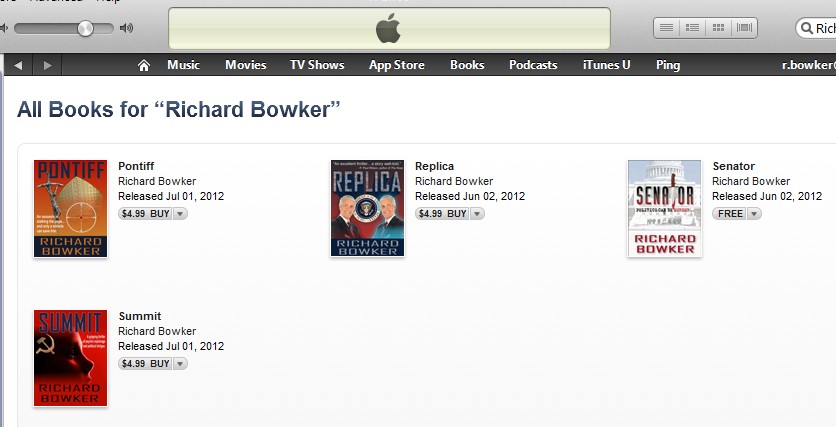
The four novels I have so far released in ebook format are now available on Apple’s iBook store.  Yay!  I don’t know how to link to these guys, but here’s what they look like in iTunes:

Eagle-eyed readers will notice that Senator is free.  That’s right–for a limited time only, it’s available for insanely low price of zero dollars and zero cents.  That’s pretty darn cheap!  At this price, quantities can’t last, so you’d better pick up yours quickly, before Apple runs out.

For those of you who picked up Senator at a higher price, my apologies.  As I noted here, we’ve made some changes to our business model.  I’m using an outside publisher to get my stuff onto sites like iBooks, as well as to goose sales generally.  A standard way to do that is to give a book away and get people hooked so that they’ll buy the others.

Anyway, here is the great (and tragic) Phil Ochs singing his great song “Changes,” just a couple of years before his death.  In a kinder, fairer world, Phil Ochs would have been as long-lived and honored as Dylan.

“Emergency situation, everybody to get from street.”

I have never quite understood the attraction of the phrase “emergency situation.”  How is that different from an emergency?  Why waste your breath on the extra four syllables?  I suppose it has something to do with people’s desire to use obfuscatory bureaucratese–why say something simply if you can say the same thing in a more obscure and high-falutin’ way?  Maybe it also offers an out if the event turns out not to be quite as dire as expected: “I didn’t say it was an emergency; I just said it was an emergency situation.”

My sense was that the phrase caught on in the past 10-15 years, but the Google Ngram for American usage shows it has been on the rise for a long time and actually peaked in the 1980s:

British English shows a similar pattern, but a lower absolute level of usage.  I wish there was a way to compare the usage of the phrase against just the word emergency.

Prescriptivists may see this usage as more evidence of the decline and fall of the language.  I certainly find it ugly and unnecessary.  Maybe that makes me a prescriptivist.

Here is the funniest use of the word emergency I know of, from the 60s movie The Russians Are Coming The Russians Are Coming, where the Alan Arkin character is trying to coach the crew of his grounded Russian sub to speak a simple English sentence.  I think it might actually be even funnier if he used “emergency situation” instead of “emergency”:

“You knew full well what was right, but you chose wrong.”

That was the judge’s comment when sentencing Monsignor Lynn to 3-6 years in the Archdiocese of Philadelphia sex abuse trial. As I mentioned before, this case is in its own way much more significant than the Penn State scandal, because the Catholic church is (some would say) more important than college football.  Andrew Sullivan notes that Pope Benedict was apparently responsible for much the same crime 30 years ago:

[T]his precise chain of events – in which a child-rapist priest was reported as a criminal to the church authorities, then sent to therapy, then reassigned only to rape again – is exactly what Joseph Ratzinger did in Munich in the 1980s. How does an institution allow a lower priest to go to jail for such an act, while allowing the chief pontiff to carry on as if nothing had happened, as if children had not been raped because of his direct complicity in protecting the rapist?

Here’s an interesting quote from one of Lynn’s supporters:

After the sentencing, Ann Casey, a friend of Monsignor Lynn for 36 years, said she believed he was a scapegoat and a victim of his intense faith in the archdiocese’s leaders. “It was his vow of obedience to the church that landed him this morning in jail,” she said.

That is to say, he was only following orders.  This is, of course, the problem that comes from being part of an institution with an absolute belief in the rightness–and goodness–of its beliefs and practices.  Nothing can be allowed to happen that might lessen people’s faith in that institution.  And if you have taken a vow of obedience, nothing can stand in the way of fulfilling that vow.

The judge’s remark is an interesting refutation of the NOMA position that morality is the province of religion. Clearly we have a common understanding of when religious authorities are being immoral.  We need to hold them to our standards, not theirs.  So why should religion be privileged in its pronouncements as to what is right and wrong?

Let’s hope Monsignor Lynn has a chance to ponder this in prison.