Unknown's avatar

About Richard Bowker

Author of the Portal series, the Last P.I. series, and other novels

Free Will and the Immigration Debate

I keep meaning to post about free will.  Everybody loves posts about free will!   Obama’s recent decision about immigration finally prompted me to come up with something.  So this is about politics as much as it’s about free will.

I have never really understood free will.  Where does this freedom come from, if we don’t postulate a soul or some other non-material entity that has no basis in science?  If everything is deterministic (except for some stuff down at the quantum level), where does the freedom come from?  I’ve read Dennett’s Freedom Evolves, and I don’t really get it.  It seems to me that he comes up with a kind of free will by redefining what free will means away from what everyone thinks it means.

So I don’t see how we can have free will. And if free will doesn’t exist, where does responsibility come from?  And similarly, where does merit come from?  In what way do we deserve what we have — or not deserve what we don’t have?

A point Michael Sandel made in his course (and book) Justice brought this home to me in a personal way.  Sandel gives the Justice course every couple of years to hundreds of Harvard students. In the course, he talks to the students about the concept of “moral desert”.  And he brings up the issue of admission to Harvard.  These kids have gotten into Harvard because they’re smart and talented.  Well, OK, there are plenty of kids who are smart and talented.  But the kids who got in worked hard and studied hard and accomplished amazing things with their talents.  Isn’t that the difference?  Well, OK, but — at this point Sandel asks for a show of hands: how many of the kids in the audience were the first-born in their families?

Every time he gives the course, an astonishing number raise their hands.  So, what do we make of this?  Being the first-born helps you get into Harvard.  But no one chooses their birth order.  He quotes John Rawls (another Harvard philosopher): “No one deserves his greater natural capacity nor merits a more favorable starting place in society.”

I graduated from Harvard.  Yay for me!  But I have never been able to figure out why this should say anything good (or bad) about me.  I didn’t make myself intelligent; I didn’t make myself hard-working — I just always seemed to be that way.  I wasn’t the first-born in my family, but I certainly got plenty of support and encouragement in my studies.  If I had wanted to make different choices along the way, could I have?  I have no idea.  But I suspect not — I am who I am.

This brings me, in a roundabout way, to immigration.  The immigration debate always seems to me to circle around moral desert and, ultimately, about free will and determinism.  What do we who were born in America deserve because we were born here?  Beats me.  It just seems to me that we are awfully lucky, the way I was lucky in my parents and my genes and my upbringing.  Do the immigrants who are here illegally deserve to be thrown out?  They’ve broken the law!  But the kids covered by Obama’s decision haven’t exactly broken the law — they’re just here, where life has put them.  They can no more change who they are than I can change who I am.  We can make the case that throwing them out will help the economy or reduce the need for bilingual education or whatnot– at the expense of untold human suffering, of course.  But I think that case is far from clear.

Anyway, as a reward for reading this drivel, here is the great Bonnie Raitt singing “Luck of the Draw.”  (She too attended Harvard for a while.)

Happy Bloomsday

…celebrating the travels of Leopold Bloom through Dublin on June 16, 1904.

Here is what Wikipedia has to say about Bloomsday.  I didn’t know that the manuscript of Ulysses resided in Philadelphia. Here is a page from the Circe episode:

Speaking of revisions, Joyce did his share.  I remember seeing a page from the manuscript of Finnegan’s Wake at the British Library, and every single word on it was crossed out.

Here is a great reading of the final lines of Molly Bloom’s soliloquy.  In it, Joyce probably breaks every rule of good writing.  And it doesn’t matter; fiction doesn’t get any better than this:

Rules for Writing — Rule 2: Revise

Here’s another in an intermittent series of my randomly (and repetitively) numbered rules for fiction writers who aren’t quite good enough to get away with breaking all the rules.  If you’re reading this post, I’m talking about you.

First, let’s distinguish revising from rewriting.  The distinction is a little arbitrary, but for my purposes, revising is taking what you’ve written and making it better; rewriting is taking what you’ve written and writing it all over again.  On a computer, when you revise, you’re working on the same file; when you rewrite, you’re opening a new file and labeling it “Chapter 1 Draft 2” or something.

I’m inclined to believe that everyone revises; I’m not so sure that professional authors cranking out multiple books per year are doing much rewriting.  But anyway, in my opinion, revising is the most fun you can have as a writer.  Staring at a blank screen can be intimidating and discouraging; the blinking cursor seems to tick away the seconds of your life.  But once that screen is filled with words, it’s much easier, and more satisfying, to mess with those words and make them better.

As I mentioned in my post on Rule 0, it’s helpful to begin a writing session by revising your previous day’s output.  But there’s really no bad time to revise; it’s just a question of deciding when to stop.  Somebody once said that he knew he was done with a story when he’d go through it and take out some commas, and then he’d go through it again and start putting the commas back in.

Revising is mostly about style; rewriting is mostly about plot and characterization.  So revising involves applying all them grammer and spelling rules that you learned in Rule 7, but it also involves going beyond them; you want to make your prose sing (or, at least, to keep it from wandering off key).  How do you do that?  A good place to start is with George Orwell’s rules for writing (from his essay “Politics and the English Language“):

  1. Never use a metaphor, simile, or other figure of speech which you are used to seeing in print.
  2. Never use a long word where a short one will do.
  3. If it is possible to cut a word out, always cut it out.
  4. Never use the passive where you can use the active.
  5. Never use a foreign phrase, a scientific word, or a jargon word if you can think of an everyday English equivalent.
  6. Break any of these rules sooner than say anything outright barbarous.

I don’t know to what extent Orwell intended these rules to apply to fiction, but I’d say that Rule 6 is even more applicable to a novelist than it is to a non-fiction writer.  There are times when you’re striving for an effect that may require the passive voice, or a foreign phrase, or a cliché, particularly in dialog or a first-person narrative.  But it’s a good idea to be aware of Orwell’s rules, even if you decide to break them.

Orwell’s rules don’t cover something that is central to revision but that’s hard to put into into a rule: the rhythm of your words.  Sometimes, for example, you want to repeat a word for an effect; sometimes the repetition just sounds stupid or awkward.  Sometimes you want to start a bunch of consecutive sentences in the same way; sometimes that’s just an oversight that needs fixing.  I’ve heard of writers who read their words aloud to check how they sound — that’s certainly a good idea for dialog.  I don’t do it, but I sound out everything in my mind.

And there’s a related rule that I’ll talk about more someday: Show your work to someone else. Sometimes the words that sound just right to you will provoke a violent allergic reaction in your friends. Better to know that before you’re finished than after.

“If I had a sister like you, I would have killed myself, too.”

Those South Boston folks have a way of cutting to the heart of the matter.

However, with Connors’s reference to the 1984 death of her brother, David, Greig’s composure crumpled. She gasped when Connors spoke and then put her hands to her face and mouth – and started to cry. It took her several minutes to regain her composure.

In March, Greig said in open court that she had sought psychiatric counseling after her brother shot himself to death.

This was the only remark from the victims that caused Catherine Greig any visible emotion at her sentencing yesterday.

The mugshot

The whole Whitey Bulger saga is too improbable for fiction, but Greig is one of the most improbable characters in it.  She was Bulger’s second choice to accompany him in his life on the lam.  He first left town with his “common-law wife,” Theresa Stanley.  But Stanley decided she’d rather be with her children, so Bulger turned to Greig, his emergency backup girlfriend.  And she apparently didn’t give a second thought to dropping the rest of her life so that she could go on the run with the mobster.  She took  care of him for 16 years.  And now she doesn’t even get her on Wikipedia page, only a section in Bulger‘s.  And eight years in prison in which to reminisce about all the good times she had with her man:

The man once suspected of gallivanting through Europe had been holed up in the same rent-controlled apartment for at least 13 years, staying up late into the night watching television in his living room with black curtains drawn. When he finally went to bed, the aging gangster slept alone in the master bedroom – windows covered in opaque plastic sheeting – while his girlfriend used the guest room.

I dipped into this world just a little bit in Senator (did I mention that the ebook is now available?).  The IRA gun-running subplot is loosely based on the story of the Valhalla, recounted here. The book I read about the Valhalla suggested that a young guy who was a member of Valhalla’s crew and later disappeared had been murdered by British spies.  We now know he was tortured and killed by Bulger and his cronies because he was a snitch.

Great guys.

In which I issue a pre-emptory challenge

I’m listening to a course from UC Berkeley called “Punishment, Culture, and Society.”  It’s pretty good!  But I’m not going to talk about it!

Instead I want to talk about the professor’s grammar and pronunciation.  They ain’t that great.  He seems to think phenomena is singular; he uses hung when pedants would say he should use hanged.  (He occasionally corrects himself on the latter — someone apparently taught him the rule — but he can’t get it right consistently.)  And here are some of his mispronunciations:

  • Peremptory comes out sounding like pre-emptory.  And the guy’s a lawyer!
  • He says maelstorm instead of maelstrom.
  • He pronounces gibbet with a hard g — like gibson instead of giblet.  And the guy’s an expert on the death penalty!

Lectures are actually a good place to come across mispronunciations.  Where else are you going to hear the word gibbet?  I actually have no idea why I know how to pronounce it (I looked it up to make sure I was right).

It’s too bad we can’t easily track pronunciation over time, the way Google Ngram Viewer lets us track print usage.  How does a dictionary writer know that gibbet is pronounced with a soft g?  How is the poor law professor supposed to figure it out, without consulting a dictionary?

A long long time ago I wrote a series of vocabulary-building books.  One of them contained the word flaccid.  The dictionaries I checked all gave the pronunciation as FLAK-sid.  But literally everyone I asked actually pronounced the word FLASS-id.  (And I asked a lot of people — I have no idea what they thought of me.)  At some point dictionaries acknowledged the existence of FLASS-id as an alternative, and this article says some dictionaries now give it as the preferred pronunciation.

It seems to me that almost no one actually speaks the word flaccid, so some people figure out its pronunciation by applying some rule or via analogy — e.g., “flaccid is formed like accident, and I know how to pronounce accident.”  Or, if they can’t figure out a rule or an analogy, they try to intuit the pronunciation through some sense of the word’s meaning — e.g., “flaccid has something to do with softness and flabbiness, so it must have a soft, flabby pronunciation.”  What’s odd is that I now hear the soft acc sound in other words, like accessory.  What’s up with that?

Back to the law professor.  The Language Wars, the book I’m currently reading, describes the tortuous path English has taken to get to its current state of spelling, grammar, and pronunciation.  In the iptivist divide, it’s descriptivist, not prescriptivist.  Who cares how you pronounce gibbet, or if you use hung instead of hanged?  No one misunderstands what the professor is saying.  And yet, I can’t help getting the impression that the guy must be a bit of a lightweight.  Wouldn’t someone who really knew what he was doing manage to align his grammar and pronunciation with current standards, however arbitrary they may be?

That’s why writers would do well to heed Rule 7.

“Treat every goodbye as if it were your last one.”

Tough times in my little town.

The much-loved minister of religious education at our Unitarian church saw her house burn down a few weeks ago.  Everyone got out safely, although she was slightly injured. Her family was just settling down from that trauma when her five-year-old daughter was diagnosed with a rare form of kidney cancer.

What’s up with that, God?

Meanwhile, the much-loved captain of the high school hockey team went to the doctor for a checkup and found out he had advanced testicular cancer.

Last year, a graduating senior was fatally injured in a freak car accident.  The parents kept him on life support long enough for everyone to say goodbye to him.

The class speaker at this year’s high school graduation reminded us of another event that happened fifteen years ago. One evening while the family was visiting their grandparents on Cape Cod, his mother kissed him good night, and he went to sleep.  He never saw her again.  Suffering depression as the result of injuries suffered in a car accident, she apparently abandoned her car and walked into the ocean. Her body was never found.

“Treat every goodbye as if it was your last one,” her son told his fellow graduates.

They cheered him to the rafters.  The town has held fundraisers for the hockey player.  The school started a scholarship to honor the memory of the kid who died in the car crash.  The church has raised money for the minister, organized meals for her family, visited the little girl in the hospital…

One of the benefits of Unitarianism’s theology-free approach to religion is that it doesn’t have to tie itself into knots explaining how God could allow a five-year-old girl to come down with cancer, or a loving mother to feel she had to walk into the ocean to rid herself of the demons in her brain.  Theodicy is stupid and unnecessary.  What matters is how we all — in our church, in our town, in our world — join together to help ease the suffering that is part of the price of being alive.

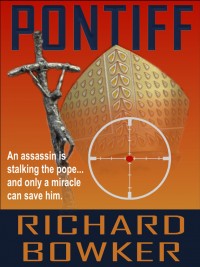
Pontiff available for $0.99 on Amazon!

Here.  The price has already been sliced at Barnes & Noble.  Buy now — you may never see prices this low again!  You could get yourself the Kindle edition of Knocking on Heaven’s Door, but it would set you back $14.99.  Why in the world would you do that?  You could buy War and Peace for $0.99, but you’ve already read War and Peace.  Why would you want to read it again?  Logic demands that you buy Pontiff.

I’m just sayin’.

Knock-knock-knockin’ on the Large Hadron Collider’s door

I’m sure you’ve all been waiting with bated breath (or baited breath, which Google Ngram Viewer tells me is skyrocketing in popularity) for my final thoughts on Lisa Randall’s Knocking on Heaven’s Door.  Here are previous thoughts.

First, Lisa Randall is obviously a supremely brilliant and accomplished person.  This really makes me want to hate her, but I can’t quite.  She’s obviously doing her best to explain this hard quantum stuff to the likes of me, and it only kind of leaks out along the edges that she received word that LHC had finally been turned on (or something) while she was in Barcelona for the world premiere of an opera for which she had written the libretto.  Just shoot me now.

When I have difficulty understanding a science book like this, I naturally assume it’s me, not the writer. Undoubtedly that’s true here.  But even with that I think the book is a bit of a slog, because Randall doesn’t have an interesting point of view on her material, or at least an engaging style with which to simply tell the story.  Everything just kind of sits there.  It felt like a long term paper, and I’m being forced to give it an A because I can’t really find anything wrong with it.  I wonder if Randall ever got anything besides A’s.

Second, the book has a somewhat short shelf life, and it’s already apparently out of date.  The main part of the book is a description of the Large Hadron Collider and what we might discover from it.  The book came out last year, when the results were just starting to come out.  Here we are a year or so later, and one of the major theories she describes, Supersymmetry (SUSY for short), has apparently fallen by the wayside based on analysis of the 2011 results.  (I don’t know why I frequent the blog Not Even Wrong, since I understand virtually nothing the guy says — but, unlike Randall, he says it very engagingly!  The vision of the LHC results taking down the life’s work of thousands of theorists is terrifying–and, I’m sure, true.)

Finally, why does she have to add the “g” to the end of Knockin‘?  If Knockin’ was good enough for Dylan, why isn’t it good enough for her?  Anyway, here is Dylan, unplugged, with the original:

Awesome photo of the Venus transit

Insanely awesome, really — it shows Venus transiting the sun along with the Hubble space telescope.  It’s copyrighted, so I won’t reproduce it, just link to it.

This is the from the same guy who got a photo of the International Space Station crossing the sun during a lunar eclipse.

There should be a Nobel Prize for astrophotography, and Legault should win it.

Barnes & Noble would prefer not to compete with Amazon on ebook pricing

This is dog-bites-man news, I suppose, but Barnes & Noble is opposed to the idea of having to compete with Amazon on the price of ebooks.  They have made their case in a court filing in the Department of Justice’s lawsuit against Apple and several publishers.

“We think that the Department of Justice got this wrong,” Gene DeFelice, the company’s general counsel, said in an interview. “The settlement destroys independently negotiated commercial relationships. It harms authors, innocent publishers and bookstores, including small-business owners. And it also punishes consumers who stand to benefit from increased competition and lower prices brought about by the agency model.”

Here’s some background on the DOJ suit.

The crux of the disagreement, it seems, is whether the “commercial relationships” were “independently negotiated.”  The DOJ contends that there was collusion, because none of the publishers could afford make a deal with Apple that guaranteed higher ebook prices (via the agency model) if its competitors weren’t going to follow suit (and, probably, Apple wouldn’t have made that deal).

Note that it’s not just the agency model that’s at issue, but the “most favored nation” status granted Apple, in which publishers agree that they must use the agency model with all other ebook distributors if they use it with Apple.  This is what prevents Amazon from undercutting Apple’s prices.

In any case, Barnes & Noble (who isn’t a party to the suit, just a very interested bystander), claims that prices will go up as a result:

Barnes & Noble replied to us with a statement from general counsel Gene DeFelice, who says “The settlement is likely to lead to predatory pricing and increase monopoly by Amazon.” The settlement will also decrease competition, leading to “less choice and increased prices in medium and long term,” DeFelice said.

This is the scenario that I just don’t get.  Right now I buy ebooks on Amazon and read them on the Kindle app on my iPad.  If Amazon starts raising prices, I’ll just go buy my ebooks at the Apple store and read them on the Apple reader for the iPad.  Further, if ebook prices do go up, that would make the prices of hardcover and softcover books attractive once again, which should please Barnes & Noble (assuming they’re still around at that point).  Where does the monopoly pricing power kick in?

Of course, authors are worried, because their royalties may go down.  Bricks-and-mortar bookstores are worried, because their sales may go down.  The world is changing, for everyone.  The question is what can the various parties do–legally–to protect their interests in the new world.