The Girl on the Train; also, chapter titles

Everyone seems to love The Girl on the Train.  It was a number one best seller; it’s being made into a movie; it’s on Obama’s summer vacation reading list.  So fine.  I just read it on my summer vacation.

The first thing I noticed is that the author used the technique I have settled on for my new novel: the point-of-view character is identified at the beginning of each chapter (along with the date and time of day).  I have become a little dubious about this technique since my
writing group reviewed my latest chapters, and Jeff pointed out that I hadn’t correctly established my point-of-view character in one of them.  “But I don’t need to,” I said.  “The point-of-view character is identified in the chapter title.”

“Oh,” Jeff replied.  “I hadn’t noticed that.”

So maybe I need to remove the “Chapter” designation; maybe I need to make the name of the character bigger.  That’s what Paula Hawkins does.  It’s probably all that stands between me and a deal for a major motion picture.

Anyway, her novel is well written and cleverly constructed, but I ended up being pretty disappointed.  Here are the problems I had with it (moderate spoiler alert):

  • I figured out who the murderer was pretty early on.  I kept expecting there would be a further twist, but the twist never came.
  • The critical event in the plot is witnessed by one of the narrators, but she doesn’t remember what happened because she was having an alcoholic blackout.  Or perhaps it didn’t happen.  Or perhaps she remembered it incorrectly.  But finally she remembers it, and that solves the mystery.  Meh.
  • One of the other narrators solves the mystery because the murderer unaccountably holds onto a key piece of evidence against him.  Phooey.
  • The climax is straight out of a Lifetime movie.  Woman finally realizes that the man she loved is really a lying cheating murdering psychopath.  The man comes after her.  Can she summon up the moxie to defeat him?  Ugh.

But really, her chapter titles are pretty good.
That sinking feeling, redux

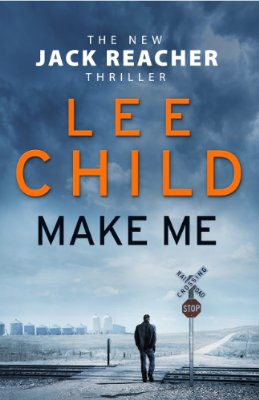
After My Name is Lucy Barton I decided it was time for something different, something manly.  No one is more manly than Jack Reacher.  So I tried the latest in the series, Make Me. I soon started getting that sinking feeling when you realize that the Jack Reacher novel you’re reading is just like all the other Jack Reacher novels.  A setting deep in the heartland, far from the police.  Personality-free female sidekick.  A dark conspiracy that, when finally revealed, makes little sense.  A super-villain with no name, no past, no particular motive for his bottomless evil. Complicated set pieces in which Reacher kills or maims multiple foes due to his understanding of firearms, fighting, human psychology, etc.

Maybe I need to go back to the beginning with Jack Reacher.  I’ve read about half a dozen of these books, and the best of them was The Enemy, an earlyish novel written in the first person and set back in the time when he was still in the military, before he began his lonely wanderings blah blah blah.

In the meantime I have started re-reading Emma by Jane Austen.  No sinking feelings so far.

That sinking feeling when you realize that the novel you’re reading is about an author with an unhappy childhood

I liked Elizabeth Strout’s Olive Kitteridge (although I liked the HBO movie better).  Her new novel is called My Name is Lucy Barton, and the reviews I have seen have been luminous.  “It is both a book of withholdings and a book of great openness and wisdom” raves the Washington Post, for example.  Maybe I’m the wrong audience. 

“A book of withholdings” is another way of saying it’s short (193 pages, actually).  The narrator (who’s about 60) is sort of telling you the story of her life, but she mostly skips over stuff like why her marriage failed and what her books are about; she names characters almost grudgingly, as if naming them would force her to pay more attention to them.  She focuses on her childhood, but she does this by setting up the narrative voice at two removes: she is remembering a long hospital stay in the 1980s when her mother flew into New York and stayed with her, and they ended up talking, often elliptically, about their shared past.  Turns out it wasn’t that great.  Nothing much flows from this, as far as I can tell; no conflict and no resolution, except in the sense that the narrator seems at peace with what she has had to endure. The complex narrative structure doesn’t seem to accomplish much; telling a story in a non-linear fashion doesn’t necessarily make the story more interesting.

I do want to say that I listened to the book, and the narrator was just wonderful.  If it weren’t for her, I probably would have given up.

Renowned be thy grave

As today’s Google Doodle will let you know, this is the 400th anniversary of Shakespeare’s death.  The Times today has a clever faux-obituary.

Here is a funeral song he wrote a few years before his death.

Fear no more the heat o’ th’ sun
Nor the furious winter’s rages;
Thou thy worldly task hast done,
Home art gone and ta’en thy wages.
Golden lads and girls all must,
As chimney-sweepers, come to dust.

Fear no more the frown o’ th’ great;
Thou art past the tyrant’s stroke.
Care no more to clothe and eat;
To thee the reed is as the oak.
The sceptre, learning, physic, must
All follow this and come to dust.

Fear no more the lightning flash,
Nor th’ all-dreaded thunder-stone;
Fear no slander, censure rash;
Thou hast finished joy and moan.
All lovers young, all lovers must
Consign to thee and come to dust.

No exorciser harm thee,
Nor no witchcraft charm thee.
Ghost unlaid forbear thee;
Nothing ill come near thee.
Quiet consummation have,
And renowned be thy grave.

As is often the case in Shakespeare’s late romances, the beautiful young woman to whom this song is sung is not in fact dead.  (In real life she wasn’t even a woman, but that’s neither here nor there.)  Shakespeare, of course, isn’t really dead either.  Let’s raise a tankard to him today!

Easter 1916

The Easter Rising took place a hundred years ago.  It was an idiotic, doomed adventure that caused hundreds of deaths and maybe led, years later, to Irish independence:

Almost 500 people were killed in the Easter Rising. About 54% were civilians, 30% were British military and police, and 16% were Irish rebels. More than 2,600 were wounded. Most of the civilians were killed as a result of the British using artillery and heavy machine guns, or mistaking civilians for rebels. The shelling and the fires it caused left parts of inner city Dublin in ruins.

And, of course, it led to a great poem.  If you’re a terrorist (or, maybe, a freedom fighter), you should hope that you have William Butler Yeats around to make you immortal, to turn your dreams into myth. Here’s the final stanza of “Easter 1916”:

Too long a sacrifice
Can make a stone of the heart.
O when may it suffice?
That is heaven’s part, our part
To murmur name upon name,
As a mother names her child
When sleep at last has come
On limbs that had run wild.
What is it but nightfall?
No, no, not night but death.
Was it needless death after all?
For England may keep faith
For all that is done and said.
We know their dream; enough
To know they dreamed and are dead.
And what if excess of love
Bewildered them till they died?
I write it out in a verse —
MacDonagh and MacBride
And Connolly and Pearse
Now and in time to be,
Wherever green is worn,
Are changed, changed utterly:
A terrible beauty is born.

Here’s the proclamation of an Irish republic, signed by some of those whom excess of love bewildered:

A nice review of “The Portal”

Here’s a nice review someone just posted on Amazon for my novel The Portal:

The story is riveting from beginning to end. Two preteens far from home but in fact not far but in a parallel universe is a fascinating concept all by itself. Throw in the time travel, dangerous situations, an array of interesting characters to interact with, and the emotions evoked as they experience privations and loss, and this becomes a captivating story you don’t want to put down until the very end. Recommended for teens and adults.

I couldn’t have said it better myself!  I’ll probably post more of these when I get closer to publishing its somewhat long-awaited sequel.

“The Year of Lear”

Every time I read a Shakespeare play or read a good book about him, I wonder why I waste my time doing anything else.  Here’s one: The Year of Lear: Shakespeare in 1606 is James Shapiro’s followup to his A Year in the Life of William Shakespeare: 1599.  The idea is to connect the plays Shakespeare wrote in a given year with the events taking place that year.  England in 1606 saw the aftermath of the Gunpowder Plot, concerns about King James’s push to unite England and Scotland, witchcraft trials, repression of Catholics, and the return of the plague.  Among other things.  During this welter of events, and presumably reacting to them, Shakespeare found the time to write King Lear, Macbeth, and Anthony and Cleopatra. Not a bad year.

Of course, Shapiro’s book is full of suppositions, because we know absolutely nothing about Shakespeare’s inner life.  But it’s fun to guess!  Shapiro has a lot to say about what I think is one of the most fascinating issues in Shakespeare.  Why did he rework the plot of an older play called King Leir and change its happy ending to the unbearably tragic ending of his version?  Was it the times?  Was it something in his personal life?  Was he trying different meds?

And what caused him (or someone else) to change his original ending (published in the Quarto of 1608) to what we find in the First Folio of 1623?  It’s still tragic, but there is now a thin shaft of light amid the all-encompassing darkness.  (This still wasn’t enough for playgoers, who preferred a version adapted by Nehum Tate that restored the happy ending of King Leir; this version held the stage until 1838.)

Anyway, Shakespeare is forever.  And I’m pleased to see that Glenda Jackson is returning to the stage in a gender-blind production of King Lear at the Old Vic. That’s big news, since Jackson has been away from acting since 1992.

I saw her in a production of Macbeth with Christopher Plummer in 1988.  It was not a success, as the Times review makes clear; maybe that contributed to her decision to go into politics.  The production was still in ferment when I saw it in Boston.  In the performance I attended, I remember her practically masturbating during the “unsex me here” speech.  Not sure that made it to Broadway.

Oddly, a brief clip from the production survived into the YouTube age.  Here it is, although be warned: you’ll have to look at the insufferable Gene Shalit interviewing Jackson:

What I read in 2015

Highlights, anyway.  Much of it listened to, rather than read.  Listed more or less in order of enjoyment.

H is for Hawk by Helen Macdonald.  An English woman takes up hawking to get over the death of her father.  She tells the story of training the hawk, interspersed with a psychobiography of T.E. White, the author of The Once and Future King.  Well, that doesn’t sound promising, does it?  But it’s glorious.  I felt like I was entering deeply into a wondrous world I never knew existed.  And Macdonald’s narration is also glorious.

Being Mortal by Atul Gawande.  This book, about how we deal with the end of life, has gotten a lot of praise, and it deserves every bit of it.

The Iliad.  Narrated by Dan Stevens.  I talk about it here.

SPQR by Mary Beard.  A history of ancient Rome up to the early 200’s.  I love this kind of book.

Middlemarch by George Eliot.  It still works.

Fore! The Best of Wodehouse on Golf.  I don’t know a mashie from a niblick, but Wodehouse on anything is great.  I was trying to read The Kreutzer Sonata by Tolstoy and kept switching back to this book so I could feel good about life.

CivilWarLand in Bad Decline by George Saunders.  Weird, wonderful stories about weird, wonderful people.  With a lovely afterword about how Saunders finally found his voice and his success.

The Man Who Mistook His Wife for a Hat by Oliver Sacks.  Finally got around to reading this.  Lovely, illuminating stories.

Adverbs by Daniel Handler.  A strange but enjoyable “novel” for adults by the author of the Lemony Snicket series.

Paris 1919 by Margaret MacMillan.  Who doesn’t want to listen to 25 hours of narration about the peace conference after World War 1?  I learned a lot.

Faith vs. Fact by Jerry Coyne.  A good summary of why science works as an explanation of the world and religion doesn’t.  Fairly familiar stuff to people who read Coyne’s web site, but worth getting down on paper.  It probably won’t change many minds, alas.

Life’s Greatest Secret by Matthew Cobb.  Tells the story of the scientific discoveries about DNA, RNA, and genetics, down to the present day.  Great, although a bit too dense for someone listening to it at rush hour.

Sapiens: A Brief History of Humankind  by Yuval Noah Harari.  Harari is a big, big picture kind of guy and has all kinds of provocative ideas, not all of which I agree with.  But I was entertained and educated nevertheless.

Station Eleven by Emily St. John Mandel.  This is a novel about the world after a flu epidemic causes civilization to collapse, with lots of flashbacks to the final days of the world we knew.  It’s been a big best-seller and was nominated for the National Book Award.  I’m a big fan of dystopian novels — I’ve written a few myself!  But this one, despite being very well written, left me a bit cold.  Too many characters and too many plot strands insufficiently developed.  And I really didn’t get the Station Eleven stuff.

Between the World and Me by Ta-Nehisi Coates.  This book was showered with praise and awards, but it left me rather cold.  I’ve enjoyed his shorter work more.  Partly it was the author’s narration, which I thought was rushed.  And I wished he pronounced the word “asked” rather than “axed”.  But I also found it difficult to follow his argument sometimes (if there was an argument).  The centerpiece of the book is the death of one of his college friends at the hands of an out-of-control police officer.  This is a symptom of what’s wrong with America; fair enough.  But the police officer was black, working for a black-controlled police department.  I wanted Coates to connect the dots for me better than he did. Here’s a long review that says what I thought about the book better than I can.

The Six Wives of Henry VIII by Alison Weir.  More than I wanted to know about them, I guess.

I notice that several of these books came my way via BookBub.  And I notice that my Kindle is filling up with BookBub titles that I really want to read, all purchased for $1.99 or less.  Is this the future?  Do we like this future?

Emma is 201

Jane Austen’s novel Emma was published on this day in 1815, although this article says that the title page of the first edition gives a publication date of 1816.

The recent BBC ranking of British novels by non-English critics puts Emma at at #19, 8 ranks lower than Pride and Prejudice.  The Guardian puts it at #9 among all English-language novels.  No other Austen novels are on the list.  Huh?  (This is a pretty idiosyncratic list, actually.)

Here’s a very entertaining discussion of Emma from the BBC’s In Our Time podcast.

Time to add it to the to-be-reread list.

Both the year’s and the day’s deep midnight

The shortest day of the year of the year used to be December 13, Saint Lucy’s Day.  Now it’s December 21; Here in the Boston area we get a little over nine hours of sunlight.

Here is John Donne’s great Nocturnal upon Saint Lucy’s Day:

‘Tis the year’s midnight, and it is the day’s,
Lucy’s, who scarce seven hours herself unmasks;
         The sun is spent, and now his flasks
         Send forth light squibs, no constant rays;
                The world’s whole sap is sunk;
The general balm th’ hydroptic earth hath drunk,
Whither, as to the bed’s feet, life is shrunk,
Dead and interr’d; yet all these seem to laugh,
Compar’d with me, who am their epitaph.


Study me then, you who shall lovers be
At the next world, that is, at the next spring;
         For I am every dead thing,
         In whom Love wrought new alchemy.
                For his art did express
A quintessence even from nothingness,
From dull privations, and lean emptiness;
He ruin’d me, and I am re-begot
Of absence, darkness, death: things which are not.


All others, from all things, draw all that’s good,
Life, soul, form, spirit, whence they being have;
         I, by Love’s limbec, am the grave
         Of all that’s nothing. Oft a flood
                Have we two wept, and so
Drown’d the whole world, us two; oft did we grow
To be two chaoses, when we did show
Care to aught else; and often absences
Withdrew our souls, and made us carcasses.


But I am by her death (which word wrongs her)
Of the first nothing the elixir grown;
         Were I a man, that I were one
         I needs must know; I should prefer,
                If I were any beast,
Some ends, some means; yea plants, yea stones detest,
And love; all, all some properties invest;
If I an ordinary nothing were,
As shadow, a light and body must be here.


But I am none; nor will my sun renew.
You lovers, for whose sake the lesser sun
         At this time to the Goat is run
         To fetch new lust, and give it you,
                Enjoy your summer all;
Since she enjoys her long night’s festival,
Let me prepare towards her, and let me call
This hour her vigil, and her eve, since this
Both the year’s, and the day’s deep midnight is.