Use your talent before life decides to take it away

The other day I heard a story about a brilliant young novelist who had a brain aneurysm that left her unable to write.  The next morning I listened to a podcast about Jacqueline Du Pre, the brilliant British cellist who came down with multiple sclerosis at the age of 27, subsequently had to give up performing, and died from the disease at the age of 42.

It’s good to be reminded every once in a while that life sucks; so create beauty while you can.  Here is Du Pre playing the first movement of the Elgar Cello Concerto; you could just watch her emote for eight minutes without bothering to listen to the music.  The orchestra is conducted by her husband, Daniel Barenboim.  She was 22 at the time; he was 25.  They were on top of the world then; she’s been dead for 30 years now, and he is still going strong.  (The movie Hillary and Jackie recounts the story of Du Pre, her sister, and their husbands.  It’s a harrowing story, although apparently its accuracy is in dispute.)
 

Now where was I?

I had a great couple of weeks away from my novel.  Real life is great!  But now what?  What are these characters supposed to be doing?  Wasn’t there some plot point I wanted to add right around here?  Didn’t I note that down somewhere?  I have this other note, but what does it mean?

I came across a good piece of writing advice once from Graham Greene (I think).  Don’t stop writing when you reach a difficult part; stop when you reach an easy part.  That makes it easier for you get rolling the next time you sit down to write.  Why don’t I pay more attention to Graham Greene?

Actually, even the easy stuff seems difficult after a couple of weeks.  Surfing the Internet certainly seems like a more attractive option than rewriting that sentence.  And I really ought to recheck my email — it’s possible someone has written me in the past five minutes.

OK, let’s try again.  Blogging is just one more excuse.

Walden Pond, 160 years on

2014-05-15 14.55.18

My edition of Walden notes that, of all the English-language books published in 1854, only two are still read: Dickens’ Hard Times and Henry David Thoreau’s Walden.

My son spends a lot of his time shepherding college kids around the historic sites of Jordan, and he has begun to realize that there were plenty of historic sites in his own back yard that he hadn’t visited.  Walden Pond is one of them.  He’s home for a couple of weeks, so we went for a visit.

2014-05-15 14.20.37

A hundred and sixty years on, Walden Pond is part suburban bathing beach, part national literary landmark. Moms tend toddlers playing in the sand while Japanese tourists troop past, taking photos of each other.  Overhead, planes fly by headed for Hanscom Field.  As rush hour approaches, a traffic jam develops on Route 126, just a few yards from the pond.  On the far side of the pond the train line that was just built in Thoreau’s day is still in use, ferrying commuters to and from North Station.

You tramp half a mile from the bathing beach to the site of Thoreau’s cabin:

2014-05-15 14.56.10

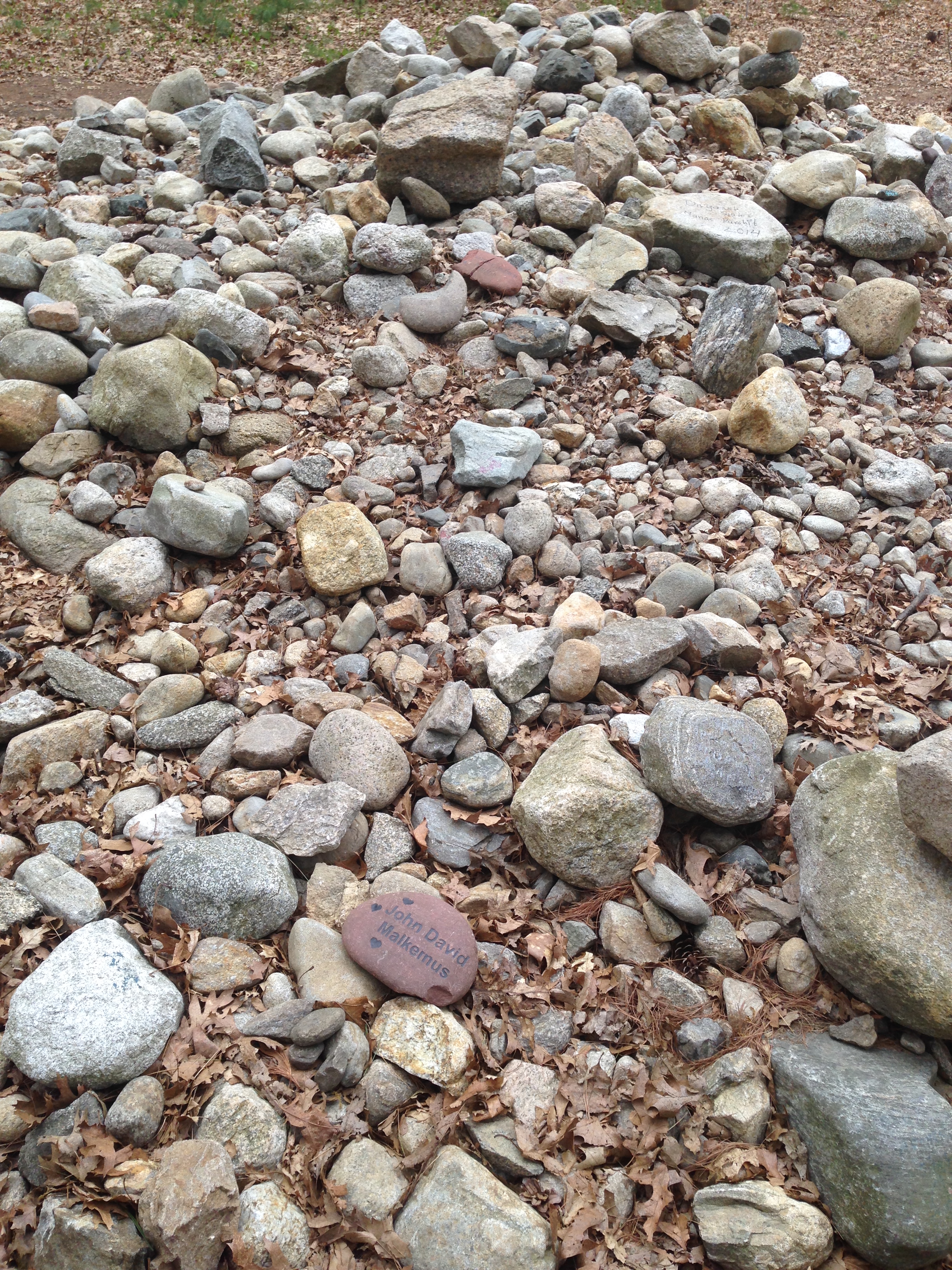
People leave rocks behind in homage to Thoreau:

2014-05-15 15.01.58

The original cabin is long gone.  But back in the parking area, you can visit a replica. It is tiny:

2014-05-15 17.07.45

In front of the cabin is a statue of Thoreau.  Here is a touristy shot of my son showing Thoreau and Arabic-language novel he’s been reading:

2014-05-15 17.09.01

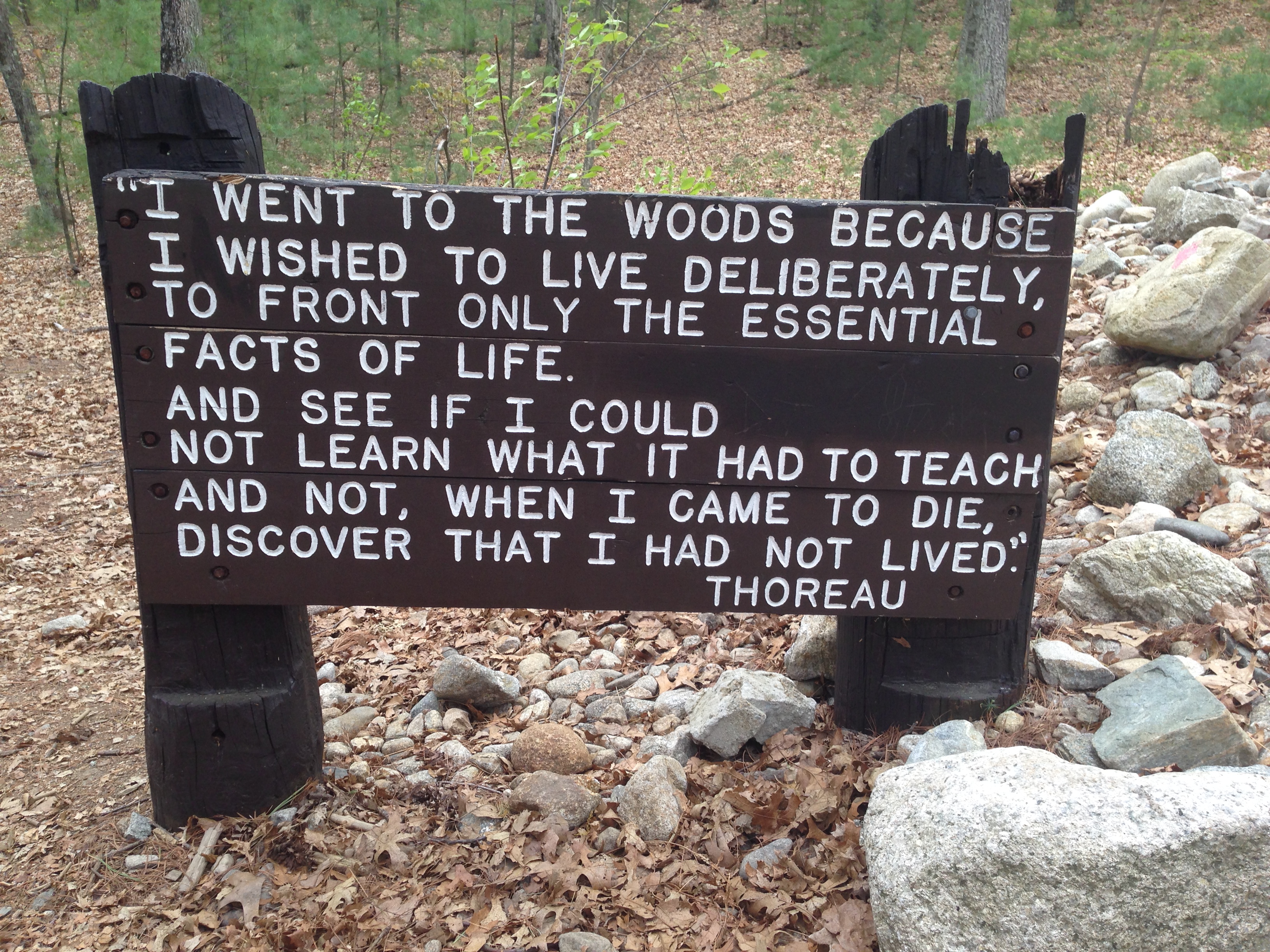
Walden is a strange book. I find a lot of it boring, but in the midst of an uninteresting passage I’ll be astonished by a beautifully crafted insight. Here’s a familiar one that seems appropriate for graduation season:

If you have built castles in the air, your work need not be lost; that is where they should be. Now put the foundations under them.

Writers in Movies: The New York Times gets into the act

Last Sunday’s Book Review had a pair of essays on the topic “Why is it so hard to capture the writer’s life on film?”  This a question that seems easy enough to answer.  Thomas Mallon captures it like this:

Because no one wants to watch somebody typing, Hollywood often makes movies about writers who stop writing. It’s easier, and more entertaining, to show them being Technicolorfully destroyed by fame or drink or premature success.

And he brings up one of my favorite writer’s movies, Wonder Boys:

The hard part is always trying to show writers doing what they actually do. The Michael Douglas character occasionally sits at his Selectric wearing a woman’s bathrobe, like a pitcher’s lucky underwear, trying to summon more phrases for his already overlong, inert manuscript.

It seems a bit odd that there are so many movies about people whose lives are so fundamentally boring.  My guess — and it’s only a guess, mind you — is that this is because many movies are written by writers.  Anyway, these essays are pretty good, and they provide me with several additions to my list of writerly movies to watch (or re-watch):

Barton Fink
Deconstructing Harry
Julia
The Hours
Beloved Infidel
Capote

And, in particular, Bright Star, which I’ll blog about next.

Why give away an e-book?

The Portal continues to be free on Amazon and Barnes & Noble.  The main idea here is to generate customer reviews, because reviews are what stimulate e-book sales.  As my publisher says:

The more reviews, the more sales. In other words, “people are interested in buying what other people are interested in reviewing”. This is the basic definition of Social Engagement.

Reviews are hard to come by, actually.  I don’t know what percentage of readers leave reviews, but it can’t be very high.  Giving the book away for a while increases the pool of readers, which increases your odds of getting reviews.

My publisher is more interested in the number of reviews than how positive the reviews are, but obviously that matters to the author!  It also matters to some potential advertisers, who aren’t interested in promoting books unless they have received a certain number of reviews at a certain quality level (e.g., at least 10 reviews, average higher than 4.0).

Here are the first couple of (five-star) reviews that have come in as a result of this promotion. Both readers have a similar reaction — which is exactly the reaction I was hoping for, actually. This one is titled “A Lot of Heart”:

I thought at first this was going to be another YA gimmicky novel with kids complaining about their lives and using the device of dimension travel just to come up with random quirky things, but this book is much more than that. You really get to know and care about the characters, and things move along quite well and not predictably. The really surprising part is the life lessons learned by the characters – they really leave you with something more than just a fun little read. Glad I read it!

And this one is titled “Very Enjoyable”:

Really enjoyed this book. At first I thought it was going to be kind of silly but it didn’t take long till I could hardly put the book down. I found myself identifying with the curiosities of Larry.

Really hope there is a second in the series coming!

So, thanks to these readers, and everyone else who takes the time to leave a review.

Writers in movies: Hemingway & Gellhorn

Another in an occasional series.

Like An Invisible WomanHemingway & Gellhorn is about a famous novelist’s relationship with a woman — in this case, the war correspondent Martha Gellhorn.  This was an HBO original movie and got a ton of Emmy nominations.  Unlike An Invisible Woman, this movie has an A-list actress, Nicole Kidman, playing the woman.  She’s pretty good!  Clive Owen as Hemingway, however, never convinced me the way Ralph Fiennes as Dickens convinced me.  Surely the director (Philip Kaufman) could have found an American who’d have done a better job. (At least an American could have gotten the accent right.)

The other major problem with the  movie is the script.  It never settles down and becomes about anything.  It just dramatizes a series of real-life incidents, usually with clever camera work and editing, and that becomes the film.

We do, of course, see Hemingway writing, and I assume they got that right.  He types standing up, his typewriter on a dresser, floating discarded sheets of paper in the direction of a wastebasket at his feet. He types as bombs fall in the street outside, and he types after a long night of drinking, while Gellhorn is too hung over to get out of bed.  And the script is full of what I assume are accurate Hemingway quotes, such as: “Writing’s like Mass.  God gets mad if you don’t show up.”  All good stuff.  But they didn’t make me like the movie.

World building

Here’s a bland paragraph from the novel I’m working on:

She was sitting on our patched brown Victorian sofa wearing her patched blue robe.  Two glasses of cider and a plate of bread and cheese and apple slices sat on a side table.  She had lit a fire in the fireplace, so the front parlor wasn’t as cold as it usually was.  She patted the sofa next to her, and I sat down gratefully.  She snuggled up against me.

What’s wrong with that?  But when my writing group was discussing this chapter, it raised a question from Mary: Where did they get the wood?

This is in the post-apocalyptic world of my Last P.I. series, so it’s not an unreasonable question.  But it’s one that has never occurred to me.

World building is in some ways straightforward.  For the Last P.I. world, the big picture is easy enough.  There was a nuclear war a couple of decades ago; Boston is still struggling in the aftermath.  People are poor; they’re still salvaging what they can from the past and figuring out how to survive in the present.  And it’s also not hard to come up with lots of details to flesh out the world: people wear patched robes and sit on patched furniture.  Auto parts are scarce and valuable; most people don’t have central heat or electricity…

What’s tricky is calibrating the level of detail to convey in the actual novels, from sentence to sentence.  A few readers have complained that I haven’t given enough back story about the war.  That’s a big picture issue.  Mary wants to know about firewood; that’s an issue about the details.  My goal is to put in enough detail to make the world convincing and vivid, without piling on so much information that the story’s momentum is lost.

I have some ideas about how to handle the firewood question.  But you’ll have to buy the book if you really want to know the answer.

Let’s try another cover for Summit

In the “every cloud has a silver lining” department, my publisher has decided that the crisis in Ukraine might spark some interest in my cold-war psychic-espionage classical-music novel Summit, which has nothing to do with Ukraine but does include several Russian bad guys and a beautiful Russian heroine. Previously they ditched its original cover because they thought the hammer-and-sickle motif was outdated; now they have decided it’s just fine. So here’s our latest cover:

I should also add that the novel is well worth the measly three bucks we’re charging for it.

Do you write and tell?

The New York Times runs occasional pieces on writing in its Draft feature.  They are of variable quality.  The latest one, called “Not Telling” is pretty good.  The writer, a novelist I’ve never heard of named Alice Mattison, is obsessively secret about her novels while she’s writing them:

If I talk about the book, I believe — I cannot help believing — my characters will be angry, and will no longer confide in me about their embarrassing, troubled lives.

She won’t even talk about the novel with her husband:

Once, I decided I should tell my husband a little about the novel I was writing. I informed him that I was about to do so and he sat up straight and looked eager. He’d been waiting for a while. I said — certain I was revealing something of interest — “It’s in five parts.” Then I sat back and waited for enthusiasm.

I have a lot of sympathy.  I share my drafts with my writing group, but no one else.  My lovely wife has been informed that I’m writing another one of those Walter Sands private eye novels, but that’s it.  In my case, I’m not afraid of my characters getting angry; I’m afraid that talking out loud about the plot will make it sound stupid — to me as well as to the listener — and I’ll lose the hubris I need to keep going.  At an early stage of writing, my plot is kind of stupid.  Not to mention my prose is scattered and unfocused, as I figure out motivations and settings.  But I need to stay confident that things are going to get better.  I need to keep the world I’m creating safe from outsiders until I’m sure enough in it to pull back the curtain.  Then, if people don’t like what I’ve created, I can figure out what, if anything, I need to change — without deciding the whole damn thing’s no good.

Are missing apostrophes more important than dying teenagers?

We report, you decide.

A bizarre battle is raging in towns across Britain between lovers of the English language and local councils that are culling the humble apostrophe from street signs.

The historic university city of Cambridge was the latest in a series of places this year that have made the change, which transforms names such as King’s Road into Kings Road.

Cambridge was forced to backtrack after anonymous punctuation protectors mounted a guerrilla campaign, going out in the dead of night and using black marker pens to fill in the missing apostrophes.

Apparently an apostrophe error earlier this year caused an ambulance to go to a wrong address, resulting in a teenager dying of an asthma attack.

“National guidelines recommended not allocating new street names that required any punctuation, as, we gather, this was not well coped with by some emergency services’ software,” Tim Ward of Cambridge City Council told AFP.

Although I’m not one of those who think the language is going to hell in a handbasket, I have some sympathy for the protesters who say the solution to the problem is not to make punctuation worse, but to make the software that emergency services use better.

On a vaguely related topic: At some point when I wasn’t paying attention, the Catholic Church seems to have removed the possessive from church and school names — at least in my neck of the woods.  When I was a lad,we lived in Saint Columbkille’s parish; this is now Saint Columbkille parish.  The parochial school down the street from me is Saint Paul School.  And so on.  A brief Google search indicates that if the school uses the possessive, “Saint Paul’s,” it’s Episcopalian.

The possessive doesn’t make a lot of sense in this context, I suppose.  Public schools don’t use it; there aren’t any Martin Luther King’s High Schools.  But the possessive usage for saints is so ingrained in my neurons that I’m always stopped short when I encounter the new style.

Next thing you know I’ll be demanding that the Mass return to Latin, which, after all, is the language that God speaks.