My ePublisher weighs in on the state of ebooks

Every once in a while my ePublisher sends out an email giving their thoughts on the state of ebook publishing.  The latest one is pretty interesting. In a section titled “Reality Sets In” they talk about the glut of ebooks on the market:

With the filters removed, the market is flooding with dreck. It’s hard to get an exact number, but there are about 4 million ebooks on the market right now with nearly 100,000 new titles added each month. Shockingly, most will never sell a single copy. Of the remainder, only about 2% will sell at any meaningful quantity.

Unfortunately for many, self-publishing was sold as the easy path to notoriety and fortune; simply publish your story and readers will send you mountains of cash! But many found out the hard way that the only thing more demanding than publishers are readers and their unbridled reviews. A few discovered success, while the masses simply found a harsh dose of reality; this business is tough.

With time, this realization will thin the ranks as the hopeful become discouraged and opt for other pursuits.

They point out one way that Amazon (and other vendors) could help thin the ranks:

The available inventory of ebooks needs to be purged. At some point, natural selection will reign and the purge will happen.

We’ve already seen the first waves in the subscription services, and, at some point, resellers will also tire of being loaded down with dreck and will perhaps begin charging to maintain books in their system. Imagine the income Amazon could draw down if they charged $1 per month per title? Once one eRetailer does it, the others will follow. Then, all books that never sold a sustainable number of copies will leave the system and things will normalize—for a while.

It never made much sense to me that Amazon (and other vendors) would just store everyone’s ebooks on their servers for free.  Sure, storage is cheap, but it costs Amazon something to store millions of books, from most of which they will never see a penny in revenue.  I would certainly pay a storage fee if it would help get rid of the dreck.

My ePublisher’s advice to writers has been constant for a while: quality matters.  So does productivity.  Series are better than individual titles.  Long, complex narratives don’t do as well as simpler narratives.  Attention spans aren’t what they used to be.  Readers have lots of other ways to entertain themselves–often on the same device on which they’re doing their reading.  So get back to work.

Which I will now try to do.

More on e-book price resistance

Via The Passive Voice, I see the Wall Street Journal reporting on the decline in e-book sales from the major publishers.  This is in the wake of the new contracts they signed with Amazon, which allowed them to continue to set their own prices.

A recent snapshot of e-book prices found that titles in the Kindle bookstore from the five biggest publishers cost, on average, $10.81, while all other 2015 e-books on the site had an average price of $4.95, according to industry researcher Codex Group LLC.

“Since book buyers expect the price of a Kindle e-book to be well under $9, once you get to over $10 consumers start to say, ‘Let me think about that,’” said Codex CEO Peter Hildick-Smith

Hachette cited fewer hot titles and the implementation of its Amazon deal as reasons that e-books fell to 24% of its U.S. net trade sales in the first half of 2015, from 29% a year earlier. Declining e-book sales contributed to a 7.8% drop in revenue in the period.

Then there’s this paragraph:

One high-level publishing executive disputed that the Amazon pacts are contributing to the e-book sales decline. “This is a title-driven business,” he said. “If you have a good book, price isn’t an issue.”

This is, of course, insane.  Price is always an issue.  Maybe you’ll pay more for a new Stephen King book, but there is a price at which you won’t bother to buy it.  And how much money are big publishers leaving on the table by not appropriately pricing their backlist?  The novelist James Salter died recently.  I had heard of him but never read anything by him.  I went on Amazon, and all his ebooks were $9.99 or more; recently one showed up on BookBub for $1.99, so I scooped it up.  As the Passive Guy says:

Since Amazon is the biggest bookstore in the world, one which obsessively collects and analyzes data concerning customer behavior, it is much better qualified to set optimum prices to maximize revenues from the sales of ebooks than a bunch of provincial publishers who have never run any sort of store and have virtually nothing in common with a typical reader.

If you give a kid a stick of dynamite, why would you expect anything other than trouble?

E-books and price resistance

Now that I have a Kindle Paperwhite, I’m paying more attention to my book-buying thought process. Yesterday I was thinking fondly about A Fan’s Notes, and I was prepared to purchase the ebook, but I just couldn’t bring myself to click the button — $9.99 just seemed too high a price for an impulse purchase where there was a good chance I’d be disappointed.  I would certainly have bought it for $4.99, but I wouldn’t have gone much higher.

The big publishers essentially won their battle with Amazon over agency pricing for ebooks.  They get to set the price, and they don’t seem to want to go below $9.99, even for a 47-year-old mid-list book like A Fan’s Notes.  I can’t really say they’re over-charging simply based on my personal level of price resistance.  But:

We’re hearing widespread but totally unofficial reports that big publisher ebook sales are dropping noticeably when their new higher Agency prices are activated.

And:

What appears to be happening, writes Shatzkin, is that higher Agency pricing by publishers may be placing  the majors’ ebooks right out of the market for many potential buyers.

I did pay $11.99 recently for the ebook version of Faith vs. Fact.  But that was at least partially because I’ve gotten a lot of enjoyment over the years from reading Jerry Coyne’s website Why Evolution Is True and wanted to give something back to him.  I find it hard to imagine I’d pay that much otherwise.

Interesting times for traditional publishers.

My Kindle Paperwhite and me

I finally splurged and bought a Kindle Paperwhite–and immediately thereafter Amazon went ahead and announced a new improved model at the same price.  Oh, well.

My lovely wife got an early-model Kindle a few years ago, and neither of us used it much–the interface was clunky, and the resolution wasn’t very good.  I then used the Kindle app on my iPad 2, which was much better, but the iPad’s weight and form factor weren’t ideal for casual reading.  The Paperwhite is much better.

Thoughts on the Paperwhite so far:

  • The weight and form factor are fine.  You can hold the thing in one hand while holding your beer in your other hand.
  • It’s easier to use in sunlight than the iPad.
  • The resolution in my model is good enough for me, although I’m always happier to get better resolution. The ability to change font size and screen brightness is a big plus (as it is on the iPad app).
  • The built-in dictionary and Wikipedia are probably the biggest advantages for me over reading printed books.  I’m currently reading a novel set in the ninth century called Pope Joan, and the author doesn’t spare the medieval vocabulary.  (She does a good job with the olde-time dialog, although her characters aren’t particularly interesting so far)  At my age I should know what a posset is, but OK, I don’t.  It’s so easy to highlight the word and have the Kindle tell me what it means.
  • I sure wish it had color, if just for the book covers.
  • A battery charge lasts, like, forever.

And, of course, there’s the content. I was listening to Being Mortala wonderful book about old age and dying. The author mentioned Tolstoy’s novella The Death of Ivan Ilyich, which I haven’t read in decades.  So I went to the Kindle store and found it for $1.99–in a book with everything else Tolstoy ever wrote.  So now I have War and Peace and Anna Karenina on my Kindle, just in case.  If I get tired of Tolstoy, I can always dip into the complete stories of H. P. Lovecraft, which I also picked up for $1.99.  (I’m going to go out on a limb here and say that Tolstoy is a better writer.)  Or the complete stories of Chekhov.  Or an old P. G. Wodehouse novel.  Or the Federalist Papers, which I never got around to reading when I was in school.

So far I haven’t spent more than $1.99 on anything I’ve bought for the Paperwhite, and I probably have enough on it to last me the rest of the year.  The older content has its share of typos and faulty layout, but the price is right.

Have I mentioned lately that my novels are all available for the Kindle Paperwhite at astonishingly low prices?  No typos, no faulty layout.

Would you write honest reviews in return for free books?

A friend of mine mentioned to me today how much she liked my novel Senator, which she had just finished.  So I thanked her and asked her if she’d written a customer review.  The question seemed to baffle her.  She had never considered writing a review.  Why would she do that?  But of course, now that I asked her…

We’ll see if she gets around to it.

In the ebook world, nothing is more important for sales than customer reviews.  But they’re extraordinarily hard to get, in my experience.  And it’s not just my books–I’ve come across lots of books by fairly well-known authors that have just a handful of reviews.

My publisher has a marketing arm called eBook Discovery that just launched a Read and Review Club to try to address this.  If you sign up, you can download certain books for free every couple of weeks, in return for leaving an honest review at Amazon or other eRetailer.  There’s some additional logistics involved, but that’s the basic idea.  I have no idea if this will work, but it doesn’t seem implausible.  I think the key will be to get a sufficient variety of books from authors they don’t publish, so that readers will stay interested.  Why not click the link and give it a try?

By the way, I believe them when they say they want honest reviews–if you hate the book, say so.  They are of the opinion that it’s the number of reviews that matters, not how positive the reviews are.  I’m not quite sure I believe this, but that’s what they say.

The fluffy bunnies are here to get their revenge

My friend Craig Shaw Gardner has ever-so-slowly been releasing his funny fantasy novels as ebooks.  His Cineverse Cycle has finally arrived, and that’s a good thing for humanity.  Here’s the overall plot summary, such as it is:

Roger Gordon’s life was dull until a Captain Crusader Decoder Ring unlocked a door to the world of B-movies. Now his life is filled with adventure as he frolics through the silver screen’s weirdest westerns, thrillers, and romances.

The three books are Slaves of the Volcano God, Bride of the Slime Monsterand Revenge of the Fluffy Bunnies.  I have previously expressed my opinion that Revenge of the Fluffy Bunnies is the best book title in the history of Western Civilization.  I stand by this opinion. Here’s its cover:

So why are you just sitting there like a doofus reading my stupid blog?  Go enter the Cineverse!

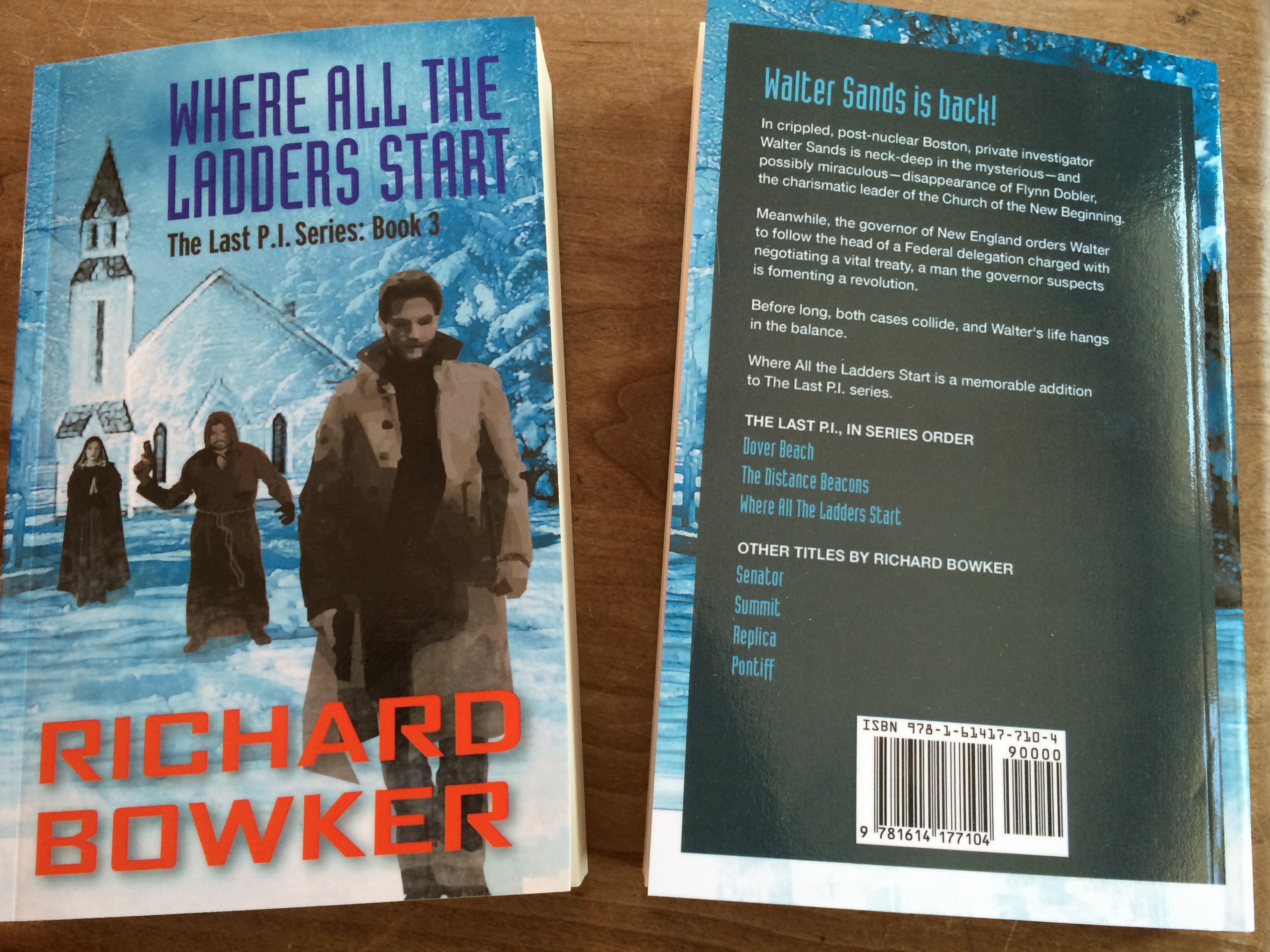
“Where All the Ladders Start”: The printed books have arrived!

Here’s what the book looks like:

2015-02-21 07.20.54

I’m all in favor of ebooks, but physical books do seem more “real,” don’t they?

But here’s the problem you run into with printed books: My publisher got complaints about the point size of the font they use, so they upped it from 10-point to 12-point.  This means that, instead of being about 300 pages, the book ends up being a lengthy 392 pages. Which means that they have to charge more for it than, for example, The Portal: $17.95 retail.

I can get you a discount, though.

My new novel “Where All the Ladders Start” is available now!

My new novel Where All the Ladders Start is out on Amazon, Barnes & Noble, Google Play, and other fine ebook retailers.  For those of you who haven’t been paying attention, it’s the third book in my Last P.I. series, which also includes Dover Beach and The Distance Beacons. In this one, our hero, Walter Sands, investigates the disappearance of the charismatic leader of the Church of the New Beginning. Twists and turns ensue, along with lots of humor and a few Deep Ideas.

Ladders cover final jpeg

(Note to local readers: even though there is snow on the cover, no shoveling takes place in the novel, and only a small amount of dangerous driving.  This is the nice kind of snow, not the kind of never-ending, soul-destroying snow that is falling as I type these words.)

The ebook is priced at a mere $4.99.  A print version will be available shortly.  If you want a print copy, let me know and I can send you an autographed copy at a discount.

Two readers have already left reviews of Where All the Ladders Start.  Here’s the first, which was up before I even knew the book was available:

fantastic series, rich characters, read this, read the whole series!

it may seem like hyperbole but I LOVE the characters and ideas that roam the world they are set in, and so should you. give this a try!

And here’s the second:

Most excellent.
I look forward to the next in the series.

So I really don’t see why you don’t just go buy the book right now.  You don’t even have to go out into the snow!

“Senator” Free Friday link

Here’s the link for the Free Friday writeup of Senator on Barnes & Noble.

People are already reviewing it, which I think is weird.  As with my previous Free Friday experience, the reviews are bimodal—people either love it or hate it.  Here is a hater who left a comment:

Used the Lord’s name in vain multiple times at the beginning so I read no further.  I don’t recommend this one at all.

Can’t argue with that.  Here are some more favorable comments from Barnes & Noble and elsewhere.  This one is voted the most helpful on Barnes & Noble:

One of Richard Bowker’s best novels — full of characters who are not just interesting but believable. Bowker’s style is clean and spare, but also engaging, vivid, and fast moving. I read this when it first appeared in hardcover, and am glad to see it back in print as an ebook.

And here’s the most helpful review on Amazon:

The beginning of this book put me off. I generally do not care for novels written in the first person, and the first chapters were tedious, another overworked story of the dead mistress whose murder threatens to ruin her high-placed lover. However, once all of the players were identified, I found myself relating to the protagonists and many supporting characters on the same kind of personal level as when I first read Presumed Innocent so many years ago. Bowker creates the flawed hero of the classics, a man driven on the one hand by ambition and on the other,by a sense of honor. Even at the end, the Senator possessed strengths and weaknesses that are not entirely resolved. In other words, he is human. This is not just a fine tuned murder mystery, it is a journey into the very complex issues of guilt and innocence-good and evil. For nearly a quarter century, I was a prosecutor of serious felonies, a position not without personal as well as professional challenges. It was not uncommon for me to sometimes relate to the defendant sitting one chair away at counsel table on a very human level. That did not change the nature of my mission–I was considered a tough prosecutor– but it made me reflect upon the difference between the concept of legal guilt and that of moral evil. This is not a story in which the murderer is arrested, tried and convicted, but its resolution is gratifying. In the past 18 months I have downloaded more than 415 books on my Kindle, and read all but a very few.This is one of the better ones, perhaps when it comes to a political mystery, the very best.

Just one more:

This is one of my favorite Richard Bowker novels — full of characters who are not just interesting but believable. Bowker writes in a clean, spare style that I find engaging and vivid, but also fast moving. I read this when it first appeared in hardcover, and am glad to see it back in print as an ebook.