Naming names

I was too annoyed with Western civilization last month to write the usual recap of my year’s reading.  But the best novel I read was The Sympathizer, which my son recommended to me.  It’s a novel about the Vietnam war, and life in America, and Apocalypse Now, and sundry other things, written from the point of view of a nameless Vietnamese double-agent.  For my son, this was pre-history; for me, it was stuff I had vaguely experienced, second-hand, told from a completely different perspective.
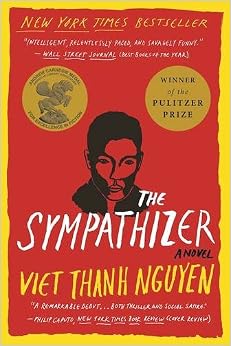
It was brilliant, but the author made a couple of choices that I found odd.  I liked that the narrator was nameless, but I was puzzled that many other characters–but not all–were also nameless.  The narrator’s boss is referred to only as The General, but the boss’s daughter has a name.  One character he has to deal with is called “the crapulent major”, while a comparable character is named Sonny.  (Spoiler alert: the narrator ends up murdering both of them.)

I have trouble deciding ahead of time whether minor people and places deserve a name.  In the novel I’m writing now, I have already had to retrospectively name a couple of places that turned out to be more important than I originally expected.  But this is standard fiction writing: characters and places, if they become important enough, get a name; otherwise, it’s hard to keep track of them  Nguyen is obviously trying to distance us from some of his characters; I’m not sure why.

Another distancing effect: he doesn’t use quotation marks.  My son didn’t even notice this, but it annoyed me.  It seemed like an affectation.  Punctuation helps the reader, and sometimes we need all the help we can get.
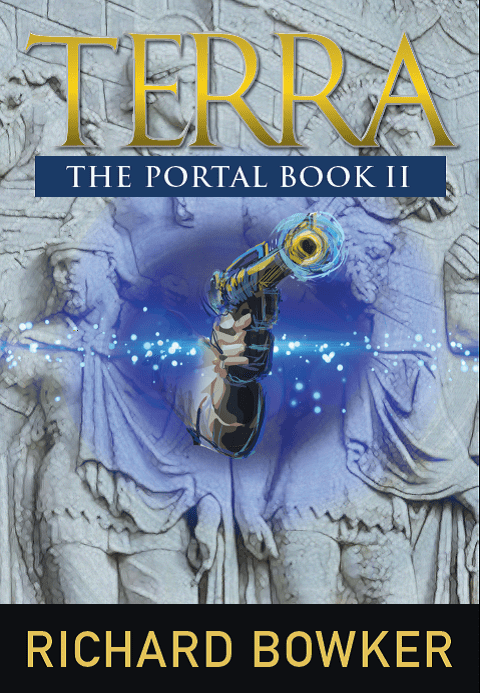
The paperback version of Terra is now available!

It’s $14.99 and worth every penny!  Available on Amazon and Barnes & Noble.  (I have no idea how there is already a used copy for sale from a bookseller on Amazon.)

By the way, we’re in the process of coming up with a new cover for The Portal to give us continuity in the series.  I’ll post a draft when we have it.

Terra cover

First customer review of Terra

And it’s a good one!

A really intriguing and rather different coming of age story. Alternate universe, strange portals to travel through and a planet called Terra. Earth, but not Earth. A place where the Roman Empire never fell, although with some very big differences. The first being that power resides in the hands of the priests, who control the portal, the Via. A schism has developed in the priesthood with the head priest (pontifex) attempting to corrupt the ideals of the finder of the portal and original priest of the order.

This is the second book of the series, having not yet read the first story of Larry and his portal hopping I was concerned it would be difficult to follow. It wasn’t. There were enough explanations to give one a basic understanding of what had occurred in the first episode so that the characters motivations could be understood, without destroying the suspense and giving away the previous storyline.

The combination of alternate universe travel, the Roman Empire still existent, some wonderfully complex characters, a high level of suspense and many twists made for an edge-of-the-seat read.

Highly recommended.

One of the many tough things about writing a sequel is trying to make the novel intelligible on its own.  I’m glad to see this reader enjoyed Terra without having read its predecessor.

Points of view

Here’s an article from the Times Book Review about the return of the omniscient point of view in fiction:

Most 19th-­century novelists didn’t try to hide their authorial presence. With modernism’s emphasis on the self and the rendering of individual consciousness, omniscience became unfashionable. ­Twentieth-century realists moved closer to their characters and wrote in the first person or limited third.

I have been thinking a lot about point of view lately.  All my novels to date have been told either in the first person or limited third-person (where you can have multiple points of view, but you’re only in one person’s point of view for any one scene).  All of them, that is, until Terra, where ninety percent of the novel is told in the first person, and then in the final chapter I switch to limited third for two different characters.  I worried about doing this, but I did it to set up the next novel in the sequence, Barbarica, which I’m working on now.

Barbarica is structured as a kind of kaleidoscopic limited-third novel — that is, we shift constantly from one point of view to another as the story progresses.  Will this work?  Dunno.  My writing group, which is experiencing this in real time, is getting antsy to see something from the point of view of my original narrator, Larry Barnes.  So, I have finally reached him in the sequence I’ve vaguely laid out, and suddenly I don’t know how to proceed.  Should I go back into his familiar first-person narrative style?  Or should we encounter Larry for the first time in limited third?  I think the decision will be fairly important to the reader’s experience of the story.

So now I’ll end this blog post and make the call.

Writing is hard, by the way.

Terra now available on Kobo, Google Play, iTunes…

For those of you who like to take less-traveled roads, my new novel Terra is now available on Kobo, Google Play, and iTunes.  I’m not sure what’s taking Barnes & Noble so long.

Here’s an article about the market shares of ebook vendors.  iTunes has 11% of the market; Barnes & Noble has 8%; Kobo has 3%; Google Play has 2%; Amazon has almost all the rest.  Oddly, most of my sales come from Barnes & Noble.  I do see a smattering of sales from the other vendors not named Amazon.

I will now start reminding people that customer reviews are the life’s blood of book sales.  So far Terra has none.  I expect that they may be hard to come by, since the novel will be of most interest to folks who have read The Portal.  So it’s all the more urgent for me to browbeat you into both reading and reviewing the thing.

Here’s the plot summary and first chapter.

“Terra” is now available from Amazon!

It took longer than I expected — but Terra is finally here.

Terra is the sequel to my novel The Portal; it extends and deepens the story of Larry Barnes and the cosmic gateway he has discovered to parallel universes.  Here’s a summary, along with the first chapter.

Terra cover

The ebook will be available on Barnes & Noble and other online vendors before long.  A print version will show up shortly thereafter.

By the way, if you read the marketing description of Terra on Amazon, you’ll notice a reference to the next book in the series, which is called Barbarica.  Don’t hold your breath waiting for it to appear, though; I’m about a quarter of the way through the first draft.

The Girl on the Train; also, chapter titles

Everyone seems to love The Girl on the Train.  It was a number one best seller; it’s being made into a movie; it’s on Obama’s summer vacation reading list.  So fine.  I just read it on my summer vacation.

The first thing I noticed is that the author used the technique I have settled on for my new novel: the point-of-view character is identified at the beginning of each chapter (along with the date and time of day).  I have become a little dubious about this technique since my
writing group reviewed my latest chapters, and Jeff pointed out that I hadn’t correctly established my point-of-view character in one of them.  “But I don’t need to,” I said.  “The point-of-view character is identified in the chapter title.”

“Oh,” Jeff replied.  “I hadn’t noticed that.”

So maybe I need to remove the “Chapter” designation; maybe I need to make the name of the character bigger.  That’s what Paula Hawkins does.  It’s probably all that stands between me and a deal for a major motion picture.

Anyway, her novel is well written and cleverly constructed, but I ended up being pretty disappointed.  Here are the problems I had with it (moderate spoiler alert):

  • I figured out who the murderer was pretty early on.  I kept expecting there would be a further twist, but the twist never came.
  • The critical event in the plot is witnessed by one of the narrators, but she doesn’t remember what happened because she was having an alcoholic blackout.  Or perhaps it didn’t happen.  Or perhaps she remembered it incorrectly.  But finally she remembers it, and that solves the mystery.  Meh.
  • One of the other narrators solves the mystery because the murderer unaccountably holds onto a key piece of evidence against him.  Phooey.
  • The climax is straight out of a Lifetime movie.  Woman finally realizes that the man she loved is really a lying cheating murdering psychopath.  The man comes after her.  Can she summon up the moxie to defeat him?  Ugh.

But really, her chapter titles are pretty good.

The Bad Sex award

The Bad Sex award for 2015 was given out last December.  Guess I missed it.  Here’s an interesting article in The Guardian about it.  The British award is given out for badly written erotic passages in otherwise good novels.  The winner was the singer Morrissey for a ridiculous passage in his novel List of the Lost.  The article makes the point that fear of being nominated for the award may actually be having a beneficial effect on literature, at least in the UK:

Grandees of the English novel are now hardly ever shortlisted because even the likes of Ian McEwan and Howard Jacobson now eschew sexual description, quite possibly in part due to awareness that such scenes could be performed to a baying, champagne-guzzling audience at the In And Out club the following December; and newcomers emerge from their creative writing degrees equally convinced that they’re best avoided.

I find writing a sex scene to be difficult.  Here’s the problem: a sex scene in most novels tends to be important; something major is happening to central characters.  (If they’re not central, why are you showing them having sex?)  Important scenes require vivid writing; you can’t just say: “They went into the bedroom, took their clothes off, and made love.”  So you want to ramp up the prose.  But what can you say about sex that hasn’t already been said?  You start reaching for metaphors, and before you know it you’re heading towards a Bad Sex nomination.

The thing to do, I think, is to focus on the characters’ reactions to what is happening, their emotions, rather than physical description.  Because the characters are what matter, after all; not the sex.  So sex scenes become exercises in characterization, not description.

By the way, Lee Child wants no part of writing sex scenes in his Jack Reacher novels.  He usually summarizes them briefly after the fact.  It had been good, Reacher thought.  It had been very good.  This is actually a good approach for Child.  A very good approach.  I wish he’d use the same approach for exploding brains and the like.

Sequels

I’m finally getting around to reading Funeral Games, the last volume in Mary Renault’s trilogy about Alexander the Great.  It is wonderful.  And it addresses some issues I’m trying to solve while starting up my new novel, which will be a sequel to my upcoming novel Terra (which by the way, should be available in a matter of weeks.)

The first problem with writing a sequel is that you have to treat it as a stand-alone novel. You shouldn’t assume that the reader has read (or has remembered) the book to which it’s a sequel.

But there’s also a deeper problem.  Why are you breaking the story in two?  Why not write one long novel?  The sequel really needs to be somehow different.

What Renault did in Funeral Games is something I’ve decided to try in my own sequel. The predecessor to Funeral GamesThe Persian Boy, is a first-person narrative, told by a young eunuch named Bagoas who grew close to Alexander at the  peak of his glory.  But in Funeral Games, which tells the story of what happened after Alexander’s death, Renault gives us a panoramic multiple-third-person point of view.  We are now inside the heads of characters whom before we only saw from Bagoas’s point of view.  And Bagoas is now seen from their point of view.  The effect is to immediately deepen and broaden the story.  And changing the point of view also helps with the first problem — we get to experience events from the first two books in the point-of-view characters’ memories, so the backstory is established effortlessly.

Anyway, this is exactly what I’m trying to pull off in my new novel.  We’ll see how successful I am.  Renault set the bar very high.