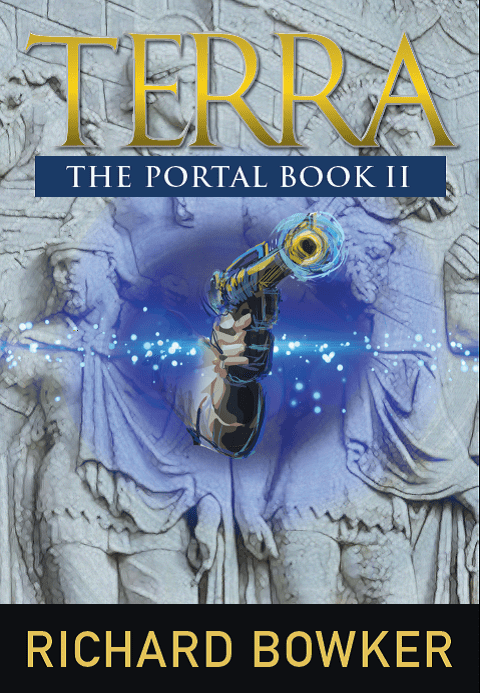
Cover for my new novel

. . . which is called Terra, you will recall.  Subject to further fiddling.  Comments are welcome.  You will notice that we’re looking for a parallel universe vibe here.  What is that ray gun doing against the backdrop of a bas-relief from ancient Rome?  Guess you’ll have to read the novel to find out.

Terra cover

So what’s that new novel of yours about, anyway?

I’m glad you asked.  It’s called Terra — have I mentioned that?  And it’s the follow-up to The Portal.  Here’s the marketing blurb I wrote for it yesterday:

Larry Barnes thinks he’ll never use the portal again.  The strange device that took him to a parallel universe has disappeared, and he is back living his normal life — until one day a beautiful woman appears and begs for his help.  She tells him that the mysterious preacher he met in his travels is in trouble on another world, and only Larry can save him.  Against his better judgment Larry enters the portal with her, and soon he finds himself in a desperate battle against a secret priesthood that wants to kill the preacher – and Larry.  As he struggles to defeat the priests and return home, Larry begins to sense he may have powers that he never dreamed of, and he begins to understand that his fate is inextricably linked to that of the preacher . . . and the portal.

I don’t like these sorts of blurbs; they seem to suck everything that’s interesting or different out of a book in order to fit it comfortably into its genre.  Maybe I can do better.  Should I bring in the many-worlds interpretation of quantum mechanics?  That would probably help sell some copies, don’t you think?

Did I really write that sentence?

I have finished the third draft of my novel.  It’s now five thousand words longer and considerably better.  I think I’m pretty close to being done.  Here is how this works, in my experience:

  • First draft — I figure out what I want to say.
  • Second draft — I say it.
  • Third draft — I clean up the mess.

Here’s an example of the mess.  I came across this sentence the other morning: “After a few hours we stopped to eat and feed the horses.”  Wait, what?  How can you feed the horses after you have eaten them?  I guess maybe that wasn’t what I had in mind.

Was I asleep when I wrote that sentence?  Drunk?  No, I was just working through the action and not paying enough attention to the style.  So that sentence is fixed.

Now I need to read through the whole thing again.  You know, just in case.

Third draft

I’ve begun the third draft of my novel, which so far has mainly involved fiddling with the second draft.  I love fiddling!  This means that I’m pretty close to where I want to end up, and I just need to make everything better — add details, .

There’s just one problem: this novel is the sequel to  my novel The Portal, and it presumes that there will be a Book 3.  If there isn’t, people will find the ending pretty darn unsatisfying.  But I haven’t exactly plotted out Book 3 yet.  Hey, I’ve been busy!  So I’m worried that the action and characters of this unwritten book will require even more fiddling with Book 2.

So it looks like I need to do some plotting before I finish my novel.  Luckily, I like plotting almost as much as I like fiddling.

Second draft is done!

Well, that took a while, during which posting here was light to nonexistent.  The second draft comes out at about 80,000 words, which is about where I expected it to end up.

Much has changed throughout the book, although the basic structure has stayed the same.  I’m hoping the final revisions we’ll go fairly quickly.

And I’m closing in on a cover design . . .

“So, have you finished that novel of yours yet?”

Shut up.  Really, just shut up.

The plan was to get the sequel to The Portal done in 2015, but 2016 finds me about three-quarters of the way through the second draft.  This isn’t like a George R.R. Martin delay, and I don’t have editors and publishers and translators and millions of readers waiting on me.  It’s just a personal thing.  But still.

What I don’t want to do (and I’m sure Martin doesn’t want to do) is to publish the thing before it’s ready.  I can feel the temptation to declare victory and move on.  But the list of things I want to tweak in the next draft is growing….

So I’ll get there–maybe by March.  Maybe before George R.R. Martin.

The top 100 British novels, voted by non-British critics

The BBC polled a bunch of non-British book reviewers and literary scholars to come up with their list.  Note that it’s British novels only — so no James Joyce.

I’m a sucker for articles like this.  The first thing I want to know is how many of these books I haven’t read — or, in this case, writers haven’t even heard of.  I count 13 writers who are completely new to me, most of them from the 1980s on.  I haven’t been keeping up!  There are probably another 20 or so that I’ve known about forever but never read — Doris Lessing, John Galsworthy, Arnold Bennett, Paul Scott, Anthony Trollope, George Gissing . . .

Some more thoughts:

  • I’m glad to see P.G. Wodehouse on the list, if only at position 100.  But another 20 of his novels are just as good as Code of the Woosters and could reasonably have ended up on a list like this.
  • I’m also glad to see Philip Pullman’s His Dark Materials on the list.  Someone at work complained about its being rated higher than The Chronicles of Narnia.  That doesn’t bother me a bit.
  • I’m not a big Kazuo Ishiguro fan, so I’m annoyed that he takes up two spots on the list.  Remains of the Day is #18?  Higher than Emma, Persuasion, and Jude the Obscure?  Really?
  • I liked Ian McEwan’s Atonement, but I don’t think it deserved #15.
  • I didn’t like Ford Madox Ford’s The Good Soldier, so I have no idea what it’s doing at #12.
  • I’m OK with Middlemarch at #1, but I’d put it below Great Expectations, which came in at #4.
  • There’s four Virginia Woolf novels on the list.  Maybe it’s time to re-read her.  I liked To the Lighthouse (#2), but I couldn’t finish Orlando (#66).

I need to read more novels.

Amazon is purging book reviews again

This made news a few years ago.  The difference this time is now Amazon apparently may purge reviews from someone an author “knows” online.

Yes, you read that right. This can be someone who has friended you on Facebook, followed you on Twitter, or has done business with you in a way that’s detectable to the Amazon review police….

Amazon spokespeople say that anybody who knows the author might “benefit financially” from the book’s sales, and financial beneficiaries have always been forbidden to review. (I wish I knew how to benefit financially when one of my 873 Facebook friends has a bestseller, but I’m obviously not working this right.)

So how do they determine if you “know” an author, anyway?

They’re not telling.

I’m all for taking down reviews that are fake or paid for in some way (even by the promise of a free book).  But that seems, er, excessive.  The modern method of book marketing involves authors having an online presence–via a blog, Twitter, Facebook….  You’re supposed to find “friends” out there.  Why penalize someone who finds them?

If the purge ever reaches me,  I don’t think it will have much effect.  The vast majority of the reviews my books have received have been from complete strangers . . . I think.  But I don’t really know, since a user can follow my blog with one name and review one of my novels with another.  Can Amazon figure this out?

Yeah, I suppose it can.