Unknown's avatar

About Richard Bowker

Author of the Portal series, the Last P.I. series, and other novels

So how’s the piano playing going?

Thanks for asking.

It’s going great! Wish I could practice more. Here’s what I’ve found:

  • Memorizing is harder than when I was a kid but not impossible. If I practiced more, I’d have a lot more stuff memorized.
  • I don’t have the attention span to work on long, difficult pieces. If I had more time…
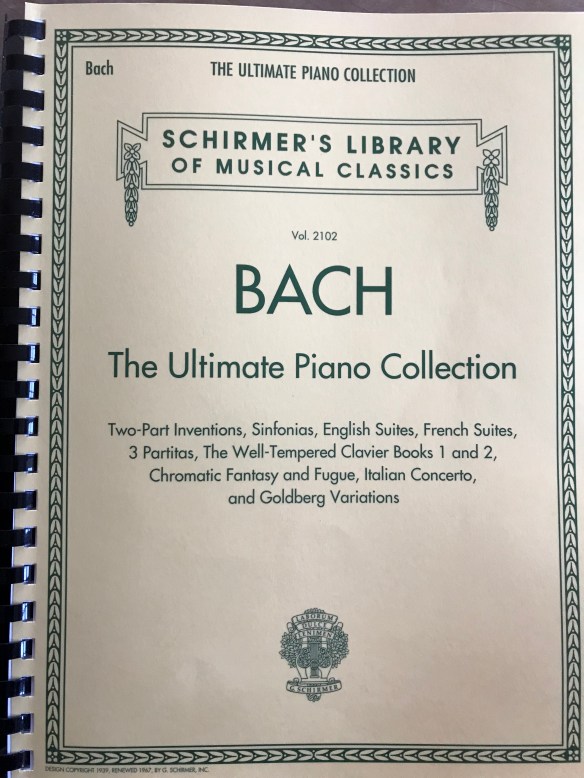
  • Balancing between mastering pieces and sight-reading is my biggest challenge. I could spend a lifetime just working my way through this book:

2018-09-16 15.50.07

  • Nobody cares that I play, and that’s fine. It’s not like every house I visit has a piano, and people are dying to hear a little Bach. That might have been the case 80 years ago when Cooke wrote Playing the Piano for Pleasure, but not anymore.
  • I’m definitely expanding my repertoire — more Brahms, more Schubert, more Debussy, more Lennon & McCartney.
  • I bought a book of scales and chords with a firm purpose of improving my technique and my music theory. Can’t say I’ve made much progress, though.

Two books to avoid

I used to read a lot; now I don’t. Writing gets in the way. (Also working for a living.) And when I read nowadays, I often get cranky. Here are two very different books that made me cranky recently.

The Outsider is the first Stephen King book I’ve read in decades. He just wrote too damn much, and I couldn’t keep up, so I stopped trying. King has his strengths and his weaknesses, but I always thought the strengths outweighed the weaknesses. But I didn’t enjoy The Outsider. The setup annoyed me: It’s structured as a police procedural, but the police procedures don’t work because the actual perp happens to be some kind of shape-shifting life-force-sucking evil monster, not the poor suspect whose body and DNA he replicated. So all the police work falls apart. Then everyone goes into monster-hunting mode, and King expends a lot of effort setting up the ground-rules about what powers the monster has. These ground-rules seemed utterly arbitrary to me–put in place so he could give us a thrilling climax. I wasn’t thrilled. Meh.

On the other end of the spectrum is Wuthering Heights, which is one of those novels that any self-respecting English major should have read before graduating from college. But I didn’t get around to it till last month. Here’s a list of the 100 greatest novels of all time where it shows up at #46; this seems pretty typical. If I’d been younger when I read it, I probably would have contemplated Bronte’s depth of characterization and reinvention of the novel’s form and maybe ignored the fact that everyone in this novel is freaking insane. The me who read the book on his well-earned vacation got increasingly annoyed at this fact.

Maybe it’s just me.

Boxed sets

I’m pondering creating a “boxed set” of the ebooks for The Last P.I. series; it would sell for less than the three books sold individually.The mechanism is fairly straightforward; the only real extra work (and expense) is to create a new cover. There’s lots of this going on nowadays. My publisher says that it would make the series more attractive to Bookbub, which is the main advertising channel for ebooks nowadays. One more way to get the word out.

Let me know what you think!

Finishing a novel

I read through my third draft, picking up more stuff along the way. The stuff keeps getting more and more trivial, but it’s real. Why did I type “here” instead of “hear” in one place? Why did I add the “ue” to “Epilogue” but not to “Prolog”? Why did I refer to the city as “Roma” everywhere but in one place, where I used “Rome”? Why did I waver between “goodbye” and “good-bye”?

More important, reading straight through let me spot places where I repeated a point I’d already made and places where I failed to make a point I wanted to make. The text feels smoother now. Somehow I managed to add another thousand words. Well, I guess I needed them.

Most important, I made final decisions about a few niggling issues that were bothering me. In a large, multi-viewpoint novel, you wonder if you have too many viewpoints, or not enough. Does the story hang together as you shift and shift and shift between viewpoints? In a novel that carries the story forward from two previous novels, have you resolved enough of the questions, have you provided satisfactory resolutions for enough of the characters?

Well, you’re never certain, but I’m pretty sure I’m done with this novel, except for a final proofing. Which means I now leave the characters, and the world, behind.

I’ll miss them.

Third draft is done

It mainly involved cleanup of the significant changes I made in the second draft. The biggest change was choosing a different point-of-view character for a chapter. Not too bad. Except…

There’s one thing about the novel that bugs me. Is it a problem or not? I can’t quite decide. Fixing it (if it needs fixing) would require a bit of rejiggering. I may need to put this to a vote of my writing group. We live in a democracy, after all.

Third draft

After leaving the novel to simmer for a while while I stared at busts of Roman emperors, I’ve finally started the third draft. So far, it’s going quickly–nothing like the second draft. I think that I’ve basically gotten it right.

We’re also making progress on cover designs.

So, maybe this fall?

Even more busts of Roman emperors (and others)

For some reason one of my most popular posts was about busts of Roman emperors at Boston’s Museum of Fine Arts. Turns out the place that has even more busts of Roman emperors is Italy — specifically, the Uffizi in Florence. Here are a few.

Here’s Claudius, not looking very happy:

2018-05-30 13.03.47

Here’s Domitian, who was awful:

2018-05-30 13.32.14.jpg

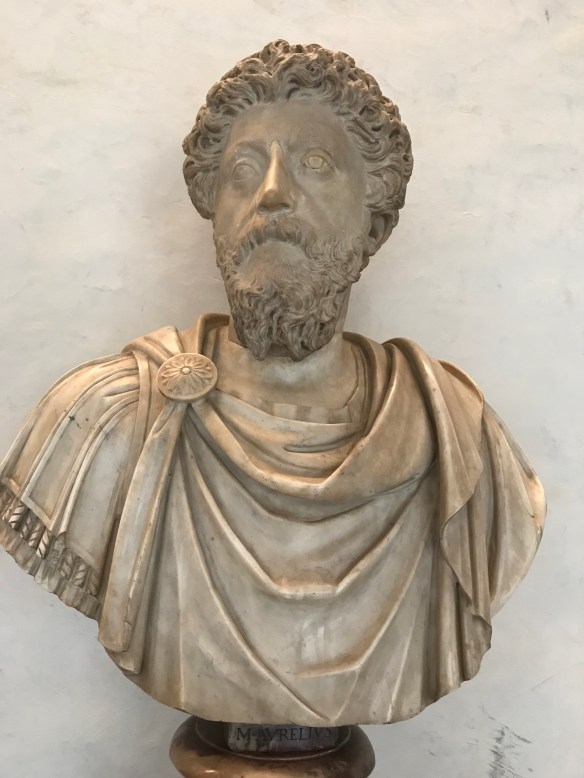
Here’s Marcus Aurelius, who wasn’t awful:

2018-05-30 13.36.51

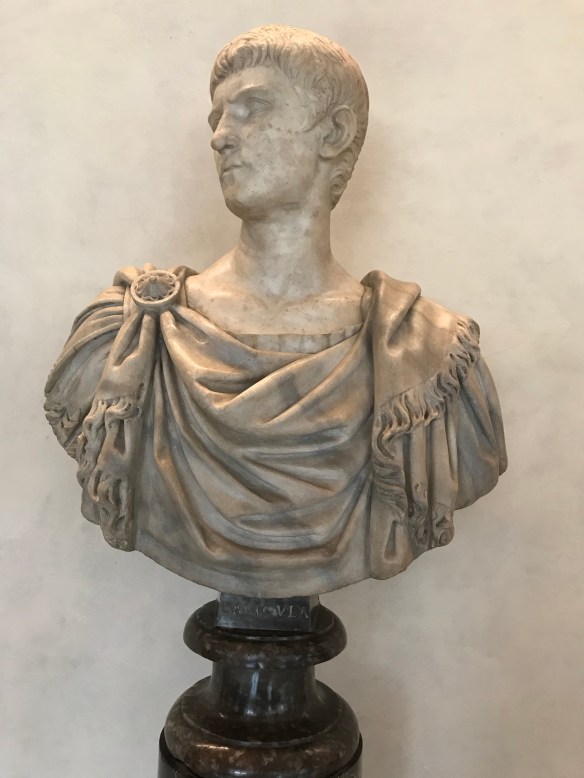
Here’s Caligula. Does he look like he’s insane?

2018-05-30 13.03.27

Here’s Tiberius, who was a perv:

2018-05-30 12.59.16

Here’s Julius Caesar, who wasn’t an emperor, but c’mon, this is a pretty interesting bust. I wouldn’t want to mess with this guy:

2018-05-30 13.01.11

And Cicero, who also wasn’t an emperor:

2018-05-30 13.00.35

I don’t know how lifelike these busts are, of course, but they sure seem lifelike. These are real people, staring out at us across 2000 years of history.

This Living Hand

When we think of Rome, the first thing that comes to mind, of course, is the English poet John Keats, who died there in 1821 of tuberculosis at the age of 25. Here is his grave in the Protestant cemetery in Rome, with the epitaph he wrote for himself:

2018-05-25 13.42.18.jpg

Odd that the gravestone doesn’t even mention his name. On a wall next to the grave we see this:

2018-05-25 13.43.32.jpg

Next to Keats’s grave is that of his friend Joseph Severn, who accompanied him to Rome, since Keats was too sick to travel by himself:

2018-05-25 13.42.35.jpg

There are worse things to be remembered for, I suppose, than being the friend of John Keats.

A couple hundred yards away from Keats are interred the ashes of Percy Bysshe Shelley, who died in a boating accident in Italy at the age of 29:

2018-05-25 13.54.44.jpg

The quotation is from The Tempest.

Here is a painting of Shelley’s funeral pyre:

Many of the details of the painting are apparently made up. For one thing, Shelley’s body was in bad shape by the time he washed up on shore. (The only way they recognized him was his clothing and the copy of Keats’s poems in his back pocket.)

Keats died in a tiny apartment at the foot of the Spanish Steps in Rome. This is now the site of the Keats-Shelley Memorial House, which contains letters, books, and other memorabilia of English poets. Via Wikipedia, here’s what happened to the contents of the House during World War 2:

During World War II, the Keats–Shelley House went “underground”, especially after 1943, in order to preserve its invaluable contents from falling into the hands of, and most likely being deliberately destroyed by, Nazi Germany. External markings relating to the museum were removed from the building. Although the library’s 10,000 volumes were not removed, two boxes of artifacts were sent to the Abbey of Monte Cassino in December 1942 for safekeeping. In October 1943, the abbey’s archivist placed the two unlabelled boxes of Keats–Shelley memorabilia with his personal possessions so that they could be removed during the abbey’s evacuation and not fall into the hands of the Germans. The items were reclaimed by the museum’s curator and returned to the Keats–Shelley House, where the boxes were reopened in June 1944 upon the arrival of the Allied forces in Rome.

I didn’t have time to visit the Keats-Shelley House, but here’s what it looked like at 23:00 on a Roman night:

2018-05-31 23.37.27.jpg

And this gives me a chance to reprint this final fragment by Keats, written as he confronted the certainty of his coming death.

This living hand, now warm and capable
Of earnest grasping, would, if it were cold
And in the icy silence of the tomb,
So haunt thy days and chill thy dreaming nights
That thou would wish thine own heart dry of blood
So in my veins red life might stream again,
And thou be conscience-calm’d–see here it is–
I hold it towards you.
I find these eight short lines utterly terrifying.

One cannot underestimate Feynman’s contributions to physics

I was listening to a podcast about the physicist Richard Feynman and I heard some professor utter this sentence. He meant the exact opposite, of course. What he wants us to understand is that Feynman’s contributions to physics were immense — that is to say, even if you tried, you couldn’t overestimate them. Garner’s Modern American Usage notes similar similar sentences from the Post, the Times, and the Globe. He compares it to the phrase “could care less”, which in informal usage is understood to mean the oppose of what the words seem to imply — that is, we use it to mean “couldn’t care less”.  Garner rates “could care less” a 3, which means “Widespread but still considered incorrect”. He rates “impossible to underestimate” a 1 — that is, “Rejected”.

I have trouble with “impossible to underestimate” myself, so I have sympathy for the professor on the podcast. There’s some kind of double negative going on in the phrase that makes the logic hard to work out. If you just said, “Don’t underestimate Feynman’s contributions…” the usage would be correct, but “impossible to underestimate” just heads in the wrong direction.

One space or two?

Between the first draft of my novel and the second I went cold turkey and switched from two spaces after a sentence (which I’ve been doing for half a century or so) to one space. I did a global search-and-replace through my manuscript and changed all eleventy-billion occurrences of “period-space-space” to “period-space”.  I typed all my new sentences with one space between them. I switched over to single spaces in my emails as well. And I will never look back.

Yes, I know, this was an amazing achievement. Appreciate the congrats. I did it mainly because those extra spaces were going away when the document was prepared for publication. Also, at work I work on a lot of documents with multiple authors, and it is moderately important to be consistent. Also, I just wanted to show myself what I was capable of.

Anyway, here’s a study that purports to show a slight benefit to two spaces after a period. This gets the authors a feature article in the Washington Post, but the study has lots of issues, as this wonderful article in Lifehacker points out. The key issue is that the study uses a monospace font. But nobody nowadays uses a monospace font, except for showing computer code or the like!

[R]eading a proportional font and a monospace font are two completely different scenarios. The study even acknowledges this: “It is possible that the effects of punctuation spacing seen in the current experiment may differ when presented in other font conditions.” Of course it’s possible—that’s what the whole debate is about! Why would you use Courier New!

So the study is pretty bogus, but I suppose the money from the two-space lobby will continue to roll in, and the researchers will go on speaking tours, write best-selling books, appear on major talk shows, etc. Good for them. But I will have the quiet satisfaction of having done the right thing by switching to one space, even at enormous personal cost. Not all heroes wear capes.