One Hundred Years of Solitude

Novels just don’t get any better than that.  I don’t really have much more to say about it, but I feel like quoting its first sentence, which is one of the best first sentences ever:

Many years later, as he faced the firing squad, Colonel Aureliano Buendia was to remember that distant afternoon when his father took him to discover ice.

RIP, Gabriel García Márquez.

Any Ian McEwan fans out there?

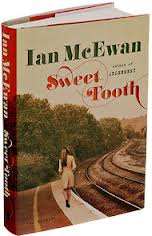
Ian McEwan is a superb writer, and his subject matter is the sort of thing I’m attracted to: murder, science, espionage, literature.  I’ve read most of his novels, and each one of them leaves me feeling dissatisfied for one reason or another.  The latest is called Sweet Tooth (bad title), which is kinda sorta an espionage novel set in the England of the 1970s.  I raced through it, but I was thoroughly annoyed by the end.  Here’s why:

  • Despite being set in England’s MI5 and filled with espionage types, the book is really light on plot.  Not much actually happens.
  • In reality, the focus turns out to be on a fairly uninteresting love triangle among three not very sympathetic people.
  • The novel ends with a post-modern twist.  (McEwan did something similar in Atonement.)  Time was I was very much in favor of post-modern twists.  My tastes have apparently changed, or maybe McEwan just didn’t pull this one off.  In this case, it just made me want to toss the completed book against the nearest wall.

The novel got lots of rave reviews from critics, but on Amazon it has a relatively modest 3.5 rating (by contrast, my novel Senator has, ahem, a 4.3 rating and Dover Beach a 4.1). Lots of people seem to share my reservations.

What I liked about the novel was its wonderfully detailed depiction of England in the 1970s. On the other hand, the couple of times McEwan wrote about something I’m familiar with, he got it wrong.  (No one “takes a legal degree from Harvard” — at least, not back then.)  Kinda shakes your confidence.

The best books I read in 2013

I don’t read anywhere near as much as I’d like to.  Here’s a brief list, more or less in order, of my favorites from 2013, most of which came out in earlier years.

  1. The Immortal Life of Henrietta Lacks (audiobook) — A wonderful mixture of science, sociology, and human interest, beautifully narrated.
  2. Pride and Prejudice (e-book) — Filling a gap in my education here.  I probably would have enjoyed it better in a print version, but it was wonderful nevertheless.
  3. Let’s Explore Diabetes with Owls (audiobook) — David Sedaris has turned himself into a national treasure.  His essays are funny on their own, but even better when he reads them.
  4. Olive Kitteridge (print book) — How come no one told me about this novel, which won the Pulitzer Prize a few years ago?  It suffers a bit from being a series of interconnected short stories (like Winesburg, Ohio) rather than a true novel, but it’s still moving and beautifully written.  On the other hand, I tried listening to Elizabeth Strout’s latest novel, The Burgess Boys, and gave up on it for various reasons.
  5. Lawrence in Arabia (audiobook) — A long, engrossing look at the Middle East during World War I.  (It helps that I have a kid living over there now, in a country that didn’t exist back then.)  I should have read it rather than listened to it, since I wanted to study maps, see photos of the characters, etc.
  6. The Particle at the End of the Universe (print book) — I cannot understand physics, but I like to try.  Sean Carroll is a very engaging writer who really understands stuff like the Large Hadron Collider and the Higgs Boson, to the point where I could delude myself into thinking this stuff finally made sense.
  7. The Signal and the Noise (audiobook) — I love Nate Silver’s 538 blog, and this book was pretty good too — a look at how prediction works (and doesn’t work) in various fields.  Again, I should have read it rather than listened to it — there were too many graphs I wanted to look at rather than have the narrator describe them to me.
  8. Telegraph Avenue (e-book) — Not Michael Chabon’s best novel, but still very enjoyable.
  9. Why Does the World Exist: An Existential Detective Story (e-book) — For some reason I’m interest in why the world exists.  I enjoyed this book a lot, although it also annoyed me a lot.  Here is my moderately clever review written with the limited vocabulary of Up Goer Five.
  10. The Annotated and Illustrated Double Helix (print book) — Filling another gap in my education.  The annotations and illustrations added considerably to my enjoyment of what by now is a familiar story.  On its own, Watson’s narrative wasn’t as interesting as The Immortal Life of Henrietta Lacks.

Other books I enjoyed: Lee Child’s One Shot and Gary Shteyngart’s Super Sad True Love Story.  I most emphatically did not enjoy Thomas Kyd’s Spanish Tragedy.(including the parts supposedly written by Shakespeare) or Lee Child’s A Wanted Man. Neither Kyd nor Child (hmm, that’s an odd juxtaposition) will care.

In which Jack Reacher starts to repeat himself

I liked One Shot,  the first Jack Reacher novel I read.  So I decided to try another — A Wanted Man.  I listened to this one.  And I was disappointed.

The narrator, Dick Hill, was fine, although he couldn’t do females very well.  He was hampered by a plot that required Reacher to talk with a broken nose, which got boring after a while.  Another problem — again, not the narrator’s fault — is that Child did a Dan Brown-worthy research dump in this novel, and I was desperate to skim through the unnecessary prose.  Did I really need to know how Denver got its name, when not a single scene in the novel actually took place in Denver?

But I had bigger problems with the story line.  One Shot was crisply plotted, I thought, even if the central mystery turned out to be pretty dull.  A Wanted Man aims higher — it involves the CIA and the FBI and Arab terrorists and what not.  But at some point we find out that pretty much everything that happened in the first, exciting part of the novel was in fact completely pointless. And when the solution to the mystery is finally revealed, it turns out to be completely idiotic. The Arab terrorists are doing something in a suburb of Kansas City that they could have done just as easily in a suburb of Mogadishu.

My biggest problem, though, was that once again all the plot machinery seems to have been put in place to give Reacher a chance to sneak into a secluded compound in the dead of night and, against impossible odds and perfectly legally, kill a bunch of bad guys in a bunch of interesting ways.  Is this how every Jack Reacher novel works?  I realize that genre novels in a series are supposed to be somewhat repetitive — that’s part of their appeal.  But I need a little more variety than this.  In addition, Child didn’t bother doing any characterizations of the people Reacher is killing, so the carnage feels much less consequential than in One Shot, where he gave us point of view scenes for most of the victims.  Finally, he pulls an “I could kill you now, Mr. Bond” with the hostage Reacher is saving — there is absolutely no reason for this guy to still be alive (and therefore no reason for Reacher to be risking his life to save him).

Blecch.  Someone please point me to a better Jack Reacher novel.  I’ll give him one more chance.

“Pride and Prejudice” two hundred years later

A previous post reminded me that I had never read Pride and Prejudice.  So I decided to give it a try.  Here’s my experience of reading Pride and Prejudice in the modern world.

I downloaded the text for free from Amazon.  It took less than a minute to get it onto my iPad–but I got annoyed, as usual, because Apple won’t let you download Kindle books from inside the Kindle app.  The two-step process cost me an extra 20 seconds or so to get the novel to appear out of thin air.

I started reading the book on my iPad while flying 38,000 feet in the air across America.  I took advantage of the Kindle app’s built-in dictionary to tap on unfamiliar words and learn what they mean.  The words I didn’t know mainly had to do with modes of transportation in Jane Austen’s day; I now understand the difference between a curricle and a phaeton, although I’m not sure the definitions will stick in my brain.  Not much need to know those words today unless you’re reading a Jane Austen novel.

As I mentioned, I continued reading the novel while watching the final game of the 2013 World Series. Most of the players had incomes in excess of Mr. Darcy’s ten thousand pounds a year (even adjusted for inflation); however, watching them pour champagne over each other in the locker room convinced me that not even Mrs. Bennet would have found them respectable suitors for her daughters.  Also, I’m not sure any of the girls would have found those beards attractive.

I picked up the novel again while waiting to drive down to Commercial Street in Provincetown and see the somewhat unusual sights it has to offer.  This time I read the book on my iPhone; the Kindle app helpfully synced my place in the book with the furthest place I had reached on my iPad.  How does it do that?  Many of the folks I saw on Commercial Street were heading to a ball, but I don’t think the ball was anything like the one that Mr. Bingley hosted at Netherfield.  The men I encountered were, if anything, even less suitable than the baseball players.

I finished the novel while watching the Patriots destroy the Steelers on Sunday afternoon, followed by the Bears edging the Green Bay Packers on Monday Night Football.  Clearly neither Mr. Gronkowski nor Mr. Polomalu were suitable matches.  Nor Mr. Rogers, whose collarbone fractures so easily.  Mr. Brady would possibly have made a good husband to one of the girls, had he not scandalously sired a child out of wedlock some years ago.

At any rate, it is now 200 years since Pride and Prejudice was first published, and the world has changed.  And it is still exactly the same.  We now have a lovely new word humblebrag, and here is Mr. Darcy talking about the same thing in 1813:

“Nothing is more deceitful,” said Darcy, “than the appearance of humility. It is often only carelessness of opinion, and sometimes an indirect boast.”

What a great novel.

Literature and Empathy

Jerry Coyne has a post on a study published in Science about how reading literary fiction makes people more empathetic.  (He uses the word empathic, which looks to be the same thing, but the WordPress spellchecker objects to it.) Here is the New York Times writeup of the study, which uses empathetic.

[The study] found that after reading literary fiction, as opposed to popular fiction or serious nonfiction, people performed better on tests measuring empathy, social perception and emotional intelligence — skills that come in especially handy when you are trying to read someone’s body language or gauge what they might be thinking.

Coyne finds the study unconvincing, as does Steven Pinker in a tweet. The significance levels aren’t all that high, and the empathy level is measured immediately after reading — there is nothing to suggest that the effect, if real, is permanent.  And one of the tests of empathy used — where you look at pictures of people and guess what emotions they are expressing — seems really unlikely to be affected by the kind of prose you just read.

The study offers the kind of results that English teachers and writers and fiction lovers will like.  Which provides plenty of reason to treat it with a bit of suspicion — it’s easy to be convinced by studies that prove what you already are sure is true.

But in any case, does it matter?  I suppose I’d like to be able to tell my kids that they should read good fiction because it will improve their emotional intelligence or social perception or whatever.  But even if it does no such thing, they ought to read good fiction because it will make their lives better.  That’s my story and I’m sticking to it.

How come no one told me about Lee Child?

He’s pretty good!  Which is refreshing, after my experience with Dan Brown.

My friend Doug lent me One Shot. (I’m mistrustful of Doug’s taste in non-Shakespearean Elizabethan drama, but that’s another post.)  The style was clean and serviceable, the characters were sufficiently well developed for a thriller, and the plot was bullet-proof, if you were willing to get into the spirit of the thing.

Jack Reacher is a bit of a stretch.  I expected not to like the superhuman above-the-law vigilante aspect of the character; I prefer heroes with flaws, or at least foibles.  But there was just enough of a sense of humor about the character that I could put up with him.

Here’s what I didn’t like:

  • Amnesia was a major plot device.  Child handled it much better than Dan Brown did, but it’s still a cheap cop-out.
  • The plot seemed a bit too focused on letting Jack Reacher hurt or kill as many bad guys as possible without legal repercussions.  I could do without that, but it seems to be Reacher’s thing.
  • Ultimately, the stakes were too low for all the mayhem.  Spoiler alert: the whole story revolves around kickbacks for paving contracts in a medium-sized Midwestern city. Again, the mystery behind this was handled well, but when it was finally revealed, my attitude was: “People are getting killed left and right for this?”

Still, on the basis of this one novel I’d put Lee Child on a par with Michael Connelly.  Which means I’d happily read or listen to more of his books, without having terrifically high expectations.

First Rowling, then Shakespeare… who’s next?

The Times today has an article about the possibility that Shakespeare wrote a passage in an edition of The Spanish Tragedy, an early Elizabethan play by Thomas Kyd.  The original computer analysis (by Brian Vickers) was very similar to that used to suggest that J. K. Rowling was the author of The Cuckoo’s Calling, which we talked about here.  Big Think describes what Vickers did:

Sir Brian has employed software called Pl@giarism–a free program developed by Maastricht University to catch law students cheating on their written work–to search a database of the 58 different plays performed in London between 1580 and 1595. But Sir Brian isn’t looking to catch anyone cheating. Rather, he is looking for examples of so-called “self-plagiarism.” The Pl@giarism software identifies every occasion that a sequence of three words appears in Shakespeare’s known works, and then looks for repetitions of these sequences in an unattributed text. Some of these word sequences are common, everyday collocations such as “by the way” or “Yes, my lord.”

Excluding those phrases, Sir Brian focuses on word sequences that are unique to Shakespeare. For instance, the word sequence “eyebrows jutty over” appears only twice in all of Elizabethan drama. One instance is in Shakespeare’s Henry V, written in approximately 1599. The only other instance is found in the fourth edition of Thomas Kyd’s “The Spanish Tragedy,” published in 1602. This version contains additions to five scenes, totaling 320 lines. In these short passages, Sir Brian found 46 collocation matches that are completely unique to Shakespeare’s poems and plays written before 1596. That evidence is hard to argue with.

What got the Times’ attention was another paper that focuses on Shakespeare’s handwriting and how that helps explain oddities in the passage:

In a terse four-page paper, to be published in the September issue of the journal Notes and Queries, Douglas Bruster argues that various idiosyncratic features of the Additional Passages — including some awkward lines that have struck some doubters as distinctly sub-Shakespearean — may be explained as print shop misreadings of Shakespeare’s penmanship.

“What we’ve got here isn’t bad writing, but bad handwriting,” Mr. Bruster said in a telephone interview.

What I couldn’t find in a cursory Google search was the actual passage in question.  It’s easy enough, though, to find the standard sample of Shakespeare’s messy handwriting–the passage from the manuscript of the play Sir Thomas More that is generally agreed to be by Shakespeare:

Next time, should J. K. Rowling disguise her writing style?

Here’s an interesting interview on Science Friday with Patrick Juola, the guy who’s computerized analysis helped identify J. K. Rowling as the author of the mystery The Cuckoo’s Calling.  He gives much more detail about exactly what kind of analysis he did over at Language Log.  Essentially, he compared the novel to works by Rowling, P.D. James, Ruth Rendell, and Val McDermid on four linguistic variables: distribution of word lengths, use of the 100 most common English words, and two other tests based on authorial vocabulary.

So, the final score? The results look “mixed,” but pointing strongly to Rowlng. There were certainly a couple of likely losers: nothing at all pointed to Rendell as a possible author, and only one test, and an unreliable one at that, suggested James. McDermid could be a reasonable candidate author, but the word length distribution seemed almost entirely uncharacteristic of her. The only person consistently suggested by every analysis was Rowling, who showed up as the winner or the runner-up in each instance.

One of the comments to Juola’s Language Log post suggests that a determined author can defeat analyses like these.  This is referred to as “adversarial stylometry.”  There are two basic approaches: obfuscation, where you try to simply hide your own style, and imitation, where you try to copy someone else’s style.  (A third approach is machine translation, where you translate an original passage using machine translation services.)  I doubt that any of this is worth Rowling’s time, but you might consider it if, say, you’re a whistleblower who wants to remain anonymous.

Of course, all of this analysis is overshadowed by the Onion’s shocking revelation that J.K. Rowling’s books were really written by Newt Gingrich:

“Assuming a fake identity really gave me a lot of freedom to build out the world of Hogwarts and flesh out the characters without drawing unwanted attention to myself or having the novels associated in any way with my political career,” Gingrich said in a statement, confirming reports he wrote the first four books in the fantasy series while still in office, but wrote the remainder before his 2012 presidential run.

Why do people rely on anything besides the Onion for their news?

What books do you pretend to have read?

Book Riot did an informal poll of its readers about books they pretend to have read.  Here are the top 20:

  1. Pride and Prejudice by Jane Austen (85 mentions)
  2. Ulysses by James Joyce
  3. Moby-Dick by Herman Melville
  4. War and Peace by Leo Tolstoy
  5. The Bible
  6. 1984 by George Orwell
  7. The Lord of the Rings by J.R.R. Tolkien
  8. The Great Gatsby by F. Scott Fitzgerald
  9. Anna Karenina by Leo Tolstoy
  10. Catcher in the Rye by J.D. Salinger
  11. Infinite Jest by David Foster Wallace
  12. Catch-22 by Joseph Heller
  13. To Kill a Mockingbird by Harper Lee
  14. Fifty Shades of Grey by E.L. James
  15. Jane Eyre by Charlotte Bronte
  16. Crime and Punishment by Fyodor Dostoevsky
  17. Wuthering Heights by Emily Bronte
  18. Great Expectations by Charles Dickens
  19. Harry Potter (series) by J.K. Rowling
  20. A Tale of Two Cities by Charles Dickens (21 mentions)

“Pretend to have read” is a slippery category — Pretend to whom?  Your snobby literary friends?  Your co-workers standing around the water cooler?  Your girlfriend the English major who won’t sleep with you if you haven’t finished Ulysses?  Does anyone really care nowadays what you’ve read and what you haven’t read?  Presumably the folks that Book Riot readers hang out with do.

Can you spot the one that isn’t as classic-y as the rest?  I thought you could.  As the Book Riot writer suggests, presumably people pretend to have read Fifty Shades of Grey so they don’t get left out of interesting conversations.

Of the books on the list, I haven’t read Pride and Prejudice and Wuthering Heights (among the nineteenth century classics), and Fifty Shades of Grey and The Infinite Jest (among the recent novels).  I’ve dipped into the Harry Potter books with my kids, but haven’t read any of the novels straight through.

There, I’m glad I could finally get that off my chest.