I’d rather write than talk about writing

This is the weekend when the Arisia science fiction convention takes place in Boston.  Back in the day, I was the guest of honor at the first Arisia.  It was just about the last science fiction convention I’ve attended.  This can’t have had a good effect on my writing career (such as it is).  But I just don’t like talking about writing, or publishing, or science fiction, or anything related thereunto.  But I’m happy to write about that stuff here!

Many (perhaps most) of my acquaintances don’t know that I write novels.  And that’s fine with me.  Because when they find out, the conversations are mostly painful.  Where do you get your ideas?  Why haven’t your books been made into movies?  Why do you still have a day job?  Also: I have this great idea for a novel, but I’ve never had the time to write it up.  Maybe you can do that for me, and we can split the profits!

At conventions, you’re basically trying to sell your books to people who are mainly there to dress up in costumes, which is a different sort of pain.  Or you’re talking to other writers, which can be fun, but it’s mostly depressing.  Either they’re like you, and therefore they’re going to complain about everything having to do with the publishing industry.  Or else they’re more successful than you, in which case you have to contain your envy.

I have always envied Thomas Pynchon, who was successful early enough to never have to deal with any of that.  Just write your books and cash your checks.  What could be better?

What do you do if you discover that you’ve made one huge mistake?

I’m closing in on the completion of the first draft of my novel, and I have finally, definitively realized that I made one huge mistake in my plotting.  I revealed a secret too soon, and as a result everyone’s motivations for the rest of the story are messed up.  So, should I go back and start rewriting?  Or should I soldier on to the finish, knowing that I’m going to have to revise a lot of what I’m currently writing?

I believe the answer, alas, is to soldier on and complete the first draft.  The problem with stopping to rewrite is that I can’t know what else I’ve messed up until I get to the end and survey the damage.

The mistake stems from not having a clear enough idea of the various subplots when I began the thing.  So I’ve ended up with a bunch of characters who weren’t there in the original outline.  They just, er, showed up as I made my way through the story, and I never managed to integrate them well enough into the plot.

I always think: next time I’ll get everything right in the outline.  But I never do.  I figure out the journey I want to take, but there are always lots of unexpected detours before I get where I want to go.

Writers in moves: Leave Her to Heaven

This is my second offering in this series.

Leave Her to Heaven was a popular film noir (beautifully filmed in Technicolor, actually) from 1945.  Here is IMDB’s summary:

A writer meets a young socialite on board a train. The two fall in love and are married soon after, but her obsessive love for him threatens to be the undoing of both them and everyone else around them.

Gene Tierney is the psychopathic socialite; Cornel Wilde is the writer.  The premise is fine, and Gene Tierney is great (and gorgeous).  The problem I had with the movie was that the Cornell Wilde character is a complete drip, and Cornell Wilde isn’t enough of an actor to make us care about him.

The fact that the main character is a writer is of little significance to the plot.  It mainly allows Wilde and Tierney to meet cute — he sees her reading his novel on a train.  This lets him quote a line from the novel to her:

When I looked at you, exotic words drifted across the mirror of my mind like clouds across the summer sky.

Oh, dear.  I’m pretty sure it’s always a mistake to quote from a fictional writer’s work in a movie.

(As an aside, on a plane once I sat across from a woman  who was reading something I had written — not one of my novels, alas, but a work-for-hire I had perpetrated for a high-tech company.  When I mentioned the coincidence to her as we deplaned, she was signally uninterested.  At least she wasn’t a psychopath.  I think.)

After the train scene, we just see Wilde occasionally pecking away at an old-fashioned manual typewriter, always wearing a writerly jacket and tie. There is no discussion of the creative process; there is no angst over deadlines; he finishes the book, and one day a copy arrives in the mail.  Writing novels is just what he does, because he comes from Boston, don’t you know, and went to Harvard.

I’ll just add that the trial sequence, featuring Vincent Price as the DA who was also Gene Tierney’s scorned lover, is about as over-the-top ridiculous as anything I’ve seen recently.

Any Ian McEwan fans out there?

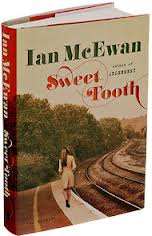
Ian McEwan is a superb writer, and his subject matter is the sort of thing I’m attracted to: murder, science, espionage, literature.  I’ve read most of his novels, and each one of them leaves me feeling dissatisfied for one reason or another.  The latest is called Sweet Tooth (bad title), which is kinda sorta an espionage novel set in the England of the 1970s.  I raced through it, but I was thoroughly annoyed by the end.  Here’s why:

  • Despite being set in England’s MI5 and filled with espionage types, the book is really light on plot.  Not much actually happens.
  • In reality, the focus turns out to be on a fairly uninteresting love triangle among three not very sympathetic people.
  • The novel ends with a post-modern twist.  (McEwan did something similar in Atonement.)  Time was I was very much in favor of post-modern twists.  My tastes have apparently changed, or maybe McEwan just didn’t pull this one off.  In this case, it just made me want to toss the completed book against the nearest wall.

The novel got lots of rave reviews from critics, but on Amazon it has a relatively modest 3.5 rating (by contrast, my novel Senator has, ahem, a 4.3 rating and Dover Beach a 4.1). Lots of people seem to share my reservations.

What I liked about the novel was its wonderfully detailed depiction of England in the 1970s. On the other hand, the couple of times McEwan wrote about something I’m familiar with, he got it wrong.  (No one “takes a legal degree from Harvard” — at least, not back then.)  Kinda shakes your confidence.

The best books I read in 2013

I don’t read anywhere near as much as I’d like to.  Here’s a brief list, more or less in order, of my favorites from 2013, most of which came out in earlier years.

  1. The Immortal Life of Henrietta Lacks (audiobook) — A wonderful mixture of science, sociology, and human interest, beautifully narrated.
  2. Pride and Prejudice (e-book) — Filling a gap in my education here.  I probably would have enjoyed it better in a print version, but it was wonderful nevertheless.
  3. Let’s Explore Diabetes with Owls (audiobook) — David Sedaris has turned himself into a national treasure.  His essays are funny on their own, but even better when he reads them.
  4. Olive Kitteridge (print book) — How come no one told me about this novel, which won the Pulitzer Prize a few years ago?  It suffers a bit from being a series of interconnected short stories (like Winesburg, Ohio) rather than a true novel, but it’s still moving and beautifully written.  On the other hand, I tried listening to Elizabeth Strout’s latest novel, The Burgess Boys, and gave up on it for various reasons.
  5. Lawrence in Arabia (audiobook) — A long, engrossing look at the Middle East during World War I.  (It helps that I have a kid living over there now, in a country that didn’t exist back then.)  I should have read it rather than listened to it, since I wanted to study maps, see photos of the characters, etc.
  6. The Particle at the End of the Universe (print book) — I cannot understand physics, but I like to try.  Sean Carroll is a very engaging writer who really understands stuff like the Large Hadron Collider and the Higgs Boson, to the point where I could delude myself into thinking this stuff finally made sense.
  7. The Signal and the Noise (audiobook) — I love Nate Silver’s 538 blog, and this book was pretty good too — a look at how prediction works (and doesn’t work) in various fields.  Again, I should have read it rather than listened to it — there were too many graphs I wanted to look at rather than have the narrator describe them to me.
  8. Telegraph Avenue (e-book) — Not Michael Chabon’s best novel, but still very enjoyable.
  9. Why Does the World Exist: An Existential Detective Story (e-book) — For some reason I’m interest in why the world exists.  I enjoyed this book a lot, although it also annoyed me a lot.  Here is my moderately clever review written with the limited vocabulary of Up Goer Five.
  10. The Annotated and Illustrated Double Helix (print book) — Filling another gap in my education.  The annotations and illustrations added considerably to my enjoyment of what by now is a familiar story.  On its own, Watson’s narrative wasn’t as interesting as The Immortal Life of Henrietta Lacks.

Other books I enjoyed: Lee Child’s One Shot and Gary Shteyngart’s Super Sad True Love Story.  I most emphatically did not enjoy Thomas Kyd’s Spanish Tragedy.(including the parts supposedly written by Shakespeare) or Lee Child’s A Wanted Man. Neither Kyd nor Child (hmm, that’s an odd juxtaposition) will care.

Christmas Eve in the world of “Dover Beach”

In this excerpt from my novel Dover Beach, the bookish would-be private eye Walter Sands spends Christmas Eve alone in a grim London hotel room, where he is haunted by memories of Christmases past.  Things have not always gone well for him in the bleak post-apocalyptic world he inhabits.

The e-book of Dover Beach is still free on Amazon, for some reason.  Which is a pretty good deal, when you come to think of it.  It is ranked #21 among technothrillers, for some reason.  It is not a technothriller; technothrillers don’t quote Dickens, at least not this liberally:

I took a bath. I reread the newspaper. I reread the Gideon Bible. I stared out the frosted window of my dreary room and gazed at the ruddy faces passing by in the dark, alien world. And I waited for a visitor.

It was the Ghost of Christmas Past. I knew he would come. He always came, so why should he make an exception now that I was in London, in his hometown?

“Rise, and walk with me!”

There was no refusing him, of course. Some nights, perhaps, but not on Christmas Eve.

Through the window, across the frigid London sky, over the fierce, churning ocean—to the awful abode of memories, still alive, still waiting to claim me…

“Why, it’s old Fezziwig!”

Not likely. It was a solemn, gaunt man—too gaunt, far too DOVER-BEACH-COVER1Lsolemn—his bony hand resting on my shoulder, light as a leaf. I was warm—the wood stove was kept well filled. But I was hungry. Always hungry. The man’s eyes glittered, reflecting the oil lamp’s flickering flame. “Tomorrow is Christmas,” the man said. “Least, Mrs. Simpkins says so. I’ve kinda lost track myself. Thing is, well, there’s nuthin’ to give you. I’ve tried—you’ve seen how I’ve tried, haven’t you? But everything’s gone. The entire world is gone. Oh, I’m so sorry.”

The man’s glittering eyes turned liquid and overflowed, wetting his leathery skin, his gray beard. His hand moved down onto my back and pulled me toward him. He held me against his chest, and I heard the ka-thump ka-thump of his heart beneath the frayed flannel shirt. The intensity of the sound scared me. The sudden strength of the hand scared me. I stayed there, listening, and eventually the hand loosened its grip, and I stepped back. The man looked at me—looking (I know now) for forgiveness, and if not forgiveness, at least some sort of understanding. But he was looking for something I was far too young to offer.

“Daddy,” I said, “what’s Christmas?”

“These are but shadows of things that have been,” said the Ghost.

“That’s swell,” I said. “That’s really swell.”

The Spirit pulled me along.

And I was chopping wood outside a familiar, broken-down barn. I was sweating, despite the cold, and my arms ached. A woman came out of the barn, carrying a scrawny chicken she had just killed. Her face was lined and wind-burned, her body shapeless under a heavy coat. She stopped and looked at me, and I kept on chopping. “Walter,” she said, “things is tough.”

“Yes, ma’am,” I said. I kept on chopping.

“Mr. Simpkins says we’ll have to leave here pretty soon if things don’t get better. I don’t know what we’ll do if we leave, where we’ll go, but there’s got to be someplace better.”

“I expect,” I said. I put another log on the block.

“But we’ll take care of you, Walter. We made a promise, and no matter how hard things get, we keep our promises. You understand?”

“Yes, ma’am. Thank you, ma’am.”

The woman nodded, satisfied. “Christmas is coming, but I’m afraid there won’t be any gifts. We can have a tree, though. You like them old ornaments, right? We can make the place real festive. Won’t that be nice?”

I split the log neatly. “Very nice,” I said. “Much obliged.”

The woman nodded some more. Chicken blood dripped onto the snow. “It’s the spirit that counts, that’s what I always say. We don’t have much in the way of things anymore, but we still have the spirit, don’t we, Walter?”

“Yes, ma’am. We still have the spirit.”

The woman smiled and went inside. I picked up another log and put it on the block.

“Spirit,” I said, “show me no more! Conduct me home. Why do you delight to torture me?”

“One shadow more!” exclaimed the Ghost.

“No more!” I cried. “No more. I don’t wish to see it. Show me no more!”

But the relentless Ghost pinioned me in both his arms, and forced me to observe what happened next.

The three of us were sitting in the parlor that first year together, and Stretch was expounding. “If we’re going to preserve our civilization, we have to preserve its rituals. Rituals are what bind us together. They shelter us from the terror of loneliness and death. They give life meaning and shape.”

“Christmas sucks,” I said.

Gwen smiled.

“It isn’t Christmas that sucks,” Stretch explained earnestly, “it’s your experience of Christmas. That’s why it’s so important to create our own experiences—to overcome those other experiences, to connect with the best of the old civilization, to keep us alive. Don’t you see?”

Yeah, I saw.

And then it was Christmas Eve. The pine boughs had been strewn, the popcorn strung, the fire roared wastefully; and at midnight we all kissed and exchanged presents that we couldn’t afford.

I gave Gwen a typewriter I had bought at the Salvage Market.

Gwen gave me a book from Art’s special stock. It was called The Maltese Falcon.

“See?” Stretch said. “Isn’t this good? Isn’t this the way life should be lived?”

And then later, lying upstairs in each other’s arms. “What do you think of Christmas?” I asked Gwen. “Is Stretch right?”

“I think,” she said, “that I have never been happier in my life.”

“Spirit,” I said, in a broken voice, “remove me from this place.”

“I told you these were shadows of the things that have been,” said the Ghost. “That they are what they are, do not blame me!”

“Remove me!” I exclaimed. “I cannot bear it!”

He let me go finally—back to my bleak hotel room, back to my guilt, back to this present that I had so longed for all my life—while he went off, presumably, to torture some other undeserving soul. No other ghosts came to call—I didn’t expect any—and eventually I drifted off to a tense and restless sleep.

When I awoke it was Christmas Day.

Print version of “The Portal” now available from Amazon!

Right here.  It’s more expensive than the e-book version, of course, but don’t you like the feel of a real physical book in your hands?  Also, don’t you think it would make a great Christmas present?  Actually, I’ve given this a lot of thought, and I can’t come up with a better Christmas present than this book.

OK, maybe a Samsung 40-inch 1080p 60Hz LED TV.  But just barely.

9781614174639

In which Jack Reacher starts to repeat himself

I liked One Shot,  the first Jack Reacher novel I read.  So I decided to try another — A Wanted Man.  I listened to this one.  And I was disappointed.

The narrator, Dick Hill, was fine, although he couldn’t do females very well.  He was hampered by a plot that required Reacher to talk with a broken nose, which got boring after a while.  Another problem — again, not the narrator’s fault — is that Child did a Dan Brown-worthy research dump in this novel, and I was desperate to skim through the unnecessary prose.  Did I really need to know how Denver got its name, when not a single scene in the novel actually took place in Denver?

But I had bigger problems with the story line.  One Shot was crisply plotted, I thought, even if the central mystery turned out to be pretty dull.  A Wanted Man aims higher — it involves the CIA and the FBI and Arab terrorists and what not.  But at some point we find out that pretty much everything that happened in the first, exciting part of the novel was in fact completely pointless. And when the solution to the mystery is finally revealed, it turns out to be completely idiotic. The Arab terrorists are doing something in a suburb of Kansas City that they could have done just as easily in a suburb of Mogadishu.

My biggest problem, though, was that once again all the plot machinery seems to have been put in place to give Reacher a chance to sneak into a secluded compound in the dead of night and, against impossible odds and perfectly legally, kill a bunch of bad guys in a bunch of interesting ways.  Is this how every Jack Reacher novel works?  I realize that genre novels in a series are supposed to be somewhat repetitive — that’s part of their appeal.  But I need a little more variety than this.  In addition, Child didn’t bother doing any characterizations of the people Reacher is killing, so the carnage feels much less consequential than in One Shot, where he gave us point of view scenes for most of the victims.  Finally, he pulls an “I could kill you now, Mr. Bond” with the hostage Reacher is saving — there is absolutely no reason for this guy to still be alive (and therefore no reason for Reacher to be risking his life to save him).

Blecch.  Someone please point me to a better Jack Reacher novel.  I’ll give him one more chance.

“Pride and Prejudice” two hundred years later

A previous post reminded me that I had never read Pride and Prejudice.  So I decided to give it a try.  Here’s my experience of reading Pride and Prejudice in the modern world.

I downloaded the text for free from Amazon.  It took less than a minute to get it onto my iPad–but I got annoyed, as usual, because Apple won’t let you download Kindle books from inside the Kindle app.  The two-step process cost me an extra 20 seconds or so to get the novel to appear out of thin air.

I started reading the book on my iPad while flying 38,000 feet in the air across America.  I took advantage of the Kindle app’s built-in dictionary to tap on unfamiliar words and learn what they mean.  The words I didn’t know mainly had to do with modes of transportation in Jane Austen’s day; I now understand the difference between a curricle and a phaeton, although I’m not sure the definitions will stick in my brain.  Not much need to know those words today unless you’re reading a Jane Austen novel.

As I mentioned, I continued reading the novel while watching the final game of the 2013 World Series. Most of the players had incomes in excess of Mr. Darcy’s ten thousand pounds a year (even adjusted for inflation); however, watching them pour champagne over each other in the locker room convinced me that not even Mrs. Bennet would have found them respectable suitors for her daughters.  Also, I’m not sure any of the girls would have found those beards attractive.

I picked up the novel again while waiting to drive down to Commercial Street in Provincetown and see the somewhat unusual sights it has to offer.  This time I read the book on my iPhone; the Kindle app helpfully synced my place in the book with the furthest place I had reached on my iPad.  How does it do that?  Many of the folks I saw on Commercial Street were heading to a ball, but I don’t think the ball was anything like the one that Mr. Bingley hosted at Netherfield.  The men I encountered were, if anything, even less suitable than the baseball players.

I finished the novel while watching the Patriots destroy the Steelers on Sunday afternoon, followed by the Bears edging the Green Bay Packers on Monday Night Football.  Clearly neither Mr. Gronkowski nor Mr. Polomalu were suitable matches.  Nor Mr. Rogers, whose collarbone fractures so easily.  Mr. Brady would possibly have made a good husband to one of the girls, had he not scandalously sired a child out of wedlock some years ago.

At any rate, it is now 200 years since Pride and Prejudice was first published, and the world has changed.  And it is still exactly the same.  We now have a lovely new word humblebrag, and here is Mr. Darcy talking about the same thing in 1813:

“Nothing is more deceitful,” said Darcy, “than the appearance of humility. It is often only carelessness of opinion, and sometimes an indirect boast.”

What a great novel.

Literature and Empathy

Jerry Coyne has a post on a study published in Science about how reading literary fiction makes people more empathetic.  (He uses the word empathic, which looks to be the same thing, but the WordPress spellchecker objects to it.) Here is the New York Times writeup of the study, which uses empathetic.

[The study] found that after reading literary fiction, as opposed to popular fiction or serious nonfiction, people performed better on tests measuring empathy, social perception and emotional intelligence — skills that come in especially handy when you are trying to read someone’s body language or gauge what they might be thinking.

Coyne finds the study unconvincing, as does Steven Pinker in a tweet. The significance levels aren’t all that high, and the empathy level is measured immediately after reading — there is nothing to suggest that the effect, if real, is permanent.  And one of the tests of empathy used — where you look at pictures of people and guess what emotions they are expressing — seems really unlikely to be affected by the kind of prose you just read.

The study offers the kind of results that English teachers and writers and fiction lovers will like.  Which provides plenty of reason to treat it with a bit of suspicion — it’s easy to be convinced by studies that prove what you already are sure is true.

But in any case, does it matter?  I suppose I’d like to be able to tell my kids that they should read good fiction because it will improve their emotional intelligence or social perception or whatever.  But even if it does no such thing, they ought to read good fiction because it will make their lives better.  That’s my story and I’m sticking to it.