Pull on a thread, unravel a subplot

My writing group sits by the fire, drinking Whale’s Tail and eating cashews.  They have read my latest chapters, and it’s time to comment on them.  They like them!  That’s great, because the first draft is almost done and lots of stuff is starting to come together.

There’s just this one teensy tiny plot thread that doesn’t seem quite right.  Do I need to add a sentence?  Do I need to explain a motivation a little more?  Well, no, that doesn’t quite do it.  What if my hero does this?  What if the female character does that?  What if something happened in a previous chapter to set things up better?  Her husband — what if he does something?  But wait, we haven’t even met the husband!  And suddenly he’s the key to everything!  How did that happen?

By the time I finish my Whale’s Tail I have another whole subplot to write, and I am further away from finishing my novel than when I started drinking.  Time for another Whale’s Tail.

Thanks a lot, writing group!

What do you do if you discover that you’ve made one huge mistake?

I’m closing in on the completion of the first draft of my novel, and I have finally, definitively realized that I made one huge mistake in my plotting.  I revealed a secret too soon, and as a result everyone’s motivations for the rest of the story are messed up.  So, should I go back and start rewriting?  Or should I soldier on to the finish, knowing that I’m going to have to revise a lot of what I’m currently writing?

I believe the answer, alas, is to soldier on and complete the first draft.  The problem with stopping to rewrite is that I can’t know what else I’ve messed up until I get to the end and survey the damage.

The mistake stems from not having a clear enough idea of the various subplots when I began the thing.  So I’ve ended up with a bunch of characters who weren’t there in the original outline.  They just, er, showed up as I made my way through the story, and I never managed to integrate them well enough into the plot.

I always think: next time I’ll get everything right in the outline.  But I never do.  I figure out the journey I want to take, but there are always lots of unexpected detours before I get where I want to go.

Any Ian McEwan fans out there?

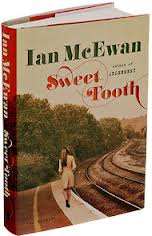
Ian McEwan is a superb writer, and his subject matter is the sort of thing I’m attracted to: murder, science, espionage, literature.  I’ve read most of his novels, and each one of them leaves me feeling dissatisfied for one reason or another.  The latest is called Sweet Tooth (bad title), which is kinda sorta an espionage novel set in the England of the 1970s.  I raced through it, but I was thoroughly annoyed by the end.  Here’s why:

  • Despite being set in England’s MI5 and filled with espionage types, the book is really light on plot.  Not much actually happens.
  • In reality, the focus turns out to be on a fairly uninteresting love triangle among three not very sympathetic people.
  • The novel ends with a post-modern twist.  (McEwan did something similar in Atonement.)  Time was I was very much in favor of post-modern twists.  My tastes have apparently changed, or maybe McEwan just didn’t pull this one off.  In this case, it just made me want to toss the completed book against the nearest wall.

The novel got lots of rave reviews from critics, but on Amazon it has a relatively modest 3.5 rating (by contrast, my novel Senator has, ahem, a 4.3 rating and Dover Beach a 4.1). Lots of people seem to share my reservations.

What I liked about the novel was its wonderfully detailed depiction of England in the 1970s. On the other hand, the couple of times McEwan wrote about something I’m familiar with, he got it wrong.  (No one “takes a legal degree from Harvard” — at least, not back then.)  Kinda shakes your confidence.

The best books I read in 2013

I don’t read anywhere near as much as I’d like to.  Here’s a brief list, more or less in order, of my favorites from 2013, most of which came out in earlier years.

  1. The Immortal Life of Henrietta Lacks (audiobook) — A wonderful mixture of science, sociology, and human interest, beautifully narrated.
  2. Pride and Prejudice (e-book) — Filling a gap in my education here.  I probably would have enjoyed it better in a print version, but it was wonderful nevertheless.
  3. Let’s Explore Diabetes with Owls (audiobook) — David Sedaris has turned himself into a national treasure.  His essays are funny on their own, but even better when he reads them.
  4. Olive Kitteridge (print book) — How come no one told me about this novel, which won the Pulitzer Prize a few years ago?  It suffers a bit from being a series of interconnected short stories (like Winesburg, Ohio) rather than a true novel, but it’s still moving and beautifully written.  On the other hand, I tried listening to Elizabeth Strout’s latest novel, The Burgess Boys, and gave up on it for various reasons.
  5. Lawrence in Arabia (audiobook) — A long, engrossing look at the Middle East during World War I.  (It helps that I have a kid living over there now, in a country that didn’t exist back then.)  I should have read it rather than listened to it, since I wanted to study maps, see photos of the characters, etc.
  6. The Particle at the End of the Universe (print book) — I cannot understand physics, but I like to try.  Sean Carroll is a very engaging writer who really understands stuff like the Large Hadron Collider and the Higgs Boson, to the point where I could delude myself into thinking this stuff finally made sense.
  7. The Signal and the Noise (audiobook) — I love Nate Silver’s 538 blog, and this book was pretty good too — a look at how prediction works (and doesn’t work) in various fields.  Again, I should have read it rather than listened to it — there were too many graphs I wanted to look at rather than have the narrator describe them to me.
  8. Telegraph Avenue (e-book) — Not Michael Chabon’s best novel, but still very enjoyable.
  9. Why Does the World Exist: An Existential Detective Story (e-book) — For some reason I’m interest in why the world exists.  I enjoyed this book a lot, although it also annoyed me a lot.  Here is my moderately clever review written with the limited vocabulary of Up Goer Five.
  10. The Annotated and Illustrated Double Helix (print book) — Filling another gap in my education.  The annotations and illustrations added considerably to my enjoyment of what by now is a familiar story.  On its own, Watson’s narrative wasn’t as interesting as The Immortal Life of Henrietta Lacks.

Other books I enjoyed: Lee Child’s One Shot and Gary Shteyngart’s Super Sad True Love Story.  I most emphatically did not enjoy Thomas Kyd’s Spanish Tragedy.(including the parts supposedly written by Shakespeare) or Lee Child’s A Wanted Man. Neither Kyd nor Child (hmm, that’s an odd juxtaposition) will care.

Christmas Eve in the world of “Dover Beach”

In this excerpt from my novel Dover Beach, the bookish would-be private eye Walter Sands spends Christmas Eve alone in a grim London hotel room, where he is haunted by memories of Christmases past.  Things have not always gone well for him in the bleak post-apocalyptic world he inhabits.

The e-book of Dover Beach is still free on Amazon, for some reason.  Which is a pretty good deal, when you come to think of it.  It is ranked #21 among technothrillers, for some reason.  It is not a technothriller; technothrillers don’t quote Dickens, at least not this liberally:

I took a bath. I reread the newspaper. I reread the Gideon Bible. I stared out the frosted window of my dreary room and gazed at the ruddy faces passing by in the dark, alien world. And I waited for a visitor.

It was the Ghost of Christmas Past. I knew he would come. He always came, so why should he make an exception now that I was in London, in his hometown?

“Rise, and walk with me!”

There was no refusing him, of course. Some nights, perhaps, but not on Christmas Eve.

Through the window, across the frigid London sky, over the fierce, churning ocean—to the awful abode of memories, still alive, still waiting to claim me…

“Why, it’s old Fezziwig!”

Not likely. It was a solemn, gaunt man—too gaunt, far too DOVER-BEACH-COVER1Lsolemn—his bony hand resting on my shoulder, light as a leaf. I was warm—the wood stove was kept well filled. But I was hungry. Always hungry. The man’s eyes glittered, reflecting the oil lamp’s flickering flame. “Tomorrow is Christmas,” the man said. “Least, Mrs. Simpkins says so. I’ve kinda lost track myself. Thing is, well, there’s nuthin’ to give you. I’ve tried—you’ve seen how I’ve tried, haven’t you? But everything’s gone. The entire world is gone. Oh, I’m so sorry.”

The man’s glittering eyes turned liquid and overflowed, wetting his leathery skin, his gray beard. His hand moved down onto my back and pulled me toward him. He held me against his chest, and I heard the ka-thump ka-thump of his heart beneath the frayed flannel shirt. The intensity of the sound scared me. The sudden strength of the hand scared me. I stayed there, listening, and eventually the hand loosened its grip, and I stepped back. The man looked at me—looking (I know now) for forgiveness, and if not forgiveness, at least some sort of understanding. But he was looking for something I was far too young to offer.

“Daddy,” I said, “what’s Christmas?”

“These are but shadows of things that have been,” said the Ghost.

“That’s swell,” I said. “That’s really swell.”

The Spirit pulled me along.

And I was chopping wood outside a familiar, broken-down barn. I was sweating, despite the cold, and my arms ached. A woman came out of the barn, carrying a scrawny chicken she had just killed. Her face was lined and wind-burned, her body shapeless under a heavy coat. She stopped and looked at me, and I kept on chopping. “Walter,” she said, “things is tough.”

“Yes, ma’am,” I said. I kept on chopping.

“Mr. Simpkins says we’ll have to leave here pretty soon if things don’t get better. I don’t know what we’ll do if we leave, where we’ll go, but there’s got to be someplace better.”

“I expect,” I said. I put another log on the block.

“But we’ll take care of you, Walter. We made a promise, and no matter how hard things get, we keep our promises. You understand?”

“Yes, ma’am. Thank you, ma’am.”

The woman nodded, satisfied. “Christmas is coming, but I’m afraid there won’t be any gifts. We can have a tree, though. You like them old ornaments, right? We can make the place real festive. Won’t that be nice?”

I split the log neatly. “Very nice,” I said. “Much obliged.”

The woman nodded some more. Chicken blood dripped onto the snow. “It’s the spirit that counts, that’s what I always say. We don’t have much in the way of things anymore, but we still have the spirit, don’t we, Walter?”

“Yes, ma’am. We still have the spirit.”

The woman smiled and went inside. I picked up another log and put it on the block.

“Spirit,” I said, “show me no more! Conduct me home. Why do you delight to torture me?”

“One shadow more!” exclaimed the Ghost.

“No more!” I cried. “No more. I don’t wish to see it. Show me no more!”

But the relentless Ghost pinioned me in both his arms, and forced me to observe what happened next.

The three of us were sitting in the parlor that first year together, and Stretch was expounding. “If we’re going to preserve our civilization, we have to preserve its rituals. Rituals are what bind us together. They shelter us from the terror of loneliness and death. They give life meaning and shape.”

“Christmas sucks,” I said.

Gwen smiled.

“It isn’t Christmas that sucks,” Stretch explained earnestly, “it’s your experience of Christmas. That’s why it’s so important to create our own experiences—to overcome those other experiences, to connect with the best of the old civilization, to keep us alive. Don’t you see?”

Yeah, I saw.

And then it was Christmas Eve. The pine boughs had been strewn, the popcorn strung, the fire roared wastefully; and at midnight we all kissed and exchanged presents that we couldn’t afford.

I gave Gwen a typewriter I had bought at the Salvage Market.

Gwen gave me a book from Art’s special stock. It was called The Maltese Falcon.

“See?” Stretch said. “Isn’t this good? Isn’t this the way life should be lived?”

And then later, lying upstairs in each other’s arms. “What do you think of Christmas?” I asked Gwen. “Is Stretch right?”

“I think,” she said, “that I have never been happier in my life.”

“Spirit,” I said, in a broken voice, “remove me from this place.”

“I told you these were shadows of the things that have been,” said the Ghost. “That they are what they are, do not blame me!”

“Remove me!” I exclaimed. “I cannot bear it!”

He let me go finally—back to my bleak hotel room, back to my guilt, back to this present that I had so longed for all my life—while he went off, presumably, to torture some other undeserving soul. No other ghosts came to call—I didn’t expect any—and eventually I drifted off to a tense and restless sleep.

When I awoke it was Christmas Day.

Print version of “The Portal” now available from Amazon!

Right here.  It’s more expensive than the e-book version, of course, but don’t you like the feel of a real physical book in your hands?  Also, don’t you think it would make a great Christmas present?  Actually, I’ve given this a lot of thought, and I can’t come up with a better Christmas present than this book.

OK, maybe a Samsung 40-inch 1080p 60Hz LED TV.  But just barely.

9781614174639

In which Jack Reacher starts to repeat himself

I liked One Shot,  the first Jack Reacher novel I read.  So I decided to try another — A Wanted Man.  I listened to this one.  And I was disappointed.

The narrator, Dick Hill, was fine, although he couldn’t do females very well.  He was hampered by a plot that required Reacher to talk with a broken nose, which got boring after a while.  Another problem — again, not the narrator’s fault — is that Child did a Dan Brown-worthy research dump in this novel, and I was desperate to skim through the unnecessary prose.  Did I really need to know how Denver got its name, when not a single scene in the novel actually took place in Denver?

But I had bigger problems with the story line.  One Shot was crisply plotted, I thought, even if the central mystery turned out to be pretty dull.  A Wanted Man aims higher — it involves the CIA and the FBI and Arab terrorists and what not.  But at some point we find out that pretty much everything that happened in the first, exciting part of the novel was in fact completely pointless. And when the solution to the mystery is finally revealed, it turns out to be completely idiotic. The Arab terrorists are doing something in a suburb of Kansas City that they could have done just as easily in a suburb of Mogadishu.

My biggest problem, though, was that once again all the plot machinery seems to have been put in place to give Reacher a chance to sneak into a secluded compound in the dead of night and, against impossible odds and perfectly legally, kill a bunch of bad guys in a bunch of interesting ways.  Is this how every Jack Reacher novel works?  I realize that genre novels in a series are supposed to be somewhat repetitive — that’s part of their appeal.  But I need a little more variety than this.  In addition, Child didn’t bother doing any characterizations of the people Reacher is killing, so the carnage feels much less consequential than in One Shot, where he gave us point of view scenes for most of the victims.  Finally, he pulls an “I could kill you now, Mr. Bond” with the hostage Reacher is saving — there is absolutely no reason for this guy to still be alive (and therefore no reason for Reacher to be risking his life to save him).

Blecch.  Someone please point me to a better Jack Reacher novel.  I’ll give him one more chance.

Temporary Monsters

Now that you have dutifully purchased Dover Beach at its amazingly low price of $0.99, you will want to also purchase my friend Craig Shaw Gardner’s new funny fantasy novel Temporary Monsters.  If you are wondering whether this novel is worth the $4.27 that Penguin Group (USA) LLC is charging for it, I have just three words for you: Bob the Horse.  Bob the Horse is perhaps the most irritatingly comic character ever invented.

Here is the clever cover:


“Dover Beach” is an Ereader News Today book of the day

I’m not sure how this works, but look here.  Not Dangerous Flames or Arielle Immortal Quickening, although I’m sure they are both very fine novels.  Scroll down to the third one.  That’s mine.

Ninety-nine cents is pretty cheap for a book this good, don’t you think?  It used to be free for a while, but you were too busy and didn’t get around to downloading it, now did you?  Will it ever be free again?  I wouldn’t count on it, if I were you.  If I were you, I’d spend the $0.99 and see what all the excitement is about.

DOVER-BEACH-COVER1L

Forbidden Sanctuary: The alien escapes

My science-fiction novel Forbidden Sanctuary is a first-contact thriller in which one of the aliens who have landed here learns about Christianity from an interpreter who happens to be a devout Catholic.  He becomes convinced that it is Earth’s counterpart to the persecuted faith that he secretly follows on his home planet.  This is a very high concept, and the book is well worth the $2.99 it’s gonna cost you!

Forbidden Sanctuary ebook

You can read the first chapter here.  In this excerpt we see the alien–Tenon–escape from his ship, trying to find sanctuary in the Catholic church he knows is nearby.

**********

In the first instant he was half inclined to turn back. This world was dark, and confusing, and bitter cold. How could he hope to find refuge in it? But of course he had come too far to turn back. He shut the door behind him, and started carefully down the long staircase to the ground.

They had guards too, of course, but they too were looking the other way, more interested in keeping Earthpeople away from the ship than Numoi away from Earth. He crouched low to the stairs as he descended, and prayed that the helmeted creatures at the bottom would not turn around.

They didn’t. Five steps from the bottom Tenon leaped over the railing and landed silently beside the stairs. He looked around. There were no other guards nearby that he could see. He moved to his right until he was well outside the guards’ line of sight, and then he walked slowly away from the ship.

The area around it was deserted. Who could be outside in this cold? It was very well lit, however, and he felt conspicuous. He picked up his pace, and soon he was in the shadows of a building. He could hear the murmur of voices inside. It was probably warm in there; he longed to join the voices. But would they protect him? No, he needed a sign: something to show him that the vomurd was continuing. He walked on.

And before very long he reached a fence, long and high and fiercely metallic. He could see a guard to his left, but once again the man was facing away from the Ship. Well then, he must climb the fence.

It was difficult for his hands to get a grip, and at the top were twisted strands of wire that tore at his flesh; but it was all right, he should be able to put up with pain. When he reached the ground on the other side he stopped to look back through the fence at the large pyramid that was his past, and then he trudged off along the road he found at his feet.

Around him were dark, looming hills, and tall, hard, bare-looking plants. Over everything was a layer of crusted snow. He had never actually seen snow before, but there was plenty of it in the land of the Stani, and Argal had spoken of it more than once. White grains of ice, as far as you could see. He shivered, and looked up at the alien sky. The stars were sharp and clear, their strange patterns almost as unsettling as the snow. Was one of them their star? He was unclear on such matters. Did anyone really know? It didn’t matter now.

By the fence he had seen a few of those fast-moving mechanical vehicles other crew members had talked about in tones of wonder, but none were on this road. Perhaps they were not used at night. Perhaps no one was allowed out after dark. There was so much he didn’t know—including how much farther he had to walk before he would find what he was looking for. So far there was nothing—no sign of a village, a farmhouse, a light. He could be going entirely in the wrong direction—a town just out of sight behind him, none for a day’s travel ahead of him. They would find his frozen body in the snow, by the road, and they would say: a fit punishment for a Chitlanian, to die in a land like the Stani’s.

If he was not used to the cold, at least he was used to the walking. He had had enough forced marches to keep his legs in shape, even after the inactivity of the Voyage: rushing to the border to subdue some recalcitrant tribe, providing an escort for some minor ambassador, scouring the hillside for heretics…

He recalled that painstaking search, knowing only that they were looking for enemies of the state, going from cave to cave, sword at the ready, determined to root out the traitors.

And he was the one who found them; scrambling up a small slope at dusk, weary and frustrated, he had entered the low cave and shined his torch, and there they were. About twenty of them, white-robed, gentle-eyed, sitting, waiting. His sword came out, and then he was calling for assistance, and one of the white-robes had said: “Calm yourself, soldier. You have nothing to fear from us.” And they came with him peacefully, praying all the while to Someone he had not yet heard of.

He had received a promotion for his daring single-handed capture of the heretics. The promotion had made him eligible for the Voyage. But that meant nothing to him compared with the image in his memory of those faces as they went to their deaths, faces transfigured by an emotion he had never felt, but longed to feel. Soon after that he was scouring the hills, alone, looking for someone who trusted him enough to bring him to Argal.

His hands were numb. He clapped them against his side to bring the feeling back. He was having difficulty focusing his eyes. He had to squint continually to keep them working. His ears roared with pain. His legs wanted to stop, but stopping, he now realized, meant death.

And besides, there were signs now of life: lights in the hills, a dwelling, then, after a while, another. He squinted at each dwelling as he passed it. Not what he was looking for. Not yet.

Millions, he kept telling himself. There are millions.

One of those vehicles suddenly appeared, its lights like some incredible animal eyes piercing the darkness. He stopped, transfixed, as it roared past him, its occupant faceless behind the glare of the lights. He took a deep breath, and continued.

He had been a soldier all his life, and yet he had never known fear. Occasionally there would be danger, but the Numoi were always in control, and besides, to die for Numos (so he had believed) was the greatest possible glory of your life.

Now he would gladly die for Chitlan, but still he was afraid, because he was alone in the dark on a strange world, and he did not know what hazards awaited him around the corner, over the next rise, and he did not want to die senselessly, by walking on the wrong side of the road, or touching an object that was not supposed to be touched, or making a sound where silence was required.

He did not know whether the water in his eyes was caused by the cold, or by something else.

He did not want to think of the past anymore, but he couldn’t help it, to keep his thoughts in this world was to invite despair; and if he lost the will to keep his legs moving then everything would have been in vain.

He thought of Argal, who had walked the length of Numos, and all the outlands as well, risking his life with every step he took. But he had a mission, and he never complained. He thrived on it, really; how he would have enjoyed the challenge of this situation.

Tenon pictured Argal sitting in a hearth chamber, his dirty peasant robes gathered around him, his face creased and scarred with the ravages of his life. And the eyes! Eyes that held knowledge and truth, that had pierced deeper into the mysteries of all-that-is than any living being. Eyes, Tenon thought, with a shiver, that he would never look into again.

He recalled the first time: they had led Tenon to him blindfolded, at night, wary of a pure-blooded soldier with an impeccable record. He kept waiting for the feel of a knife against his throat, but these people were different (he kept reminding himself); that was why he had put himself in their hands.

When the blindfold came off he found himself in the stone-floored hearth chamber of a peasant farmhouse. In the dim firelight he saw a couple of young rustics regarding him suspiciously and, beyond, the foreigner he had struggled so long to meet, the foreigner who had a price of five thousand goldpieces on his head.

“Come and sit, soldier,” Argal had said in a low, friendly voice. “Perhaps we can learn from each other.”

But what could he teach Argal? He knew only what the Numian schools had taught him, and that, it turned out, was less than nothing in Argal’s eyes.

For some reason Argal spoke little of Chitlan that first night. Perhaps he wanted to tear down Tenon’s old religion before building a new one; perhaps it was just where his thoughts were when Tenon arrived. At any rate, he began by speaking of the Ancients.

“It is fascinating to me how little even educated Numoi know about these Ancients. It’s nothing more than myth and pious double-talk—which, you know, is precisely what the Ancients wanted. Did you know, for example, that there were exiles from Numos at the time the Ancients were putting together the hasali you are now a part of?”

Tenon, of course, had not known that.

“Some of them reached the land of the Stani. They wrote about what they understood—and feared—but they were foreigners and, I’m afraid, they were at best ignored, at worst mistreated. Their writings lay unread—until I came upon them. I was just a young scholar back then, and I had not even heard of Chitlan. So the Stani leaders threw open their archives to me, not knowing what they possessed.”

“What was it?” Tenon asked, intrigued and half afraid.

“Well,” Argal replied, “here is my interpretation of it. I believe it to be true. You see, the Ancients were practical, clear-sighted, and, according to their lights, benevolent people who above all were interested in answering one question: how do you set up a lasting, peaceful civilization? You will not find this question discussed in the Chronicles of the Ancients, or any of the other writings that have been preserved by the priestesses, because all mention of it had to be suppressed as part of the answer.”

“And what was their answer?”

“Oh, there were many parts to it, like the structure of the government and the size of the nation. But the centerpiece was this: to create a religion. And the centerpiece of the religion was the Ship.”

“But isn’t—wasn’t—?”

“Isn’t the Ship proof of the truth of your religion? No, it is only proof of the genius of the Ancients. I don’t pretend to understand how it works, but I do know there is nothing miraculous about it—nothing to compare, for example, with a resurrection from the dead. But we will come to that another night.

“You see, they wanted it to appear miraculous. So they destroyed all documents concerning the theory of timeless travel and the construction of the Ship. They cloaked their work in mystical terminology, and taught their successors how to copy what they had done, but not how to understand it. Instead of using what they had learned to add to the material well-being of their nation, they used it to transform its spirit.

“They gave Numos a central symbol, a ceaseless quest that would provide a focus for all the work and thoughts of its people. They were lucky, I think, in a couple of points. Enough of the Ships returned from the black void that they have not come to symbolize utter futility. And the crews never have discovered other intelligent life—because that would end the quest, and with it the value of the symbol.”

(Tenon-by-the-hearth had circled his hand slowly in understanding, finally getting used to this strange perspective on his world, starting the slow transformation that would lead him far from his mindless orthodoxy. Tenon-in-the-cold-alien-air, product of the transformation, thought: the Voyages are too important to Numos, though. The Council will simply redefine the goal, and the Voyages will continue, more meaningless than ever. But that has nothing to do with me anymore. Tenon shivered, and tried to walk faster.)

Argal’s eyes had gleamed in the firelight, pleased at Tenon’s understanding. “Do you see?” he exclaimed. “It is an artificial religion, designed to provide stability and meaning to a civilization. As such it has been successful and, in some ways, I grant, admirable. But it is not the truth. A civilization, it seems, can be based on a lie, but now we know the truth, and the truth will destroy this civilization like a rock shattering a hollow, decayed fossil.”

Tenon noticed one of the young peasants writing down Argal’s words, and he started to realize that this was the beginning of something immense, that he was hearing words that would be remembered in a thousand generations the way the acts of the Ancients were remembered in his. But still there were doubts. “If a lie is so powerful,” he asked, “how will the truth destroy it?”

“Its time has come,” Argal responded. “The lie is not what it once was. The crews still go off every twenty cycles to meet their fate, but there is confusion and fear beneath their brave façades. The priestesses still carry out the prescribed rituals, but there is boredom behind their gestures. The Council still rules, but the people feel free to grumble at their edicts. The entire planet is ready to listen, ready to believe. And that is precisely why Chitlan chose this moment to appear in our midst. We will be victorious, and there is not a power in the Universe that can stop us.”

And how often had Tenon heard those words spoken—by different hearths, to other new believers? Yet they never failed to thrill him. Often he lacked Argal’s utter certainty in the final triumph, but he never lacked faith in him, or in Chitlan.

A cold wind cut through him, as he realized again that Argal was gone. He was on his own; he had left those hearths behind forever.

There were dwellings all around him now, but no sign of what he was looking for. Pray, he must pray. His legs must continue to move, he must fight off the tears….

And eventually he saw it—sharply etched against the planet’s bright half-moon, just as he had imagined it. Angela’s words echoed in his mind: they put Him to death on a cross. And she herself had worn a tiny gold cross around her neck. Symbol of her faith.

O, lucky people, who could display their symbols so openly! He rushed over the banks of snow to the building with the cross, joy and anticipation warming his frigid body. Across the walk, up the short flight of stairs…

And the door was locked. Tenon stared at it in disbelief. That could not be. Then he reasoned: not everyone on the planet was a follower of Jesus. Perhaps there were still people who wanted to harm them. Of course they would lock their place of worship in that case. But certainly their chief priest or priestess would be inside—asleep, most likely, but eager to help a believer in trouble.

He pounded on the door. No one came. He pounded again. His hands, already cut and raw from the wire of the fence, ached with the effort, but the door remained locked. Finally he gave up and started to walk around the building, looking for other entrances. They were all locked. There were windows, of course. He could break a window and get inside. But that would be desecration. That would not be allowed.

He came around to the front again and sat on the steps, exhausted and fearful. Perhaps someone would open it up in the morning. But how long would it be until morning? He could not survive much longer without shelter. How much worse a death that would be—frozen on the very steps of their temple, his goal reached but meaningless.

That could not happen. He struggled to think things through. It was clear that he had to get indoors. There were plenty of dwellings. Most of them were probably occupied. What he needed was one occupied by a follower of Jesus. But how would he know?

He would have to take a chance. Which one?

The one nearest the temple, obviously. Would someone who was not a follower of Jesus want to live next to one of His temples?

Tenon got up and walked across a short pathway to the nearest dwelling. It was in darkness, like the temple. He stood in front of the door for a long time, summoning his courage. It has to be done, he told himself. There was no other way. He knocked.

And knocked. And after an eternity a light appeared behind the door. He saw the shadow of a person through the small, curtained glass panes and heard a brief, gruff sentence. There was nothing he could say, so he knocked some more.

Finally the door opened a crack—still locked with a chain—and a face appeared.

They looked at each other through the crack, and Tenon dimly realized that the man was as frightened as he was.

With his trembling hands Tenon tried to form a cross. “Jesus,” he whispered, hoping it sounded right on his alien tongue. “Jesus.”

The man kept looking at him, and the chain remained in place, and suddenly Tenon could take no more, and the tears came streaming out of his eyes. “Jesus,” he moaned as he felt his legs giving way, and then he heard the chain move, and the door swung open, and he fell forward into warmth and light.