The second draft is done!

As I hoped, the second draft of my novel went a lot faster than the first.  By the time I had finished the first draft, I had pages of notes about what I needed to change, and I came up with lots of new ideas before beginning the second draft.  New characters showed up!  Old characters disappeared!  Motivations got rejiggered!  New plot twists got twisted!

There’s more to be done, but at least now the thing feels like a completed novel.  It exists; before it was more or less a jumble in my mind.

Here’s the kind of thing I’m going to have to do now: the last words of the novel used to be “Gwen repeated.”  But this morning I decided they should be: “Gwen said again.”  But as I say the words over in my mind, I’m not entirely happy with the internal rhyme.  Will anyone care?  No.  But I think I better change them back.  Or maybe not.

A note on the authoring process: somewhere on this blog I’ve talked about rewriting on a computer.  Computers make it easy to use your original draft as the basis for the rewrite, but that lessens the incentive to re-imagine your content.  This time around I started with a blank document, but I copied the first draft into it chapter by chapter.  Often I would use a sentence from the original; occasionally an entire paragraph.  But mostly the text was there to remind me of what was going on, and most of it got deleted as I completed its replacement.  Overall, I managed to reduce the books length by about seven percent, which was one of my goals.  The first draft didn’t feel quite streamlined enough for a private eye novel.

Now on to the tweaking!

Dover Beach goes live on BookBub!

My novel Dover Beach is now featured on the BookBub website, and it’s in the email BookBub sent out to 400,000 science fiction readers.  The book is on sale for the ridiculously low price of $0.99.   Here’s where I discuss the economics of a BookBub promotion.  (If you want to buy the book, click the link on the BookBub page — they’ll get some revenue, and if they get enough click-through sales, this may help convince them to feature another one of my books.)

DOVER-BEACH-COVER1L

My publisher came up with this blurb for the book–there is presumably a word limit:

A Philip K. Dick Award finalist set in a harrowing world devastated by war: Believing himself a clone, Dr. Charles Winfield enlists the help of Wally Sands to expose a top-secret government project. But in his pursuit of answers, Wally uncovers truths about himself — and crosses paths with a killer…

This manages to get two or three things wrong, but whatever; I probably couldn’t have done any better.  Here’s a customer review, titled “A Different but Wonderful Private Eye Story”, that does a better job of capturing what the book is about:

Walter is a quirky private eye like none you’ve ever experienced! The poor fellow stumbles into one disaster after another, making you laugh, cringe, and pity the lovable, determined character. By the way, Walter is a survivor of the downfall of America so he’s familiar with overcoming challenges. As the story unfolds, tidbits are revealed toward understanding what happened. To assist Walter is an eclectic and interesting collection of friends who assist him along the way. They will become like friends to you also. This book has twists and turns, great wit and humor, and very colorful characters. I loved book so much that I ordered the next novel in the series (A Distance Beacon) right away. Great job!

This reviewer gets everything right, except the name of the sequel.  But it’s close!

By the way, there has never been a better time to get one of my books. Senator is also available for $0.99, and The Portal continues to be free.  Here’s a recent five-star review of The Portal, titled “A Lot of Heart”:

I thought at first this was going to be another YA gimmicky novel with kids complaining about their lives and using the device of dimension travel just to come up with random quirky things, but this book is much more than that. You really get to know and care about the characters, and things move along quite well and not predictably. The really surprising part is the life lessons learned by the characters – they really leave you with something more than just a fun little read. Glad I read it!

Amazon vs. Hachette: The competition starts taking advantage

For all the articles I’ve read about Amazon’s hardball tactics in their battle with Hachette, I have seen little discussion of the risk it’s taking.  They are obviously leaving an opening for the competition.  The Times finally ran an article about what’s happening on that front.  An independent Seattle bookstore hand delivered copies of J. K. Rowling’s new book along with a “Hachette swag bag.”  And the big vendors were also taking advantage:

On Walmart.com on Thursday, “The Silkworm” was one of three books featured on the books’ home page at 40 percent off, or $16.80. Walmart has also promoted the book with ads on Facebook and through mass emails to its customers promoting Hachette books. On Barnes & Noble’s site, “The Silkworm” was one of four of “the week’s biggest books.” A digital edition for the Nook was $11.99. It was Barnes & Noble’s No. 2 best-seller on Thursday. On Bookish, the website that the major publishers started last year to combat Amazon, it was the first “new and notable” release featured, and was selling for $19.60.

This doesn’t mean Amazon will back down, or that it won’t win.  But it surely is taking a risk.

“Who’s going to blink first?” mused Mr. Sindelar, the independent bookseller. “That’s what everyone wants to know. I have no idea. But a lot of our customers told us they were buying from us explicitly as a protest against Amazon. We live in Seattle, where people go to farmers’ markets. They don’t want to limit the diversity of where they shop. I think this has helped people realize that if Amazon is the only option, that’s putting way too much power in one company.”

Another author complains about the new digital world order

This one is Tony Horwitz, who wrote the wonderful Confederates in the Attic. He recounts his tale of woe in a New York Times op-ed.  He got an offer from a new digital media outfit to write an e-book about the Keystone pipeline.  They in turn contracted with an ebook publisher to produce and market the book.  But the digital media outfit collapsed before he got his advanced, and the ebook publisher collapsed after the book was published.  He now has little prospect of getting sufficient revenue from the ebook to make the months of research and writing worth while (although the publicity of a Times op-ed is going to help).

But now that I’ve escorted two e-partners to the edge of the grave, I’m wary of this brave new world of digital publishers and readers. As recently as the 1980s and ’90s, writers like me could reasonably aspire to a career and a living wage. I was dispatched to costly and difficult places like Iraq, to work for months on a single story. Later, as a full-time book author, I received advances large enough to fund years of research.

How many young writers can realistically dream of that now? Online journalism pays little or nothing and demands round-the-clock feeds. Very few writers or outlets can chase long investigative stories. I also question whether there’s an audience large enough to sustain long-form digital nonfiction, in a world where we’re drowning in bite-size content that’s mostly free and easy to consume. One reason “Boom” sank, I suspect, is that there aren’t many people willing to pay even $2.99 to read at length about a trek through the oil patch, no matter how much I sexed it up with cowboys and strippers.

It’s a sad story, but Horwitz’s main problems seem to have been shaky publishers and the lack of demand for long-form journalism, not the ebook model itself (which let him publish his story within days of its completion, while it was still in the news).

And you don’t have to deal with shaky publishers to have a tale of woe.  I sold my novel Senator to an enthusiastic editor at William Morrow, a well-established publisher.  But my editor subsequently left the company amid rumors that Morrow was going to be acquired.  The book was therefore an orphan, assigned to a foster-editor who had no stake in its success. Without any publicity or editorial push, it sank without a trace — until I resurrected it as an ebook.  These things happen.

Parents, don’t let your children become authors.  Teach them Java and C++, and let them write code, not books.

Slate weighs in on Amazon vs. Hachette

This article makes a couple of interesting points.

First, mainstream publishers are screwing authors on e-book royalties:

“Look at Harper’s own numbers,” DeFiore wrote. “$27.99 hardcover generates $5.67 profit to publisher and $4.20 royalty to author. $14.99 agency priced e-book generates $7.87 profit to publisher and $2.62 royalty to author.”

Looks fishy, doesn’t it? And the same basic math holds throughout the industry, including at Hachette.

The 15% royalty on hardcovers has always been justified by the costs of manufacturing, storing, and shipping the physical object.  Those costs disappear with an e-book.  But apparently the publishers are not passing much of that savings to the author.  And Amazon knows this.

By leaving royalty rates where they are, publishers have left their nice digital margins hanging out there for everyone to see. And when Amazon sees someone else’s healthy profits, it’s like a dog smelling a steak. As Jeff Bezos has said, “Your margin is my opportunity.”

The other point the author makes is that reduced profits for publishers means a brain drain as fewer people decide to write books:

If publishers make less money on every book, they are going to pay people less to write and edit them, and talented people will decide to do something else with their time. Consider that it takes at least five years, and usually more, to write a definitive presidential biography. If an advance of $100,000 exceeds the budget that an Amazon-dominated world will allow, then the only author who can write such a biography must be either independently wealthy or subsidized by a full-time job, probably teaching at a university.

Do you buy this argument?  I suppose it could be true for mainstream non-fiction.  It certainly seems untrue for fiction — or, at least, it would be balanced off by an influx of talented writers who are simply bypassing the barriers put up by mainstream publishers. If I earned more from my writing I could quit my day job and write more, but that’s fundamentally a function of success in the marketplace, not advances from a publisher.

Publishers as gatekeepers

One of the arguments made on behalf of mainstream publishers in the Amazon-Hachette war is that publishers act as gatekeepers — keeping the junk out of the market and using their editorial skills to improve the books they do let into the market.  Here’s a writer offering up a paean to these gatekeepers in the the pages of Publishers Weekly:

In a market of unlimited book options, how does an audience make choices? At the moment, most of that burden is carried by the book business. The publicity and marketing campaigns and cover designs and flap copy—the things that publishers do—are not just methods of selling books; they’re also readers’ main tools for discovering books. The same is true of the curating and merchandising in stores, and book coverage in the media. Without reviews, staff recommendations, and endcap displays, unlimited choices aren’t narrowed down—they’re overwhelming.

Second, if all books become cheap or free to readers, then writers are unlikely to earn much (if anything). Who will want to write if writing doesn’t pay?

Third, without the gatekeepers, those who do write will create books that are worse—and not just authors whose dormant genius must be drawn out by patient editors, but all authors. Every book that doesn’t first have to get past a gatekeeper or two, or 10, before being put in front of the public will be worse.

He then goes on to describe how much his manuscript was improved in the process of being submitted to agents and publishers.  Well, your mileage may vary; mine certainly did.  As I’ve mentioned elsewhere on this blog, the editorial support and advice I got while I was part of the mainstream publishing world ranged from trivial to nonexistent.  Editors didn’t have the time or the interest or the talent to make my novels better.

Two further points.  First, the main idea behind being a gatekeeper is to keep out the bad stuff. But of course fallible human beings are making judgments that could well be wrong.  The most poignant case of this was John Kennedy Toole’s amazing A Confederacy of Dunces, shunned by mainstream publishers and only published by an obscure university press years after his suicide at the age of 31.

Less poignant, but of more immediate interest to me, is my novel The Portal, which my agent several years ago declined to market, deeming it unpublishable.  So now it’s out there in the self-published universe, and the rave customer reviews are starting to pile up.  Here’s one of many:

A Terrific Read! I wasn’t sure what to expect when I started reading this. Would the promising story idea deflate once it got past the initial set-up, as so many other books do? It definitely did not, and stayed entertaining all the way through – I could not put it down. I have kids around the same age and I really felt for these boys – they’re lost and are doing whatever they can to stay alive, stay together and hopefully get home. Glad the book was complete in itself, but it would be great to see them have more adventures like this. Overall, two very enthusiastic thumbs up!

(The semi-poignant part of this saga is that in the years after my agent rejected it I managed to lose the final draft — no hard copy, no soft copy.  Luckily, my friend Jeff managed to hang on to the final Word file.  Apparently he had more faith in it than I did!)

The second point is that gatekeepers are going to let stuff through that they shouldn’t.  Not all books that come out from major publishers are worth reading, or are as good as they could possibly be. The two most recent Jack Reacher books could certainly have been improved — one by going through another draft, the other by being tossed into the wastebasket.  But apparently the publisher doesn’t care — they just want a Jack Reacher book every year.

I don’t know anything about Emma Donoghue, but her latest novel, Frog Music, is a historical mystery and apparently very different from her previous “worldwide bestseller,” Room.  The Boston Globe hated it, the New York Times hated it, and lots of Amazon and (especially) Barnes & Noble customers also hate it.  My guess is that her publisher, Little Brown (part of Hachette), was hoping for another Room, but this is what the author delivered to them.  So they were stuck publishing something they didn’t much like.  (Also, the Kindle version costs $12.99, which suggests that the e-book pricing wars haven’t quite started yet — it’s actually a buck cheaper at B&N.  So I’d just like to mention that you can buy pretty much all of my e-books for the price of one Frog Music.)

Use your talent before life decides to take it away

The other day I heard a story about a brilliant young novelist who had a brain aneurysm that left her unable to write.  The next morning I listened to a podcast about Jacqueline Du Pre, the brilliant British cellist who came down with multiple sclerosis at the age of 27, subsequently had to give up performing, and died from the disease at the age of 42.

It’s good to be reminded every once in a while that life sucks; so create beauty while you can.  Here is Du Pre playing the first movement of the Elgar Cello Concerto; you could just watch her emote for eight minutes without bothering to listen to the music.  The orchestra is conducted by her husband, Daniel Barenboim.  She was 22 at the time; he was 25.  They were on top of the world then; she’s been dead for 30 years now, and he is still going strong.  (The movie Hillary and Jackie recounts the story of Du Pre, her sister, and their husbands.  It’s a harrowing story, although apparently its accuracy is in dispute.)


Now where was I?

I had a great couple of weeks away from my novel.  Real life is great!  But now what?  What are these characters supposed to be doing?  Wasn’t there some plot point I wanted to add right around here?  Didn’t I note that down somewhere?  I have this other note, but what does it mean?

I came across a good piece of writing advice once from Graham Greene (I think).  Don’t stop writing when you reach a difficult part; stop when you reach an easy part.  That makes it easier for you get rolling the next time you sit down to write.  Why don’t I pay more attention to Graham Greene?

Actually, even the easy stuff seems difficult after a couple of weeks.  Surfing the Internet certainly seems like a more attractive option than rewriting that sentence.  And I really ought to recheck my email — it’s possible someone has written me in the past five minutes.

OK, let’s try again.  Blogging is just one more excuse.

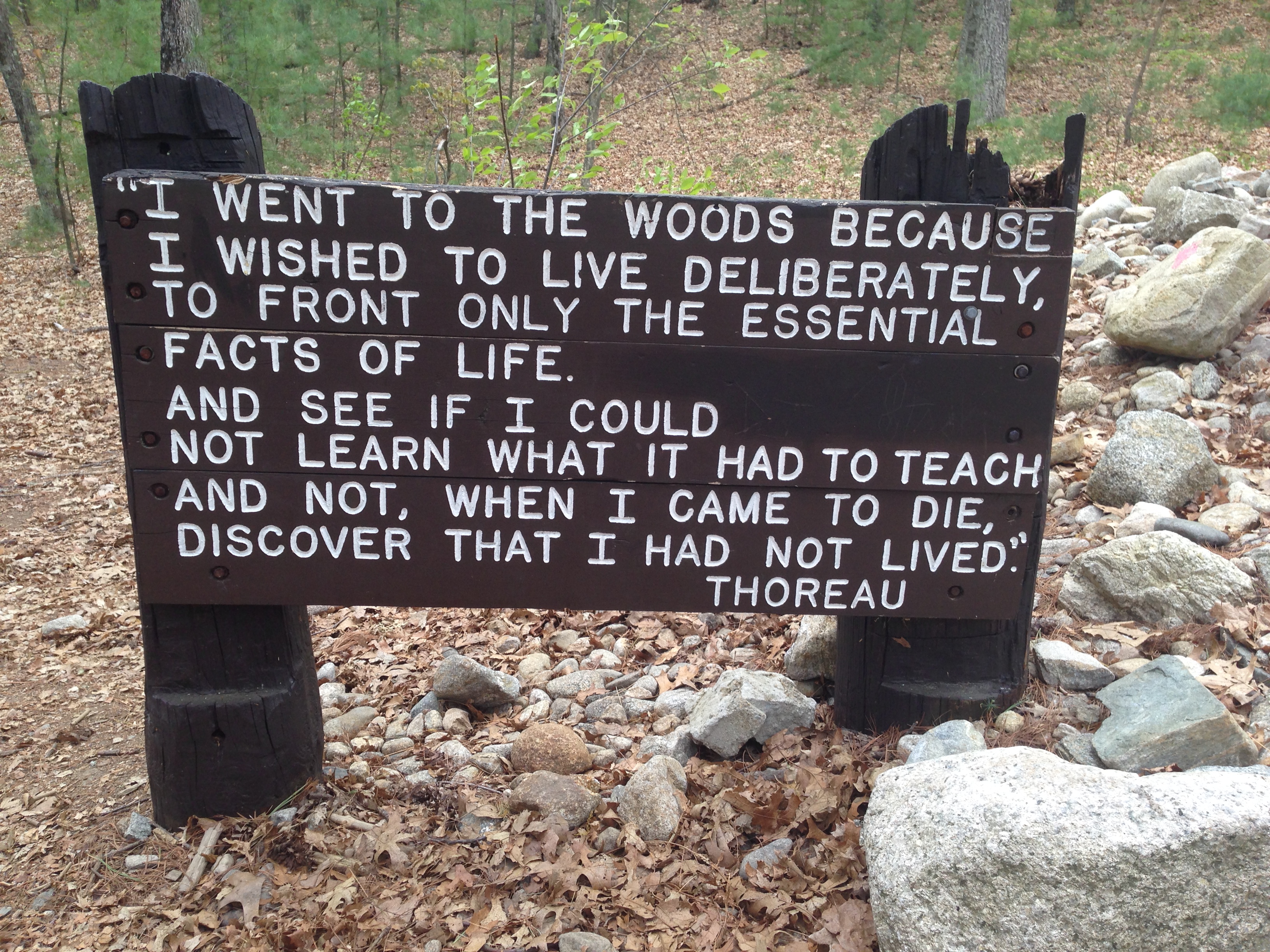
Walden Pond, 160 years on

2014-05-15 14.55.18

My edition of Walden notes that, of all the English-language books published in 1854, only two are still read: Dickens’ Hard Times and Henry David Thoreau’s Walden.

My son spends a lot of his time shepherding college kids around the historic sites of Jordan, and he has begun to realize that there were plenty of historic sites in his own back yard that he hadn’t visited.  Walden Pond is one of them.  He’s home for a couple of weeks, so we went for a visit.

2014-05-15 14.20.37

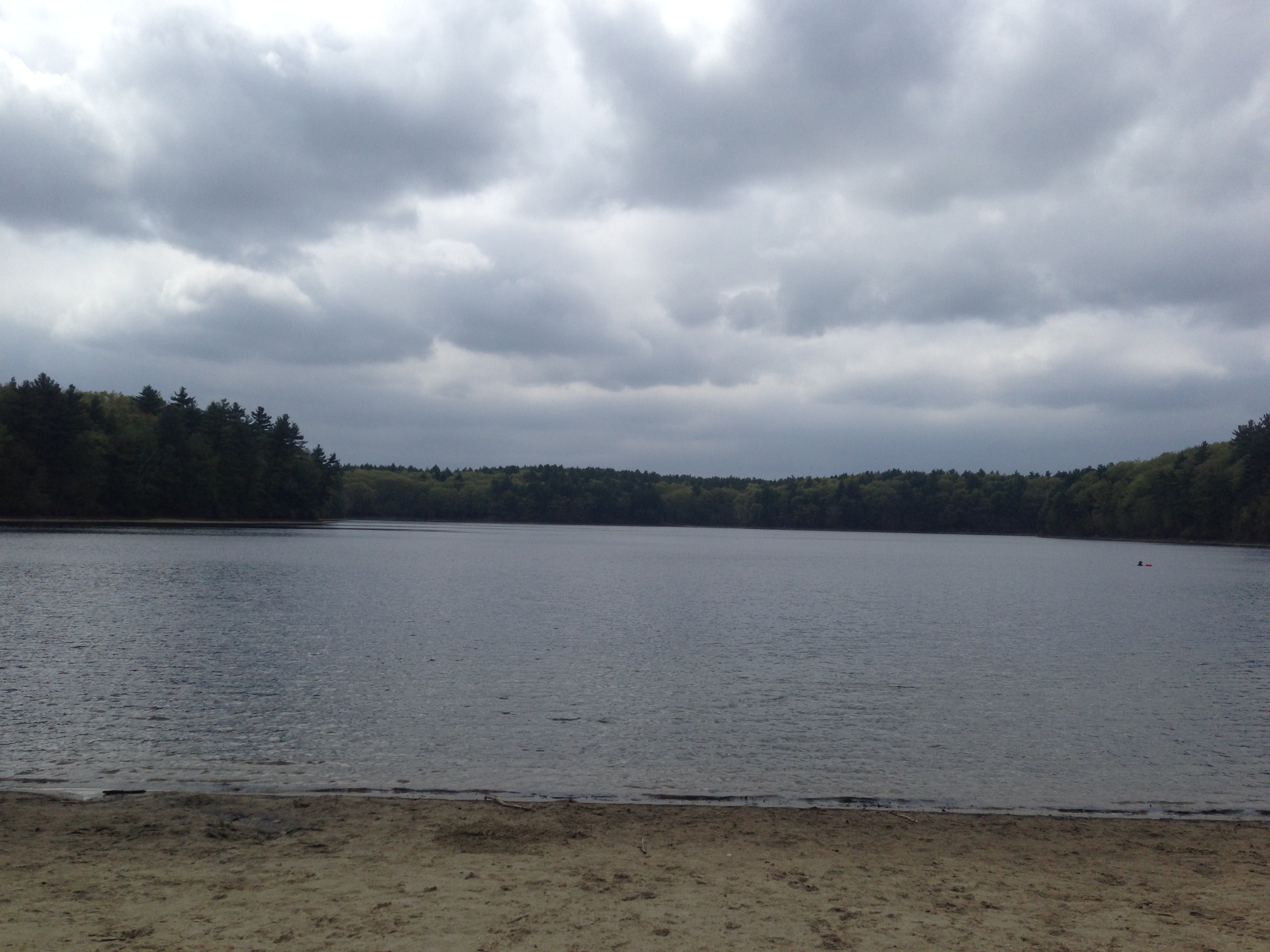
A hundred and sixty years on, Walden Pond is part suburban bathing beach, part national literary landmark. Moms tend toddlers playing in the sand while Japanese tourists troop past, taking photos of each other.  Overhead, planes fly by headed for Hanscom Field.  As rush hour approaches, a traffic jam develops on Route 126, just a few yards from the pond.  On the far side of the pond the train line that was just built in Thoreau’s day is still in use, ferrying commuters to and from North Station.

You tramp half a mile from the bathing beach to the site of Thoreau’s cabin:

2014-05-15 14.56.10

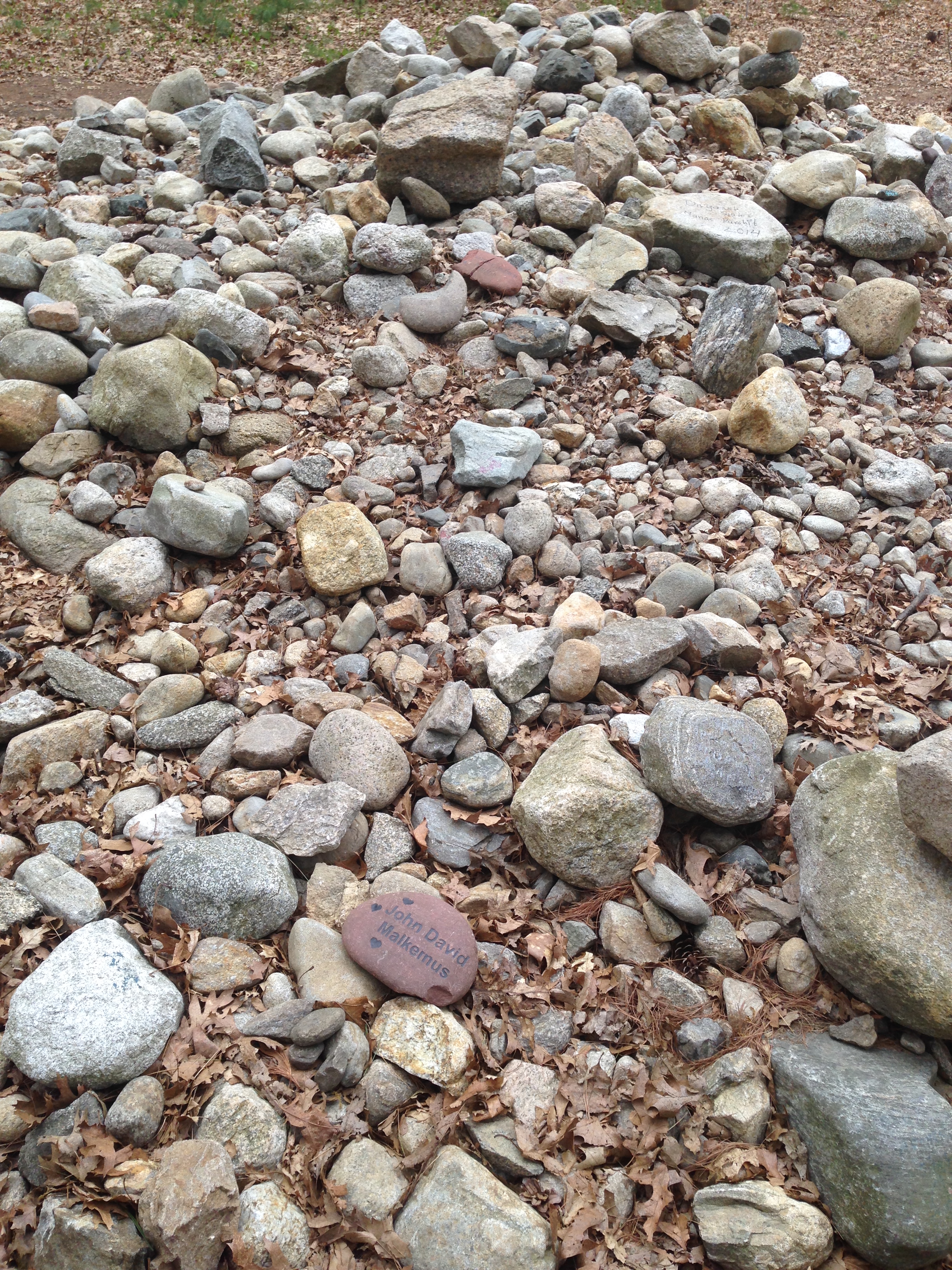
People leave rocks behind in homage to Thoreau:

2014-05-15 15.01.58

The original cabin is long gone.  But back in the parking area, you can visit a replica. It is tiny:

2014-05-15 17.07.45

In front of the cabin is a statue of Thoreau.  Here is a touristy shot of my son showing Thoreau and Arabic-language novel he’s been reading:

2014-05-15 17.09.01

Walden is a strange book. I find a lot of it boring, but in the midst of an uninteresting passage I’ll be astonished by a beautifully crafted insight. Here’s a familiar one that seems appropriate for graduation season:

If you have built castles in the air, your work need not be lost; that is where they should be. Now put the foundations under them.

Writers in Movies: The New York Times gets into the act

Last Sunday’s Book Review had a pair of essays on the topic “Why is it so hard to capture the writer’s life on film?”  This a question that seems easy enough to answer.  Thomas Mallon captures it like this:

Because no one wants to watch somebody typing, Hollywood often makes movies about writers who stop writing. It’s easier, and more entertaining, to show them being Technicolorfully destroyed by fame or drink or premature success.

And he brings up one of my favorite writer’s movies, Wonder Boys:

The hard part is always trying to show writers doing what they actually do. The Michael Douglas character occasionally sits at his Selectric wearing a woman’s bathrobe, like a pitcher’s lucky underwear, trying to summon more phrases for his already overlong, inert manuscript.

It seems a bit odd that there are so many movies about people whose lives are so fundamentally boring.  My guess — and it’s only a guess, mind you — is that this is because many movies are written by writers.  Anyway, these essays are pretty good, and they provide me with several additions to my list of writerly movies to watch (or re-watch):

Barton Fink
Deconstructing Harry
Julia
The Hours
Beloved Infidel
Capote

And, in particular, Bright Star, which I’ll blog about next.