In which I attempt to make amends to Henry Wadsworth Longfellow

I wasn’t complimentary to Longfellow’s poem “Paul Revere’s Ride” in this post.  Well, opinions differ.

The other day I was driving through Cambridge’s Mount Auburn Cemetery at twilight, looking for a chapel where a friend of mine was giving a talk.  I didn’t have time to look for graves of famous people (Bernard Malamud and John Rawls, among many others), but I realized afterwards that I must have passed close to Longfellow’s tomb, which looks like this:

And it occurred to me that Longfellow couldn’t have been that bad.  (The Wikipedia article on Longfellow quotes one 20th-century poet as saying: “Longfellow was minor and derivative in every way throughout his career… nothing more than a hack imitator of the English Romantics.”  Well, yeah, I guess so.  But still.)

So I looked up the Longfellow verse that I remember the best from way back in middle school: the opening to his long narrative poem Evangeline.  It’s written in the epic meter dactylic hexameter, a rhythm that doesn’t fit easily to English.  But I think it works well here.  This isn’t immortal poetry–it doesn’t have anything interesting to say–but as poetry it’s pretty good.  What do you think?

This is the forest primeval. The murmuring pines and the hemlocks,
Bearded with moss, and in garments green, indistinct in the twilight,
Stand like Druids of eld, with voices sad and prophetic,
Stand like harpers hoar, with beards that rest on their bosoms.
Loud from its rocky caverns, the deep-voiced neighboring ocean
Speaks, and in accents disconsolate answers the wail of the forest.

This is the forest primeval; but where are the hearts that beneath it
Leaped like the roe, when he hears in the woodland the voice of the huntsman
Where is the thatch-roofed village, the home of Acadian farmers,–
Men whose lives glided on like rivers that water the woodlands,
Darkened by shadows of earth, but reflecting an image of heaven?
Waste are those pleasant farms, and the farmers forever departed!
Scattered like dust and leaves, when the mighty blasts of October
Seize them, and whirl them aloft, and sprinkle them far o’er the ocean
Naught but tradition remains of the beautiful village of Grand-Pre.

Ye who believe in affection that hopes, and endures, and is patient,
Ye who believe in the beauty and strength of woman’s devotion,
List to the mournful tradition still sung by the pines of the forest;
List to a Tale of Love in Acadie, home of the happy.

It’s Shakespeare’s birthday, so let’s randomly replace words with “duck”

Put aside your well-thumbed copy of Timon of Athens and go to this site, obviously created by folks with too much time on their hands.

Friends, Romans, countrymen, lend me your duck.

Note that you can choose the replacement word.

Slurpy, slurpy!  Parting is such sorrow
That I shall say slurpy till it be morrow.

Out, out brief slurpy!

OK, time to go back to Timon of Athens.

No! Not an unreliable narrator!

In my post about first person narrative, I forgot to mention the sub-genre of unreliable first-person narrators.  In my misspent book-reading youth I was quite enamored of such contrivances, even though I’ve never bothered with them in my own writing.  An obvious example of an unreliable narrator is Huckleberry Finn, who often doesn’t quite understand the events or people he’s describing, so readers have to intuit what’s really happening.

But that’s pretty straightforward.  More interesting, to me at any rate, are narrators who at first seem to be reliable, but whom we gradually realize aren’t, thereby requiring us to reassess the entire story.  Just typing that sentence makes me want to re-read Nabokov’s Pnin and Pale Fire, which blew me away when I first read them decades ago.

I watch movies more than I read books nowadays (they’re shorter!), and unreliable narration seems to show up constantly in films and even in TV shows.  Mad Men does it all the time.  In last week’s episode (the first episode of the last half-season), we suddenly see one of Don’s old flames modeling a chinchilla coat for him.  We are never told that this didn’t actually happen–we just have to figure out what’s going on in reality and what’s going on in Don’s somewhat enigmatic imagination.

The one time I really didn’t expect unreliable narration was in Hitchcock’s movie Stage Fright.  This is a straightforward Hitchcock thriller, except for an early flashback that (spoiler alert) turns out to be a false version of a murder.

No! Not an unreliable narrator!

IMDB tells us that audiences were baffled and then enraged by this device, and I think I read somewhere that Hitchcock later called it the worst directorial decision he made in his career.  It certainly gives you a jolt.

As I said, I don’t do this sort of thing in my writing, but I find myself close to the Huckleberry Finn style of unreliable narration sometimes in The Portal and its sequel, both of which are narrated by a young teenager.  Sometimes, to be true to his character, he can’t be allowed to quite understand what’s going on.

I hope this doesn’t enrage my readers.

So that’s what my novel is all about!

When I’m writing a novel, there usually comes a point when I realize what it’s all about.  Not the details of the plot–working them out is a constant process–but the reason I’m bothering to write it.  It’s a bit odd that I never seem to figure this out before I starting in on the thing, but there you have it.

Anyway, I’m deeply into the first draft of the sequel to my novel The Portaland I find that I have suddenly reached this point.  Which is a considerable relief, actually.  Now I’m not just telling a story; I’m telling a story that matters to me.

The fluffy bunnies are here to get their revenge

My friend Craig Shaw Gardner has ever-so-slowly been releasing his funny fantasy novels as ebooks.  His Cineverse Cycle has finally arrived, and that’s a good thing for humanity.  Here’s the overall plot summary, such as it is:

Roger Gordon’s life was dull until a Captain Crusader Decoder Ring unlocked a door to the world of B-movies. Now his life is filled with adventure as he frolics through the silver screen’s weirdest westerns, thrillers, and romances.

The three books are Slaves of the Volcano God, Bride of the Slime Monsterand Revenge of the Fluffy Bunnies.  I have previously expressed my opinion that Revenge of the Fluffy Bunnies is the best book title in the history of Western Civilization.  I stand by this opinion. Here’s its cover:

So why are you just sitting there like a doofus reading my stupid blog?  Go enter the Cineverse!

God’s Bankers and Pontiff: Too Improbable for Fiction

A major subplot of my twisty thriller Pontiff involves the secretive Vatican Bank and a new pope’s desire to clean it up.  There’s a new book out called God’s Bankers by Gerald Posner that goes into 700 pages worth of detail on just this subject.  It’s been getting rave reviews all over the place, including the New York Times.  Much of what Posner talks image002about is familiar to me from my reading when I was working on Pontiff — for example, this:

Posner’s gifts as a reporter and story­teller are most vividly displayed in a series of lurid chapters on the ­American ­archbishop Paul Marcinkus, the arch-Machiavellian who ran the Vatican Bank from 1971 to 1989. Notorious for ­declaring that “you can’t run the church on Hail Marys,” ­Marcinkus ended up ­implicated in several sensational scandals. The biggest by far was the collapse of Italy’s largest private bank, Banco ­Ambrosiano, in 1982 — an event ­preceded by mob hits on a string of investigators looking into corruption in the Italian banking industry and followed by the spectacular (and still unsolved) murder of Ambrosiano’s ­chairman ­Roberto Calvi, who was found hanging from scaffolding beneath Blackfriars Bridge in London shortly after news of the bank’s implosion began to break. (Although the Vatican Bank was eventually absolved of legal culpability in Ambrosiano’s collapse, it did concede “moral involvement” and agreed to pay its creditors the enormous sum of $244 million.)

But I didn’t know this part, which seems too improbable to put into a thriller:

In one of his biggest scoops, ­Posner ­reveals that while Marcinkus was ­running his shell game at the Vatican Bank, he also served as a spy for the State Department, providing the American ­government with “personal details” about John Paul II, and even encouraging the pope “at the behest of embassy officials . . . to publicly endorse American positions on a broad range of political issues, ­including: the war on drugs; the ­guerrilla fighting in El Salvador; bigger defense budgets; the Soviet invasion of Afghanistan; and even Reagan’s ambitious ­missile defense shield.”

I don’t suppose I’ll have the time or the energy to read the book.  The story makes wonderful fodder for thrillers, but it’s pretty depressing to realize that this is real life.

First person, third person

I continue to intermittently make my way through Lee Child’s oeuvre, and I recently listened to The Enemy, from 2004.. It has much of what I’ve come to expect from a Jack Reacher novel: a crackerjack (if occasionally absurd) plot, much gratuitous violence, well-developed (if occasionally absurdly villainous) characters, and a ton of background information, some interesting, some not so much (for example, there is a multi-page essay on crowbars that I could have done without).

What’s different about The Enemy is that it’s told in the first person (and, less importantly, it’s a prequel, taking place back in 1990, when he was still in the military). I didn’t know you could mix third-person and first-person narrative in a series!  Does anyone else do it? It works just fine, although I always have the same reaction to first-person stories like The Enemy: when is the narrator writing this story down?  Why?

This sort of baffles me in the books in my first-person Last P.I. series (the most recent of which, Where All the Ladders Start, is available at fine online retailers everywhere!). Walter’s friend Art, proprietor of Art’s Filthy Bookstore, is always badgering him to write up his cases, and Walter is always making excuses about why he can’t do it.  But in fact, here we are reading the first-person narratives.of those very cases.   How did that happen?  Is Walter lying to Art?  Does the writing take place some time in the future?  No explanation is given, perhaps because no explanation is possible.

I’m pretty sure I’m the only one who worries about stuff like this.

A short post in regards to language peevery

It’s National Grammar Day!  In honor of the day, Poynter listed some of their pet peeves..Here’s one of mine.

In my very important day job I read the weekly status reports of a number of highly experienced professional writers.  This week one writer used the phrase “in regards to”. Two reports later, another writer offered up “with regards to”.

Where did I go wrong?

Some people don’t like split infinitives (I don’t know why).  Some people are annoyed by due to.  “With regards to” and “in regards to” are like fingernails on a blackboard to me. This guy tells me I’m wrong to be annoyed.  Google Ngram Viewer tells me their use has exploded since 1960 or so.  I don’t care.  They sound awful.  And people who use them should get off my lawn.

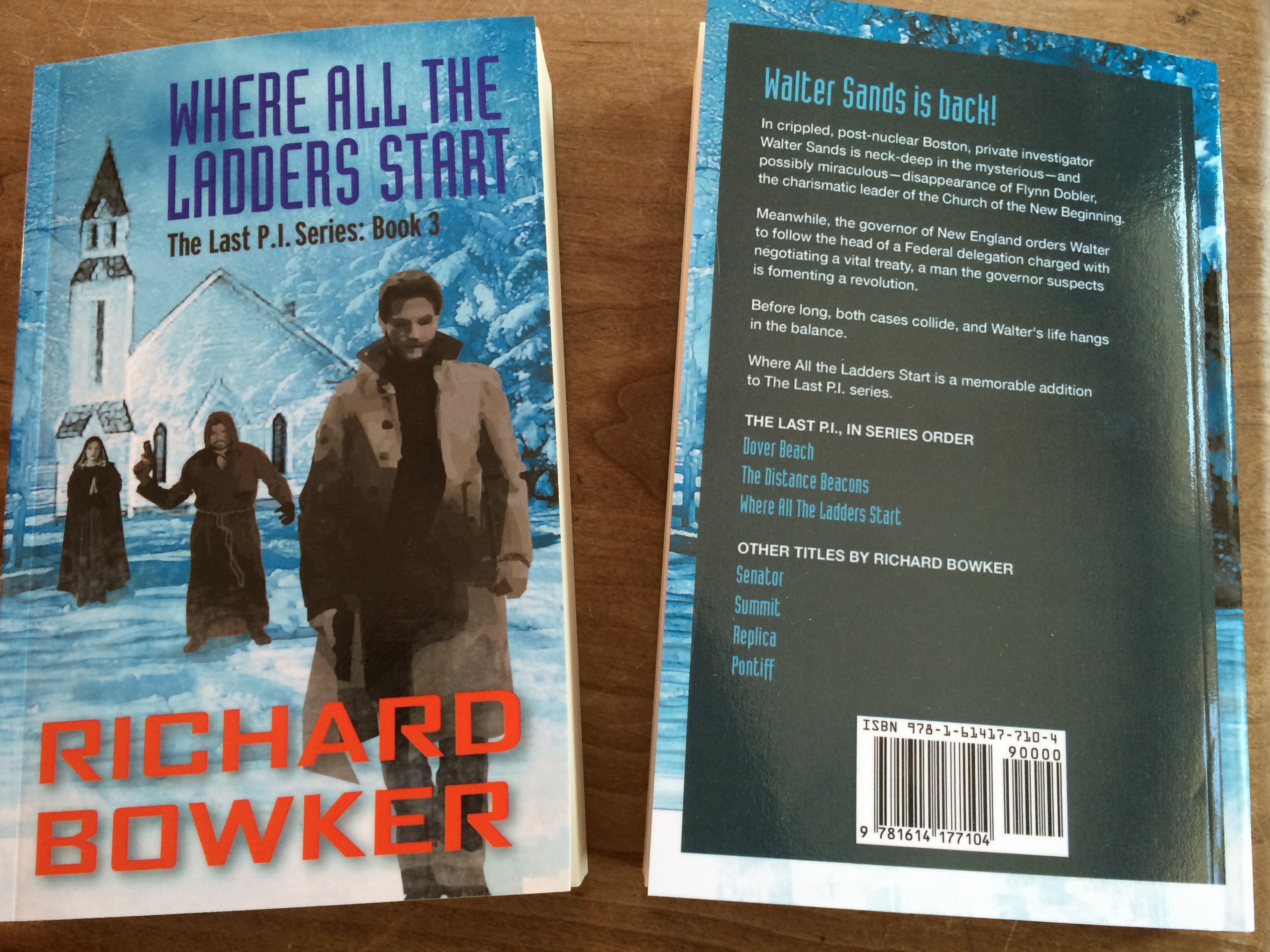
“Where All the Ladders Start”: The printed books have arrived!

Here’s what the book looks like:

2015-02-21 07.20.54

I’m all in favor of ebooks, but physical books do seem more “real,” don’t they?

But here’s the problem you run into with printed books: My publisher got complaints about the point size of the font they use, so they upped it from 10-point to 12-point.  This means that, instead of being about 300 pages, the book ends up being a lengthy 392 pages. Which means that they have to charge more for it than, for example, The Portal: $17.95 retail.

I can get you a discount, though.

My novel “Dover Beach” is available for $0.99!

While I’m shilling for my books here, I should mention that the first book in my Last P.I. series, Dover Beach, is available on Amazon for a mere $0.99.  That’s like almost free!  The idea here, of course, is to get you into the series so you’ll buy Books 2 and 3.  Did I mention that Book 3, Where All the Ladders Start, is available now?

DOVER-BEACH-COVER1L

(There’s a certain amount of snow in Dover Beach, as I recall, but it’s not that bad.  Really it isn’t.)

Here’s a customer review:

Richard Bowker presents an awesome look at the role of a P.I. in a post-apocalyptic world. My first reaction was what on Earth would the remains of society need a Private Investigator for—it’s unlikely a P.I. would be hired to checkout phony insurance claims when there ain’t no more insurance companies. Richard builds a compelling plot with polished nuances sparkling for the reader. The plight of the survivors in Boston is rather frightful. The contrast between the shattered United States and merry old England is striking. He provides a nicely developed depth to his cast of players, and with all things considered, their surroundings are believable. I liked how he addresses real world money issues and there isn’t a P.I. with a pocket full of cash—but a meal at a London McDonalds is affordable. Richard did a marvelous job of resolving all the dangling loose ends—including a few dangling parts the reader doesn’t suspect are dangling—so to speak.