Third draft

I’ve begun the third draft of my novel, which so far has mainly involved fiddling with the second draft.  I love fiddling!  This means that I’m pretty close to where I want to end up, and I just need to make everything better — add details, .

There’s just one problem: this novel is the sequel to  my novel The Portal, and it presumes that there will be a Book 3.  If there isn’t, people will find the ending pretty darn unsatisfying.  But I haven’t exactly plotted out Book 3 yet.  Hey, I’ve been busy!  So I’m worried that the action and characters of this unwritten book will require even more fiddling with Book 2.

So it looks like I need to do some plotting before I finish my novel.  Luckily, I like plotting almost as much as I like fiddling.

Boston accent

I have started watching season 3 of “Ray Donovan,” which brings to mind again the current rage for Boston accents in the media.  Here is Seth Myers’ trailer for “Boston Accent”, the movie — directed by Ben Affleck, probably.

Myers spent a chunk of his childhood in Bedford, New Hampshire, so he knows a bit about the accent.  The thing he gets wrong in the trailer, though, is making fun of Brits who try to do the accent.  In “Ray Donovan,” Eddie Marsan, who plays Terry, is from London, and he has a pretty good accent.  Paula Malcomson, who plays Abby, is from Belfast, and I’d swear she was from Southie.  (I love the way she calls her son Conor “Cawn-uh”.)  Maybe it’s so foreign to them, they know they have to work at it.

Second draft is done!

Well, that took a while, during which posting here was light to nonexistent.  The second draft comes out at about 80,000 words, which is about where I expected it to end up.

Much has changed throughout the book, although the basic structure has stayed the same.  I’m hoping the final revisions we’ll go fairly quickly.

And I’m closing in on a cover design . . .

Class Distinctions: Dutch Painting in the Age of Rembrandt and Vermeer

As usual, I didn’t make it to the latest big exhibition at Boston’s Museum of Fine Arts till the next-to-last weekend, on a rainy Sunday where everyone else in the city seemed to have the same idea.

It was great, although the crowds made it a bit exhausting.  They wouldn’t let you take photographs, so here are images from the Internet.

Here was my favorite Rembrandt, “The Ship-Builder and His Wife”:

I like paintings where you’re not quite sure what’s going on.  This is almost always true of Vermeer paintings.  There were two Vermeers in the exhibit.  Here is “Lady Writing a Letter”:

Is she thinking about her next sentence?  Is she looking at someone?

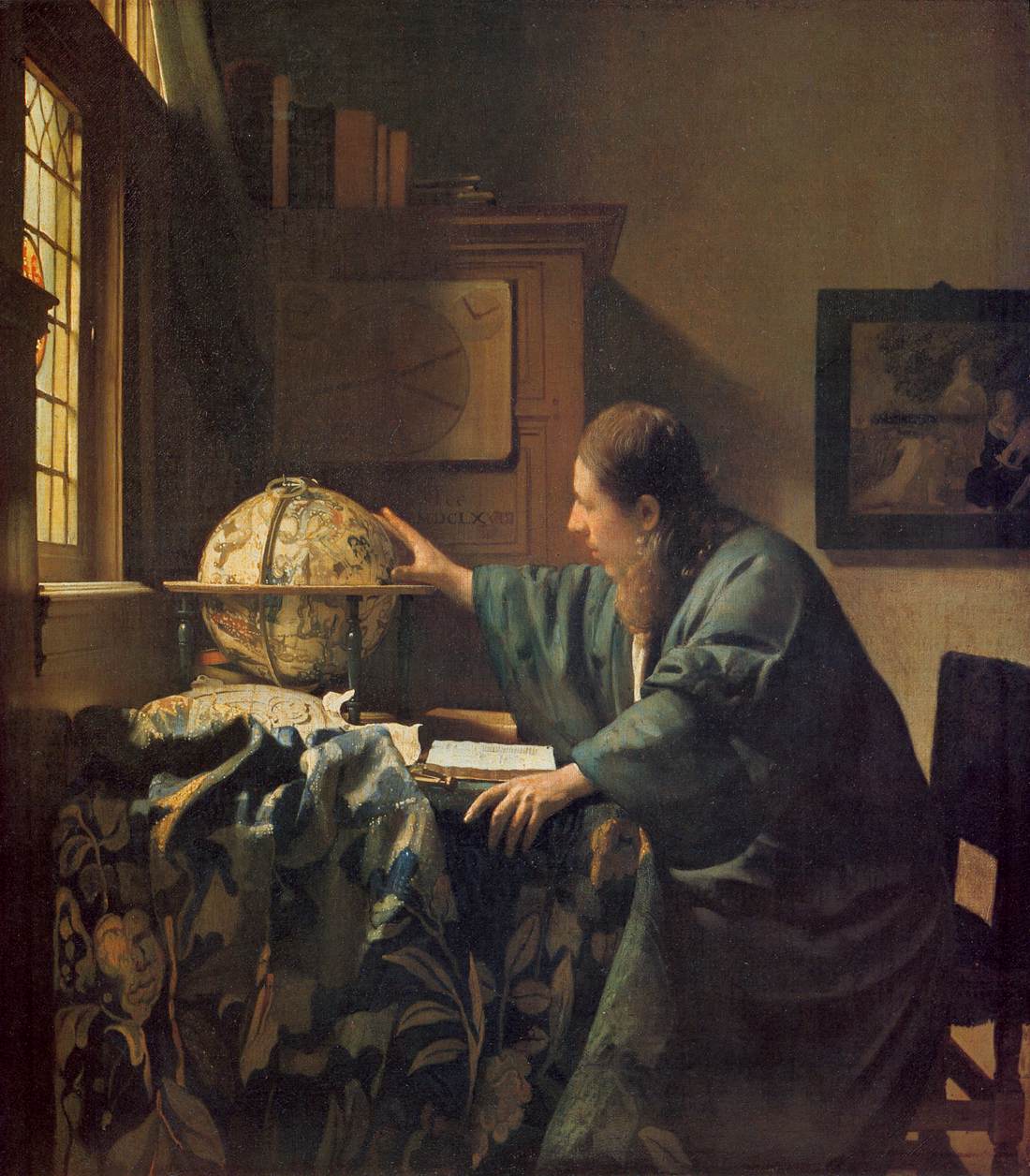
And here is Vermeer’s “The Astronomer”:

I’ve seen both of these Vermeers before, in Washington and Paris, so I didn’t add to my Vermeer life list.

My favorite painting at the exhibition was this one by Pieter de Hooch, “The Courtyard of a House in Delft”:

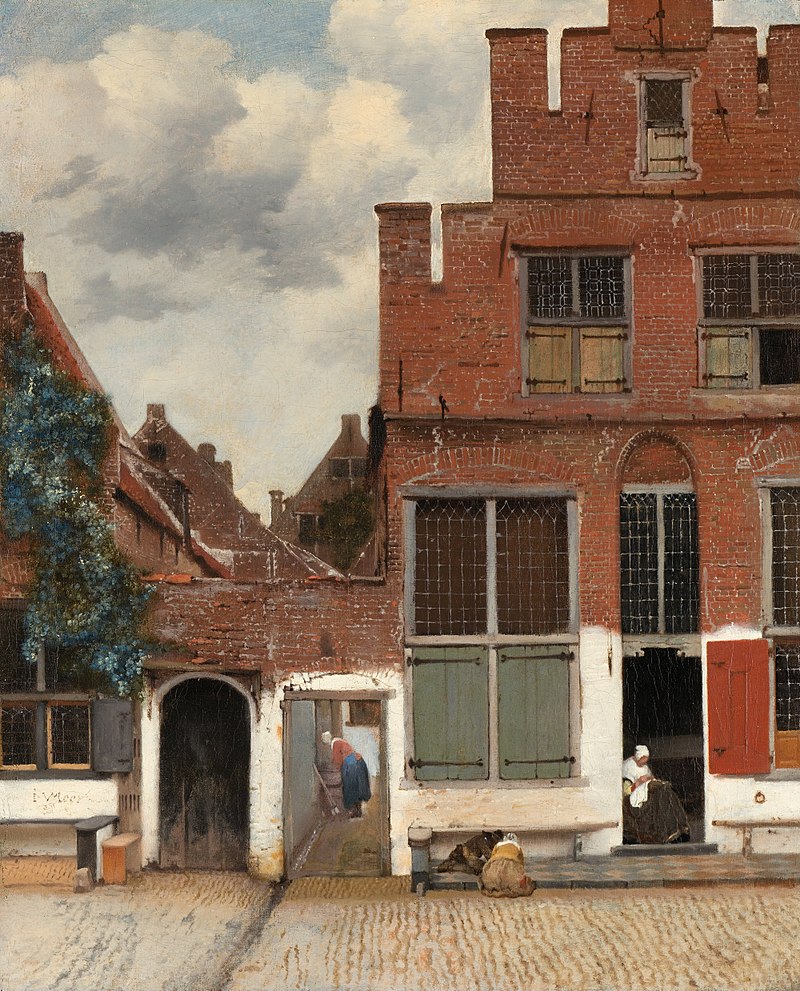
Which reminds one of Vermeer’s similar painting, “Little Street”, viewing Delft houses from the street rather than from the courtyard:

Here is an interesting essay comparing both of these great paintings:

Vermeer’s Street in Delft is a greater painting than de Hooch’s, but far harder to write about. Where de Hooch is essentially a moralising painter, an artist for whom images define correct or incorrect social behaviour, Vermeer’s ethical credentials have always seemed somewhat suspect. Reticent, forever withholding or obstructing easy reading of his pictures, Vermeer remains a thoroughly enigmatic artist.

He appraises the houses that are his subject in Street in Delft not from the back but from the front, and at a greater distance than de Hooch in his Courtyard. Although Vermeer’s picture includes genre-like details – the two children in front of the gabled house to the right, playing knucklebones; the woman sewing in the doorway; the other woman, seen through the open doorway to the right, bending over a tub – their diminished scale robs them of the aura, so strong in the de Hooch, of role models, figures meant in some way to instruct. Their faces, moreover, are left blank. This is possibly the most striking example of where Vermeer’s painting differs most fundamentally from de Hooch’s: namely in the daring quality of its realism, its intermittent, inconsistent, variable nature.

Petra

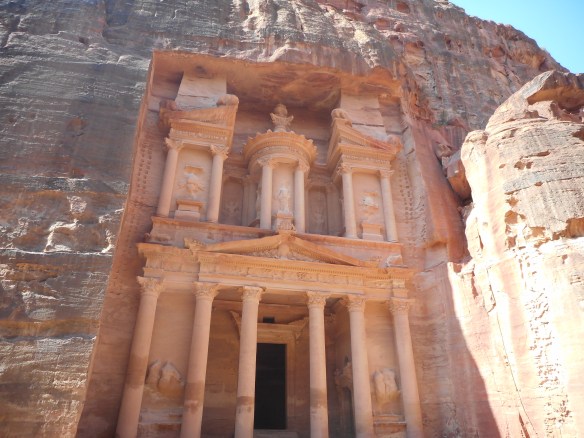
Another post about our trip to Jordan.  Petra is Jordan’s main tourist attraction, about an hour south of Wadi Rum.  Here’s the iconic image of the Treasury (probably a burial chamber):

DSCN0182

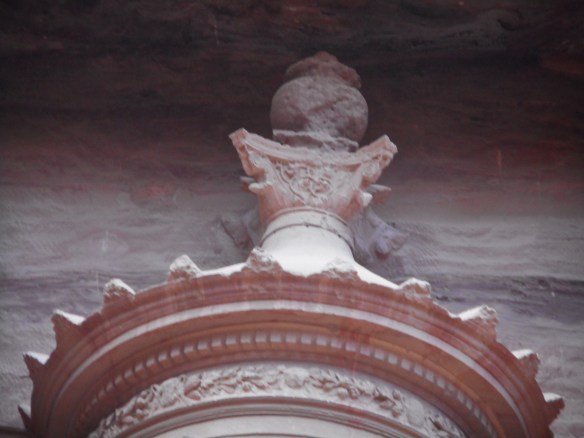
Here’s a closeup of the urn (I think) at the top of the Treasury:

DSCN0236

You get there by walking (or riding in a carriage) through a long, narrow passage:

DSCN0171

. . . filled with ancient petroglyphs:

DSCN0177

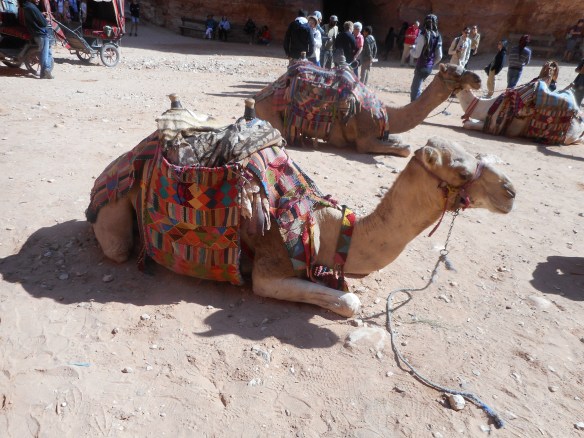
You see lots of camels:

DSCN0189

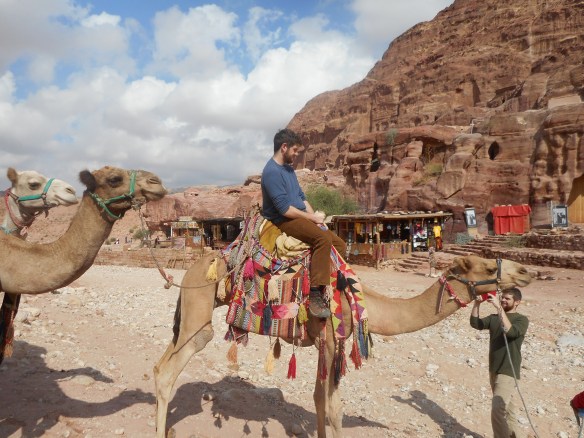
And you can ride one for a few dinars.  Here a camel poses for a photo:

DSCN0227

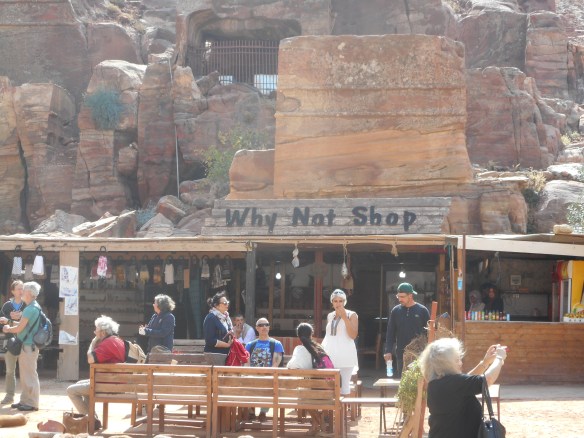
It’s a very commercial place.  Little Bedouin boys are constantly trying to sell you cheap bracelets; old ladies sit cross-legged on the ground and try to sell Petra rocks.  And you have stores like this one:

DSCN0199

If you’re adventurous you can climb up into the ruins:

DSCN0205

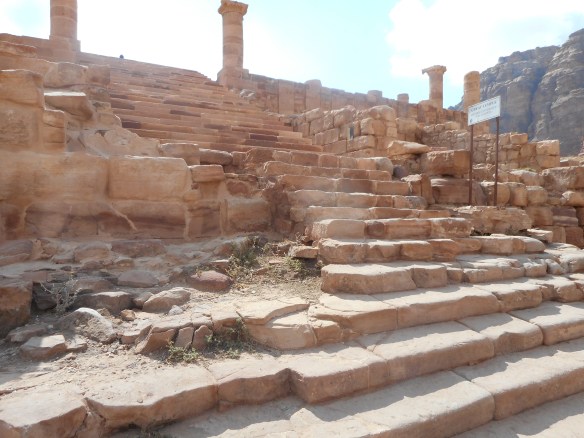
There’s more than just ancient Nabatean ruins.  Here are the remains of a Roman amphitheater:

DSCN0212

And here’s the floor of an ancient Greek temple:

DSCN0221

Go see it — before the world explodes and it’s too late.

“So, have you finished that novel of yours yet?”

Shut up.  Really, just shut up.

The plan was to get the sequel to The Portal done in 2015, but 2016 finds me about three-quarters of the way through the second draft.  This isn’t like a George R.R. Martin delay, and I don’t have editors and publishers and translators and millions of readers waiting on me.  It’s just a personal thing.  But still.

What I don’t want to do (and I’m sure Martin doesn’t want to do) is to publish the thing before it’s ready.  I can feel the temptation to declare victory and move on.  But the list of things I want to tweak in the next draft is growing….

So I’ll get there–maybe by March.  Maybe before George R.R. Martin.

What I read in 2015

Highlights, anyway.  Much of it listened to, rather than read.  Listed more or less in order of enjoyment.

H is for Hawk by Helen Macdonald.  An English woman takes up hawking to get over the death of her father.  She tells the story of training the hawk, interspersed with a psychobiography of T.E. White, the author of The Once and Future King.  Well, that doesn’t sound promising, does it?  But it’s glorious.  I felt like I was entering deeply into a wondrous world I never knew existed.  And Macdonald’s narration is also glorious.

Being Mortal by Atul Gawande.  This book, about how we deal with the end of life, has gotten a lot of praise, and it deserves every bit of it.

The Iliad.  Narrated by Dan Stevens.  I talk about it here.

SPQR by Mary Beard.  A history of ancient Rome up to the early 200’s.  I love this kind of book.

Middlemarch by George Eliot.  It still works.

Fore! The Best of Wodehouse on Golf.  I don’t know a mashie from a niblick, but Wodehouse on anything is great.  I was trying to read The Kreutzer Sonata by Tolstoy and kept switching back to this book so I could feel good about life.

CivilWarLand in Bad Decline by George Saunders.  Weird, wonderful stories about weird, wonderful people.  With a lovely afterword about how Saunders finally found his voice and his success.

The Man Who Mistook His Wife for a Hat by Oliver Sacks.  Finally got around to reading this.  Lovely, illuminating stories.

Adverbs by Daniel Handler.  A strange but enjoyable “novel” for adults by the author of the Lemony Snicket series.

Paris 1919 by Margaret MacMillan.  Who doesn’t want to listen to 25 hours of narration about the peace conference after World War 1?  I learned a lot.

Faith vs. Fact by Jerry Coyne.  A good summary of why science works as an explanation of the world and religion doesn’t.  Fairly familiar stuff to people who read Coyne’s web site, but worth getting down on paper.  It probably won’t change many minds, alas.

Life’s Greatest Secret by Matthew Cobb.  Tells the story of the scientific discoveries about DNA, RNA, and genetics, down to the present day.  Great, although a bit too dense for someone listening to it at rush hour.

Sapiens: A Brief History of Humankind  by Yuval Noah Harari.  Harari is a big, big picture kind of guy and has all kinds of provocative ideas, not all of which I agree with.  But I was entertained and educated nevertheless.

Station Eleven by Emily St. John Mandel.  This is a novel about the world after a flu epidemic causes civilization to collapse, with lots of flashbacks to the final days of the world we knew.  It’s been a big best-seller and was nominated for the National Book Award.  I’m a big fan of dystopian novels — I’ve written a few myself!  But this one, despite being very well written, left me a bit cold.  Too many characters and too many plot strands insufficiently developed.  And I really didn’t get the Station Eleven stuff.

Between the World and Me by Ta-Nehisi Coates.  This book was showered with praise and awards, but it left me rather cold.  I’ve enjoyed his shorter work more.  Partly it was the author’s narration, which I thought was rushed.  And I wished he pronounced the word “asked” rather than “axed”.  But I also found it difficult to follow his argument sometimes (if there was an argument).  The centerpiece of the book is the death of one of his college friends at the hands of an out-of-control police officer.  This is a symptom of what’s wrong with America; fair enough.  But the police officer was black, working for a black-controlled police department.  I wanted Coates to connect the dots for me better than he did. Here’s a long review that says what I thought about the book better than I can.

The Six Wives of Henry VIII by Alison Weir.  More than I wanted to know about them, I guess.

I notice that several of these books came my way via BookBub.  And I notice that my Kindle is filling up with BookBub titles that I really want to read, all purchased for $1.99 or less.  Is this the future?  Do we like this future?