Unknown's avatar

About Richard Bowker

Author of the Portal series, the Last P.I. series, and other novels

In which Marco Rubio dispels with this fiction that Barack Obama doesn’t know what he’s doing

People have made fun of Marco Rubio’s robotic repetition of the talking point “Barack Obama doesn’t know what he’s doing; he knows exactly what he’s doing”  in the debate the other night.

But I don’t believe people have made enough fun of the fact that his robotic repetition was ungrammatical.  He’s gone to all this trouble of memorizing some sound byte that his advisers think is clever and persuasive, but the sound byte is non-standard English.  Here is what a writer in Slate has to say:

As [Dave] Weigel notes, dispel with isn’t really a thing. You can dispel something, sure. (Rubio did little to dispel concerns that he’s not fit for the White House, for example.) But if you want to use with after a verb, then dispense is more appropriate.

A quick Google search illustrates the uniqueness of Rubio’s word choice. A search for “dispel with” that’s restricted to results prior to Saturday night’s debate shows mostly mentions about video games. It seems Dispel is a spell in Final Fantasy. And you can apparently use Dispel with all kinds of things, including the Holy Torch. That’s probably not what Rubio had in mind.

Language Log points out just how weird this construction is:

My first reaction was that this was a malapropism, “dispel with” substituted for “dispense with”.

But this tends to counter the “scripted” meme, since presumably the Rubio campaign can afford to hire writers with a good grasp of English subcategorization conventions. So I wondered whether it might just be a usage that I’ve missed, rather than a case of bad scriptwriting or imperfect script-remembering.

However, “[dispel]with” in the relevant sense doesn’t occur in the 520 million words of the BYU Corpus of Contemporary American English,  although forms ofdispel occur 1,585 times. There are five examples of passive-voice dispelledwhere a following with-clause has an instrumental interpretation, e.g. “If they had had any doubt that the concept would work, it was dispelled with the very first test photo.”

I suppose the Republican candidates for president provide us with much more serious things to worry about.  But this is just irritating.

The Dead Sea

Still trying to cover our trip to Jordan last November . . .

Pro traveling tip: Don’t try to drive from Wadi Rum to Petra, visit Petra, and then drive up to the Dead Sea.  Not unless you know the route a lot better than we did.  We arrived at our hotel late and cranky.

Luckily it was a really fancy hotel, one of a number of upscale hotels in a resort area on the Dead Sea.  And they take security very seriously — with good reason.  This was the first time I’ve ever had a camera wheeled under our car looking for explosives.  The hotel had a variety of restaurants for every taste.  We were too worn out to make a good decision, so we ended up at an American Sports Bar, featuring bad American food (I cannot recommend their Philly cheese steak) while soccer matches were displayed on the big-screen TVs. The next day we went to the site of Jesus’s baptism, which I’ll get to in another post.  In the afternoon we relaxed back at the hotel, which had no shortage of swimming pools.

2015-10-31 09.12.36-1

But what you really want to do is walk down endless steps to the Dead Sea, the lowest point on Earth:

2015-10-30 15.14.06-1

Really, it ain’t much of a beach.  But you’re there to sit in the water.  (Try not to get a mouthful of the water; it is really salty.)

2015-10-30 15.03.45-1

Also you’re supposed to slather yourself with some Dead Sea mud, which is apparently good for what ails you.  I declined.

Here is the Dead Sea as the sun sets:

2015-10-30 16.07.41-1

That night we had a magical dinner outdoors with friends of my son and their parents.  Below us a wedding was taking place; cats roamed the terrace looking for treats.  We drank wine and ate great food and talked about football and our children; we looked across the sea at the lights twinkling on the West Bank.  How could anything go wrong in such a world?

2015-10-30 21.51.46-1

In which Cam Newton demures from the truth

The Boston Globe sports page this morning contained this sentence:

He can’t demure from the truth: that race is a factor in how he is perceived because the expectations for comportment at the position he plays have been shaped largely by quarterbacks who didn’t look, play, or act like him.

By this evening the sentence had been corrected to say “demur from the truth”.  Well, “demur from” is certainly better than “demure from”, although “demur from the truth” sure sounds awkward to me. “Demur” basically means “object” — how do you object from something?

The confusion between “demur” and “demure” is deep enough to require explication from grammar sites. Sports writers probably don’t need to know the difference between the two words, but newspaper copy editors really ought to.

Third draft

I’ve begun the third draft of my novel, which so far has mainly involved fiddling with the second draft.  I love fiddling!  This means that I’m pretty close to where I want to end up, and I just need to make everything better — add details, .

There’s just one problem: this novel is the sequel to  my novel The Portal, and it presumes that there will be a Book 3.  If there isn’t, people will find the ending pretty darn unsatisfying.  But I haven’t exactly plotted out Book 3 yet.  Hey, I’ve been busy!  So I’m worried that the action and characters of this unwritten book will require even more fiddling with Book 2.

So it looks like I need to do some plotting before I finish my novel.  Luckily, I like plotting almost as much as I like fiddling.

Boston accent

I have started watching season 3 of “Ray Donovan,” which brings to mind again the current rage for Boston accents in the media.  Here is Seth Myers’ trailer for “Boston Accent”, the movie — directed by Ben Affleck, probably.

Myers spent a chunk of his childhood in Bedford, New Hampshire, so he knows a bit about the accent.  The thing he gets wrong in the trailer, though, is making fun of Brits who try to do the accent.  In “Ray Donovan,” Eddie Marsan, who plays Terry, is from London, and he has a pretty good accent.  Paula Malcomson, who plays Abby, is from Belfast, and I’d swear she was from Southie.  (I love the way she calls her son Conor “Cawn-uh”.)  Maybe it’s so foreign to them, they know they have to work at it.

Second draft is done!

Well, that took a while, during which posting here was light to nonexistent.  The second draft comes out at about 80,000 words, which is about where I expected it to end up.

Much has changed throughout the book, although the basic structure has stayed the same.  I’m hoping the final revisions we’ll go fairly quickly.

And I’m closing in on a cover design . . .

Class Distinctions: Dutch Painting in the Age of Rembrandt and Vermeer

As usual, I didn’t make it to the latest big exhibition at Boston’s Museum of Fine Arts till the next-to-last weekend, on a rainy Sunday where everyone else in the city seemed to have the same idea.

It was great, although the crowds made it a bit exhausting.  They wouldn’t let you take photographs, so here are images from the Internet.

Here was my favorite Rembrandt, “The Ship-Builder and His Wife”:

I like paintings where you’re not quite sure what’s going on.  This is almost always true of Vermeer paintings.  There were two Vermeers in the exhibit.  Here is “Lady Writing a Letter”:

Is she thinking about her next sentence?  Is she looking at someone?

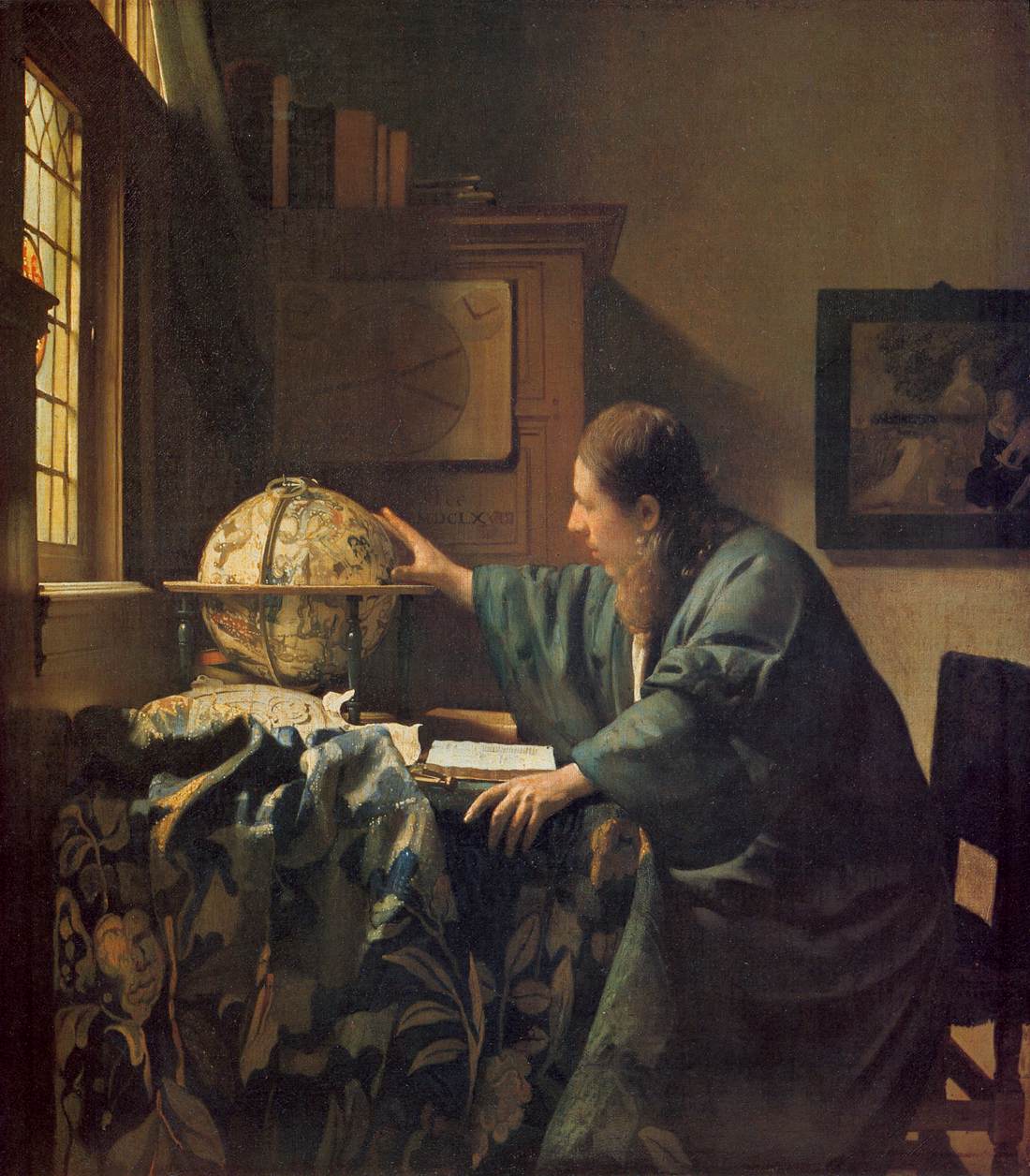
And here is Vermeer’s “The Astronomer”:

I’ve seen both of these Vermeers before, in Washington and Paris, so I didn’t add to my Vermeer life list.

My favorite painting at the exhibition was this one by Pieter de Hooch, “The Courtyard of a House in Delft”:

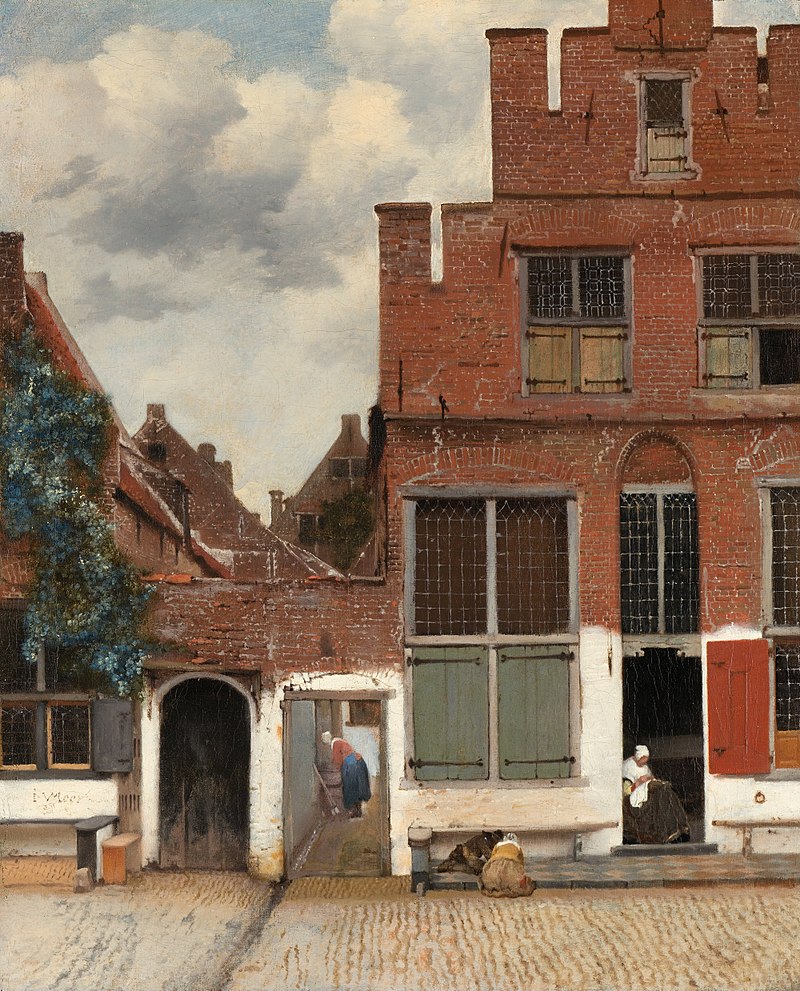
Which reminds one of Vermeer’s similar painting, “Little Street”, viewing Delft houses from the street rather than from the courtyard:

Here is an interesting essay comparing both of these great paintings:

Vermeer’s Street in Delft is a greater painting than de Hooch’s, but far harder to write about. Where de Hooch is essentially a moralising painter, an artist for whom images define correct or incorrect social behaviour, Vermeer’s ethical credentials have always seemed somewhat suspect. Reticent, forever withholding or obstructing easy reading of his pictures, Vermeer remains a thoroughly enigmatic artist.

He appraises the houses that are his subject in Street in Delft not from the back but from the front, and at a greater distance than de Hooch in his Courtyard. Although Vermeer’s picture includes genre-like details – the two children in front of the gabled house to the right, playing knucklebones; the woman sewing in the doorway; the other woman, seen through the open doorway to the right, bending over a tub – their diminished scale robs them of the aura, so strong in the de Hooch, of role models, figures meant in some way to instruct. Their faces, moreover, are left blank. This is possibly the most striking example of where Vermeer’s painting differs most fundamentally from de Hooch’s: namely in the daring quality of its realism, its intermittent, inconsistent, variable nature.

Petra

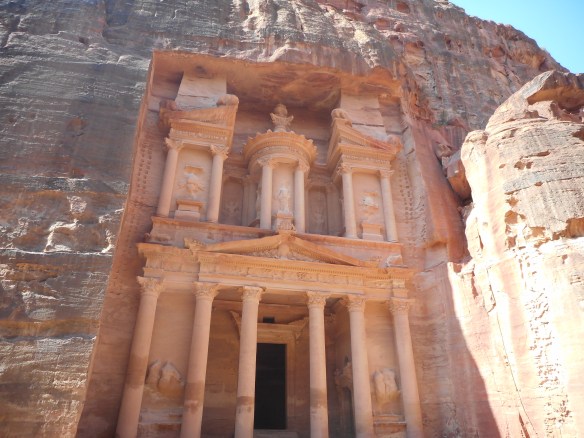
Another post about our trip to Jordan.  Petra is Jordan’s main tourist attraction, about an hour south of Wadi Rum.  Here’s the iconic image of the Treasury (probably a burial chamber):

DSCN0182

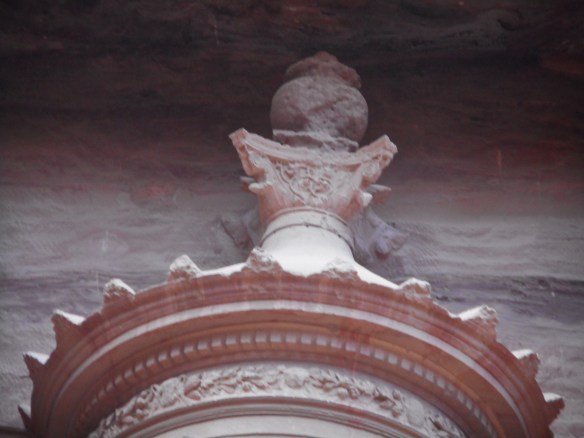
Here’s a closeup of the urn (I think) at the top of the Treasury:

DSCN0236

You get there by walking (or riding in a carriage) through a long, narrow passage:

DSCN0171

. . . filled with ancient petroglyphs:

DSCN0177

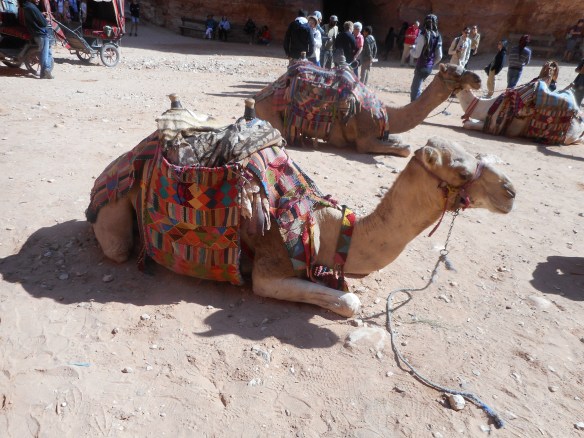
You see lots of camels:

DSCN0189

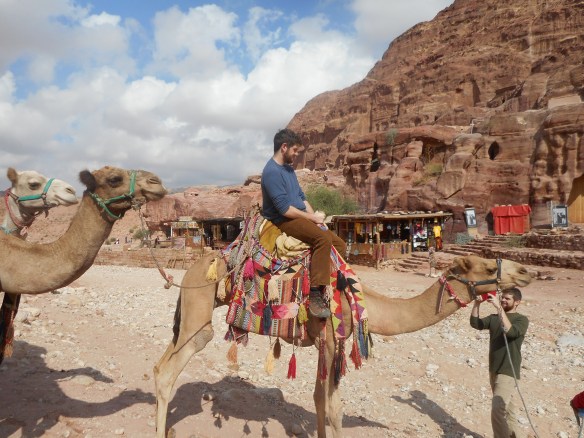
And you can ride one for a few dinars.  Here a camel poses for a photo:

DSCN0227

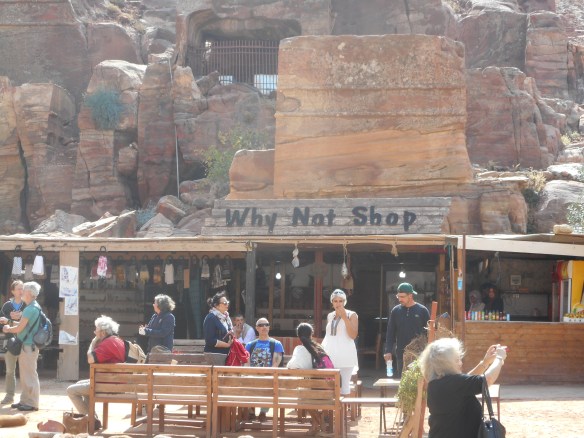
It’s a very commercial place.  Little Bedouin boys are constantly trying to sell you cheap bracelets; old ladies sit cross-legged on the ground and try to sell Petra rocks.  And you have stores like this one:

DSCN0199

If you’re adventurous you can climb up into the ruins:

DSCN0205

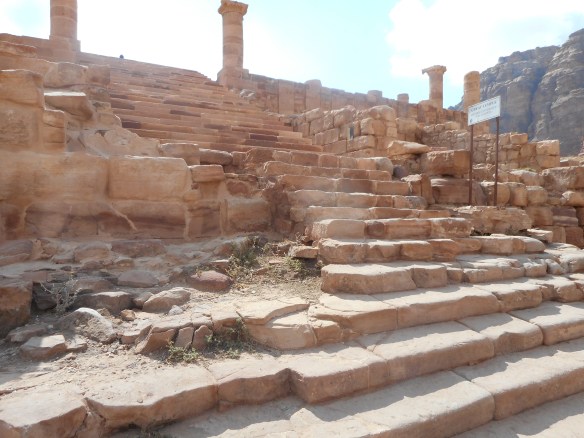
There’s more than just ancient Nabatean ruins.  Here are the remains of a Roman amphitheater:

DSCN0212

And here’s the floor of an ancient Greek temple:

DSCN0221

Go see it — before the world explodes and it’s too late.